Rural Revitalization and Integrated Urban-Rural Development

Spatial Evolution of Urban Travel Agency Service Network in the Context of Integration: A Case Study of Wuxi City, China

  • HE Diaoxia
Expand
  • Wuxi Vocational Institute of Commerce, Wuxi, Jiangsu 214153, China

HE Diaoxia, E-mail:

Received date: 2025-01-20

  Accepted date: 2025-06-10

  Online published: 2026-04-13

Supported by

The Research Project on Philosophy and Social Sciences in Jiangsu Universities and Colleges(2020SJA0933)

Abstract

The travel agency network is a spatial organization that connects tourist flow between cities and scenic spots. Taking Wuxi City as the research object, the kernel density and service network measurement model were used to quantitatively evaluate the spatial evolution of the travel agency service network in Wuxi in 2005, 2010, 2015, and 2020. The results reveal that the “centripetal” spatial distribution of travel agencies is still strengthening. Liangxi District has always been a hot spot for travel agencies, but the development of peripheral hot spots is also accelerating. The evolution of the trends in how travel agencies operate in the three major sectors differs markedly. The hotspot network of travel agencies in the urban and Jiangyin sectors has developed rapidly, but the hotspot network of travel agencies in the Yixing sector has begun to emerge, albeit relatively slowly. Moreover, the focus of Wuxi’s tourism service network is the connection between urban areas. Notably, the network connection between urban areas and Jiangyin continues to strengthen. The travel agency service network between Jiangyin and Yixing has not yet been established, and the integrated service network of regional tourism still needs to be strengthened. From the aspects of tourism service market construction, the results of this study can guide business support capacity improvement and travel agency service innovation, as well as corresponding countermeasures and recommendations for Wuxi travel agency service network development.

Cite this article

HE Diaoxia . Spatial Evolution of Urban Travel Agency Service Network in the Context of Integration: A Case Study of Wuxi City, China[J]. Journal of Resources and Ecology, 2026 , 17(2) : 662 -670 . DOI: 10.5814/j.issn.1674-764x.2026.02.025

1 Introduction

Tourism is a network system that essentially involves the flow of people, among other related factors (Leiper, 1979; Bao et al., 2017; Lu and Deng, 2019). Information technology has resulted in the emergence of networking in the tourism industry (Ge and Xi, 2015), and personalization and diversification have become major trends in consumption (Wang, 2015). Tourism spatial organization is being increasingly restructured, and integrated and collaborative development are prominent trends in the tourism industry (Chen and Zhang, 2021). Regarding tourism geography, various research directions are being pursued (Wang, 2016). In this context, the evolution characteristics of organizational networks are generally similar to those of flat, networked, and virtualized enterprises (Liu and Zhen, 2004). In this context, the organizational structure of tourism enterprises is transformed into a network-based organizational structure. This has driven the evolution of tourism enterprise locations and functional connections between enterprises, directly affecting the spatial structure and layout of the tourism industry (Huang and Huang, 2015) and promoting the evolution of tourism service network spatial organization.
With the shift of the spatial research paradigm, “flow”, networks, and nodes have become important factors affecting urban spatial structure (Wang et al., 2018). Particularly, the development of regional integration and global tourism has accelerated the flow of inter- and intracity tourism element resources (Su et al., 2023; Zhang et al., 2024). As an important element of the tourism service network, travel agencies are a concentrated reflection of the coupling of tourism “flow” space and “location space” (Garcia et al., 2022). The travel agency network is a spatial organization that connects tourist flow between cities and scenic spots. It also plays an important role in the reconstruction of tourism spatial organization at different scales. Research related to travel agencies is underway, particularly in two fields. The first is the spatial layout and site selection of travel agencies. Site selection is crucial for the development of tourism enterprises (Smeral, 1998). Scholars have studied the location choice of tourism investment (Lin, 2003; Endo, 2006; Bian, 2007), the spatial location choice of tourism enterprises’ interests (An, 2004), and the impact of the spatial location choice of tourism enterprises (Bian, 2015). For example, Xue et al. (2005) studied the factors influencing the spatial location selection of travel agencies and found that large travel agencies tend to form macronetworks in provincial capital cities, famous tourist cities, and booming and economically developed cities while forming micronetworks in central and community stores. The second is the study of spatial organization between tourism enterprises from the perspective of the tourism service supply chain. Specifically, scholars have focused on the multilevel tourism supplier network structure (Page, 2003), tourism supply chain model (Li et al., 2007), and tourism service supply chain and complex network (Shu, 2010). For example, Lin and Wei drew on the research results of psychology and behavioral economics, as well as the latest research paradigm of the behavioral supply chain, to study the impact of travel agency fairness preference on supply chain performance and decision-making in the tourism service supply chain (Lin and Wei, 2018). Overall, travel agency enterprise attribute data have been utilized to conduct research on travel community locations from the perspective of “location space”. By comprehensively utilizing travel community location and functional attribute data, the flow space and location space are placed within a unified framework. Moreover, few specialized studies have been conducted from the perspective of the service network space. However, this is an important foundation for supporting the high-quality and integrated development of urban tourism in the context of global tourism.
Based on the enterprise data of travel agencies, this paper selects the kernel density and complex network models to study the spatial evolution of the travel agency service network in Wuxi from 2005 to 2020. The changes in the hot spots of travel agencies and the network connections between counties and cities in Wuxi are explored, and corresponding optimization countermeasures are proposed. Specifically, the aim is to combine flow space with location space and enrich the research in the field of tourism service facilities from the perspective of high-quality integrated tourism development.

2 Research area, data, and methods

2.1 General situation

Wuxi is a Type II large city in the Yangtze River Delta with notable tourism resources. In 2020, the total tourism revenue of Wuxi City reached 105.789 billion yuan, with four 5A-level tourist attractions, ranking 12th and 2nd among 41 cities in the Yangtze River Delta. In recent years, by focusing on the high-quality integration of the Yangtze River Delta, Wuxi has actively strengthened cooperation with other cities to develop its tourism industry, coordinated the utilization of tourism resources, promoted the integrated development of tourism market and services. However, business supporting capabilities, transportation advantages, and tourism resource endowments, among other factors, have produced significant differences between the development of the tourism industry and the travel agency service networks. Moreover, uneven and insufficient development are still present. Choosing Wuxi as a case study to analyze its travel agency service network has good typicality, as doing so can provide a reference for integrating urban tourism and developing a comprehensive tourism service system.

2.2 Data source

Considering the significant adjustments in the zoning of Wuxi City in recent years, this study takes the 2020 Wuxi City zoning as the base map and divides the data from 2005, 2010, and 2015 into different zoning units based on enterprise addresses. The travel agency data are sourced from the tourism directory of the Jiangsu Provincial Department of Culture and Tourism, as of December 2020. Taking the list of registered travel agency enterprises in Wuxi as a starting point, the Tianyancha online database is used to sort out the registration time, registration place, and branch structure of travel agencies as well as identify and process the samples of eligible travel agency enterprises. This paper considers 2005, 2010, 2015, and 2020 as the years of interest to analyze the service network of travel agencies in Wuxi.

2.3 Research method

2.3.1 Kernel density estimation

The kernel density estimation method is useful for visualizing point distribution patterns. Search for a circular area at the center p of the grid to be calculated, and then calculate the density value of each grid. As the distance from the center point increases, the weight assigned gradually decreases.
$\hat{\Lambda}_{h}(p)=\sum_{i=1}^{n} \frac{1}{h^{2}} k\left(\frac{p-p_{i}}{h}\right)$
where $\hat{\Lambda}_{h}(p)$ is the density value of point p, k() is the weight function, and (ppi) represents the distance between the point p and pi, which require density estimation in the equation. The distance between pi, ph is the bandwidth or search radius, and the selection of its value will affect the smoothness of density estimation. This study applies kernel density estimation to reveal the spatiotemporal changes in the density distribution of travel agencies.

2.3.2 Travel agency service network measurement model

According to Taylor’s Chain Network Model (Taylor, 2001), Vij represents the service value of travel agency j in county i. The strength of the travel agency service network connection between the headquarters in county a and the branch in county b represented by travel agency j is:
${C}_{ab,j}={V}_{aj}\times {V}_{bj}$
The strength of the travel agency service network connection between the headquarters in county b and the branch in county a represented by company k is:
${C}_{ba,k}={V}_{bk}\times {V}_{ak}$
The strength of the travel agency service network connection between county a and b can be expressed as:
${C}_{ab}={\displaystyle \sum }_{j=1}^{e}{C}_{ab,j}+{\displaystyle \sum }_{k=1}^{f}{C}_{ba,k}$
In the equation, e and f represent the number of travel agencies with headquarters located in county a(b) and branch offices located in county b(a), respectively. For Wuxi, a 7×7 matrix is used to represent each county, which is summed by the row and column:
${N}_{a}={\displaystyle \sum }_{i=1}^{n}{C}_{ai    }      \left(\text{a}\ne \text{i}\right)$
${R}_{a}={\displaystyle \sum }_{i=1}^{n}{C}_{ia    }      \left(\text{a}\ne \text{i}\right)$
${C}_{a}={N}_{a}+{R}_{a}    $
$S={\displaystyle \sum }_{a=1}^{n}{N}_{a}+{\displaystyle \sum }_{a=1}^{n}{R}_{a}$
where Cai refers to the comprehensive connectivity of the travel agency service network between the headquarters in county a and the subsidiary in county i (ai), whereas Cia is the opposite. Na represents the degree of output, reflecting the ability of county a to control the travel agency service network of other counties. Ra represents the degree of entry, reflecting the ability of other counties to control the travel agency service network of county a. Ca represents the dot degree of county a, reflecting the nodular nature of node county a in the network. The larger its value, the better it can be integrated into the entire travel agency service network. S represents the total network connection strength.

3 Research results

3.1 Spatiotemporal evolution of travel agency layout hotspots

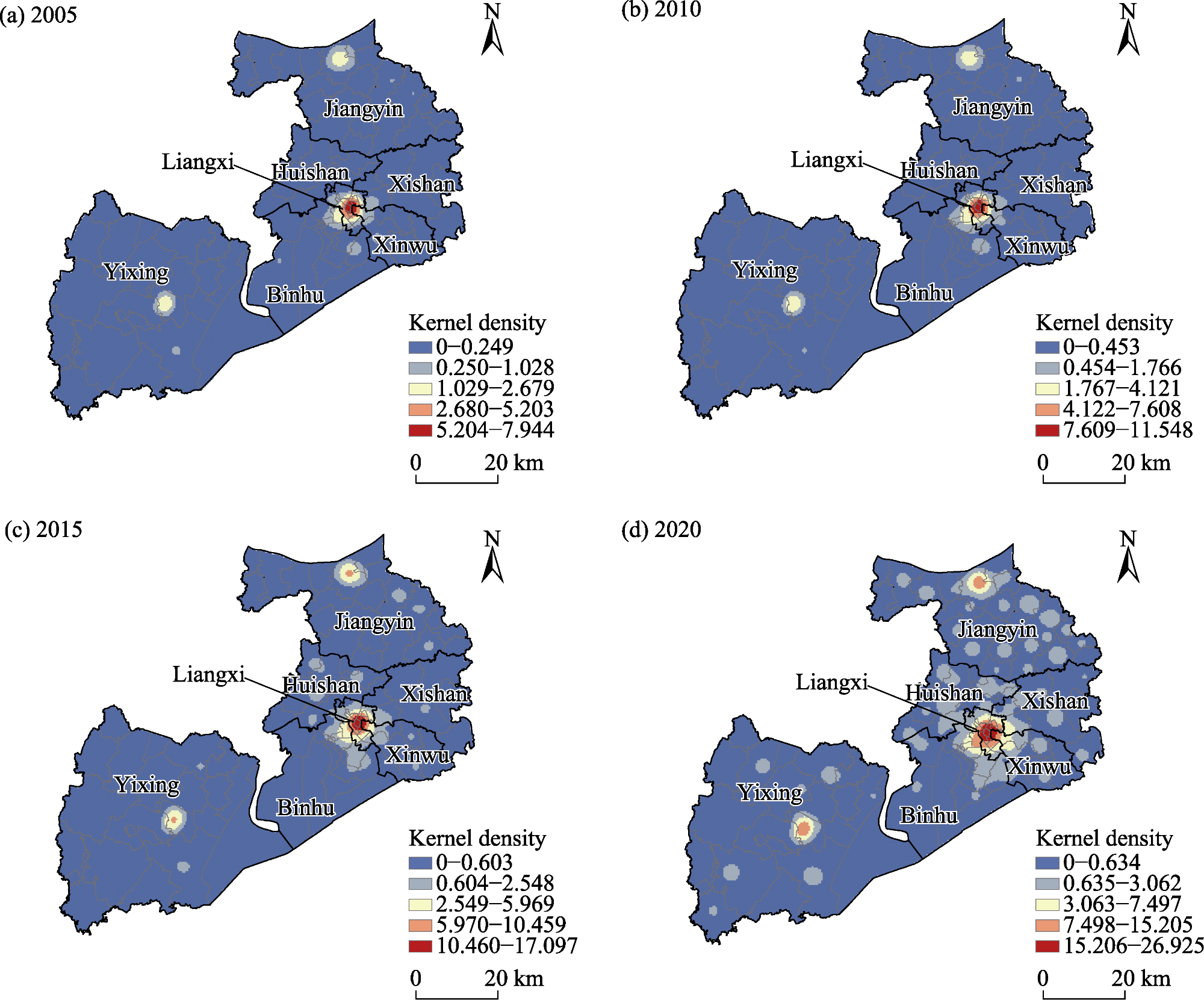
The analysis of the spatial agglomeration of travel agencies shows that the overall spatial layout of travel agencies presents a relatively pronounced pattern of “one core, two centers, and multiple warm points”, with significant differences between the urban area and the major plates of Yixing and Jiangyin (Figure 1).
Figure 1 Evolution of the spatial distribution of kernel density of travel agencies in Wuxi from 2005 to 2020
Liangxi District has always been a hot spot for travel agencies to gather together, with outstanding “core” service functions. Since 2002, Chong’ansi Street and Tongjiang Street in Liangxi District have been the primary cores of travel agency clusters, with their hot spot value increasing from 7.94 in 2005 to 26.93 in 2020. After 2010, the hot spots in the urban area showed a trend of expanding southward and westward, especially toward Qingmingqiao Street, Yangming Street, and Helie Street in Binhu District. However, the rate at which the hot spots spread was relatively slow. In 2020, the number of travel agency headquarters owned in Liangxi District and Binhu District reached 101, accounting for 36.9% of the total travel agency headquarters in the city, an increase of 2.8% compared to 2005 (Table 1). The “centripetal” agglomeration of travel agencies is still strengthening. The gathering and evolution of travel agencies in Liangxi District is closely related to its comprehensive service support, transportation location advantages, and distribution of high-level scenic spots in its urban area. Liangxi District has one World Cultural Heritage site, one 5A-level scenic spot, six 4A-level scenic spots, and one provincial-level tourist resort. Wuxi also has abundant business and commercial facilities, with notable comprehensive service capabilities and transportation advantages, making it attractive, from the perspective of layout, to travel agencies.
Table 1 District and county distribution of Wuxi travel agency headquarters in 2005 and 2020
Region 2005 2020
Yixing 8 45
Xinwu 2 19
Xishan 0 9
Liangxi 10 70
Jiangyin 12 76
Huishan 7 24
Binhu 5 31
In Chengjiang Street in Jiangyin and Yicheng Street in Yixing, two major county-level gathering hotspots have formed. The influence of these hotspots is on the rise, with the thermal value increasing from the third level to the second level. The spatial scope of the hot spot center shows high similarity to the urban form. The Chengjiang hot spot primarily runs from north to south, whereas the Yicheng hot spot primarily runs from east to west. This development evolution is closely related to the scale of the local tourism market and the support of development policies. Statistics has shown that the proportion of domestic tourists in Yixing over the four years was 11.34%, 21.43%, 25.01%, and 33.83%, respectively. The continuous growth of tourist numbers has stimulated both the agglomeration of travel agencies and the improvement of hotspots. Jiangyin is a pilot area for the new round of comprehensive reform of the service industry in Jiangsu Province, and it has greatly enhanced the city’s comprehensive service capacity, tourists’ tourism consumption experience, and the gathering of tourism industry elements, such as travel agencies.
Marked differences exist in the evolution patterns of the hot spot networks in the three major sectors, with the characteristics of “small agglomeration and wide dispersion” emerging. The evolutionary patterns of travel agency agglomeration in urban areas (Liangxi, Xishan, Huishan, Binhu, Xinwu), Yixing, and Jiangyin show significant differences (Figure 1). In 2005 and 2010, the distribution of travel agencies in the three major sectors demonstrated a high degree of centrality. Liangxi District was the center of the urban area, Yicheng Street was the center of Yixing, Chengjiang Street was the center of Jiangyin, and sporadic “warm spots” appeared in the Taihu Lake Street and other places. In 2015, a hot network of travel agencies in urban sectors and Jiangyin began to emerge, with Luoshe, Yuqi Qianzhou Street, Chang’an Street, as well as Zhouzhuang, Huashi, and Changjing, among other places, becoming hot spots for travel agency layout. In Yixing, hot spots are mainly present in the layout of travel agencies in Dingshu Town and Qiqiao Town, but the spatial impact is very small. By 2020, the hot network of travel agencies in the urban and Jiangyin areas had developed rapidly. The Street, Luoshe Street, Dongbeitang Street, and Chang’an Street in the urban area are connected as a warm spot. Moreover, Yangshan Hudai Town, Shuofang, Meicun, Anzhen Street, and Ehu Town are travel agency warm spots. In the Jiangyin section, travel agencies such as Ligang Street, Shengang Street, Yuecheng Town, Qingyang Town, Xuxiake Town, and Zhutang Town have been added as hot spots. The hot network of travel agencies in the Yixing sector has begun to emerge, with the addition of two hot spots for travel agencies in Zhangzhu Town and Guanlin Town. The new changes presented by travel agencies in 2020 are related to the development of comprehensive tourism and characteristic small town scenic spots. The establishment of characteristic small towns, such as Yixing Xizhu Chanju (Yunhu Chachan) Town, Huzhou Tea Tourism Style Town, Jiangyin Xinqiao Shishang Town, Huishan Yangshan Taoyuan Style Town, Lingshan Chanyi Town in Binhu District, and Xishan Taxus Town has expanded the supply of tourism products. Notably, however, it is also related to the impact of the COVID-19. The travel agencies gathered in the original central city began to sprawl around to adapt to the new trend of changes in tourist source organizations.

3.2 Spatiotemporal evolution of travel agency service network connections

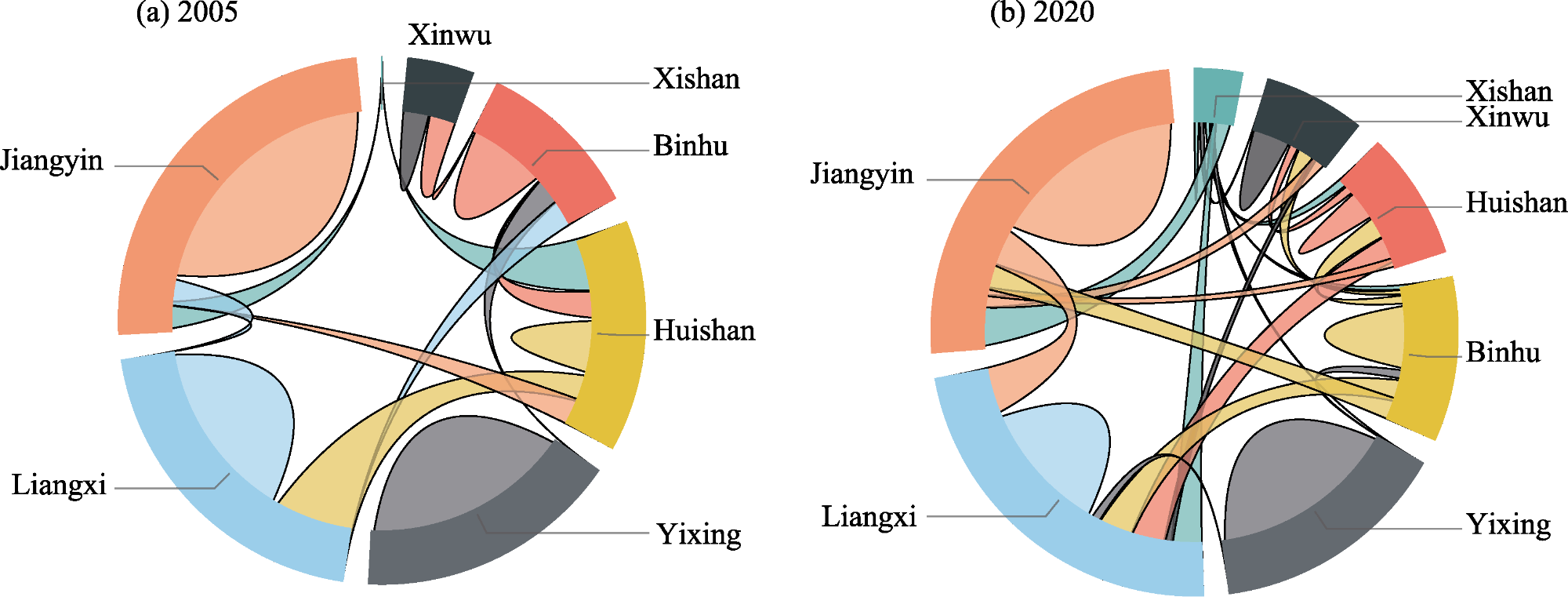
Considering the spatiotemporal evolution of travel agency layout hotspots, two years, 2005 and 2020, were selected. A travel agency service network measurement model was applied to analyze the evolution of travel agency service network connections over 15 years (Figure 2). The characteristics are reflected in the following aspects.
Figure 2 Wuxi travel agency service network connection in 2005 and 2020
The strength and breadth of service network connections are constantly increasing, but localization is still the focus. As shown in Figure 2, the total connection strength (S) of travel agency service networks within and between counties and cities in 2005 and 2020 was 13 and 118, respectively, showing significant growth. By using Equation (7) to calculate the point degree (Ca) of each district and county, it can be found that, in 2005, the point degrees of Huishan, Xishan, and Liangxi were relatively strong, at 8, 6, and 5, respectively, which were well integrated into the entire travel agency service network. Binhu, Jiangyin, and Yixing had 4, 3, and 2 points, respectively, indicating a deviation in the degree of integration into the entire travel agency service network. By 2020, the point intensities of Liangxi, Jiangyin, Binhu, and Huishan had strengthened relatively, at 60, 54, 39, and 32, respectively. Xishan, Xinwu, and Yixing had 27, 29, and 5 points, respectively, showing an improvement compared to 2005. Applying Equation (5) to calculate the output (Na) of each district and county reveals that, in 2005, the maximum output of Huishan was 5, reflecting the greatest impact of Huishan on the tourism service network of other districts and counties. In second place is Liangxi with a yield of 3. By 2020, Liangxi and Jiangyin ranked in the top two with an output of 38 and 29, respectively, whereas Huishan ranked third, with an output of 17. This indicates that Liangxi has taken on the organizational hub function in the travel agency service network and is continuously strengthening it, whereas Huishan’s organizational function in the network has decreased. By 2020, except for the weak connection between travel agencies in Yixing and other counties and cities, the strength of travel agency network connections between other counties and cities had been strengthening. Constructing a localization coefficient (${B}_{e}={N}_{a0}/{N}_{a}$, where Be is the localization coefficient, Na0 is the number of institutions with headquarters and branches in county and city a, and Na is the number of branches with headquarters in county and city a in other counties and cities, that is, the degree of localization of travel agency service networks in each county and city a) reveals that the localization degree of travel agency service networks in Yixing was the highest in 2005 and 2020 (Table 2). All travel agency headquarters and branches were located locally in Yixing. Except for Xishan, the travel agency’s service network localization index increased by 0.01 in 2020 compared to 2005 in Huishan only, indicating an increase in localization level. The localization index of travel agency service networks in Jiangyin, Liangxi, and Binhu decreased by 3.38, 1.49, and 0.56, respectively, in 2020 compared to 2005.

Table 2 Localization index of service network of travel agencies in Wuxi in 2005 and 2020
District Na0 Na Be
2005 2020 2005 2020 2005 2020
Binghu 3 15 2 16 1.50 0.94
Huishan 2 7 5 17 0.40 0.41
Jiangyin 10 47 2 29 5.00 1.62
Liangxi 7 32 3 38 2.33 0.84
Xishan 0 1 0 8 0 0.13
Xinwu 1 9 1 10 1.00 0.90
Yixing 8 45 0 0

Note: ∞indicates the highest localization degree of travel agency service.

Significant differences exist in service network connections among the three major sectors, and the degree of integration still needs to be further strengthened. In 2005, the connection between urban areas was the focus of Wuxi’s tourism service network, with the tourism service network connection between Liangxi and Huishan as the backbone, and the network connection strength (C) was 4. The network connections between Binhu and Liangxi, Binhu and Yixing, Huishan and Binhu, Huishan and Jiangyin, Jiangyin and Liangxi, Jiangyin and Huishan, and Xinwu and Binhu were all 1. By 2020, the network connections between urban areas and between urban areas and Jiangyin had been strengthening. The network connections between Liangxi and Jiangyin, Liangxi and Huishan, Xishan and Jiangyin, Liangxi and Binhu, and Jiangyin and Binhu were 20, 14, 13, 13, and 11, respectively. The network connection strength (C) of Xishan and Liangxi, Huishan and Binhu, Xinwu and Jiangyin, Xinwu and Binhu, Xinwu and Huishan, Jiangyin and Huishan, Xinwu and Liangxi, Xishan and Huishan, Liangxi and Yixing, Binhu and Yixing, Xishan and Xinwu, Xishan and Yixing, and Binhu and Xishan was 8, 7, 6, 5, 4, 4, 3, 3, 2, 2, 1, 1, and 1, respectively. The travel agency service network in Huishan mainly connects with Liangxi, Binhu, Xinwu, and Jiangyin, whereas that in Binhu mainly connects with Liangxi and Yixing. Notably, the travel agency service network between Jiangyin and Yixing had not yet been established in 2005 and 2020, and the comprehensive tourism integration service network needs further strengthening. The differential changes in travel agency service network connections among the three major sectors are closely related to policy orientation, economic development, and tourist market demand. The promotion of the integration of Xicheng and Xiyi has a good policy guidance effect on the layout of travel agencies. In 2005, the gross domestic product of Huishan District was 23.208 billion yuan, ranking 7th among the top 100 small and medium-sized cities in China in terms of comprehensive strength. Notably, economic development has stimulated tourism consumption demand and promoted the tourism network connection between Huishan and Liangxi.
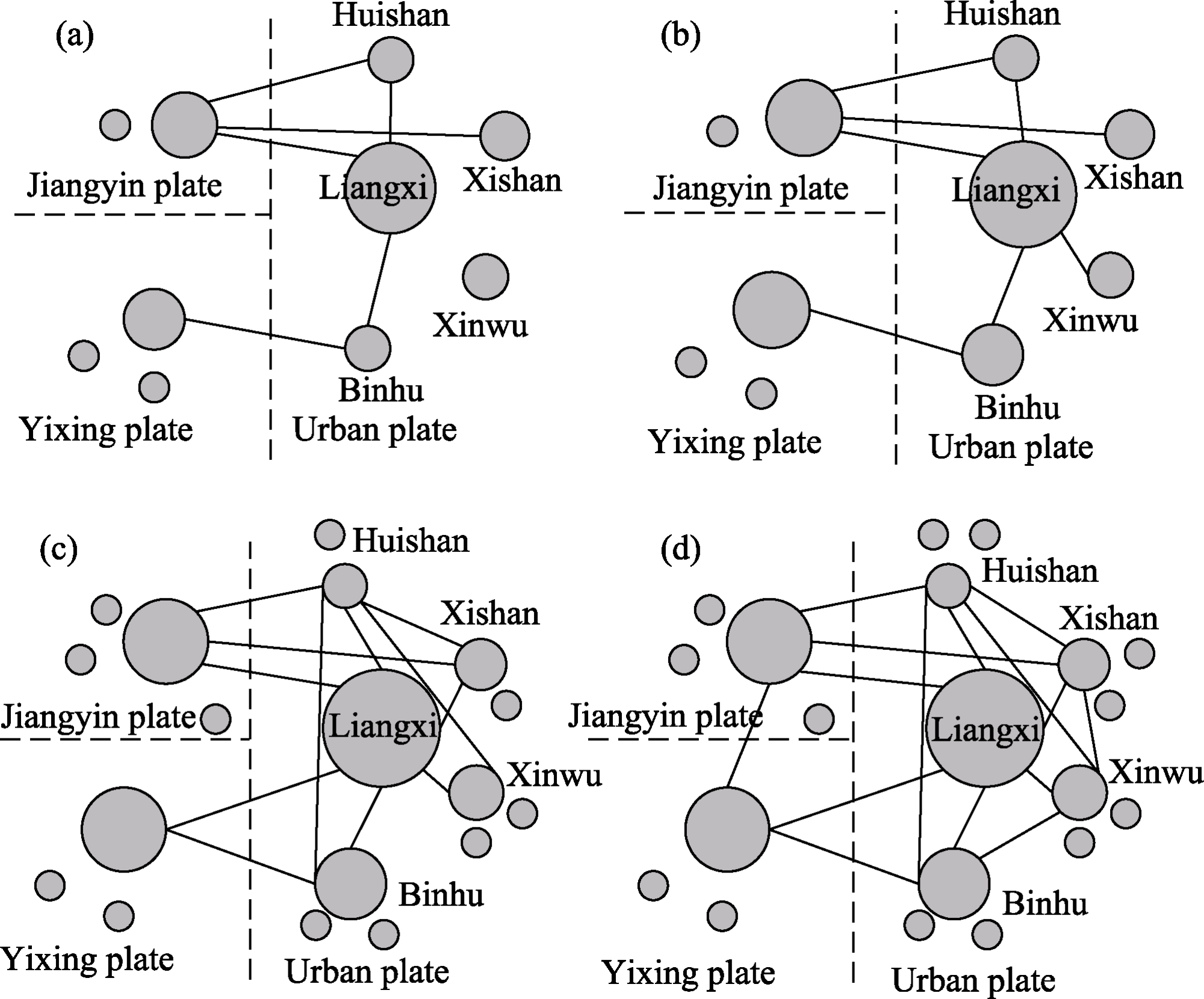
Considering the distribution and evolution of travel agency hotspots and the evolution of travel agency networks, from the perspective of combining flow and location space, the evolution of Wuxi travel agency service network can be preliminarily divided into the following four stages (Figure 3).
Figure 3 Evolution pattern of Wuxi travel agency service network
In the first stage (Figure 3a), within each sector, relying on urban transportation and business conditions and tourism resource endowments, nodes with county towns and business centers as carriers become important spaces for travel agency layout, gradually agglomerating and forming hotspots. At this stage, the scale of hotspots and the connections between sectors are weak.
In the second stage (Figure 3b), with better comprehensive supporting facilities and increased demand for tourism development, the scale and connection of existing hotspots begin to strengthen, and secondary hotspots begin to appear along the transportation line and around the hotspots. The ability of each district within the urban area to control tourism flow varies, and the core role of the organization begins to emerge.
In the third stage (Figure 3c), with the promotion of regional integration and the development of the entire tourism industry, the network connection of travel agencies between sectors is strengthened, and networking and flattening are observed. The travel agency network connections between peripheral counties and urban areas, as well as within urban areas, still dominate.
In the fourth stage (Figure 3d), with the advancement of informatization; emergence of new phenomena, such as microtourism; and the construction of regional tourism information platforms, the spatial differentiation of travel agency service networks further accelerates, and the hierarchical structure of peripheral nodes and urban area nodes becomes increasingly orderly. The travel agency service network is highly integrated and collaborative, forming a network model of an orderly supplement of service space and functions.
Currently, the evolution of the Wuxi travel agency service network is in the third stage of development and change.

4 Discussion

In recent years, the tourism supply chain has become increasingly flattened, with resource providers like airlines and hotel chains more frequently bypassing travel agencies to deal directly with travelers. Simultaneously, China’s tourist demographics have become more segmented, with diverse customer needs leading to the fragmentation of travel agency products. This is especially evident in the domestic market, where travel agency services are shifting from traditional group tours to fragmented products and services (Guo, 2024; Ho et al., 2024). With the growing demand for customized travel experiences, specialized and niche travel agencies are emerging in the Wuxi market, filling gaps that traditional agencies struggle to address.
Tourism service networks, similar to other service networks, are resilient, as manifested in the network’s ability to adapt and recover when facing market fluctuations, changes in consumer demands, and external shocks (Hanita et al., 2024). As core nodes within tourism service networks, travel agencies directly influence the resilience level of the entire network through their degree of coordination with other tourism elements. Travel agencies should transform from being mere distribution channels to resource integrators, breaking through the limitations of traditional tourism elements. Collaboration and coordination between travel agencies and other key tourism stakeholders, including cultural industries, tourist attractions, and hotels, has become indispensable.
With the increasing unification of the Yangtze River Delta and the development of tourism services throughout Wuxi, the following three suggestions are proposed with respect to high-quality and integrated services based on the analysis of the evolution characteristics of Wuxi travel agency service network: 1) Accelerate the construction of emerging tourist destinations in accordance with the concept of global tourism. In combination with the “14th Five-Year Plan”, the implementation of the “beautiful rivers and lakes” action and the the Taihu Lake 108 scenic corridor project will be accelerated, and the Taihu Lake Bay will be built into a tourism center with resource allocation capacity. Government agencies and the travel agency need to strengthen spatial interaction between cultural and tourism industries while integrating diverse stakeholders and reinforcing both internal and external connections (Chen, 2022; Xie et al., 2025). They should actively promote collaborative development between travel agencies and other tourism elements, including cultural venues, sports facilities, educational research bases, rural tourism sites, and hotels (Pham et al., 2021). As China’s integration of culture and tourism enters a deeper phase, travel agencies must evolve beyond merely acting as distribution channels to become resource integrators and product creators (Gao and Bi, 2021). By collaborating with accommodation providers, restaurants, museums, performance venues, and other diverse entities, travel agencies can jointly develop multifaceted tourism products. This approach enhances the cultural content and comprehensive experience of tourism services, creating a tourism ecosystem where multiple stakeholders benefit (Li et al., 2018). 2) Focusing on the construction of business service facilities in Yixing and Jiangyin, decision-makers will optimize the spatial layout of the tourism industry (elements), seize the construction opportunities of the Taihu Lake Tunnel and the Yima Fast Track on the Suzhou-Wuxi- Changzhou South Expressway, and connect Yangxian Lake Ecological Resort, Mashan International Health Tourism Island, Shanshui City Resort, the Taihu Lake New Town Ecological Leisure Area, and Taike Park Smart Ecological Area through the Taihu Lake Bay. Additionally, promoting the overall integration of the Taihu Lake tourism into the “Taihu Lake Plus” will result in deep integration into the tourism service network of the city and the Yangtze River Delta and deepen and intensify the connection with the tourism service network in the central urban area of Wuxi. 3) By focusing on the promotion of higher quality integration in the Yangtze River Delta, decision-makers will accelerate the construction of a “1+4+N” smart tourism service system to promote full integration in fields such as culture, sports, tourism, and education. Thus, Wuxi can be built into a smart tourism city with IoT characteristics, creating a cross-regional tourism industry chain system, and improving the standardization, quality, and branding level of travel agency service networks. Travel agencies should focus on developing distinctive, customized, and experience-oriented products while enhancing their ability to integrate online and offline services. This approach allows them to explore new profit models and development paths.

5 Conclusions

This paper analyzes the spatial evolution of travel agency service networks in Wuxi since 2005, applying data points and functional connection data of travel agency enterprises, GIS spatial analysis, and network analysis methods. The research results reveal the following.
First, the overall spatial layout of travel agencies in Wuxi has been characterized by one core, two centers, and multiple temperature points since 2005. The number of travel agencies in various districts and counties has developed rapidly, but the centripetal agglomeration trend of travel agencies has been strengthening. Liangxi District has always been a hot area for travel agencies to gather, being characterized by outstanding core service functions. After 2010, the hot space in the urban area showed a trend of expanding outward, but the diffusion intensity was not strong. Regarding Chengjiang Street in Jiangyin and Yicheng Street in Yixing, two county-level agglomeration hotspots formed, with the central heating value increasing. The spatial range of the hotspots is highly similar to that of the urban form. The agglomeration evolution of travel agencies in urban areas, including Liangxi, Xishan, Huishan, Binhu, and Xinwu, as well as in the Yixing and Jiangyin plates, differs significantly, with the characteristics of “small agglomeration and large dispersion” emerging. The hot network of travel agencies in the urban area and Jiangyin area has developed rapidly, whereas that in the Yixing area has begun to emerge, albeit relatively slowly.
Second, the evolutionary characteristics presented by the spatial layout of travel agencies are, on the one hand, influenced by information technology, leading to a shift in the organizational structure of travel agency enterprises toward a networked organizational structure. On the other hand, they are influenced by the comprehensive supporting service capacity of the central urban area, especially the high-end business supporting facilities. In addition, the pilot comprehensive reform of the service industry, support policies for the construction of characteristic towns, and requirements for epidemic control also have a strong impact on the site selection and layout of travel agencies. Notably, the evolution of the Wuxi travel agency service network is in the third stage.
Third, the strength and breadth of travel agency service network connections are constantly increasing. The total connection strength in 2020 was more than 9 times that of 2005. Liangxi District has assumed the “organizational” hub function in travel agency service network connections, whereas Huishan’s organizational function in the network has decreased. The travel agency service network in Yixing has the greatest degree of localization, with all travel agency headquarters and branches being local, whereas connections with other counties and cities remain weak.
Fourth, the connection between urban areas is the basis of Wuxi’s tourism service network connection. The network connection between urban areas and Jiangyin is constantly strengthening, and the network connection between Yixing and urban areas needs to be strengthened. The travel agency service network between Jiangyin and Yixing has not yet been established, and the integrated service network of global tourism still needs to be further strengthened.
The transformation of spatial research paradigms and changes in travel agency enterprise organizations offer a new perspective on the evolution of travel agency service networks. This article takes Wuxi City as a case study to analyze the hot topics of travel agency layout and organizational connections and summarizes a four-stage model from the perspective of combining flow space and location space. While this represents research progress, several aspects still merit further attention. 1) The driving mechanism for the evolution of travel agency service networks. The current research has analyzed the influencing factors of the evolution of travel agency networks from a qualitative perspective, but their evolution is comprehensively influenced by factors such as enterprise development strategy, market development environment, and carrier support conditions. How appropriate indicators should be selected for quantitative evaluation still needs further exploration. 2) Due to data limitations, further research is needed on the evolution of different types of travel agencies (e.g., international travel agencies, domestic travel agencies).
[1]
An H S. 2004. General theory of urban economics. Beijing, China: Economic Science Press. (in Chinese)

[2]
Bao J G, Zhang J, Xu H G, et al. 2017. Research on the geography of tourism in China: Between foreign and hometown. Geographical Research, 36(5): 803-823. (in Chinese)

[3]
Bian X H. 2007. Analysis of the formation mechanism of urban tourism spatial structure: Taking the Yangtze River Delta as an example. Nanjing, China: Nanjing Normal University. (in Chinese)

[4]
Bian X H. 2015. Research on the impact of urban rail transit construction on the development of urban tourism marginal areas: Based on the perspective of spatial location selection of tourism enterprises. Science Research Management, 36(6): 60-67. (in Chinese)

[5]
Chen S S, Zhang X Q. 2021. Research on the transformation and upgrading development of China’s tourism industry under the interconnection blueprint. Resource Development & Market, 37(8): 976-983. (in Chinese)

[6]
Chen Y. 2022. The impact mechanism of network embeddedness on tourism supply chain integration. Diss., Chongqing, China: Chongqing University. (in Chinese)

[7]
Endo K. 2006. Foreign direct investment in tourism-flows and volumes. Tourism Management, 27(4): 600-614.

DOI

[8]
Gao G X, Bi J W. 2021. Hotel booking through online travel agency: Optimal Stackelberg strategies under customer-centric payment service. Annals of Tourism Research, 86: 103074. DOI: 10.1016/j.annals.2020.103074.

[9]
Garcia G, Dos Anjos S, Doğan S. 2022. Online travel agencies and their role in the tourism industry. Advances in Hospitality and Tourism Research, 10(3): 361-386.

[10]
Ge Q S, Xi J C. 2015. Reflections on the development strategy of regional tourism in China under the new normal. Progress in Geography, 34(7): 793-799. (in Chinese)

[11]
Guo D J. 2024. New investment trends of travel agencies in the new era. Journal of Tourism, 39(9): 12-14. (in Chinese)

[12]
Hanita M, Bangso F D, Aprian M. 2024. Beyond attraction: Unveiling Bali’s cultural community’s role in bolstering tourism resilience amidst the COVID-19 pandemic. Journal of Destination Marketing & Management, 34: 100953. DOI: 10.1016/j.jdmm.2024.100953.

[13]
Ho P T, Ho M T, Huang M L. 2024. Understanding the impact of tourist behavior change on travel agencies in developing countries: Strategies for enhancing the tourist experience. Acta Psychologica, 249: 104463. DOI: 10.1016/j.actpsy.2024.104463.

[14]
Huang Z F, Huang R. 2015. Theoretical perspective and academic innovation of tourism geography based on human land relations. Geographical Research, 34(1): 15-26. (in Chinese)

[15]
Leiper N. 1979. The framework of tourism. Annals of Tourism Research, 6(4): 390-407.

DOI

[16]
Li C, Guo S, Cao L, et al. 2018. Digital enablement and its role in internal branding: A case study of HUANYI travel agency. Industrial Marketing Management, 72: 152-160.

DOI

[17]
Li W L, Yan H P, Li P. 2007. Several problems regarding the study of tourism supply chain. Tourism Tribune, 22(9): 92-96. (in Chinese)

[18]
Lin A P. 2003. Spatial analysis of travel agencies in Fujian Province. Fujian Geography, 18(3): 32-36. (in Chinese)

[19]
Lin Q, Wei G X. 2018. Pricing decision and contract coordination of tourism service supply chain based on fair preference. Tourism Tribune, 33(4): 59-69. (in Chinese)

[20]
Liu W D, Zhen F. 2004. Research on the impact of informationization on socio-economic spatial organization. Acta Geographica Sinica, 59(Z1): 67-76. (in Chinese)

[21]
Lu L, Deng H B. 2019. Research progress and prospects of node place models and their applications. Scientia Geographica Sinica, 39(1): 12-21. (in Chinese)

[22]
Page S J. 2003. Tourism management: Managing for change. Oxford, UK: Butterworth-Heinemann.

[23]
Pham L, Coles T, Ritchie B, et al. 2021. Building business resilience to external shocks: Conceptualising the role of social networks to small tourism & hospitality businesses. Journal of Hospitality and Tourism Management, 48: 210-219.

DOI

[24]
Shu B. 2010. A review and inspiration of research on domestic and foreign tourism service supply chains and complex networks. Tourism Science, 24(6): 72-83. (in Chinese)

[25]
Smeral E. 1998. The impact of globalization on small and medium enterprises. Tourism Management, 19(4): 370-380.

[26]
Su H, Liang Y, Wen T. 2023. Structural embeddedness, entrepreneurial behavior, and firm performance in the industry network of small tourism enterprises: The moderating role of relational embeddedness and leadership self-efficacy. Journal of Hospitality and Tourism Management, 56: 431-442.

DOI

[27]
Taylor P J. 2001. Specification of the world city network. Geographical Analysis, 33(2): 181-194.

DOI

[28]
Wang D G. 2016. Review of new propositions in tourism geography research in the era of high speed rail networking. Geographical Research, 35(3): 403-418. (in Chinese)

[29]
Wang J E, Jiao J J, Huang J, et al. 2018. Theory and methodology of transportation development and location measures. Acta Geographica Sinica, 73(4): 666-676. (in Chinese)

DOI

[30]
Wang X B. 2015. Planning for the 13th Five Year Plan for tourism development with new normal thinking. Tourism Tribune, 30(3): 2-4. (in Chinese)

[31]
Xie C W, Zhu H, Zhang K. 2025. Fitting relationships and policy insights into the high-quality integrated development of culture and tourism industries in China. Journal of Natural Resources, 40(4): 1084-1106. (in Chinese)

DOI

[32]
Xue Y, Liao B G, Qin K, et al. 2005. Location selection for space expansion of large travel agencies—Case study of “Shanghai Spring and Autumn Festival”. Tourism Science, 19(2): 38-42. (in Chinese)

[33]
Zhang Z, Wang F, Deng L. 2024. Identifying node-corridor-network of tourist flow and influencing factors using GPS big data: A case study in Gansu and Qinghai provinces, China. International Journal of Applied Earth Observation and Geoinformation, 135: 104271. DOI: 10.1016/j.jag.2024.104271.

Outlines

/