Ice-Snow Tourism and Eco-Tourism

Construction of Service Quality Evaluation Index System for Ski Resorts from Tourists’ Perspective: An Empirical Study Based on Grounded Theory

  • CHEN Wuxiang , 1, 2 ,
  • DENG Yanrong 1 ,
  • YANG Liu 1 ,
  • TANG Chengcai , 3, *
Expand
  • 1 School of History, Culture and Tourism, Guangxi Normal University, Guilin, Guangxi 541001, China
  • 2 Tourism Research Institute of Guangxi Normal University, Guilin, Guangxi 541001, China
  • 3 School of Tourism Sciences, Beijing International Studies University, Beijing 100024, China
* TANG Chengcai, E-mail:

CHEN Wuxiang, E-mail:

Received date: 2025-07-30

  Accepted date: 2025-10-30

  Online published: 2026-04-13

Supported by

The Guangxi Innovation-driven Development Special Fund Project(Guike AA20302011)

The National Natural Science Foundation of China(42471284)

The National Natural Science Foundation of China(42071199)

Abstract

With the increasing popularity of ski tourism, issues related to tourism service quality have become prominent. As the core venue for ski tourism, it is particularly important to establish a standardized service quality evaluation index system for ski resorts. As consumers, experiencers, and participants in tourism activities, tourists play a crucial role in the establishment of the service quality evaluation index system. This study evaluated the service quality of ski resorts from the perspective of ski tourists, focusing on six ski resorts (Zhangjiakou Taiwu Ski Resort, Jilin Songhua Lake Ski Resort, Altay Jiangjunshan Ski Resort, Harbin Yabuli Ski Resort, Guangzhou Sunac Snow Park, and Beijing Nanshan Ski Resort). Grounded theory was used to analyze online texts from the Ctrip website and interview data of tourists. The service quality evaluation system for ski resorts in China primarily included 4 main dimensions (Site Quality, Supporting Facilities, Operations Management, and Staff Service) and 18 specific indicators. These dimensions were interrelated and jointly determined tourists’ ski tourism experience and satisfaction.

Cite this article

CHEN Wuxiang , DENG Yanrong , YANG Liu , TANG Chengcai . Construction of Service Quality Evaluation Index System for Ski Resorts from Tourists’ Perspective: An Empirical Study Based on Grounded Theory[J]. Journal of Resources and Ecology, 2026 , 17(2) : 428 -438 . DOI: 10.5814/j.issn.1674-764x.2026.02.008

1 Introduction

With the improvement of national living standards and the rise of the ice and snow industry in China, ice and snow tourism has become an important part of economy. In November 2024, the “Opinions on Stimulating the Vitality of the Ice and Snow Economy through the High-Quality Development of Ice and Snow Sports” was issued by the General Office of the State Council, stating the need to establish a service quality evaluation system, improve the service quality of ice and snow sports, and support the development of Chongli (Hebei), Yabuli (Heilongjiang), Altay (Xinjiang), and other regions into internationally recognized ice and snow economic clusters. Moreover, General Secretary Xi Jinping instructed the vigorous development of mass ice and snow sports, citing ice and snow as valuable resources, comparable to invaluable assets, such as lucid waters and lush mountains.
Ski tourism is an important aspect of ice and snow tourism (Li et al., 2025), and studies on ski tourism are conducive to improving the service quality of ice and snow tourism and promoting the rapid development of the ice and snow economy. Currently, studies on ski tourism have focused on three levels, namely tourists, the tourism industry, and national government policies. At the level of ski tourists, field surveys and case studies supplemented by mathematical statistics have been used to segment the ski tourist market from multiple dimensions, including skiing ability and time cost (Guo et al., 2025), recreation specialization (Li et al., 2024), activity patterns (Bausch et al., 2024), lifestyle (Li et al., 2023), and perceived value variables (Xu et al., 2022). The experience attributes of ski tourists (Shang et al., 2022) and behavioral intentions have also been explored (Hall et al., 2016; Wang et al., 2022; Qi et al., 2023a). At the level of the ski tourism industry, the mechanism of system coupling and logical analysis have been utilized to study the coordinated development and relationship between China’s ski tourism industry and urbanization, as well as other tourism industries (Li, 2019; Zhao et al., 2023b; Wang and Su, 2024; Zhang et al., 2024); relationship between climate change and ski tourism (Cholakova and Dogramadjeva, 2019; Chen et al., 2020; Dannevig et al., 2021); and the connotation, dilemmas and challenges, and driving paths of the sustainable and high-quality development of the ski tourism industry (Jin, 2020; Haugom et al., 2021; Jiang and Li, 2021; Tang et al., 2022; Guan et al., 2023; Zhang and Zhou, 2023; Wang and Li, 2025). Lastly, at the level of national government policies, studies have explored the policies related to the development of the ice and snow economy and talent support needs (Zhao et al., 2023a), and those for the development of the ice and snow sports industry (Yang and Kang, 2008; Kan et al., 2017). Moreover, a policy theoretical framework to boost the ski industry has been proposed (Wang and Wei, 2022). Wang et al. (2021) used the policy network theory to identify the problems in the operation of China’s ice and snow sports policies, such as contradictions between policy communities and inter-governmental networks and insufficient political participation of producer networks. Yao and Zhong (2021) conducted a quantitative analysis of ski tourism policies from 1996 to 2019 from multiple aspects, including annual characteristics and target objects.
There are many studies on ski tourism; however, several research gaps exist. First, in terms of research content, the integration of the three levels of ski tourism research needs to be strengthened. Second, most studies have focused on tourist market segmentation and factors of behavioral intentions, and there is limited research on service evaluation system from the tourists’ perspective. Third, in terms of method selection, quantitative research methods have been mostly used to study ski tourists, and the top-down approach has been adopted to explore the effect of preset variables on ski tourists; qualitative research using a bottom-up approach is relatively rare.
Therefore, using the grounded theory and interview data, this study aimed to propose a comprehensive ski resort service quality evaluation index system to provide reference for improving the service quality of ice and snow sports.

2 Literature review and theoretical basis

2.1 Ski tourism

In 2015, the Altay Declaration was passed, confirming, for the first time, that the Altay region in Xinjiang, China is the earliest birthplace of human skiing, dating approximately 10000-20000 years ago (Yang et al., 2023). After the 18th century, with the development of productivity, the functional attribute of skiing tools weakened, and folk competitions and skill dissemination first appeared in places, such as Norway. During the Industrial Revolution (19th century), ski tourism was introduced in Europe, and ski resorts in the Alpine region were constructed. Eventually, a tourism industry centered on skiing had emerged in Switzerland, Austria, and other European countries. In 1924, skiing was listed as an official event of the Winter Olympics. Currently, ski tourism has become popular worldwide (Dou, 2008; Li and Sun, 2013).
To date, there is no unified definition of ski tourism; nevertheless, various scholars have attempted to define it. For example, Zhang (1998) stated that ski tourism is a new form of tourism that integrates sightseeing, shopping, entertainment, vacation, and business-related sports. Jordi Moreno-Gené et al. (2020) emphasized that ski tourism is a type of tourism centered on ski resorts that combines sports experience and leisure functions and is affected by internal and external factors, such as climate change, operation scale, and debt level. According to Tang and Xu (2022), ski tourism is the core component of ice and snow tourism, with ski resorts as the core carrier. Its development and distribution are driven by policies, and skiers’ experience is affected by perceived dimensions, such as interaction, price, and word-of-mouth, while negative emotions are mostly related to price and service. Chen and Ren (2024) believe that ski tourism is a new type of specialized tourism that involves ski resorts as the main spatial carrier, relies on various ice and snow resources, and integrates different functions, such as tourism sightseeing, competitive sports, and leisure vacation. Lastly, according to Jiang et al. (2025), ski tourism is a type of outdoor sports with distinct dependence on the natural environment; it is not only affected by social and economic factors, but also restricted by natural geographical conditions.
In this study, ski tourism is defined as a new form of tourism, with ski resorts as the core venue, that relies on ice and snow resources and integrates various endeavors, such as tourism sightseeing, shopping, entertainment, competitions, and leisure vacation.

2.2 Tourism service quality

Gronroos (1984) first proposed the customer-perceived service quality model and introduced service quality theory into tourism research; he defined the concept of tourism service quality from the customer’s perspective(Gronroos,1988). Wu (1997) pointed out that service quality is the sum of the characteristics and attributes that reflect the ability of services to meet the explicit or implicit needs of customers and society and enumerated its six characteristics, emphasizing that staff quality is a key factor. Wei (2011) proposed that tourism service quality includes excellent quality, value quality, and a certain degree of conformity, which is crucial for meeting tourists’ expectations. Zhao and Feng (2023) studied sports tourism service quality within the tourism service quality and defined it as the subjective reflection of sports tourists on the tourism service system, characterized by long-term nature and integrity. According to Qi et al. (2023b), ski tourists are the assessors of ski tourism service quality, which includes various aspects such as skiing facilities, supporting facilities, accessibility, and ski resort consumption.
This study focuses on the service quality of ski resorts from the tourists’ perspective. Herein, tourism service quality includes two aspects: outcome quality and process quality. Outcome quality refers to the tourists’ overall service satisfaction after experiencing tourism services, reflecting the degree to which the service items, facilities and amenities, and environmental atmosphere provided by tourism enterprises meet tourists’ needs. Meanwhile, process quality refers to the tourists’ overall perception of the service level received during the tourism experience and includes aspects, such as the attitude, efficiency, and behavior of service staff (Lin, 2023).

2.3 Ski resort service quality

Several international studies on ski resort service quality have been published. Ormiston et al. (1998) and Weiermair and Fuchs (1999) provided various tangible and intangible facility and service quality indicators for ski resorts. Yeo and Kim (2010) evaluated ski resort service quality from the following dimensions: Main facilities, auxiliary facilities, location convenience, staff service, and supporting services. He and Luo (2020) and Matzler et al. (2021) evaluated the factors of ski consumers’ satisfaction. Bichler and Pikkemaat (2021) revealed that ice and snow sports factors, as well as catering and accommodation, accessibility, and natural scenery, affect ski tourists’ choices.
In comparison, research on ski resort service quality in China is in its early stage. Using the Kano model and IPA analysis, Yu and Zhu (2019) identified the three categories of the service demand of ski resorts in China, namely basic demand factors, expected demand factors, and attractive demand factors. Li et al. (2022a) and Li et al. (2022b) conducted empirical studies on the service quality of four ski resorts in Shennongjia (Western Hubei) and Beijing, respectively, using the IPA method. Chen et al. (2022) proposed a tourist satisfaction improvement model for ice and snow tourism destinations using questionnaire surveys and IPA analysis.
With increasing government attention to the ice and snow tourism industry, the development of ski resorts needs to focus on both “high-speed” and “high-quality” services. However, local studies on ski resort service quality remain insufficient, with most studies using quantitative methods, while qualitative methods are rarely used to study ski resort service quality. Therefore, this study uses the grounded theory method to establish a ski resort service quality evaluation system from the perspective of tourists.

3 Data sources and research methods

3.1 Selection of case sites

The following ski resorts were selected as case sites for this study: Zhangjiakou Taiwu Ski Resort, Jilin Songhua Lake Ski Resort, Altay Jiangjunshan Ski Resort, Harbin Yabuli Ski Resort, Guangzhou Sunac Snow Park, and Beijing Nanshan Ski Resort. These six ski resorts are located in the four major ice-and-snow regions in China, namely Northeast China (Songhua Lake, Yabuli), North China (Taiwu, Nanshan), Northwest China (Jiangjunshan), and South China (Guangzhou Sunac). The Zhangjiakou Taiwu Ski Resort, Jilin Songhua Lake Ski Resort, Altay Jiangjunshan Ski Resort, and Harbin Yabuli Ski Resort are the scenic spots of the first batch of national ski tourism resorts. Meanwhile, the Beijing Nanshan Ski Resort is the only winter resort in Beijing and North China that integrates dynamic leisure sports, such as skiing, sliding tracks, and ice climbing. Restricted by the subtropical monsoon climate, South China has almost no natural snowfall; therefore, outdoor ski resorts are almost non-existent, and indoor ski resorts are the core venues of ice and snow tourism in this region. The Guangzhou Sunac Snow Park is a large-scale indoor ski resort in South China. Its inclusion as a study site allows the study of emerging ice and snow tourism venues in southern China. This reflects the “global nature” of the dual strategies of “Ice and Snow Silk Road” and “regional coordination.”

3.2 Data sources

Online text data and interview data were collected. The former were obtained from tourists’ review of the six selected ski resorts from the Ctrip website using the Octopus Data Collector software. Data from January 2020 to June 2025 were included in this study. After full-text reading, duplicate data and those irrelevant to the study were excluded, and 337000 words of valid text data were obtained.
In addition, 12 ski tourists, comprising 8 women and 4 men, were interviewed about ski resort service quality, including its concept, content, and suggestions. Data of the 10 tourists were used for coding analysis, while those of the remaining 2 were used for the theoretical saturation test. Respondent data are summarized in Table 1.
Table 1 Data of the interviewees (N=12)
Number Gender Age Location Ski resort destination Time of visit
1 Female 23 Beijing Zhangjiakou Taiwu Ski Resort December 2025
2 Male 42 Guangdong Guangzhou Sunac Snow Park June 2025
3 Male 33 Guangdong Altay Jiangjunshan Ski Resort March 2025
4 Male 45 Guangdong Guangzhou Sunac Snow Park February 2025
5 Female 35 Shaanxi Harbin Yabuli Ski Resort January 2025
6 Female 29 Beijing Zhangjiakou Taiwu Ski Resort January 2025
7 Female 25 Shanghai Altay Jiangjunshan Ski Resort January 2025
8 Female 20 Fujian Harbin Yabuli Ski Resort December 2024
9 Female 24 Guangxi Harbin Yabuli Ski Resort December 2024
10 Female 34 Liaoning Beijing Nanshan Ski Resort December 2023
11 Male 30 Shanghai Jilin Songhua Lake Ski Resort December 2023
12 Female 39 Beijing Beijing Nanshan Ski Resort January 2021

3.3 Research methods

Formulated by Glaser and Strauss in 1967, the Grounded Theory focuses on gaining insights or constructing knowledge about phenomena, not on justifying preconceived ideas. It involves continuous iteration between data collection and analysis and is deemed complete once theoretical saturation has been reached—that is, when neither new theoretical insights nor new properties of core categories emerge during theory development. Based on collected data, core concepts reflecting social phenomena are identified; the objective and neutral coding process is the core element of the analysis, and continuous analysis and comparison are the cornerstones of this cyclical research process; social theories are constructed through the connections between concepts (Chen, 1999). This study used the grounded theory method. Data coding and analysis were performed using Nvivo14.0 software.

4 Construction and validation of the evaluation index system

4.1 Open coding analysis

Open coding or initial coding refers to naming each word, sentence, paragraph, and event in the data and condensing the data text. In this process, researchers start with no preconceived codes and code different incidents into as many categories as possible. Open coding ends when researchers decide upon the core category.
In this study, after analyzing and recording all the evaluation text materials of the six ski resorts word by word and sentence by sentence, 77 relatively independent initial concepts were successfully extracted. Then, the initial concepts were systematically clustered and categorized, and 18 initial categories were obtained. Owing to space limitations, only some initial categories, concept codes, and original materials are listed in Table 2.
Table 2 Open coding of ski resort evaluation texts
Initial category Initial concept Original material
Attitude of
service staff
Attitude of general service
staff
The service staff at the reception were very patient, and those in the ski resort were very responsible. However, I was dissatisfied with some staff at the ski equipment return desk; they threw the locker tags casually, which showed low quality and made people uncomfortable
Teaching attitude of coaches A special thanks to Coach No. 96, who was very patient with us. With his careful teaching, we finally learned how to ski
Staff
professionalism
Professionalism of general
staff
The skiing experience was quite good. I asked the staff in the ticket hall some questions about the ski resort, and they seemed quite professional
Teaching professionalism
of coaches
I really want to complain about the teaching level. I had only met one reliable coach, whereas the other coaches made things more confusing the more they explained, and their level was very poor. After hiring coaches from Nanshan Ski Resort three times, I never hired them again
Rental
management
Update rate of ski equipment The skiing experience was quite good. The rented equipment was good and relatively new; it should have just been replaced. Good review
Rental price of ski equipment The ticket was expensive and did not include ski clothes, helmets, or goggles. Renting these individual items was expensive: 150+ for clothes, 80+ for goggles, and 50 for helmets, costing more than 300 yuan per person
Site environment Natural landscape of ski resort The ski resort had a beautiful environment and vivid and interesting scenery settings
Night lighting brightness The night session was also very good; the night lighting was bright enough, and the whole place was brightly lit
Overall environmental
cleanliness
There were left-behind items on the ski trails that no one cleaned up, and there was really a lot of garbage in the environment; it was very dirty
Catering
facilities
Catering capacity The restaurant was large, with open-air seats and a complete range of indoor seats; there were many seats, which was good
Catering diversity The resort area of Nanshan Ski Resort had a variety of catering outlets on the mountain itself and at its foot. The Taluosi Café next to the ski trail mainly provided Western food staples, such as Italian pizza and fish and chips, and beer. The Nanshan Grand Canteen, Dahuatang Northeast Restaurant, and Open-air Snack Plaza mainly provided meals and staples suitable for Asian tastes, as well as snow BBQ snacks
Ski trail
quality
Ski trail type Guangzhou Sunac Snow Park covers an area of 75000 m2 and provides five different ski trails to meet the needs of all age groups. Whether you are a beginner or a professional skier, you can find your own stage here
Ski trail length The ski trails were relatively short; it is recommended to increase the length of the ski trails. In short, it is a ski resort with very high cost-effectiveness
Snow quality I go skiing several times every winter and have also been to other ski resorts in Beijing. After arriving at Nanshan Ski Resort today, I feel that the snow quality is really good, different from other ski resorts; it surpasses all ski resorts in Beijing

4.2 Spindle code

As the second stage of coding, axial coding classifies and summarizes the initial categories of open coding, sorts out their interrelationships, and integrates them into higher-level categories through repeated integration and screening.
According to the concept of tourism service quality (as previously defined and includes two aspects, namely outcome quality and process quality), combined with the characteristics of the ski resort’s environment, facilities and equipment, management, and services, the 18 initial categories identified by open coding analysis were classified and merged, and the following main categories were obtained: site quality, supporting facilities, operations management, and staff service. Specifically, site environment and ski trail quality were included under site quality; supporting facilities covered public service, catering, accommodation, souvenir shops, transportation, entertainment, site guidance, and intelligent facilities; operations management included ticket, rental, crowd, and safety management; lastly, staff service comprised their attitude, professionalism, response efficiency, and foreign language proficiency, as detailed in Table 3.
Table 3 Results of axial coding
Main category Corresponding initial categories Meaning of initial categories
Site quality Site environment Landscape coordination of the ski resort, lighting at night, and overall environmental cleanliness
Ski trail quality Safety, width, type, quantity, congestion degree, length, and snow quality of the ski resort’s ski trails
Supporting
facilities
Public service facilities Lockers (convenience, rental price), changing rooms (cleanliness, type), parking lots (convenience, number of access passages, area, price), public toilets, smoking areas, hot water supply points in rest areas, and rest areas of the ski resort
Catering facilities Scale of catering facilities, catering diversity, and catering capacity
Accommodation facilities Convenience of accommodation, update rate of facilities, and cleanliness and hygiene
Souvenir shops Scale of shops and diversity of commodities/products available
Transportation facilities Transportation within the ski resort, mountain transportation system (space, quantity, speed, queuing and card-swiping method of the ski resort’s cable cars/magic carpets), distance from urban transportation, and public transportation stations
Entertainment facilities Type, safety, and quantity of entertainment facilities
Site guidance facilities Ski trail level signs and functional area road signs
Intelligent facilities Online ticket purchase channels and electronic lockers
Operations
management
Ticket management Ticket price, ticket transparency, and convenience of the ticket purchase process
Rental management Ski equipment (size and type of equipment, cleanliness, aesthetics, update rate, type) and rental services (number of rental points and waiting time for rental, price, process, instructions)
Crowd management Waiting time for tourists at the ski resort, queue order management, and tourist quantity management
Safety management Number of safety management staff at the ski resort, implementation of safety management systems, and allocation of medical emergency facilities and staff
Staff service Attitude Attitude and disposition of general staff and coaches at the ski resort
Professionalism Professional ability of general staff at the ski resort, and professional knowledge and ability of coaches (skiing skill level, rationality of teaching methods, and safety guidance ability)
Response efficiency Response efficiency of general staff and coaches at the ski resort
Foreign language
proficiency
Foreign language proficiency of general staff and coaches at the ski resort

4.3 Selective coding

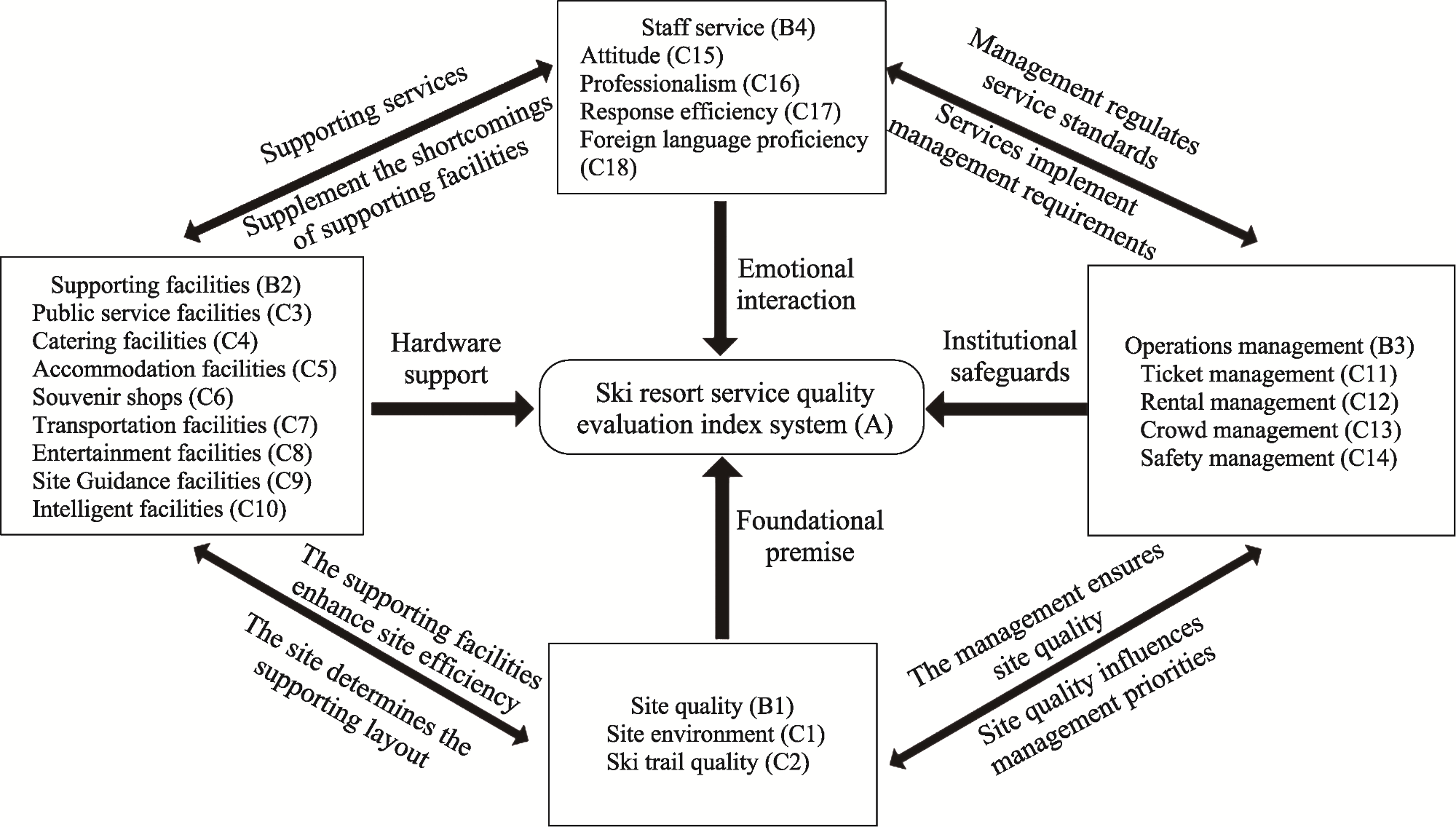
Selective coding aims to identify the core category that can summarize the main categories and analyze the internal connections of its core elements (Yi et al., 2025). To extract the core category, it is necessary to repeatedly compare the main categories and initial categories obtained earlier, that is, review the initial categories to check whether the selection of initial categories is repeated or reasonable. Through repeated comparison, we determined the “ski resort service quality evaluation index system” as the core category, and the components of the evaluation index system are listed in Table 4. The internal relationships between the main and core categories were as follows: site quality is the basic prerequisite for the ski resort service quality evaluation index system; supporting facilities are its hardware support; operations management are its institutional guarantee; and staff service are its emotional interaction. The site determines the layout of the supporting facilities, and supporting facilities enhance the efficiency of the site; site quality affects the focus of management, and management ensures the quality of the site; supporting facilities support the development of staff service, and staff service make up for the shortcomings of supporting facilities; operations management standardize the standards of staff service, and staff implement the requirements of management (Figure 1).
Table 4 Ski resort service quality evaluation index system from tourists’ perspective
Target layer
(Core category A)
Dimension
(Main category B)
Indicator layer
(Corresponding category C)
Ski resort service
quality evaluation
index system (A)
Site quality (B1) Site environment (C1)
Ski trail quality (C2)
Supporting
facilities (B2)
Public service facilities (C3)
Catering facilities (C4)
Accommodation facilities (C5)
Souvenir shops (C6)
Transportation facilities (C7)
Entertainment facilities (C8)
Site Guidance facilities (C9)
Intelligent facilities (C10)
Operations
management (B3)
Ticket management (C11)
Rental management (C12)
Crowd management (C13)
Safety management (C14)
Staff service (B4) Attitude (C15)
Professionalism (C16)
Response efficiency (C17)
Foreign language proficiency
(C18)
Figure 1 Diagram of internal relationships between the core and main categories of the ski resort service quality evaluation index system from tourists’ perspective

4.4 Theoretical saturation test

The theoretical saturation test was conducted through continuous comparative analysis and theoretical review. First, in accordance with the requirements of the grounded theory, continuous comparative analysis was conducted between the data and theory to extract the conceptual categories and their attributes. Data were sorted out in a timely manner and coded simultaneously, and new online text data were gradually supplemented; no new categories or relationships emerged, and repeated coding was conducted in the first- level coding. Second, in the data analysis and validation stage, two tourism researchers were invited to professionally review the coding content and proposed evaluation index system. After three rounds of feedback and revision, the two researchers recognized the completeness and reliability of the evaluation index system. Lastly, after the indicators were obtained, the remaining two review texts were used for the saturation test, and no new concepts or categories were found. Thus, theoretical saturation was achieved.

5 Discussion

5.1 Interpretation of the proposed evaluation index system

Based on the proposed evaluation index system, site quality was identified as the basic prerequisite, representing the foundation for conducting skiing activities, and includes two aspects: site environment and ski trail quality. Supporting facilities are the hardware support and include eight aspects: Public Service Facilities, Catering Facilities, Accommodation Facilities, Souvenir Shops, Transportation Facilities, Entertainment Facilities, Site Guidance Facilities, and Intelligent Facilities; they meet tourists’ needs in terms of catering, accommodation, transportation, shopping, entertainment, etc., and ensure the integrity of the ski tourism experience. Operations Management are the institutional guarantee of the ski resort service quality evaluation index system, including four aspects: Ticket Management, Rental Management, Crowd Management, and Safety Management; they can effectively avoid process confusion and safety risks and ensure the orderly operation of services. Staff Service are the emotional interaction of the ski resort service quality evaluation index system, reflected in four aspects: Staff Service Attitude, Professionalism, Service Response Efficiency, and Foreign Language Proficiency. The attitude and professionalism of service staff directly affected tourists’ experiences and are the key to transform “hardware services” into “satisfactory experiences”.

5.1.1 The site determines the supporting layout, while the supporting facilities enhance site efficiency

Site quality can determine the layout, quantity, etc., of supporting facilities. The distribution of ski trails can determine the layout of supporting facilities. Because there are more beginners on primary ski trails, public service facilities, such as rest areas and public toilets, should be placed nearby. Meanwhile, there are more professional tourists on advanced ski trails; hence, supporting facilities such as fast cable cars and snow emergency points need to be allocated. The scale of the site environment can also determine the quantity of supporting facilities. For example, large ski resorts need to increase the number of cable cars and spaces for catering and accommodation to meet tourists’ needs, whereas small ski resorts do not need excessive configuration to avoid resource waste.
Supporting facilities can improve the use efficiency of the site and enhance its efficiency. The speed and quantity of cable cars can optimize the use efficiency of ski trails; fast cable cars can reduce tourists’ waiting and queuing time and avoid congestion or idleness in ski trails. Public service facilities, such as rest areas and hot water supply points, can extend the stay of tourists in these areas; thus, reasonable placement of rest areas next to ski trails can reduce tourists’ fatigue, making tourists more willing to experience multiple ski trails and improving the use value of the site. Site guidance facilities can also reduce confusion among tourists; clear signages on ski trails and safety can prevent tourists from mistakenly entering advanced ski trails and maintain the order of the site environment.

5.1.2 Site quality influences management priorities, while the management ensures site quality

Site quality affects the focus and intensity of management strategies. The safety of ski trails can affect the configuration of the safety management system: advanced ski trails of the ski resort are more difficult and have higher risk coefficients than primary ski trails; thus, it is necessary to increase the number of safety management staff and the frequency of ski trail patrols to ensure tourist safety. The quantity and type of ski trails affect crowd management strategies: few ski trails and single types are prone to long lines, so it is necessary to control the number of tourists by booking skiing time periods and admitting tourists in batches. Snow quality also affects operations management; for example, if the snow quality is too hard, some ski trails need to be temporarily closed, and crowd control should be adjusted accordingly.
Operations management ensure the quality of the site. Crowd management protects the quality of ski trails by controlling the number of tourists, avoiding damage to snow quality due to trampling by excessive tourists, and maintaining the stability of snow quality. Safety management, such as medical emergency facility management and safety staff management, can reduce site risks; configuring emergency points next to ski trails can not only facilitate quick response during accidents, but also avoid disturbing other tourists owing to accident delays, hence ensuring the smooth use of the site.

5.1.3 Supporting services supplement the shortcomings of supporting facilities

Public service facilities include lockers, changing rooms, standardized parking lots, and public toilets. Intelligent facilities, such as online ticket purchase channels, promote the optimization of service staff attitude and professionalism through platform service evaluation feedback, thus improving staff response efficiency.
Service staff, with professional capabilities and emotional services, make up for the shortcomings of supporting facilities. Staff in souvenir shops endow commodities with cultural connotations through the diversity of commodities and professional explanations, enhancing the attractiveness of the ski resort’s supporting facilities. Insufficient catering capacity can be addressed by measures such as predictive meal preparation and capacity expansion during peak hours. Complaint handling staff efficiently respond to tourists’ demands through flexible handling methods, and through problem tracing, timely convert tourists’ demands into implementation paths for the improvement of supporting facilities and service enhancement.

5.1.4 Management regulates service standards, while services implement management requirements

Operations management establish the standardized guidelines for service staff. The transparent rules and convenient processes of ticket management standardize the service words and behaviors of ticket service staff, ensuring the consistency of ticket services. The crowd control tactics of crowd management staff and the requirements for tourist quantity and waiting time clearly guide the service standards of staff, and also provide a basis for the scientific setting and implementation of the maximum carrying capacity of tourists at the ski resort. Staff allocation, system implementation, and emergency protocol of safety management put forward behavioral standards for the safety services for relevant staff such as coaches and emergency personnel.
The service staff implements the operations management protocol through professionalism and efficient response. Coaches practice the safety management system by applying their professional knowledge and efficient response to timely guide and correct tourists’ skiing behaviors. General service staff, such as ticket and rental staff, ensure the smooth flow of ticket purchase and equipment rental processes with good service attitude and response efficiency, supporting the efficient operation of operations management. Staff with foreign language proficiency can accurately explain the rules on ticketing and safety to foreign tourists, ensuring precise communication and increasing accessibility.

5.2 Recommendations

Based on our findings, we propose the following suggestions to the ski resort management and staff:
First, ensure site quality, improve landscape coordination and the overall environmental cleanliness of the ski resort, and introduce design concepts to integrate ski facilities with natural landscapes. The beauty of the landscape and the cleanliness of the environment are the first things tourists notice and directly affect their satisfaction. As one interviewee commented, “The environment is beautiful, the scenery settings are vivid and interesting, and the experience is excellent!” Second, it is necessary to adjust the night lighting of the ski resort according to weather conditions to ensure proper brightness suitable for skiing. Moreover, the comprehensive quality of ski trails should be improved by reasonably planning their width, type, and length according to the scale and topographical characteristics of the ski resort. Lastly, snow quality inspections before and during skiing activities should be conducted routinely to ensure the safety of ski trails.
Regarding supporting facilities, their investment and maintenance should correspond to the site area and number of tourists, ensuring the convenience and cleanliness of facilities, such as lockers, changing rooms, parking lots, and toilets. Catering diversity should be enhanced, and prices should be reasonable; affordable and simple meals, as well as local cuisines, should be made available. The quality of accommodations may be improved by strengthening the cooperation among the surrounding accommodation industries and improving the convenience of accommodation. To improve souvenir shops, cultural and creative products should be designed according to the characteristics of the ski resort and regional culture, and the diversity of commodities should be increased. The quantity and speed of the ski resort’s mountain transportation equipment should be adjusted in a timely manner according to the real-time monitoring of tourists, and intelligent services, such as big data and cloud computing, should be implemented.
Regarding operations management, a transparent and standardized ticket and rental management system should be established; the ticket end should display the pricing, refund and modification rules, and real-time remaining tickets, and the mode of time-slot booking and online verification should be implemented. The rental end should formulate a “one customer, one disinfection” process and assign special personnel to evaluate safety performance weekly. Effective crowd management should be practiced by monitoring the passenger flow density of each area relying on intelligent equipment, setting carrying thresholds, and adopting new strategies, such as appointment-based capacity restriction and off-peak guidance during peak hours. The safety management system can be improved by allocating full-time inspectors according to the level of ski trails, adding first-aid stations at the end and buffer zones of intermediate and advanced ski trails, and conducting regular safety training and emergency drills for all staff.
Lastly, the service provided by staff and ski coaches should be enhanced to increase customer satisfaction. A hierarchical and classified training system could be built, with a focus on service standardization, emergency handling, and basic foreign languages. The training of coaches on skiing skills, safety teaching standards, and basic first-aid skills should also be conducted on a regular basis, and their skills should be assessed in theory and practical applications. The coach quality control mechanism can be improved by establishing a two-dimensional evaluation system of tourist ratings and teaching effects; teaching results could be linked with coach evaluation and salary bonus, and the hourly fees and teaching content lists of coaches at different levels should be made publicly available. Service quality supervision posts should be added, and dynamic optimization of service shortcomings through customer secret visits and online evaluation tracing should be implemented.

6 Conclusions

Focusing on the perspectives of ski tourists, this study established a ski resort service quality evaluation index and conducted an in-depth analysis of online texts from the Ctrip website and interview data based on the grounded theory. Four dimensions (site quality, supporting facilities, operations management, and staff service) and 18 specific indicators were identified. Site Quality was the basic prerequisite for the evaluation index system, supporting facilities represent hardware support, operations management serve as institutional guarantee, and staff service are the emotional component. The site determines the layout of supporting facilities, which enhance the site efficiency; the site quality affects the priorities of management, which ensures the quality of the site; the supporting facilities support the development of service staff, who make up for the shortcomings of the supporting facilities; the operations management standardizes the standards of the service staff, who implement the requirements of the management.
This study had some limitations. First, sample bias might exist, as the views of all ski resort tourists could not be obtained. Second, the research areas are mainly concentrated in some typical ski resorts in China, and the representativeness of international ski resorts and ski resorts in other regions of China is insufficient. In addition, although the ski resort service quality evaluation index was established, the index weight has not been studied. Future studies should expand the data source channels, including those of different regions, and combine multiple methods, such as field and questionnaire surveys, to obtain more comprehensive tourist feedback data. Moreover, quantitative analysis methods should be utilized to determine the index weight, and in-depth research on each indicator is needed to explore the specific paths and methods for improving service quality.
[1]
Bausch T, Ortanderl F, Pröbstl-Haider U. 2024. Rethinking growth orientation: Do ski-resorts’ strategies fit the profiles of today’s alpine skiers? International Journal of Tourism Research, 26(4): 2708. DOI: 10.1002/jtr.2708.

[2]
Bichler B F, Pikkemaat B. 2021. Winter sports tourism to urban destinations: Identifying potential and comparing motivational differences across skier groups. Journal of Outdoor Recreation and Tourism, 36: 1-10.

[3]
Chen F, Dai S, Zhu Y, et al. 2020. Will concerns for ski tourism promote pro-environmental behaviour? An implication of protection motivation theory. International Journal of Tourism Research, 22: 303-313.

DOI

[4]
Chen L, Ren S Y. 2024. Spatial pattern and influencing factors of ice-snow tourism industry in China: Taking ski resorts as an example. Business Exhibition Economy, (2): 54-57. (in Chinese)

[5]
Chen X M. 1999. Thoughts and methods of Grounded Theory. Educational Research and Experiment, (4): 58-63, 73. (in Chinese)

[6]
Chen X Y, Xu S Y, Tang C C, et al. 2022. Evaluation and promotion model of tourist satisfaction in ice and snow tourism destinations. Journal of Resources and Ecology, 13(4): 635-645.

DOI

[7]
Cholakova S, Dogramadjeva E. 2019. Climate change and ski industry in Pamporovo resort, Bulgaria: An exploratory study on the tourists’ perceptions. European Journal of Tourism Research, 22: 166-192.

DOI

[8]
Dannevig H, Gildestad I M, Steiger R, et al. 2021. Adaptive capacity of ski resorts in Western Norway to projected changes in snow conditions. Current Issues in Tourism, 24: 3206-3221.

DOI

[9]
Dou J J. 2008. From tool to toy: Historical origin of ski sports. Culture and History Vision (Theory), (9): 13-15. (in Chinese)

[10]
Gronroos C. 1984. A service quality model and its marketing implications. European Journal of Marketing, 18(4): 36-44.

DOI

[11]
Gronroos C. 1988. Service quality: the six criteria of good perceived service quality. Review of Business, 9(3): 10-13.

[12]
Guan J L, Wang F, Ma L Y. 2023. Dilemmas and countermeasures for sustainable development of ski tourism industry under “Dual Carbon” goals. Sports Culture Guide, (1): 98-103, 110. (in Chinese)

[13]
Guo X Y, Yang J P, Wang Y X, et al. 2025. Segmentation and profiling of ski tourists in Xinjiang. Journal of Glaciology and Geocryology, 47(2): 562-575. (in Chinese)

[14]
Hall J, O’Mahony B, Gayler J. 2016. Modelling the relationship between attribute satisfaction, overall satisfaction, and behavioural intentions in Australian ski resorts. Journal of Travel & Tourism Marketing, 34(6): 1-15.

[15]
Haugom E, Malasevska I, Alnes P K, et al. 2021. Willingness to pay for “green skiing”. Journal of Hospitality and Tourism Management, 47: 252-255.

DOI

[16]
He X, Luo J M. 2020. Relationship among travel motivation, satisfaction and revisit intention of skiers: A case study on the tourists of Urumqi Silk Road ski resort. Administrative Sciences, 10(3): 56. DOI: 10.3390/admsci10030056.

[17]
Jiang J X, Li S M. 2021. High-quality development of ski tourism economy in Heilongjiang Province: Dilemma and breakthrough. Academic Exchange, (9): 72-82. (in Chinese)

[18]
Jiang Y Y, Jiang L, Xu H B, et al. 2025. Structural characteristics and driving factors of China’s urban ski tourism flow network. Geographical Research, 44(5): 1439-1457. (in Chinese)

[19]
Jin Z. 2020. Tourism high-quality development opportunities brought by Winter Olympics: A case study of 1972 Sapporo Winter Olympics. Tourism Tribune, 35(4): 3-5. (in Chinese)

[20]
Kan J C, Wang F, Xu J Q, et al. 2017. Research on development of ice-snow sports industry in Heilongjiang from perspective of government functions. Journal of Shandong Sport University, 33(6): 48-52. (in Chinese)

[21]
Li J L, Zhang L, Li P, et al. 2023. Market segmentation of sports tourism based on lifestyle dimensions: Empirical analysis of ski tourists. Journal of Xi’an Physical Education University, 40(3): 342-355. (in Chinese)

[22]
Li P, Wang X Y, Wang H, et al. 2025. Study on the evolution characteristics and optimization strategies of the spatio-temporal pattern of ice-snow tourism industry in three northeastern provinces of China. Geographical Research, 44(5): 1342-1360. (in Chinese)

[23]
Li S W, Li J L, Liu X K, et al. 2022a. Service quality evaluation and optimization strategies of ski tourism in post-Beijing Winter Olympics period: From perspective of ski tourists in Beijing. Journal of Beijing Sport University, 45(5): 146-161. (in Chinese)

[24]
Li S W, Li J L, Yang S Y, et al. 2024. High-quality development of ski tourism industry under China’s new economic normal: Market segmentation based on three-season data prediction. Journal of Wuhan Sports University, 58(1): 1-12, 29. (in Chinese)

[25]
Li W X, Sun W. 2013. Research on the origin, current situation and development trend of European ski sports tourism. Journal of Beijing Sport University, 36(1): 30-35, 45. (in Chinese)

[26]
Li Y Y, Lan Z L, Yan Y. 2022b. Key issues of regional ski resort service quality based on modified IPA analysis: A case study of Shennongjia in Western Hubei. Journal of Wuhan Sports University, 56(12): 58-65. (in Chinese)

[27]
Li Z J. 2019. Analysis on the dynamic mechanism and realization path of the integration development of ice and snow industry and tourism industry. China Sport Science and Technology, 55(7): 56-62, 80. (in Chinese)

[28]
Lin J H. 2023. Study on the optimization of Yunnan tourism service quality based on continuous coherence. Diss., Kunming, China: Kunming University of Science and Technology. (in Chinese)

[29]
Matzler K, Mazanec J, Strobl A, et al. 2021. Customer satisfaction management: Exploring temporal changes in nonlinearities in satisfaction formation of skiers. Problems and Perspectives in Management, 19(2): 398-417.

DOI

[30]
Moreno-Gené J, Daries N, Cristóbal-Fransi E, et al. 2020. Snow tourism and economic sustainability: the financial situation of ski resorts in Spain. Applied Economics, 52(52): 5726-5744.

DOI

[31]
Ormiston D, Gilbert A, Manning R E. 1998. Indicators and standards of quality for ski resort management. Journal of Travel Research, 36: 35-41.

[32]
Qi S H, Wang M, Li J, et al. 2023a. Influencing factors and mechanism of ski tourism consumers’ behavioral intention: Multi-group analysis based on skiing proficiency. China Sport Science and Technology, 59(8): 90-97. (in Chinese)

[33]
Qi S H, Wang M, Li J, et al. 2023b. Path and strategy of high-quality supply of ski tourism service: An empirical study on the influencing factors of ski tourists' loyalty. Journal of Shandong Sport University, 39(5): 70-79. (in Chinese)

[34]
Shang Z, Luo J M, Kong A. 2022. Topic modelling for ski resorts: An analysis of experience attributes and seasonality. Sustainability, 14(6): 3533. DOI: 10.3390/su14063533.

[35]
Tang C C, Xu S Y. 2022. Sustainable development of ice and snow tourism—Theory & empirical studies: preface. Journal of Resources and Ecology, 13(4): 547-551.

[36]
Tang C C, Zeng R, Yang Y Y, et al. 2022. High-quality development path of China’s ice-snow tourism from the perspective of Winter Olympics. Journal of Resources and Ecology, 13(4): 552-563.

[37]
Wang G Q, Wang X, Wang J W, et al. 2022. Influence mechanism of urban residents’ ski tourism behavioral intention under the background of Winter Olympics: Empirical study in Beijing. Journal of Arid Land Resources and Environment, 36(5): 178-185. (in Chinese)

[38]
Wang H, Su W L. 2024. Integration mechanism, model and path of ice-snow culture and sports tourism. Social Scientist, (1): 87-95. (in Chinese)

[39]
Wang J W, Zhang C L, Ye M S, et al. 2021. Research on the operation experience and enlightenment of foreign ice and snow sports policies: An analysis based on policy network theory. Journal of Shenyang Sport University, 40(5): 7-15. (in Chinese)

[40]
Wang R, Wei Q M. 2022. Policy analysis on the development of ski sports industry: A grounded theory study based on Chongli, Zhangjiakou. Journal of Hebei University of Science and Technology (Social Sciences Edition), 22(3): 20-27. (in Chinese)

[41]
Wang Z H, Li J. 2025. High-quality development of ice and snow economy in the new era: Realistic foundation, challenges, and promotion strategies. Journal of Shenyang Sport University, 44(3): 114-121. (in Chinese)

[42]
Wei M. 2011. A research on tourism service quality:Measurement and evaluation. In: Lin S, Huang X (eds.). Advances in Computer Science, Environment, Ecoinformatics, and Education. Berlin, Germany: Springer: 298-304.

[43]
Weiermair K, Fuchs M. 1999. Measuring tourist judgment on service quality. Annals of Tourism Research, 26: 1004-1021.

DOI

[44]
Wu X Q. 1997. Service quality characteristics and service quality system. World Standardization & Quality Management, (7): 11-14. (in Chinese)

[45]
Xu X, Li Y P, Li Y Q. 2022. Ski tourism experience and market segmentation from the perspective of perceived value: A case study of Chongli District, Zhangjiakou. Journal of Resources and Ecology, 13(4): 655-666.

[46]
Yang J P, Tang F, Guo X Y, et al. 2023. Development model and system construction of ice-snow tourism in China. Journal of Glaciology and Geocryology, 45(6): 1923-1939. (in Chinese)

[47]
Yang S M, Kang D W. 2008. Thoughts on the development policy of ice and snow sports industry in Harbin. China Winter Sports, (3): 86-90. (in Chinese)

[48]
Yao X L, Zhong W. 2021. Quantitative analysis of China’s ski tourism policy texts (1996-2019). Journal of Harbin Sport University, 39(3): 1-6, 11. (in Chinese)

[49]
Yeo H L, Kim P S. 2010. Analysis on the improvement of ski resort service quality with the performance model. Journal of the Society of Korea Industrial and Systems Engineering, 33(1): 59-70.

[50]
Yi L S, Chen X X, Chen Y. 2025. “Subtracting” for life: A rhythm analysis of slow tourism experience. Tourism Tribune, 40(4): 107-121. (in Chinese)

[51]
Yu W Q, Zhu Y. 2019. Evaluation and improvement of service quality of ski resorts in China. Journal of Capital University of Physical Education and Sports, 31(1): 33-37. (in Chinese)

[52]
Zhang D C. 1998. Current situation and development trend of ski tourism in Heilongjiang. Tourism Tribune, (5): 48-50. (in Chinese)

[53]
Zhang R L, Jin L J, Wang Z W. 2024. Evaluation and influencing factors of integrated development of ski industry and tourism industry in China. Journal of Capital University of Physical Education and Sports, 36(1): 1-11, 42. (in Chinese)

[54]
Zhang R L, Zhou W J. 2023. Problem analysis, theoretical elements and driving paths for high-quality development of China’s ski industry. Journal of Beijing Sport University, 46(3): 1-9. (in Chinese)

[55]
Zhao L L, Ma Y, Wang X C, et al. 2023a. Research on the development of ice and snow economy and talent support demand policy in the post-Winter Olympics era. Landbridge Horizon, (4): 99-101. (in Chinese)

[56]
Zhao W Q, Zhao Y L, Ye H B, et al. 2023b. Coordinated development of ski tourism, ecological environment and urbanization: Empirical study based on coupling coordination model. Journal of Shandong Sport University, 39(2): 1-11. (in Chinese)

[57]
Zhao Y, Feng X G. 2023. Influence of sports tourism service quality on tourists’ experience quality and behavioral intention. Journal of Shanghai University of Sport, 47(12): 57-71, 82. (in Chinese)

Outlines

/