Ice-Snow Tourism and Eco-Tourism

The Development Process, Evolutionary Patterns, and Emerging Trends of Ice and Snow Tourism in China

  • TANG Chengcai , 1, 2 ,
  • JIN Tianzi 1 ,
  • SHANGGUAN Lingyi , 1, *
Expand
  • 1 School of Tourism Sciences, Beijing International Studies University, Beijing 100024, China
  • 2 Research Center for Beijing Tourism Development, Beijing 100024, China
* SHANGGUAN Lingyi, E-mail:

TANG Chengcai, E-mail:

Received date: 2025-09-04

  Accepted date: 2025-12-30

  Online published: 2026-04-13

Supported by

The National Natural Science Foundation of China(42471284)

The National Natural Science Foundation of China(42071199)

The 2025 Graduate Research Project of Beijing International Studies University

Abstract

Promoting the high-quality growth of ice and snow tourism in China requires understanding the patterns of industrial development and anticipating the emerging trends. The developmental history and features of China’s ice and snow tourism are systematically examined in this paper, which also refines the evolutionary patterns of the industry’s growth and looks at the emerging trends. The conclusions are threefold. (1) This paper divides the developmental history of China’s ice and snow tourism into the budding exploration phase, the initial growth phase, the rapid development phase, the Winter Olympics driving phase, and the high-quality development phase. During the budding exploration phase, the initial market foundation for ice and snow tourism was established. In the initial growth phase, the ice and snow tourism industry began to take shape. The rapid development phase was characterized by ice and snow sports tourism. The foundation of the ice and snow tourist industry was established during the Winter Olympics driving phase. The high-quality development phase is now being guided by the principles of ecological civilization and the sports power strategy and the tourism powerhouse strategy. (2) The spatial layout of ice and snow tourism has changed from a localized and dispersed distribution to one of comprehensive development mainly centered in the Northeast, North China and Northwest represented by Xinjiang province. The evolution of ice and snow tourism technology presents localized, diversified, and high-end characteristics. The evolution of the industry presents vertical extension of the industrial chain, horizontally integrated development, and the comprehensive development of resorts. The evolution of the ice and snow tourism market has been characterized by the diversity of tourist demands, a northward flow of tourists from southern regions, and standardization of quality inspection. (3) There are four emerging trends in the development of China’ ice and snow tourism, including new productivity to propel the intelligent, sustainable, and localized transformation of winter sports equipment and venues; climate change to accelerate the evolution of regional ice-snow tourism landscapes; innovations in digital technology to change ice-snow tourism consumption scenarios; and innovations in consumption patterns to reshape supply-side development.

Cite this article

TANG Chengcai , JIN Tianzi , SHANGGUAN Lingyi . The Development Process, Evolutionary Patterns, and Emerging Trends of Ice and Snow Tourism in China[J]. Journal of Resources and Ecology, 2026 , 17(2) : 335 -344 . DOI: 10.5814/j.issn.1674-764x.2026.02.001

1 Introduction

Since Beijing’s successful Winter Olympic bid in 2015, ice and snow tourism in China has undergone large-scale expansion. Guided by the Chinese leader’s instruction that “ice and snow are as valuable as gold and silver”, this sector has leveraged governmental and social capital to become a global leader in ski resort inventory. High-profile events, including the Beijing 2022 Winter Olympics and the 9th Asian Winter Games, have catalyzed domestic consumption and bolstered international influence. However, the indus-try’s long-term viability will require a shift from traditional factor-driven models toward “new quality productive forces” defined by high technology, efficiency, and quality.
The China Ice and Snow Tourism Development Report (2025) noted that the 2023-2024 season attracted 430 million tourists and generated 524.7 billion yuan. This transition from “cold resources” to a “hot economy” signals a new phase of high-quality development. Nevertheless, rapid expansion has exposed structural deficiencies in planning, safety, and market regulation (Tang et al., 2022a). To overcome these challenges, the industry must enhance its total factor productivity to align with the requirements of modern development.
While the global market faces stagnation and climate-related pressures (Laurent and Li, 2023; Bai and Zhang, 2025), China’s sector continues to industrialize and expand (Wang et al., 2023; Zhang et al., 2025). Geographic and seasonal barriers are diminishing as ice and snow tourism spreads to southern China (Tang, 2023). Furthermore, consumer behavior has evolved from singular sporting activities toward a diversified “experiential economy” integrated with culture, education, and health (Wang et al., 2023).
Li et al. (2025b) argued that transforming “icy landscapes” into “economic prosperity” requires fostering new productive forces. In the post-Olympic era, the focus has shifted toward sustainability and full-industry-chain integration (Tang et al., 2022b; Tang et al., 2023a). Future growth is expected to stem from advanced equipment manufacturing (Feng et al., 2025b), improvements in regional infrastructure (Kong et al., 2025), and temporal extension of the tourism season (Chen and Yue, 2025; Niu et al., 2025). Key trends include intelligent transformation and regional coordination (Tang, 2023).
Despite this progress, research gaps persist. First, there is a lack of diachronic analysis and robust theoretical frameworks to categorize the industry’s evolution. Second, the existing literature is geographically skewed toward Northeast China, while neglecting cross-regional comparisons and the intersection of technology, climate adaptation, and consumer behavior. To close these gaps, this study systematically summarizes China’s ice and snow tourism history and evolutionary patterns and analyzes future trends for technological innovation and industrial upgrading.

2 The historical development of ice and snow tourism in China

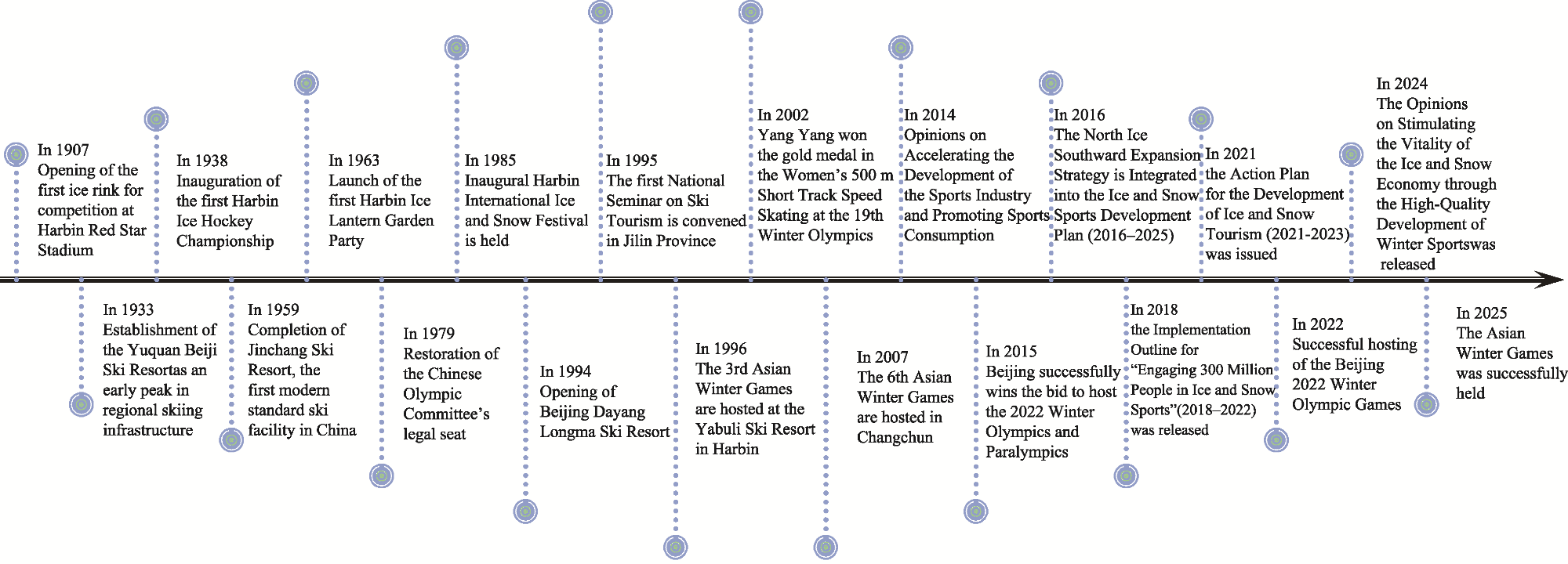
Based on the industry life cycle theory and sustainable development theory, this study posits that the phased development of ice and snow culture was influenced by policy guidance and event scheduling, which shaped the forms of ice and snow tourism in different periods. Specifically, the development of ice and snow tourism in China can be divided into five phases: 1) Budding exploration phase (before 1978); 2) Initial growth phase (1978-1995); 3) Rapid development phase (1996-2014); 4) The Winter Olympics driving phase (2015-2022); and 5) High-quality development phase (since 2022). The core events are shown in Figure 1.
Figure 1 The historical timeline of ice and snow tourism development in China

2.1 Budding exploration phase (before 1978)

Historically, ice and snow activities in China’s high-latitude and high-altitude regions originated as essential survival strategies. Prolonged winters necessitated the development of specialized transportation, such as early forms of skiing and skating. Over time, survival practices like fish and eagle hunting evolved into unique regional cultural symbols (Liu et al., 2014). While indigenous practices existed, the modern conceptualization of ice and snow sports was introduced from abroad during the late 19th and early 20th centuries. According to the Heilongjiang Sports Record, modern skiing entered China via Russia. In 1907, Harbin Red Star Stadium opened an ice skating rink, which was the first ice skating rink for competition in China. In 1933, the Harbin Railway Bureau built the Yuquan Arctic Ski Resort in Yuquan North Mountain as the first place for modern ice and snow sports in China. In 1938, Harbin held its first ice hockey tournament, which was the first ice hockey tournament in China.
Following the founding of the People’s Republic of China, skiing and skating were formalized as athletic disciplines. Initially, official venues were restricted to professional use rather than public tourism (Han and Han, 2001a). In 1959, the first national skiing competition was held in Tonghua City, Jilin Province, and the Jinchang Ski Resort was constructed as New China’s first standard ski resort. In 1963, Heilongjiang Province founded the Harbin Ice Lantern Garden Party, which has been held in Zhaolin Park every winter since then. Despite this rapid growth in Northeast China, early ice and snow tourism remained nascent, characterized by small-scale, temporary activities and a lack of systematic industrial development.

2.2 Initial growth phase (1978-1995)

The Reform and Opening-up policy in 1978 and the restoration of the Chinese Olympic Committee’s legal status in 1979 marked a turning point for winter sports. China’s debut at the 13th Winter Olympics facilitated international knowledge exchange and spurred a nationwide interest in ice and snow culture (Chen et al., 2021). By the early 1980s, winter sports reached a localized peak, particularly in Northeast China. Although these early efforts lacked systematic national guidance, the construction of international level facilities signaled China’s entry into the global competitive arena (Han and Han, 2001a). At the same time, tourism resources began shifting toward a “leisure culture” model. Northern regions created cultural landmarks like ice lanterns and snow sculptures. In 1985, the establishment of the Harbin International Ice and Snow Festival pioneered modern ice and snow tourism. In the 1980s, the General Administration of Sport introduced the “North Ice Southward Expansion” strategy to tap into southern markets. While technical and resource constraints slowed physical infrastructure growth in the south, the sector became diversified through the emergence of glacier tourism, enriching the types of ice and snow tourism that were available (Wang et al., 2012).
In 1992, Ye Qiaobo’s two silver medals at the Albertville Winter Olympics ignited national enthusiasm for winter sports. In 1994, the Beijing Dayang Longma Ski Resort was completed as one of the first facilities dedicated to the general public. In 1995, the first National Ski Tourism Seminar was held in Jilin Province, marking the official start of ski tourism in China (Han and Han, 2001b). During this period, the dual development of leisure culture and mass-market sports led to the initial formation of a cohesive ice and snow tourism industry.

2.3 Rapid development phase (1996-2014)

The 1996 Asian Winter Games in Harbin served as a catalyst for the commercialization of professional venues. Following that event, the Yabuli Ski Resort pivoted toward the mass market. The 21st century has seen a surge in diversified attractions, including ice and snow folk villages and themed townships. Advancements in snow-making technology and indoor facility construction, pioneered by the Shenzhen Alps Ice and Snow World, opened the southern Chinese market. Despite this, the lack of a cultural base and the technical difficulties of winter sports training caused expansion in the south to lag initially. In 2002, following Yang Yang’s historic first Winter Olympic gold medal, the General Administration of Sport launched the “Southward Expansion and Westward Extension of Winter Sports” strategy to address these regional imbalances.
By 2007, the 6th Asian Winter Games further bolstered the industry. But the industry remained in a developmental stage through 2014, with a national ski participation rate of only 1% (Zhang et al., 2020). In 2014, the State Council issued Several Opinions on Accelerating the Development of the Sports Industry, which explicitly promoted winter sports to stimulate consumption. During this phase, the industry began integrating the traditional culture of northern ethnic minorities into systematic tourism products. This cultural infusion transitioned the sector toward a more sustainable and scientifically structured model, with ice and snow sports tourism serving as the primary driver.

2.4 Winter Olympics driving phase (2015-2022)

Beijing’s successful 2015 Winter Olympic bid inaugurated a period of unprecedented expansion. Central to this growth was the national commitment to “engaging 300 million people in ice and snow sports”. This vision was formalized through the Ice and Snow Sports Development Plan (2016-2025) and the Implementation Outline (2018-2022), which prioritized mass participation and the “North Ice Southward Expansion, Westward Extension” strategy.
By January 2021, China had 654 standard ice rinks, an increase of 317% compared to 2015; there were also 803 ski resorts, an increase of 41% compared to 2015 (GASC, 2022). Ice and snow sports venues achieved nearly full domestic coverage. According to the Statistical Survey Report on engaging 300 million people in ice and snow sports, as of October 2021, the number of participants in winter sports nationwide reached 346 million. According to the China Ice and Snow Tourism Development Report (2023), the 2021-2022 season generated 474 billion yuan in revenue from 344 million participants.
The Olympic period gave birth to a new winter sports culture that integrated traditional tourism with diverse leisure sectors. The “Ice and Snow Plus” model merged winter sports with hot springs, folk culture, music, and cuisine, which achieved the basic establishment of an ice and snow culture system. Despite this momentum, the industry faced headwinds from global health events, which temporarily weakened the consumption foundations (GASC, 2020). To counter this stagnation, the Ice and Snow Tourism Development Action Plan (2021-2023) was implemented to ensure a “balanced and rational” national development pattern. Ultimately, the Winter Olympics driving phase succeeded in breaking geographical restrictions and contributed significantly to poverty alleviation in rural mountainous areas, thus establishing a sound foundation for the industry’s transition to a high-quality development phase.

2.5 High-quality development phase (since 2022)

China’s policymakers provided a strategic framework for improving ice and snow tourism in 2022, which emphasized sustainable development. However, current development remains uneven and requires adherence to the state leader’s thoughts on ecological civilization (Zhang, 2024).
Bolstered by the 2022 Beijing Winter Olympics and the “Leading Sporting Nation” strategy and the tourism powerhouse strategy, China has realized its “300 million participants” vision. China’s policymakers issued the State Council’s Several Opinions on Stimulating the Vitality of the Ice and Snow Economy in November 2024, which promotes technology-driven sustainable growth. The Mass Ice and Snow Consumption Market Research Report (2023-2024 Winter Season) shows that there were 2847 venues involving ice and snow sports nationwide in 2023; and as of April 2024, during the 2023-2024 winter season, 862 ski resorts were operating normally across the country, 59 of which were indoor ski venues. The China Ice and Snow Tourism Development Report (2025) released by the China Tourism Academy indicates that during the 2023-2024 winter season, the number of ice and snow leisure tourists in China reached 430 million, generating ice and snow leisure tourism revenue of 524.7 billion yuan. The General Office of the State Council issued the “Several Opinions on Stimulating the Vitality of the Ice and Snow Economy through High-Quality Development of Ice and Snow Sports”, which estimated that the total scale of the ice and snow economy should reach 1.2 trillion yuan by 2027 and 1.5 trillion yuan by 2030.
By February 2024, the Ministry of Culture and Tourism designated three batches of national-level ski resorts to support this trajectory. Central to this evolution is the two-way coupling mechanism between “new quality productive forces” and ice and snow tourism (Han et al., 2024). This relationship is defined by four pillars: technological innovation, factor reorganization, industrial integration, and institutional reform. Specifically, new quality productive forces restructure the supply side through intelligent management and high-end industrial chain extensions. Conversely, the ice and snow market provides the application scenarios and market traction necessary to stimulate further technological breakthroughs. Despite this potential, the industry faces several critical bottlenecks, including weak core competitiveness, ecological vulnerability, equipment technological barriers, and insufficient cultural integration (Tang et al., 2022a; Zhao et al., 2024). Addressing these challenges to achieve high-quality development remains a pivotal research and policy priority.

3 Patterns of ice and snow tourism development in China

3.1 The spatial evolution of ice and snow tourism

As an emerging tourism industry, ice and snow tourism now covers almost the entire country, transforming the sector from a scattered, localized presence into a comprehensive development pattern, led by the Northeast, North China and Northwest represented by Xinjiang Province. This transformation is mainly reflected in the following two aspects.
The general distribution of ice and snow tourism has changed from dispersed local locations in the north to a comprehensive development pattern led by the Northeast, North China and Northwest and represented by Xinjiang Province, with Southwest glacier tourism, southern mountain ice and snow tourism and their indoor ice and snow tourism venues appearing as secondary growth areas. Due to its wealth of ice and snow resources and solid foundation in public winter sports, ice and snow sports tourism started early in Northeast China, which in turn spurred the development of ice and snow leisure tourist venues. Initially, the development environment in the Northwest was fairly isolated. However, by using its ice and snow scenery and folk culture to stage events like ice and snow tourism festivals, Xinjiang Province opened up the Northwest’s ice and snow tourism industry. Some parts of North China built ski resorts using their mountain and snow resources to fully capitalize on the Winter Olympics legacy, which created new opportunities for the expansion of ice and snow tourism. The Southwest has developed a market centered on alpine skiing and glacier tourism, as demonstrated by locations like Xiling Snow Mountain and the Qinghai-Tibet Glacier Tourism Area, thanks to the “Southward Expansion and Westward Extension of Winter Sports” strategy.
In terms of regional characteristics, the density of ice and snow tourism formats within Northeast China has increased continuously, with enhanced coordination and synergy among provinces and cities. Led by major ski resorts such as the Yabuli and Changbaishan Ski Resorts, Northeast China has strengthened its construction of related infrastructure, including transportation, heating and water supply, while improving supporting services such as accommodation, shopping and dining. It has also reinforced the development of ice and snow brands. The Ministry of Culture and Tourism’s National Ice and Snow Tourism Boutique Routes from 2023 and 2024 state that areas like Heilongjiang and Jilin have facilitated the pooling of tourist resources and encouraged connectivity among different ice and snow tourism locations.

3.2 The evolution of ice and snow tourism technology

Initially, the ice and snow industry relied primarily on natural conditions and rudimentary infrastructure. As the sector expanded, equipment and apparel evolved through technology-driven innovation and ecological principles, and this has ensured sustainable growth across three primary dimensions.
First, the ice and snow sports equipment has shifted from imported to domestic sources. Historically, the industry’s reliance on imported equipment and a lack of domestic research and development led to high operational costs (Du, 1999). Surging demand has since incentivized research institutions and enterprises to establish a domestic manufacturing ecosystem. By prioritizing core technology research and development, China has developed a comprehensive industrial chain.
Second, innovation has transcended basic facilities and penetrated apparel, culture, and environmental management. The development of technologies such as above-zero snowmaking and carbon dioxide transcritical ice-making facilitated the expansion of venues into southern regions. Anta and Donghua University jointly developed China’s first self-developed high-performance waterproof and breathable material. The integration of dynamic thermal insulation and shock-proof technologies marks a shift from traditional manufacturing to technology-enabled branding. Scenic spots have evolved through “virtual-real integration”. VR and 3D mapping provide tourists with novel experiences, while advancements in utility infrastructure support the specialized needs of ice and snow environments.
Finally, the core technology of manufacturing has made continuous breakthroughs, and China’s ice and snow equipment has moved from low-end to high-end intelligent manufacturing. China’s independent research and development of double snowmobiles, steel frame snowmobiles and sleds has broken the paradigm of passive over-reliance on imports of core equipment. Based on Beidou satellite and GIS technology, China’s ski resorts have innovated ski track design and improved design accuracy, and tourists can now record ski experiences through AI, 5G, and other technologies, such as the launch of the “Snow Dragon” track in Yanqing during the Winter Olympics. The scale of ice and snow talent cultivated by universities is expanding rapidly, including core technical talents and operational talents.

3.3 Evolution of the ice and snow tourism industry

Ice and snow tourism has evolved from a small-scale economic activity into an industry with substantial scale. Guided by the ice and snow cultural system, it has developed multiple categories of ice and snow tourism formats. The developmental route of the ice and snow tourist business has been altered by comprehensive ice and snow tourism zones, such as ski resorts, which obtain focused benefits. Specifically, this is mainly reflected in the following two aspects.
First, forms of ice and snow tourism have evolved from single-sport experiences to a symbiotic growth of several formats. Ice and snow sports arenas were the first to expand, driven by competitive sports. Some of these locations shifted from professional instruction to public recreation, offering the basic amenities for ice and snow sports tourists and swiftly rising to prominence. Although its market share is still relatively modest due to resource distribution limits, glacier tourism also began early in China. Using the region’s natural ice and snow landscapes and emphasizing ice and snow folk culture, literature, and art, ice and snow tourist destinations—such as ice and snow folk villages, alpine snow resorts, and townships with an ice and snow theme—have steadily grown in the 21st century, thereby promoting ice and snow leisure culture tourism. Related industries including dining, lodging, and leisure shopping have also started to grow, which has accelerated the growth of the ice and snow tourist sector and extended the chain horizontally.
Second, the creation of comprehensive ice and snow tourist zones and the enhancement of development advantages via the production of ice and snow equipment are the main goals of the ice and snow tourism industry chain. The other tourist resources are becoming increasingly integrated with ice and snow sports and tourism, creating many ski tourism resorts that have grown to be industry highlights. As an endogenous engine, ice and snow tourism equipment depends on ice and snow tourism industrial parks to provide a complete industrial chain that includes all elements from component production and equipment assembly to core technologies. From the standpoint of sustainable ice and snow tourism development, the well-established ice and snow equipment manufacturing industry today emphasizes technological innovation and knowledge system construction to address issues like high energy consumption and low suitability in current venue operations, in addition to providing the facilities necessary for the operation of ice and snow venues.

3.4 Evolution of the ice and snow tourism market

China’s ice and snow tourism market used ice and snow sports as the engine, and it now produces high-quality ice and snow tourism products that are guided by the ice and snow culture and based on humanized and meticulous tourism services. Specifically, this is mainly represented by the following three aspects.
First, the demands of ice and snow tourists are becoming increasingly diverse, and tourists’ environmental behaviors have drawn attention. The younger generation has greater spiritual expectations for ice and snow tourism, which is fueled by high-quality education across the country. The ice and snow tourism industry has implemented supply-side reforms that have modernized outdated travel offerings and are focused on new tourist demographics, thus moving from simply replicating ice sculptures, snow sculptures, and seasonal festivities to uncovering local ice and snow culture and changing product offerings. At the same time, as ice and snow landscapes are vulnerable to damage amid increasing tourist inflows, greater emphasis is being placed in product design on how to guide tourists to consciously fulfill their role in ecological protection.
Second, the flow radius of ice and snow tourism consumption has been increasing. In the past, ice and snow tourism relied on visitors from nearby areas due to weak transportation network connectivity and inadequate tourism awareness. However, each ice and snow tourist destination has embraced tourism advertising and paid attention to differentiating features due to the hosting of international ice and snow events in China. As one bright feature, the southern mountain ski resort is actively developing indoor ice and snow arenas. The intimate interactions between ice and snow tourist markets in the north and south have highlighted the north’s unique ice and snow resources and culture.
Finally, ice and snow tourism has evolved from an autonomous industry based on outdated principles to one that is regulated by the government and prioritizes quality assurance. Small-scale businesses were the beginning of the ice and snow tourist industry. The market’s product system was initially driven by legendary items like China Snow Town and Harbin Ice and Snow World, but regular problems with market standards slowed its expansion. Government-business ties have tightened, regulatory and oversight procedures have been improved, and explicit rules and regulations have been gradually implemented to address the problems. Meanwhile, market entry criteria are rising as the number of ice rinks and ski resorts increases, emphasizing not only “integrated governance” but also “categorized supervision”.

4 Emerging trends in the development of ice and snow tourism in China

4.1 New quality productive forces drive the intelligent, sustainable, and localized transformation of ice and snow equipment and venues

New quality productive forces are fundamentally reshaping the ice and snow tourism economy (Feng et al., 2025a). This paradigm shift marks a transition from extensive scale expansion to an intensive growth model characterized by industrial optimization and sustainable transformation. This evolution is most prominent in equipment localization, core technology breakthroughs, and low-carbon venue operations.
The manufacturing sector is rapidly advancing toward high-end, localized production through an integrated “industry-university-research-application” model. Specialized hubs, such as the Zhangjiakou High-Tech Zone in Hebei, are establishing comprehensive industrial chains that span research and development to industrial tourism. Partnerships between technology-rich regions (e.g., Shenzhen) and traditional ice-industry hubs (e.g., Harbin) are driving the transition toward intelligent manufacturing. These efforts are allowing China to mitigate its import dependency and ascend the global value chain.
Simultaneously, venue construction and operation are emphasizing sustainable and intelligent development. Innovations in low-carbon technology have become pivotal in reshaping the ice and snow industry ecosystem. The National Speed Skating Oval (“Ice Ribbon”), a legacy venue of the Beijing Winter Olympics, utilizes CO₂ transcritical direct cooling ice-making technology, setting a benchmark for the sustainable operation of large-scale ice and snow venues globally.
In the future, the core development of new quality productive forces in the ice and snow tourism sector will concentrate on bolstering technological innovation to achieve breakthroughs in critical areas like intelligent equipment and artificial snow production, to improve collaborative efficiency and added value, and to relentlessly pursue sustainable transformation with an emphasis on ecological protection and efficient resource utilization.

4.2 Climate change drives the evolution of the regional ice and snow tourism industry landscape

The ice and snow tourism industry is fundamentally threatened by global warming, which compromises resource sustainability and increases operational risks (Tang et al., 2023b). In China, the heavy reliance on artificial snow production has exacerbated resource conflicts. To mitigate the impact of shorter snow seasons, the sector is transitioning from passive environmental dependence toward a systemic, climate-resilient framework.
Spatially, the geographical and climatic limitations are being overcome under the direction of the “southward expansion, westward advancement, and eastward extension” plan. To provide an urban ice and snow experience, southward expansion employs artificial snow production technologies. As a result, 59 indoor ski areas had been constructed nationally by the 2024-2025 snow season, primarily in southern China. For instance, Sunac Snow World in Guangzhou already welcomes more than 2 million people a year. The westward advancement is activating biological resources in order to create a frontier ice and snow corridor and create unique experiences, like skiing on Tibet’s Kuqiong Gangri Glacier and taking in the rime ice vistas in Xinjiang’s desert regions. As demonstrated by Jinshi Bay in Dalian, where “sea ice + hot springs” experiences draw tourists, eastward extension is innovating the coastal ice and snow economic zones.
Temporally, innovative four-season operation models are being adopted to overcome seasonal limitations. Some ski resorts are repurposing their facilities. For instance, Jilin’s Songhua Lake Ski Resort has converted its ski runs into a 5.2 km mountain biking trail. Ice and snow scenic areas are also extending their offerings across seasons. For example, Jilin Beishan Four-Seasons Ski Resort uses indoor climate control to simulate winter rime landscapes, creating a “reverse-season weather experience”. Other destinations are developing integrated formats that combine camping, study tours, music festivals, and more to form comprehensive tourism sites.
Looking ahead, the development of ice and snow tourism will continue to focus on technology-driven solutions and region-wide coordination. Efforts will include promoting low-energy snow-making systems, developing weather-resilient ski slopes, and establishing a national visitor flow management system that connects “winter snow in North, summer snow in the South, and spring-autumn snow in the West.” This transition will facilitate an industry-wide upgrade from single-season, single-region operations to year-round, nationwide offerings.

4.3 Digital technology is innovating new consumption scenarios in ice and snow tourism

Digital technology is giving the ice and snow tourism sector a new life and impetus by using its advantages in open sharing, data communication, and scenario invention (Niu et al., 2025). The entire tourism chain—dining, accommodation, transportation, sightseeing, shopping, and entertainment—has been impacted, leading to an improvement in the quality of the experience and a revolution in efficiency. Intelligent infrastructure development has produced impressive outcomes at the levels of scenic area management and visitor experience. For example, Harbin Ice-Snow World has achieved remote coordinated control of ice lanterns via a 5G + IoT-based lighting cloud platform. Similar innovations were implemented by Sun Island Snow Expo, which greatly increased visitor immersion by introducing China’s first first-person-view (FPV) VR live broadcast using drones.
Meanwhile, ski resort operations and services are gradually undergoing digital upgrades. For example, Fulong Ski Resort has developed 5G-enabled smart ski resorts where instructors use first-person-view devices for teaching, allowing visitors to take their sessions indoors. The resort also uses a Mixed Reality (MR) sand table to monitor skiers’ trajectories, which substantially improves rescue efficiency.
Digital marketing and IP creation have also become focal points. For example, the Jilin Cultural and Tourism Department has employed photorealistic technology to create virtual digital humans and seamlessly integrated them into real-world settings at -40 °C on Changbai Mountain. The promotional film “Snowfall Over Changbai” topped the social media local trends chart, successfully driving significant visitor traffic.
Looking ahead, the core development of digital technology in the ice and snow tourism industry will involve deepening the application of artificial intelligence (AI), big data, and virtual reality (VR) to optimize service experiences. This will promote the integration of digital industrialization to enhance operational efficiency through platform resources and empower risk management and community services to strengthen the overall resilience of the industry.

4.4 Consumption transformation is driving supply-side innovation in ice and snow tourism

Ice and snow tourism in China is evolving from a specialized activity into a multifaceted “composite experience” business. This shift is characterized by a core demographic aged 20-35 years, which is driving a surge in year-round demand. Data from July 2025 indicates that national bookings for indoor snow parks have doubled year-on-year, with the growth rates of southern regions outperforming traditional northern hubs. For example, Shanghai Snow World reported a 32% month-on-month increase in reservations. Meanwhile, public-friendly snow and ice policies have effectively lowered the barrier to participation and expanded market reach. In Wuhan’s Huangpi District, an innovative package priced at 199 USD that combines snow activities and natural scenery has successfully attracted both the family and young tourist segments.
From a regional comparative perspective, there are notable operational differences between ski resorts in northern and southern China. Northern resorts, such as Yabuli in Heilongjiang and Beidahu in Jilin, leverage natural snowfall and longer ski seasons to build their competitiveness around large-scale, internationally-certified ski trails and backcountry alpine skiing. Their operations are predominantly focused on winter, yet they face growing pressure from climate change, which is increasing the uncertainty of season length.
In contrast, southern resorts are primarily indoor facilities in cities like Guangzhou, Chengdu, and Kunming that rely on artificial snow production and climate control technologies. They emphasize the creation of “urban ice and snow lifestyle hubs” and year-round operation with commercial complexes and entertainment offerings, and they cater mainly to local and nearby experiential tourists. This North-South divergence is reshaping the supply structure of China’s ice-snow tourism—strengthening the “holiday destination with professional skiing” profile in the North, while pioneering new “urban lifestyle with leisure ice-snow activities” scenarios in the South.
Destinations are actively changing their supply models to provide “ice and snow plus” immersive experiences in order to appropriately address these more varied and customized demands. Representative innovations include Taicang Alpine Resort’s integrated ski slopes, amusement parks, and hot spring hotels, which hosted a Snow Splashing Festival that satisfied the demand for one-stop family vacations and significantly increased visitor numbers, and Kunming Heat Snow Miracle’s integration of ice and snow with ethnic culture through a Torch Festival event.
In summary, the systemic evolution of the industry can be defined by a younger consumer base, broader geographical reach, and the transition toward immersive, high-quality “ice and snow plus” experiences. These trends necessitate a shift in operational models toward year-round, culturally integrated, and multi-functional tourism complexes.

5 Discussion and conclusions

5.1 Discussion

Scholarly discourse has historically categorized ice and snow tourism as a subordinate component of the sports industry (Liu, 2011; Li, 2020; Zhang et al., 2023). However, recent literature indicates a transition toward a more comprehensive tourism economy. In discussions regarding the periodic divisions of ice and snow tourism development, Li et al. (2025a) divided it into the ice and snow recreation stage (1994-2004), the ice and snow facility improvement stage (2004-2014), the ice and snow tourism industry stabilization and strengthening stage (2014-2022), and the post- Winter Olympics stage (2022-2024) through the quantitative evolution of various ice and snow tourism sectors. Tang et al. (2025) used Chongli as a case study and divided the developmental history of ice and snow tourism destinations into the initial exploration stage (1996-2002), the scale expansion stage (2003-2014), the Winter Olympics-driven stage (2015-2022), and the high-quality development stage (2023-present), and explored the overview of tourism industry development in the construction of ice and snow tourism destinations. The public’s perception of ice and snow culture has undergone a dramatic transformation, especially during the phase driven by the Winter Olympics. China’s ice and snow tourism market is showing a thriving development trend, which is attributed to the symbiotic development of multiple industries in the ice and snow scene from the perspective of tourism.
From the perspective of industrial economics, the ice and snow tourism industry has evolved from a practice-oriented model featuring extensive exploitation of ice and snow resources. The ice and snow tourism market must prioritize maintaining the spatial equilibrium and stable operation of regional ice-snow tourism markets (Unbehaun et al., 2008; Miettunen, 2016). Derivative formats—including festivals, cultural exhibitions, and digitalized experiences—can mitigate the constraints of resource carrying capacity (Zhang et al., 2025). From the perspective of industrial linkage mechanism analysis, ice and snow tourism is realizing industrial value monetization by improving the service supply system. Moreover, the innovations and iterations of derivative formats have further constructed a positive transmission path that allows ice and snow tourism to drive the development of the ice and snow sports industry.
Drawing on the spatially differentiated characteristics of regional resource endowments and technical conditions, ice and snow tourism destinations have formed distinct spatial layouts and development patterns, which have attracted the attention of scholars. Some scholars have discussed topics such as the construction of ice and snow tourism destinations (Chi et al., 2025; Tian and Li, 2025), the construction of an ice and snow tourism industry chain (Bai, 2016), ice and snow sports tourism (Gu, 2016), and ice and snow culture development (Zhuang, 2018), but they still have not clarified the interaction between ice and snow sports and tourism. Ice and snow tourism is fundamentally driven by ice and snow culture, and ice and snow sports enhance public identification with ice and snow culture. Currently, digital technology and green concepts are revitalizing ice and snow sports, which has allowed competitive ice and snow sports to become a significant attraction for ice and snow tourism development (Shao and Wang, 2025). Ice and snow sports tourism helps to gather tourist flows to these destinations and drives the upgrading of ice and snow leisure and cultural spaces into the core spatial competitive advantage for the development of regional ice and snow tourism.

5.2 Conclusions

This paper reviewed the developmental history of China’s ice and snow tourism, summarized its evolutionary patterns, and discussed the new trends. The conclusions of the study are threefold.
(1) The developmental history of China’s ice and snow tourism is divided into the budding exploration phase, the initial growth phase, the rapid development phase, the Winter Olympics driving phase, and the high-quality development phase. Overall, ice and snow tourism has maintained a close functional relationship with ice and snow sports throughout its developmental history, gradually forming its own development mechanism. This mechanism is driven by ice and snow culture, which promotes the diversified convergence of ice and snow sports, ice and snow cultural tourism, leisure vacations and festival events. Specifically, during the budding exploration phase, ice and snow sports culture developed rapidly, to lay the preliminary foundation for the ice and snow tourism market. In the initial growth phase, ice and snow leisure culture and ice and snow sports culture advanced simultaneously, while the ice and snow tourism formats began to take shape. The Winter Olympics driving phase utilized Olympic culture to facilitate the basic establishment of the ice and snow tourism economic system. The high-quality development phase focused on optimizing the ice and snow tourism system guided by the concept of ecological civilization and the national strategy of building a leading sporting nation and the tourism powerhouse strategy.
(2) China’s ice and snow tourism has distinct evolutionary patterns. The spatial layout of ice and snow tourism has shifted from a localized and scattered distribution to one of comprehensive development primarily centered in Northeast, North China and Northwest represented by Xinjiang Province. The evolution of ice and snow tourism technology presents localized, diversified and high-end characteristics. The evolution of the ice and snow tourism industry presents a vertical extension of the industrial chain, with horizontally integrated development and the comprehensive development of resorts. The evolution of the ice and snow tourism market is characterized by the diversity of tourist demands, a northward flow of tourists from southern regions, and the standardization of quality inspection.
(3) The emerging trend of China’s ice and snow tourism development includes new productivity to drive the intelligent, sustainable, and localized transformation of ice-snow sports equipment and venues; climate change to catalyze the evolution of regional ice-snow tourism landscapes; digital technology innovations to change ice-snow tourism consumption scenarios; and consumption transformation to reshape supply-side development.

5.3 Limitations and prospects

First, this paper predominantly employed qualitative analysis and did not use specific data to examine the current state of the ice and snow tourism market. Future research should integrate quantitative methods to address the challenges of an experiential-based market. Second, while adopting a macro perspective, this paper acknowledges that destination models vary by regional and cultural contexts. Future case studies should examine specific cities to address climate-related risks and enhance destination suitability. Third, by introducing “new quality productive forces”, this paper outlines a strategic path for China’s ice and snow tourism during the high-quality development stage. Subsequent research should leverage new concepts and digital technologies to model high-quality development and clarify the market logic under these principles. Fourth, given the threat of climate change to outdoor activities, establishing a resilient industry framework will be a critical priority for future research.
[1]
Bai H S. 2016. Review of research on development of ice and snow industries. China Population, Resources and Environment, 26(S1): 452-455. (in Chinese)

[2]
Bai Z J, Zhang Y. 2025. Impact of climate change on ski tourism: A review. Journal of Resources and Ecology, 16(3): 898-906.

DOI

[3]
Chen X H, Yang X M, Zhang B H, et al. 2021. Historical evolution and development trend of ice and snow sports in China. Journal of Sport Science, 28(4): 28-34. (in Chinese)

[4]
Chen Y, Yue Y S. 2025. The value, practical challenges, and optimization path of ice-snow tourism in Northeast China from the perspective of experience economy. Journal of Shenyang Sport University, 44(3): 122-128, 136. (in Chinese)

[5]
Chi X T, Zhang B, Tang C C, et al. 2025. Ski tourism and destination attractiveness: Two separate importance-performance analyses before and after the pandemic in Korean and Chinese markets. Tourism Management Perspectives, 57: 101360. DOI: 10.1016/j.tmp.2025.101360.

[6]
Du Q Z. 1999. Conception of ski tourism development in Heilongjiang Province. Learning and Exploration, (4): 22-28. (in Chinese)

[7]
Feng C, Wang K J, Lei X Y. 2025a. The internal logic, realistic obstacles, and solutions of new quality productive forces enabling high-quality development of the ice-snow tourism economy. Journal of Harbin Sport University, 43(3): 26-33. (in Chinese)

[8]
Feng Q, Wang S J, Zhao R F, et al. 2025b. Scientific understanding and transformation path of “ice and snow are also as valuable as gold and silver”. Bulletin of Chinese Academy of Sciences, 40(7): 1168-1177. (in Chinese)

DOI

[9]
GASC(General Administration of Sport of China). 2020. National report on ice and snow sports participation and consumption under the influence of the COVID-19 pandemic released. www.sport.gov.cn/n20001280/n20745751/n20767297/c21125592/content.html. Viewed on 7 Dec 2020.

[10]
GASC(General Administration of Sport of China). 2022. Mass winter sports bear fruit—“300 Million People Participate in Winter Sports” vision becomes reality. www.sport.gov.cn/n20001280/n20745751/c246-90517/content.html. Viewed on 13 Sep 2022.

[11]
Gu J X. 2016. Research on regional consumer demands and behavioral influence of the 2022 Winter Olympics—Hebei winter sports tourism as example. Sports Science, 37(3): 114-120. (in Chinese)

[12]
Han J, Han D. 2001a. Comparative study of ski tourism at home and abroad. Human Geography, 16(3): 26-30. (in Chinese)

[13]
Han J, Han D. 2001b. The discussion of several problems of ski tourism in China. Economic Geography, 21(4): 500-503. (in Chinese)

[14]
Han Z C, Zou Q H, Yu L, et al. 2024. Generative artificial intelligence technology driving high-quality development of ice and snow tourism industry: Factor linkage, system construction and digital governance. Journal of Resources and Ecology, 15(6): 1707-1721.

DOI

[15]
Kong L J, He G, Lv L N. 2025. Spatial relationship between transportation accessibility and ice-snow tourism economic linkage. Bulletin of Surveying and Mapping, (6): 175-179. (in Chinese)

[16]
Laurent V, Li Y. 2023. Current situation and future development trend of global skiing tourism market. Journal of Resources and Ecology, 14(1): 207-216.

DOI

[17]
Li P, Wang X Y, Wang H, et al. 2025a. Spatio-temporal characteristics and optimization strategy of ice and snow tourism industry in Northeast China. Geographical Research, 44(5): 1342-1360. (in Chinese)

[18]
Li Y. 2020. Exploration of the development process of ice and snow sports. Research on Innovation of Ice Snow Sports, (23): 3-4. (in Chinese)

[19]
Li Y, Gong R R, Dong S C, et al. 2025b. The theoretical system and development direction of new quality productive forces in China’s ice-snow economy. Acta Geographica Sinica, 80(2): 543-562. (in Chinese)

[20]
Liu H Z. 2011. A study on the development strategy of ice and snow sports tour. Intelligent Information Technology Application Association. Proceedings of the 2011 International Conference on Future Computer Science and Education. Xi’an, China: ICFCSE.

[21]
Liu Y C, Yu L Q. 2014. Inheritance and development of ice and snow culture. Journal of Ice and Snow Sports, 36(5): 46-49. (in Chinese)

[22]
Miettunen V. 2016. Growth and development opportunities for the finnish snow and ice industry in preparation for the 2022 Beijing Winter Olympics: An introduction to the Chinese snow and ice market and doing business the Chinese way. Diss., Helsinki, Finland: Helsinki Metropolia University of Applied Sciences.

[23]
Niu Z P, Yang Z D, Yu Z J. 2025. The mechanism, application scenarios, and realization path of digital technology enabling high-quality development of the ice-snow tourism industry. Journal of Shenyang Sport University, 44(1): 124-130. (in Chinese)

[24]
Shao G H, Wang H L. 2025. Scientific connotation, key issues and promotion pathways for high-quality development of China’s ice and snow economy. Research on Sports Science, 39(3): 55-64. (in Chinese)

[25]
Tang C C. 2023. Ice and snow tourism has a promising future. People’s Daily Overseas Edition, 2023-02-15. (in Chinese)

[26]
Tang C C, Fang Y, Li X J, et al. 2023a. High-quality development model construction and path innovation of ice-snow tourism in China in the new era. Journal of Arid Land Resources and Environment, 37(12): 140-150. (in Chinese)

[27]
Tang C C, Jin T Z, Xiao X Y, et al. 2025. Spatiotemporal change and influencing factors of business formats in ice and snow tourism destinations based on POI: Taking Chongli as an example. Progress in Geography, 44(9): 1864-1882. (in Chinese)

DOI

[28]
Tang C C, Xiao X Y, Han Y, et al. 2022a. Development mode and optimization path of typical ice and snow tourism destinations in China. Journal of Natural Resources, 37(9): 2348-2366. (in Chinese)

DOI

[29]
Tang C C, Xiao X Y, Qin S. 2023b. Research on ice and snow tourism in China: Connotation identification, context sorting and system construction. Geographical Research, 42(2): 332-351. (in Chinese)

[30]
Tang C C, Zeng R, Yang Y, et al. 2022b. High-quality development path of ice-and-snow tourism in China from the perspective of Winter Olympics. Journal of Resources and Ecology, 13(4): 552-563.

[31]
Tian Y, Li X Y. 2025. Practical paths for high-quality development of ice and snow cultural tourism in Heilongjiang Province. Commercial Economy, (7): 11-14. (in Chinese)

[32]
Unbehaun W, Pröbstl U, Haider W. 2008. Trends in winter sport tourism: challenges for the future. Tourism Review, 63(1): 36-47.

DOI

[33]
Wang H Y, Yang Y W, Chen P, et al. 2023. The development history, evolution characteristics, and development enlightenment of China’s ice and snow industry. Proceedings of the First Hubei Provincial Sports Science Conference (Volume II) in Hubei Province, China. Huanggang, China: Hubei Provincial Sports Science Society. (in Chinese)

[34]
Wang S J, Jiao S T, Niu H W. 2012. Patterns and strategies of glacier tourism resources development in China. Journal of Natural Resources, 27(8): 1276-1285. (in Chinese)

[35]
Zhang J, Jiang Y Y, Yang Z D, et al. 2020. Annual report on the development of sports tourism in China (2019-2020). Beijing, China: Social Sciences Academic Press. (in Chinese)

[36]
Zhang L, Guo Z X, Tu Z Y. 2023. Development course, new era characteristics and future prospects of ice and snow sports in China. Sports Culture Guide, (2): 41-48. (in Chinese)

[37]
Zhang R L. 2024. Collaborative ecological civilization construction of ice and snow tourism in the new era: Logic and promotion strategies. Sports Research, 38(2): 52-62. (in Chinese)

[38]
Zhang Y F, Fan G R, Yun J. 2025. The evolution of research themes, integration analysis and the prospect of domestic and foreign snow and ice tourism. Social Scientists, (4): 121-129. (in Chinese)

[39]
Zhao X C, Gong H, Li S M. 2024. The logical connection, realistic dilemma and practical path of high-quality development of ice and snow industry under the new development concept. Journal of Harbin Sport University, 42(5): 40-47. (in Chinese)

[40]
Zhuang Y H. 2018. On theoretical dimensions and the realization path of ice-snow cultural popularization in China. Sports Science, 39(5): 109-114. (in Chinese)

Outlines

/