Journal of Resources and Ecology >
Progress and Prospects on the Value Realization of Forest Ecological Products
|
NI Shihao, E-mail: 15297990127@sina.cn |
Received date: 2025-11-07
Accepted date: 2025-12-22
Online published: 2026-02-02
Supported by
The Early-Career Young Scientists and Technologists Project of Jiangxi Province(20252BEJ730131)
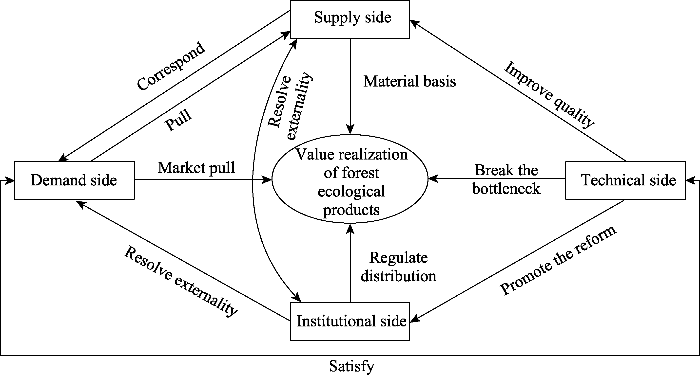
Analyzing the internal logic of the value realization of forest ecological products is crucial for promoting the implementation of the “Two Mountains” concept. Although domestic and foreign research has explored the definitions, connotations, and realization paths, existing reviews still face two limitations. On the one hand, there is a lack of systematic integration and comparison of the accounting methods, influencing factors, and practical cases related to value realization. On the other hand, they fail to fully demonstrate the latest progress and synergistic relationships in key dimensions such as innovation in accounting methods, the diversification of market-oriented paths, and the improvement of institutional systems. Therefore, this study systematically reviews the theoretical foundations and explores multidimensional prospects. By constructing a systematic analytical framework that includes connotation definition, knowledge mapping analysis, influencing factors, practical cases, and research prospects, this review summarizes research progress in standardizing accounting methods, collaborative pathways involving governmental and market mechanisms, and key influencing factors spanning the supply-side, demand-side, institutional, and technological dimensions. Furthermore, through a comparative analysis of typical domestic and international cases, this study reveals the potential for differentiated realization models and global synergy. Finally, for addressing current challenges, this study proposes future research directions from six dimensions, including the innovation of accounting methods, the diversification of market-oriented pathways, and the improvement of institutional systems, to resolve the “triple dilemma” of applying digital technology, enhancing the value chain, and facilitating participation in global ecological governance. This study not only provides an integrated analytical framework for deepening the theory of value realization of forest ecological products, thereby fostering dialogue between academic research and policy practice, but it also offers theoretical references and practical guidance for China to optimize ecological compensation mechanisms and enhance the value of forest ecosystem services during the 15th Five-Year Plan period.
NI Shihao , LIU Yuan , TONG Zhiyuan , XIAO Hui . Progress and Prospects on the Value Realization of Forest Ecological Products[J]. Journal of Resources and Ecology, 2026 , 17(1) : 40 -52 . DOI: 10.5814/j.issn.1674-764x.2026.01.004
Table 1 Mainstream classification methods of forest ecological products |
| Classification basis | Specific category | Core connotation | Typical examples |
|---|---|---|---|
| Functional attributes of ecological products | Material supply category | To supply the material needs of social production and life, the forest ecosystem’s primary service is the provision of tangible material items | Wood, forest by-products (such as rosin and tung oil), forest food (such as nuts and fungi) |
| Ecological regulation category | With maintaining the balance and stability of the ecosystem as its core function, these products play the roles of purifying the environment and regulating the climate through ecological process, and have significant positive externalities | Air purification, water conservation, climate regulation, carbon sequestration | |
| Protection support category | Taking ecosystem security as the core function and providing basic support for the realization of other ecological services is the key guarantee of ecosystem integrity | Soil conservation, agricultural protection, biodiversity conservation | |
| Cultural services category | With meeting the spiritual and cultural needs of human beings as the core function, these products rely on the forest ecological landscape and cultural connotation to provide experience, education and other services | Forest tourism and recreation, natural science education, ecological and cultural inheritance, health experience | |
| Marketability degree of ecological products | Pure public goods category | Value compensation is challenging to achieve through market mechanisms, as these products are wholly non-exclusive and non-competitive, so they need to be guaranteed by the government. There are some problems such as difficulty in value quantification and imperfect trading mechanisms | Biodiversity conservation, global soil and water conservation function, public welfare forest landscape |
| Quasi-public goods category | These products are limited, non-exclusive or non-competitive, have certain externalities, require the coordinated participation of “government + market” in supply, and have a moderate degree of marketization | Regional carbon sink, river basin water conservation, semi-public forest eco-tourism | |
| Business goods category (personal goods) | These products are completely exclusive and competitive, have a high degree of marketization, and have strong value measurability. They can realize value realization through market transactions, and the market leads resource allocation | Commercial timber, characteristic forest fruits, under-forest medicinal materials, forest tourism paid experience projects |
Table 2 Market-oriented path for the value realization of forest ecological products |
| Specific path | Corresponding ecological product type | Key elements |
|---|---|---|
| Carbon sink transactions | Regulating service forest ecological products | Core transformation: transform the forest carbon sequestration function into tradable “carbon sink assets”; Realization carrier: rely on the carbon emissions trading market value goal: realize the market-oriented realization of forest carbon sequestration value (Makkonen et al., 2015) |
| Understory economy | Supply service forest ecological products | Resource support: forest understory space resources; Core form: understory planting, breeding, and forest product processing value enhancement: realize the three-dimensional utilization of forest land, extend the industrial chain, and increase added value through intensive processing (Cubino et al., 2021; Zhou et al., 2022) |
| Ecotourism | Cultural service forest ecological products | Development content: ecological services such as forest landscape, natural rest, health care experience; Demand Orientation: meet the spiritual, cultural, and health needs of consumers; Positioning: the core path to realize cultural service products value (Phelan et al., 2020) |
| Eco-label product certification | Supply service forest ecological products | Core function: Strengthen the recognition of product ecological attributes through standardized certification value empowerment: enhance product market competitiveness and connect ecological value and economic value (Zhan et al., 2025) |
| Digital construction of equity trading platforms | Equity forest ecological products | Core carrier: equity trading platforms; Key support: digital reform improves transaction efficiency; Basic guarantee: clarify the ownership of property rights such as forest rights and runoff development rights (Xu and Kong, 2024) |
| Green finance and carbon finance instruments | All kinds of commercial forest ecological products | Service areas: cover forest ecological rights and interests, property rights and the whole process of forestry production core value: provide financial support and risk mitigation to form the endogenous driving force for value realization (Song and Du, 2024) |
Table 3 Non-market path for the value realization of forest ecological products |
| Path type | Specific path | Main participants | Key elements |
|---|---|---|---|
| Non-market-oriented value realization path for pure public goods | Transfer payments | Government | Investment institutional arrangements and policy tools, indirect value realization methods, with the fundamental purpose of ensuring social welfare (Merlo and Briales, 2000) |
| Government procurement | |||
| Ecological compensation | |||
| Public welfare funding support | |||
| Non-market-oriented value realization path for quasi-public goods | Industrialized operation of ecological capital | Government, market entities, social forces | “Government + market” multi-collaboration, government-market-social partner mechanisms, a complex where multiple mechanisms coexist, and multi-subject co-payment (Patterson and Coelho, 2009; Qiu et al., 2021) |
| Ecological indicator trading under government control |
Figure 1 Types of factors influencing the value realization of forest ecological products |
Table 4 Comparative study on the value realization of forest ecological products: China and international practices |
| Contrast dimension | Characteristics of foreign practices | Characteristics of practices in China |
|---|---|---|
| Clarity of property rights and tradability | Under the systems dominated by private forest tenure in countries such as Germany and the United States, forest owners enjoy relatively complete rights to income and the transfer of ecological services such as carbon sinks and water conservation | China implements a collective forest tenure system, where the ownership of forestland belongs to collectives and farmers hold contractual management rights. While safeguarding collective ownership, this “separation of three rights” model restricts the market-oriented circulation of ecological products |
| Allocation of powers and responsibilities among the government, the market and the community | The European Union adopts a multi-centered governance model, while Japan’s “Satoyama Initiative” takes community self-governance as its core, with the government providing framework support and the community taking the lead in ecological restoration and business decision-making | China is mainly dominated by vertical administration. The government sets assessment indicators (such as forest coverage rate) through systems like the Forest Chief System, while market and community participation play a mostly executive role |
| Market recognition of value accounting standards | International certification systems (such as FSC and PEFC) make the value of ecological products from different countries comparable and tradable through standardized methods (such as carbon sink measurements and ecological service assessments) and third-party audits | China has established the GEP accounting system and industry standards such as the “Technical Specifications for the Evaluation of Natural Resources (Forest) Assets”, but there is a problem of disconnection between administrative dominance and the market |
| Sources and allocation mechanisms of ecological compensation funds | This includes diversified funding channels, such as the “Satoyama Initiative” in Japan, which integrates payment for ecological services, brand premium, and tourism revenue. Germany achieves horizontal transfer payments through regional collaboration, with downstream cities compensating upstream forest areas. As key stakeholders in benefit distribution, communities directly share the gains | Fiscal transfer payments still dominate, and there are administrative losses in the distribution process |
Table 5 Prospects for the value realization of forest ecological products |
| Research direction | Core goal | Key initiatives |
|---|---|---|
| Innovation and standardization of accounting methods | Achieve “accurate, standardized and comparable” accounting | 1. Build a “sky-eye + earth-eye + human-eye” monitoring network with drones and simulation technologies; 2. Refine standards for forest ownership and unify cross-regional standards; 3. Integrate experimental economics and machine learning for non-use value accounting |
| Diversification and synergy of marketization paths | Establish a “government+market + online-offline” collaborative system | 1. Develop an “e-commerce + ecological products” model with blockchain; 2. Innovate “ecology + cultural tourism/health care” formats; 3. Build an international carbon sink trading market and cross-basin compensation mechanism |
| Improvement of institutional systems | Support value realization from pilot to full promotion | 1. Deepen collective forest tenure reform and integrate fragmented rights via a “forest ecological bank”; 2. Establish a forest farmer participatory value distribution mechanism; 3. Promote special legislation and multi-sector policy coordination |
| Research on differentiated realization modes | Explore context-adaptive paths | 1. Design paths by forest type (natural/plantation, public welfare/commercial); 2. Match strategies by scale (county/province/cross-regional); 3. Advance in stages by economic level |
| Global comparison and synergy | Integrate international experiences with Chinese characteristics | 1. Learn from international models (PES, eco-label) and innovate collective forest rights; 2. Explore cross-border carbon sink trading via the Belt and Road; 3. Establish cross-border watershed ecological compensation |
| Technology empowerment and intelligent management | Break value realization bottlenecks with digital technology | 1. Realize full process monitoring via IoT, satellite remote sensing and UAV; 2. Build a national digital transaction platform with big data and blockchain; 3. Develop traceability and carbon sink credit systems; 4. Use AI for dynamic ecological value assessment |
| [1] |
|
| [2] |
|
| [3] |
|
| [4] |
|
| [5] |
|
| [6] |
|
| [7] |
|
| [8] |
|
| [9] |
|
| [10] |
|
| [11] |
|
| [12] |
|
| [13] |
|
| [14] |
|
| [15] |
|
| [16] |
|
| [17] |
|
| [18] |
|
| [19] |
|
| [20] |
|
| [21] |
|
| [22] |
|
| [23] |
|
| [24] |
|
| [25] |
|
| [26] |
|
| [27] |
|
| [28] |
|
| [29] |
|
| [30] |
|
| [31] |
|
| [32] |
|
| [33] |
|
| [34] |
|
| [35] |
|
| [36] |
|
| [37] |
|
| [38] |
|
| [39] |
|
| [40] |
|
| [41] |
|
| [42] |
|
| [43] |
|
| [44] |
|
| [45] |
|
| [46] |
|
| [47] |
|
| [48] |
|
| [49] |
|
| [50] |
|
| [51] |
|
| [52] |
|
| [53] |
|
| [54] |
|
| [55] |
|
| [56] |
|
| [57] |
|
| [58] |
|
/
| 〈 |
|
〉 |