Journal of Resources and Ecology >
Management for Improved Soil Quality, Tree Diversity and Building Resilience in Panchase Protected Forest, Gandaki Province, Nepal
|
Shakti GURUNG, E-mail: shakti.gurung086@gmail.com |
Received date: 2025-05-04
Accepted date: 2025-12-06
Online published: 2026-02-02
Supported by
The Faculty Research Grant Tribhuvan University(TU-NPAR-078/79-ERG-02)
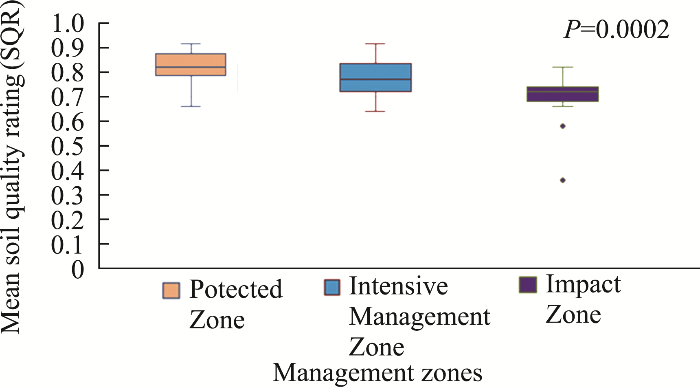
Forest ecosystem enhances environmental resilience by maintaining ecosystem stability and supporting natural processes. In Nepal, the rising temperature has exerted immense pressure on people’s livelihoods and ecosystems. In a forest, soil characteristics and tree diversity are the key components that enhance its resilience in response to various disturbances such as drought, fire, erosion, and landslides. However, the role of forest management in improving soil quality, fostering tree diversity, and building resilience is less investigated in Nepal. The present study aims to assess the role of forest management in soil quality, tree diversity, and building resilience. For this purpose, the soil quality was determined and soil quality rating (SQR) was computed across three management zones of the Panchase protected forest, using a semi-quantitative equation model. The observed tree richness was obtained from transect walk and tree counts around soil sample points. The community resilience adjoining the forest was assessed through participatory approach employing a scoring method. The results showed that SQR was higher in the Protected Zone (0.82) followed by the Intensive Management Zone (0.77) and the Impact Zone (0.69). The highly significant differences in SQR among the three management zones (P<0.001) and the highly significant difference in mean SQR between the Protected Zone and the Impact Zone (P<0.001) highlighted the role of forest management in fostering soil quality. The Protected Zone exhibited higher tree richness compared to the Intensive Management and the Impact Zones, suggesting the need for soil quality enhancement through management measures that also promote tree diversity. Furthermore, the community residing near the forest, which encompasses larger forest area demonstrated higher resilience score of 3.94 than the community residing relatively far, scoring 3.53. This suggests the contribution of forest ecosystem in building community resilience and recommends to strengthen agricultural diversity, agriculture innovation, and biodiversity-based livelihoods in community with low resilience score.
Key words: climate change; forest ecosystem; soil quality; tree diversity
Shakti GURUNG , Krishna Prasad POUDEL , WU Yanhong , Udhab Raj KHADKA . Management for Improved Soil Quality, Tree Diversity and Building Resilience in Panchase Protected Forest, Gandaki Province, Nepal[J]. Journal of Resources and Ecology, 2026 , 17(1) : 322 -334 . DOI: 10.5814/j.issn.1674-764x.2026.01.025
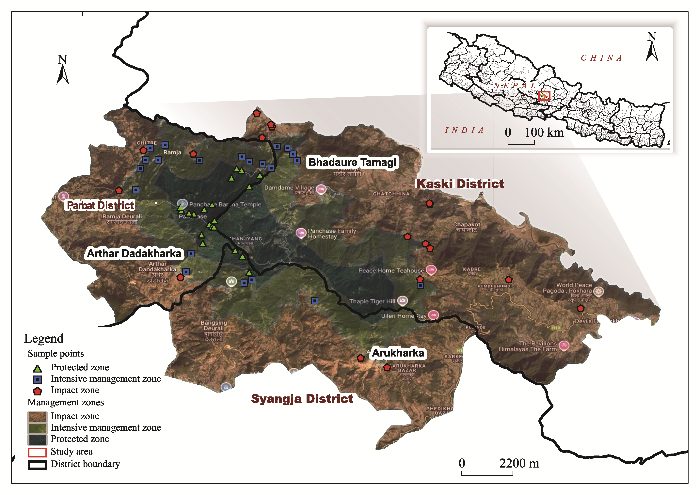
Figure 1 Panchase protected forest with three management zones and sample points |
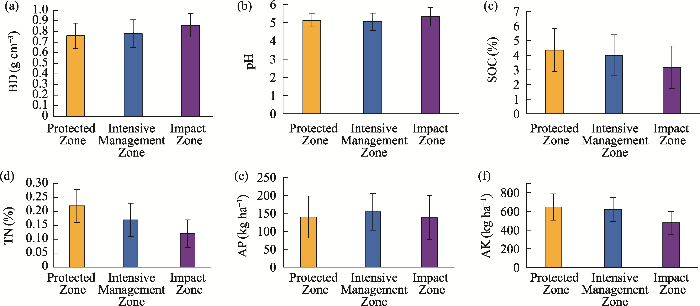
Figure 2 Average soil parameters in the three management zonesNote: a=BD, bulk density; b=pH; c=SOC, soil organic carbon; d=TN, total nitrogen; e=AP, available phosphorus; f=AK, available potassium. Error bars represent ± SD. |
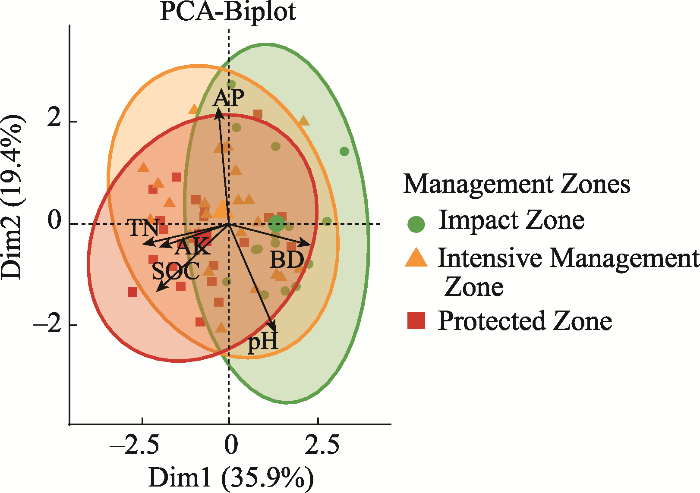
Figure 3 Principal Component Analysis (PCA) biplot of soil parameters with labeled vectors and grouped ellipses in three management zones |
Table 1 PCA loading score of six soil parameters |
| Soil parameters | PC1 | PC2 | PC3 | PC4 | PC5 | PC6 |
|---|---|---|---|---|---|---|
| BD (g cm-3) | 0.50 | -0.12 | 0.44 | 0.30 | -0.11 | -0.67 |
| pH | 0.29 | -0.61 | 0.09 | -0.62 | -0.34 | 0.17 |
| SOC (%) | -0.45 | -0.38 | 0.39 | -0.20 | 0.65 | -0.22 |
| TN (%) | -0.53 | -0.11 | -0.37 | -0.11 | -0.45 | -0.60 |
| AP (kg ha-1) | -0.07 | 0.66 | 0.43 | -0.58 | -0.13 | -0.13 |
| AK (kg ha-1) | -0.42 | -0.12 | 0.57 | 0.37 | -0.48 | 0.33 |
Table 2 Eigenvalue, percentage variance and cumulative percentage from PCA |
| Principal components | Eigenvalue | Variance (%) | Cumulative (%) |
|---|---|---|---|
| PC1 | 2.15 | 35.90 | 35.90 |
| PC2 | 1.17 | 19.43 | 55.33 |
| PC3 | 1.07 | 17.87 | 73.21 |
| PC4 | 0.79 | 13.15 | 86.36 |
| PC5 | 0.44 | 7.41 | 93.76 |
| PC6 | 0.37 | 6.24 | 100 |
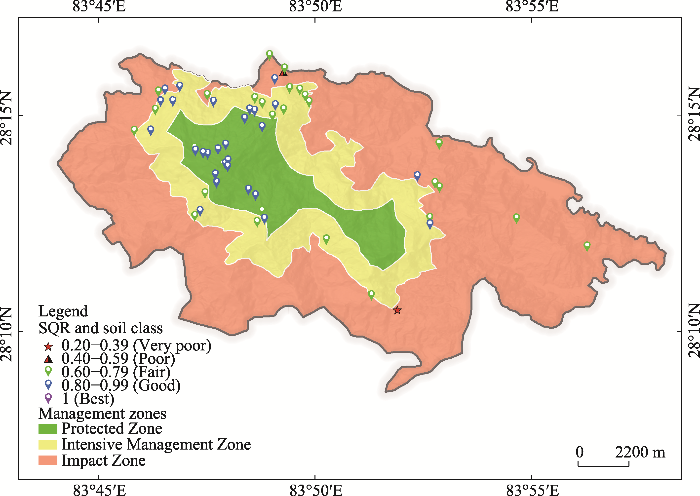
Figure 4 Soil quality rating (SQR) and soil class in three management zones |
Figure 5 Mean soil quality rating (SQR) in three management zones |
Table 3 Comparison of mean SQR in three management zones |
| Management zones | Mean difference | Lower CI (95%) | Upper CI (95%) | P-value | Significance at α=0.05 |
|---|---|---|---|---|---|
| Intensive Management zone vs. Impact Zone | 0.079 | 0.014 | 0.143 | 0.0133 | Significant |
| Protected Zone vs. Impact Zone | 0.122 | 0.056 | 0.187 | 0.0001 | Highly significant |
| Protected Zone vs. Intensive Management Zone | 0.043 | -0.015 | 0.101 | 0.1831 | Not significant |
Annex I List of tree species in three different management zones of Panchase protected forest |
| S.N. | Tree species | Management zones | ||
|---|---|---|---|---|
| Protected zone | Intensive management zone | Impact zone | ||
| 1 | Daphniphyllum himalense | ☑ | ☑ | ☑ |
| 2 | Schima wallichii | ☑ | ☑ | ☑ |
| 3 | Symplocos ramoissima | ☑ | ☑ | ☑ |
| 4 | Castanopsis tribuloids | ☑ | ||
| 5 | Quercus semicarpifolia | ☑ | ☑ | |
| 6 | Eurya cerasifolia | ☑ | ☑ | ☑ |
| 7 | Eurya acuminata | ☑ | ||
| 8 | Myrsine semiserrata | ☑ | ||
| 9 | Maesa macrophylla | ☑ | ☑ | |
| 10 | Rhododendron arboreum | ☑ | ☑ | ☑ |
| 11 | Michelia champaca | ☑ | ||
| 12 | Elaeagnus parvifolia | ☑ | ||
| 13 | Quercus glauca | ☑ | ||
| 14 | Quercus lamelossa | ☑ | ||
| 15 | Unknown sp1 | ☑ | ☑ | ☑ |
| 16 | Alnus nepalensis | ☑ | ☑ | ☑ |
| 17 | Prunus cerasoides | ☑ | ☑ | ☑ |
| 18 | Masea chisia | ☑ | ☑ | |
| 19 | Prunus cornuta | ☑ | ||
| 20 | Prunus nepaulensis | ☑ | ||
| 21 | Viburnum mullaha | ☑ | ||
| 22 | Ilex dipyrena | ☑ | ||
| 23 | Ficus neriifolia | ☑ | ☑ | ☑ |
| 24 | Viburnum erubescens | ☑ | ☑ | |
| 25 | Ficus auriculata | ☑ | ||
| 26 | Pinus wallichiana | ☑ | ||
| 27 | Maesa macrophylla | ☑ | ||
| 28 | Choerospondias axxilaris | ☑ | ||
| 29 | Macaranga pustulata | ☑ | ||
| 30 | Myrica esculenta | ☑ | ||
| 31 | Cyathea spinulosa | ☑ | ||
| 32 | Emblica officinalis | ☑ | ||
| 33 | Fraxinus floribunda | ☑ | ||
| 34 | Pinus roxburghii | ☑ | ||
| 35 | Albizia julibrissin | ☑ | ||
| 36 | Unknown sp2 | ☑ | ||
| 37 | Macaranga pustulata | ☑ | ||
| 38 | Engelhardia spicata | ☑ | ||
| 39 | Myrica esculenta | ☑ | ☑ | |
| 40 | Castanopsis indica | ☑ | ☑ | |
Table 4 Community resilience adjoining Panchase protected forest |
| Resilience elements | Community resilience score | ||
|---|---|---|---|
| Bhadaure Tamagi | Arther | Arukharka | |
| Ecosystem protection and biodiversity | 3.75 | 3.75 | 3.25 |
| Agriculture diversity | 4.00 | 3.50 | 3.50 |
| Knowledge learning innovation | 4.00 | 3.62 | 3.50 |
| Social infrastructure and livelihood | 4.00 | 3.87 | 3.87 |
| Average resilience score | 3.94 | 3.69 | 3.53 |
| [1] |
|
| [2] |
|
| [3] |
|
| [4] |
|
| [5] |
|
| [6] |
|
| [7] |
|
| [8] |
|
| [9] |
|
| [10] |
DFO (District Forest Office). 2016. Panchase Protected Forest Management Plan 2016: Protected Forest Program. Kaski, Nepal: District Forest Office. (in Nepali)
|
| [11] |
|
| [12] |
DoF (Department of Forest). 2012. Panchase Protection Forest Management Plan 2012. Department of Forest, Kathmandu, Nepal. https://www.researchgate.net/publication/353322544. (in Nepali)
|
| [13] |
FAO (Food and Agriculture Organization). 2019. Forests for resilience to natural, climate, and human-induced disasters and crises. Rome, Italy: Forestry Department, Food and Agriculture Organization.
|
| [14] |
|
| [15] |
|
| [16] |
|
| [17] |
|
| [18] |
|
| [19] |
|
| [20] |
|
| [21] |
|
| [22] |
|
| [23] |
IPCC (Intergovernmental Panel on Climate Change). 2019. Climate change and land: An IPCC special report on climate change, desertification, land degradation, sustainable land management, food security, and greenhouse gas fluxes in terrestrial ecosystems—Summary for policymakers. https://wedocs.unep.org/20.500.11822/29261.
|
| [24] |
IUCN (International Union for Conservation of Nature). 2021. Forests and climate change: Issues brief. https://www.iucn.org/resources/issues-briefs/forests-and-climate-change. Viewed on 2021-02-02.
|
| [25] |
|
| [26] |
|
| [27] |
|
| [28] |
|
| [29] |
|
| [30] |
|
| [31] |
|
| [32] |
|
| [33] |
|
| [34] |
|
| [35] |
|
| [36] |
|
| [37] |
MoALMC (Ministry of Agriculture Land Management and Cooperatives). 2017. Manual for soil and fertilizer analysis. Lalitpur, Nepal: Department of Agriculture of Nepal, Soil Management Directorate.
|
| [38] |
MoFSC (Ministry of Forest and Soil Conservation). 2017. Protected Forests of Nepal. Kathmandu, Nepal: Department of Forest, National Forest Division, https://www.researchgate.net/publication/326678917. (in Nepali).
|
| [39] |
NARC (Nepal Agriculture Research Council). 1993. Interpretation table for soil fertility. Lalitpur, Nepal: Nepal Agriculture Research Council.
|
| [40] |
|
| [41] |
|
| [42] |
|
| [43] |
|
| [44] |
|
| [45] |
|
| [46] |
|
| [47] |
|
| [48] |
|
| [49] |
|
| [50] |
|
| [51] |
|
| [52] |
|
| [53] |
|
| [54] |
|
| [55] |
UNDP (United Nation Development Program). 2022. Special report on human security. New York, USA. Retrieved from https://hdr.undp.org/content/2022-special-report-human-security
|
| [56] |
UNU-IAS (United Nations University-Institute of Advanced Studies). 2013. Indicators of resilience in socio-ecological production landscapes. Yokohama, Japan: United Nations University.
|
| [57] |
UNU-IAS (United Nations University-Institute of Advanced Studies), Biodiversity International, IGES (Institute for Global Environmental Strategies), UNDP (United Nation Development Program), 2014. Toolkits for Indicators of Resilience in Socio-Ecological Production Landscapes and Seascapes. Yokohama, Japan: United Nations University.
|
| [58] |
|
| [59] |
|
| [60] |
|
| [61] |
WWF (World Wildlife Fund). 2015. Study Report on Community and ecosystem resilience towards climate-induced disasters in Gandaki River Basin of Chitwan Annapurna Landscape. Kathmandu, Nepal: World Wildlife Fund.
|
| [62] |
|
| [63] |
|
| [64] |
|
| [65] |
|
/
| 〈 |
|
〉 |