Agricultural Ecosystem

The Impact of Digital Applications on Family Farm Income

  • XIAO Hui , 1, # ,
  • ZHANG Chenhan , 1, 2, # ,
  • LI Yingjiang , 1, 2, *
Expand
  • 1. School of Public Administration, Jiangxi University of Finance and Economics, Nanchang, 330013, China
  • 2. Institute of Ecological Civilization, Jiangxi University of Finance and Economics, Nanchang, 330013, China
* LI Yingjiang, E-mail:

#These authors contributed equally

XIAO Hui, E-mail: ;

ZHANG Chenhan, E-mail: .

Received date: 2025-10-23

  Accepted date: 2025-12-29

  Online published: 2026-02-02

Supported by

The National Social Science Fund of China(22VRC017)

The National Forestry and Grassland Administration of China, Monitoring of the Collective Forest Tenure Reform in Jiangxi Province(JYC-2025-0036)

The Early-Career Young Scientists and Technologists Project of Jiangxi Province(20252BEJ730131)

Abstract

The rapid development of the rural digital economy has emerged as a global phenomenon affecting both developed and developing countries, and China is no exception. Based on field survey data from 432 citrus family farms in Jiangxi Province in 2023, the mediating effect test and heterogeneity analysis are employed in this study to assess the impact of digital applications (DA) on family farm income (FFI). The results show that DA significantly increases FFI, with its enabling effect spanning the entire production chain from pre-production information acquisition to mid-production management and post-production marketing. Mechanism analysis indicates that DA enhances economic returns through three synergistic pathways: improving policy resource acquisition efficiency, promoting resource-efficient technology adoption, and expanding market sales channels. Heterogeneity analysis further shows that the income-enhancing effect of DA is more pronounced among farms with smaller scales, lower incomes, weaker social capital, and poorer infrastructure. These findings reflect inclusive “catch-up” and “substitution” effects, rather than the emergence of a digital divide. This study enriches the theoretical framework of digital agricultural empowerment and provides policy-relevant evidence for the formulation of targeted digital agriculture policies.

Cite this article

XIAO Hui , ZHANG Chenhan , LI Yingjiang . The Impact of Digital Applications on Family Farm Income[J]. Journal of Resources and Ecology, 2026 , 17(1) : 291 -308 . DOI: 10.5814/j.issn.1674-764x.2026.01.023

1 Introduction

As a pivotal force driving global economic and social change, the digital economy is reshaping value chains and ecosystems across all industries with unprecedented scope and intensity (Goldfarb and Tucker, 2019). As a foundational sector of the national economy, agriculture is undergoing a digital transformation that is not only a critical component of the “Digital China” initiative but also an inherent requirement for advancing the “Rural Revitalization” strategy, safeguarding national food security, and fostering common prosperity in rural areas. In recent years, digital technologies including the Internet of Things (IoT), big data, and artificial intelligence (AI) have rapidly penetrated the agricultural sector, spurring the emergence of new business formats and models such as smart agriculture and precision agriculture. These technologies are increasingly regarded as novel factors of production and key drivers of agricultural modernization, and they have fundamentally transformed the traditional modes of agricultural development (Klerkx et al., 2019; Li et al., 2024). Family farms serve as critical intermediaries between traditional smallholders and modern agricultural development, and they have assumed an increasingly prominent role within this wave of transformation. Relative to small-scale farmers, family farms are characterized by a moderate operational scale, specialized production, and stronger market orientation, positioning them as a backbone for adopting modern agricultural technologies and integrating into contemporary agricultural industrial systems (Wu et al., 2023). Nevertheless, family farms still confront multiple challenges in their development, including information asymmetry, risks associated with technology adoption, and limited market access (Janvry et al., 2017; Liu et al., 2021). Can digital applications such as IoT, big data, and e-commerce effectively alleviate these developmental bottlenecks and systematically improve farm performance and income levels? Through what underlying mechanisms and transmission channels do these effects operate? Is the digital dividend broadly inclusive, or does it instead exacerbate inequality due to heterogeneity in farm endowments and external environments? Providing rigorous answers to these questions is essential not only for evaluating the economic impacts of digital technologies in agriculture but also for informing targeted government policies and guiding new agricultural business entities, such as family farms, toward high-quality development.
The existing literature has extensively examined the impact of digitalization on agricultural business entities. At the macro level, digitalization is widely recognized as a pivotal driver of balanced urban-rural development and agricultural and rural development (Zhu et al., 2022). From a policy and institutional perspective, scholars have emphasized the need for adaptive agricultural policy reforms in the digital era, as well as the importance of building a sustainable digital agricultural ecosystem (Lajoie-O’Malley et al., 2020; Ehlers et al., 2021). At the micro level, research has focused on how digitalization reshapes the production and business practices of farms, as well as their economic performance. At the decision-making stage, digitalization has been found to facilitate a paradigm shift in farm management from experience- driven to data-driven approaches, thereby enhancing operational efficiency and managerial rigor (Klerkx et al., 2019; Rijswijk et al., 2021). Empirical studies have shown that digital decision-making tools improve the information environment and reduce decision-making uncertainty (Zscheischler et al., 2022). Moreover, the existing evidence suggests that digital adoption enhances the financial management capabilities and business acumen of farm owners by strengthening the linkage between production and market decisions, which is crucial for translating technological advantages into economic returns (Sørensen et al., 2010; Rosário et al., 2022).
At the production stage, digitalization affects the production methods and efficiency of agricultural business entities by improving the allocation of production factors. Technologies such as intelligent agricultural machinery, sensors, and data analytics can significantly enhance production efficiency and management quality in crop farming and animal husbandry (Rotz et al., 2019; Monteiro et al., 2021), thereby constituting key pathways toward smart agriculture (Karunathilake et al., 2023). Empirical evidence also demonstrates that precision agriculture technologies enhance technical efficiency and generate cost-saving and efficiency- improving effects (Aubert et al., 2012; DeLay et al., 2022). More recent studies indicate that DA can increase agricultural total factor productivity and foster more intensive patterns of agricultural growth (Li et al., 2024c; Wang et al., 2024). At the marketing stage, e-commerce is widely regarded as a critical channel for digital empowerment in agriculture. Research indicates that participation in e-commerce can significantly increase the income of farmers and enhance their developmental resilience, thereby serving as an effective channel for capturing digital dividends (Li et al., 2021; Li and He, 2024). In addition, digital marketing can strengthen brand image, accumulate intangible digital brand assets, and generate product price premiums (France et al., 2025).
Building on this literature background, this study extends the existing research along three core dimensions. First, at the theoretical level, this study develops a full-chain analytical framework for digital empowerment in agriculture. Existing studies typically treat DA as a holistic construct, so they fail to capture the heterogeneous effects of digitalization across different production stages. This study decomposes DA into pre-production information acquisition, mid- production management, and post-production marketing, and proposes an integrated “institutional alignment-technology adoption-market realization” framework that offers a new perspective on the systematic enabling logic of digitalization in agriculture. Second, at the mechanistic level, the study uncovers the synergistic transmission effects of multiple digital empowerment pathways. Prior research has often focused on individual mediating mechanisms in isolation, with limited attention to the interconnections among multiple pathways. This study empirically tests three core mediating pathways—policy resource acquisition efficiency, resource-efficient technology adoption, and market channel expansion—and their synergistic effects, thereby clarifying how digital technological advantages are translated into economic returns. Third, at the heterogeneity level, the study identifies both the catch-up and substitution effects of digitalization. Existing discussions of heterogeneity remain largely descriptive. This study further examines the economic logic through which digital capital interacts with heterogeneous farm endowments. By demonstrating that digitalization functions as a booster for latecomers and a substitute for resource-disadvantaged farms, this study provides robust empirical support for the inclusive innovation hypothesis and offers new evidence on whether digitalization mitigates the digital divide.

2 Theoretical analysis and hypotheses

2.1 Direct impact of digital applications (DA) on family farm income (FFI)

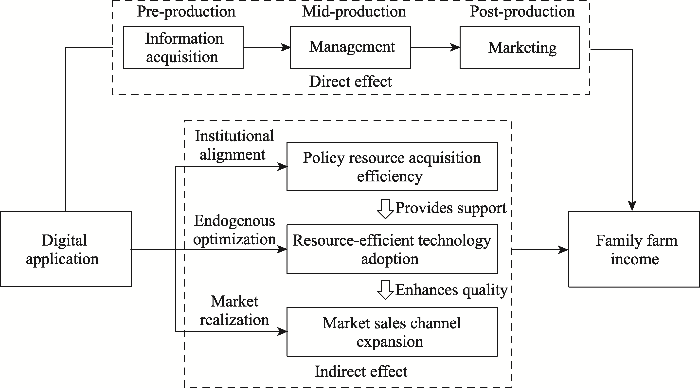
The direct impact of DA on FFI stems from their systematic integration into, and optimization of, the entire agricultural production and operation chain. By reshaping the flows of information, materials, and capital, DA systematically empowers pre-production information acquisition, mid-production management, and post-production marketing, thereby improving the overall economic performance of family farms (Lajoie-O’Malley et al., 2020).
First, at the pre-production information acquisition stage, DA facilitates more scientific decision-making by reducing information asymmetry. Traditional agricultural production relies heavily on individual experience and is therefore exposed to substantial market and natural risks. According to information economics theory, information asymmetry and incompleteness constitute primary sources of resource misallocation and market failure. By optimizing information transmission mechanisms, DA reduces the transaction costs associated with information acquisition. It also enhances the accuracy and timeliness of information, thereby enabling farm owners to access multidimensional information on markets, weather conditions, and production factors at low cost and high efficiency through digital platforms. This transformation facilitates a shift in decision-making from experience-dependent practices toward data-driven approaches (Klerkx et al., 2019). This shift is reflected in improved cropping structures, more precise input budgeting, and more effective risk management, thereby optimizing resource allocation at its source.
Second, at the mid-production management stage, DA promotes technological change and increases total factor productivity. Digital technologies such as the IoT and AI are driving a shift from extensive to intensive agricultural production, with a core focus on improving the allocation efficiency of key production factors (Monteiro et al., 2021). On the one hand, digital technologies enable precise regulation and intensive use of natural resources, particularly land. Intelligent equipment based on real-time data monitoring enables on-demand input applications, such as water, fertilizers, and pesticides, thereby increasing land productivity and improving resource-use efficiency (Karunathilake et al., 2023). On the other hand, digitalization induces capital deepening and technological substitution for labor. The adoption of automated and intelligent agricultural machinery significantly increases labor productivity. This effect is particularly pronounced in the context of rising rural labor costs, where cost reduction and efficiency enhancement are critical.
Finally, at the post-production marketing stage, digitalization reshapes market structures and enhances value realization. Due to high transaction costs, traditional agricultural product markets often place family farms, which are typically dispersed suppliers, at a bargaining disadvantage (Fafchamps and Minten, 2012). Through business models such as e-commerce and social media, digitalization has fundamentally altered this landscape. First, it enables short, or even zero-intermediary, channels that connect farms directly with consumers. By reducing transaction steps, these channels allow farm owners to implement flexible produce- to-order strategies and capture a larger share of value-chain returns (Li et al., 2021; Li et al., 2024b). Second, digitalization enhances product value added through information credentialing and brand building. Through mechanisms such as product traceability and online marketing, it alleviates the difficulty of securing price premiums for high-quality agricultural products. Greater information transparency and diversified sales channels ultimately strengthen the bargaining power of family farms within the value chain (France et al., 2025).
In summary, the systematic, full-chain empowerment enabled by DA across the pre-production, mid-production, and post-production stages directly contributes to family farm income growth through improved decision-making, higher efficiency, and expanded market access (Figure 1). Based on this analysis, the following research hypothesis is proposed:
Figure 1 Mechanism of the effect of DA on FFI
Hypothesis 1: DA has a significant positive effect on FFI, and this effect permeates the entire agricultural production and operation chain, encompassing pre-production information acquisition, mid-production management, and post- production marketing.

2.2 The mediating role of DA on FFI

2.2.1 Efficiency of policy resource acquisition

New institutional economics theory emphasizes that formal and informal institutions jointly constitute the institutional environment governing market operations, thereby profoundly shaping the behavior and performance of micro-level actors (North, 1990). In China, the government-led system of agricultural support policies, including technology promotion, financial subsidies, credit support, and agricultural insurance, constitutes an essential external resource that allows family farms to manage market risks and pursue sustainable development. However, in practice, the “policy information gap” caused by inadequate information channels and high transaction costs has severely undermined the effectiveness of these pro-farmer policies. Digital applications function as accelerators and amplifiers of policy information dissemination. First, digital applications improve the accessibility and timeliness of policy information. Digitalization overcomes the physical and temporal constraints inherent in traditional hierarchical modes of policy information delivery. Through diversified digital channels—such as government service platforms and social media—policy information can be delivered to farm households in a timely and targeted manner, significantly expanding policy coverage and improving information transmission efficiency (Zhu et al., 2022). Second, digital applications reduce the costs and barriers associated with accessing policy resources. Digital processes, such as online applications, can replace cumbersome offline procedures, thereby substantially reducing the time, travel, and communication costs incurred by family farms when seeking policy support (Gabriel and Gandorfer, 2023). Furthermore, streamlined digital platforms provide convenient channels for farm owners to obtain policy consultation, thereby mitigating the “threshold effect” resulting from information asymmetry (Yang et al., 2024). In summary, digitalization enhances the family farms’ capacity to utilize external institutional resources by expanding the reach of policy information and lowering the costs of accessing policy support. This enhanced capacity allows family farms to obtain critical productive inputs, such as technology and capital, thereby strengthening production capacity and risk resilience and ultimately translating into higher income levels (Ehlers et al., 2021). Based on this mechanism, the following research hypothesis is proposed:
Hypothesis 2: DA increases FFI by enhancing the efficiency of policy resource acquisition.

2.2.2 Adoption of resource-efficient technologies

The diffusion of innovations theory identifies the key factors shaping the adoption of new technologies by individuals, including relative advantage, compatibility, complexity, trialability, and observability (Rogers, 2003). For family farms, the adoption of resource-efficient technologies—such as water-saving irrigation, soil testing with formula fertilization, and green pest control—constitutes a key pathway for reducing costs, enhancing efficiency, and advancing green and sustainable development. However, technology adoption by farmers is not a purely economically rational decision but rather a complex process shaped by multiple constraints, including cognitive capacity, information access, risk perception, and social networks (Shang et al., 2021). DA effectively lowers the barriers to, and resistance against, the adoption of new technologies through multiple channels. First, DA alleviates information and cognitive barriers to technology adoption. Digital learning platforms overcome the temporal and spatial constraints of traditional technology training by providing farm owners with low-cost and high-efficiency access to relevant knowledge. This not only reduces the perceived complexity of new technologies but also enhances the farmers’ human capital and their capacity for technology adoption (Yang et al., 2024). In addition, successful cases shared within online communities increase the observability of these technologies (Peng et al., 2024). Second, DA mitigates perceived risk and facilitates social learning among farmers. Digital network platforms promote experience sharing and information verification among farmers. This social learning mechanism mitigates the perceived risk arising from uncertainty about technological effectiveness, thereby accelerating adoption decisions (Ahmad et al., 2024). Third, DA enhances the intrinsic value of new technologies. Digital tools are not merely information channels and they can be integrated with new technologies, thereby enhancing relative advantages and compatibility through data-driven integration. For example, integrating intelligent irrigation systems with weather-related big data can maximize the benefits of water-saving technologies (DeLay et al., 2022). In summary, digitalization promotes the adoption of resource-efficient technologies among family farms by reducing the cognitive, risk-related, and application barriers. Deeper technology adoption is reflected in lower production costs and improved resource allocation efficiency, which ultimately translates into higher FFI. Based on this mechanism, the following research hypothesis is proposed:
Hypothesis 3: DA increases FFI by promoting the adoption of resource-efficient technologies.

2.2.3 Expansion of market sales channels

The role of digitalization in expanding market channels is reflected not only in the emergence of new online channels, such as e-commerce, but more importantly in its capacity to enhance the conditions under which family farms connect with and utilize multiple market channels. This process can be understood as a reshaping of market embeddedness (Sun et al., 2023). Traditionally, farmers’ market activities have been deeply embedded in localized geographical spaces and social networks, resulting in highly constrained marketing options. Through information empowerment, digitalization allows farmers to disengage from localized market constraints and re-embed themselves within broader and more competitive markets (Goyal, 2010). This mechanism operates through three progressive levels. First, digitalization lowers information barriers and broadens available channel options. Digital platforms provide family farms with diversified market information, including procurement standards and purchase orders from high-value market channels (Zhang et al., 2025). Enhanced information transparency transforms farm owners from passive price takers into active market participants capable of making strategic channel choices. Second, digitalization enhances market access capacity and facilitates value chain upgrading. The adoption of digital management and traceability systems allows family farms to meet stringent high-end market standards for product standardization and safety, thereby facilitating access to more profitable sales channels and supporting value chain upgrading. Third, digitalization enhances bargaining power and strengthens the family farms’ positions in market transactions. With more comprehensive market information and diversified channel options, the bargaining positions of family farms in negotiations with channel providers are significantly strengthened, so they can secure more favorable transaction terms (Schulze et al., 2022). In summary, by promoting the diversification and upgrading of market channels, digitalization establishes a critical pathway through which family farms can translate production advantages into market advantages and, ultimately, economic gains. Based on this mechanism, the following research hypothesis is proposed:
Hypothesis 4: DA increases FFI by promoting the diversification of market sales channels.

3 Research design

3.1 Research area and data sources

Jiangxi Province (24°29'-30°04'N, 113°34'-118°28'E) is located in southeastern China, within the middle and lower reaches of the Yangtze River (Li et al., 2024a). It features a typical subtropical humid monsoon climate, with favorable natural endowments such as light, heat, water, and soil, providing a solid foundation for the development of the citrus industry. Within Jiangxi’s agricultural industrial structure, the citrus industry plays a central role, serving as a pillar of local agriculture and a key sector for promoting farmer income growth and rural revitalization. In recent years, along with the advancement of agricultural modernization and green development in Jiangxi Province, the citrus sector—which is an important characteristic industry—has exhibited relatively high levels of digital technology adoption, making it a suitable and representative case for analysis. Consequently, this study focuses on citrus family farms in Jiangxi Province as the primary research subject. By examining this representative region and characteristic industry, this study provides micro-level empirical evidence on the income-enhancing mechanisms of digital technologies for family farms.
The data used in this study were obtained from a field survey of citrus family farms in Jiangxi Province conducted by the research team in 2023. The structured questionnaire covered multiple dimensions, including economic, social, technological, and institutional characteristics. The questionnaire comprised six core modules: 1) basic characteristics of farm households and owners; 2) farm operations and production conditions; 3) citrus production inputs and outputs; 4) adoption of green production technologies; 5) digitalization and information acquisition; and 6) government and social services. To ensure data validity and representativeness, a stratified random sampling strategy was employed across northern, central, and southern Jiangxi. The survey covered multiple townships and administrative villages in cities such as Ganzhou, Ji’an, Fuzhou, Xinyu, and Shangrao. The field survey combined structured questionnaires with in-person interviews, and a total of 480 questionnaires were distributed. After excluding questionnaires with substantial amounts of missing information, logical inconsistencies, or incomplete responses, 432 valid observations were retained, yielding an effective response rate of 90% (Table1).
Table 1 Source and distribution of survey data
Survey region stratification Cities covered Questionnaires distributed (copies) Valid samples (copies) Effective recovery rate (%)
Northern Jiangxi Shangrao, Xinyu, Yichun 104 95 91.35
Central Jiangxi Ji’an, Fuzhou 62 53 85.48
Southern Jiangxi Ganzhou 314 284 90.45
Total 480 432 90.00

3.2 Variable specification

(1) Explained variable: Family farm income (FFI). Given the specialized nature of the research sample, annual income from citrus cultivation was adopted as the primary measure. This variable was calculated based on total citrus output and sales prices reported in the survey and directly reflects the core operating income of family farms.
(2) Core explanatory variable: Digital applications (DA). To progressively examine its impact on FFI, a basic proxy variable was used first: whether the household has internet access (Access). If the household has internet access, the value is 1; otherwise, it is 0. To more comprehensively capture the degree of farmers’ DA, and draw on existing research (Li et al., 2024c), this study further decomposed DA into three dimensions spanning the entire agricultural production process: pre-production information acquisition (D_pre), mid-production management (D_in), and post-production marketing (D_post). Specifically, pre-production information acquisition reflects the farmer’s ability to use digital channels to obtain information on production inputs. It was measured using the survey question “Do you obtain agriculture-related information via the internet?”, coded as 1 for “yes” and 0 for “no”. Mid-production management captures the depth of the farmer’s use of advanced digital technologies during production, based on the survey question “Do you use digital technologies such as the IoT, drones, or AI in production?”, coded as 1 for “yes” and 0 for “no”. Post-production marketing measures a farmer’s ability to sell products through digital platforms, based on the question “Do you sell agricultural products online?”, coded as 1 for “yes” and 0 for “no”.
(3) Mediating variables: To examine the underlying mechanisms through which DA affects FFI, this study selected three mediating variables based on theoretical considerations: efficiency of policy resource acquisition (Policy_ Access), adoption of resource-efficient technologies (Tech_ Adoption), and expansion of market sales channels (Market_Expansion) (Li et al., 2021; Wu et al., 2023; Wang et al., 2025b). First, policy resource acquisition efficiency was proxied by the survey question “How frequently do you consult government agricultural technicians about citrus production issues?” A higher frequency of contact indicates greater efficiency in accessing policy-related technical and institutional resources. Second, the adoption of resource-efficient technologies was measured by the proportion of cultivated area adopting such technologies relative to total planting area. A higher ratio indicates a greater degree of technology adoption. Third, the expansion of market sales channels was proxied by the survey question “Does the government provide sales information for citrus?” The governmental provision of such information indicates more open market information channels and a more favorable external environment for farmers to expand their sales channels.
(4) Control variables: To mitigate confounding effects and reduce omitted variable bias, this study included a set of control variables covering individual, household, farm-level, and village-level characteristics, following related studies (Wu, 2022; Wu et al., 2023). The farm owner’s age (Age) is a critical factor shaping production decisions, risk preferences, and technology adoption willingness. The farm owner’s education level (Education) serves as a core proxy for human capital—i.e., individuals with higher education typically possess stronger learning, information processing, and management capabilities. The farm owner’s years of experience in citrus cultivation (Experience) is a key determinant of citrus yield, quality, and consequently income. Household size (Family_Size) primarily shapes the family farm’s labor endowment. Citrus planting scale (Scale) is central to shaping agricultural production efficiency and total income, and also influences decisions regarding technology adoption and digital investment. Village traffic conditions (Traffic) represent a critical external factor affecting the transaction costs and market accessibility of agricultural products. The definitions and descriptive statistics for all variables are given in Table 2.
Table 2 Variable definitions and descriptive statistics
Variable type Variable name Variable symbol Variable description Mean Std. Dev.
Explained variable Family farm income FFI Citrus farming income (yuan, natural logarithm) 11.697 1.466
Core explanatory variables Internet access Access Whether connected to the internet 0.782 0.413
pre-production information acquisition D_pre Whether agricultural information acquired online (e.g., green tech, land protection) 0.681 0.467
Mid-production management D_in Whether digital technologies used in production (IoT, drones, AI, etc.) 0.463 0.499
Post-production marketing D_post Whether agricultural products sold online 0.600 0.491
Mediating
variables
Efficiency of policy resource acquisition Policy_Access Frequency of consulting government agricultural technology agents on citrus technologies (Scale of likelihood 1-5, higher=more frequent) 0.625 0.433
Adoption of resource-efficient technologies Tech_Adoption Ratio of area using resource-efficient technologies to total planted area 3.322 1.314
Expansion of market sales channel Market_Expansion Does the government provide citrus sales information? (Scale of likelihood 1-5, higher=better) 3.602 1.106
Control variables Farm owner’s age Age Age of farm owner (years) 49.347 7.814
Farm owner’s education Education Education level: 1=None; 2=Primary; 3=Junior high; 4=Senior high (vocational); 5=College and above 3.667 0.856
Farming experience Experience Years engaged in citrus cultivation (years) 14.315 8.700
Family size Family_Size Total number of people in the family farm 5.257 1.765
Citrus planting scale Scale Total area planted with citrus (Mu, 1 mu≈0.067 ha) 158.597 289.232
Village traffic conditions Traffic Village traffic conditions: 1=Very poor; 2=Poor; 3=Fair; 4=Good; 5=Very good 3.456 0.970

3.3 Model specification

3.3.1 Benchmark regression model

To test the impact of DA on FFI, this study constructed the following multiple linear regression model as the baseline model:
$FF{{I}_{i}}={{\alpha }_{0}}+{{\alpha }_{1}}D{{A}_{i}}+{{\alpha }_{2}}Contro{{l}_{i}}+{{\varepsilon }_{i}}$
In model (1), FFIᵢ is the explained variable, representing the annual income of the i-th family farm. DAᵢ is the core explanatory variable, representing the level of DA of the i-th family farm. In the initial test, the dummy variable “Internet access” was used as the measure. In the in-depth analysis, indicators for the pre-production, mid-production, and post-production dimensions were used separately. Controlᵢ represents a series of control variables that may affect FFI, including individual characteristics of the farm owner, household resources, farm operation characteristics, and the village environment. α0 is the constant term, α1 is the net effect of DA on FFI, and α2 is the coefficient vector for the control variables. εᵢ is the random error term, representing all unmodeled factors that may affect income.

3.3.2 Mediating effect model

To further examine the mechanisms through which DA affects FFI, and to test the mediating effects of the three pathways—policy resource acquisition efficiency, adoption of resource-efficient technologies, and expansion of market sales channels—this study adopted the three-step mediation testing procedure proposed by Baron and Kenny (1986). Building on model (1), the following models were constructed:
$Me{{d}_{i}}={{\beta }_{0}}+{{\beta }_{1}}D{{A}_{i}}+{{\beta }_{2}}Contro{{l}_{i}}+{{\varepsilon }_{i}}$
$FF{{I}_{i}}={{\delta }_{0}}+{{\delta }_{1}}D{{A}_{i}}+{{\delta }_{2}}Me{{d}_{i}}+{{\delta }_{3}}Contro{{l}_{i}}+{{\varepsilon }_{i}}$
In models (2) and (3), Medᵢ is the mediating variable, representing the efficiency of policy resource acquisition, adoption of resource-efficient technologies, or adoption of resource-efficient technologies of the i-th family. By regressing each of these three mediating variables in turn, the coefficient β1 measures the effect of DA on the mediating variable. The coefficient δ2 measures the effect of the mediating variable on FFI after controlling for DA. The coefficient δ1 measures the direct effect of DA on FFI after controlling for the mediating variable; and β0, β2, δ0, and δ3 are parameters to be estimated. The settings for the other variables are consistent with formula (1).

4 Results and analysis

4.1 Baseline regression

Table 3 reports the baseline regression results for the impact of DA on FFI. Column (1) shows that without control variables, the coefficient for Access is significantly positive at the 1% level. After controlling for characteristics at the individual, household, farm-level, and village-level, the coefficient for Access in column (2) remains significantly positive at the 5% level. These results provide preliminary evidence that DA can significantly increase FFI. Columns (3) to (5) further decompose DA into three dimensions—pre-production, mid-production, and post-production—to examine their respective effects on FFI. The results indicate that in all three stages DA exerts a statistically significant positive effect on income. Among the three dimensions, the effect on mid-production management is the largest, followed by pre-production information acquisition and post-production marketing. These results confirm that digital empowerment permeates the entire agricultural production chain, and thus, Research Hypothesis 1 is supported. Notably, the coefficient for farmer educational attainment is positive but not statistically significant. This counterintuitive result may be attributable to two factors. First, digital platforms provide low-cost learning channels, thereby diminishing the marginal returns to formal education. Second, educational attainment in the sample is concentrated between the junior high and high school levels (mean=3.667), so the limited variation will constrain the identification of statistically significant effects.
Table 3 Benchmark regression results
Variable FFI
(1) (2) (3) (4) (5)
Access 0.562*** 0.382**
(0.184) (0.150)
Age ‒0.016* ‒0.015 ‒0.012 ‒0.017*
(0.009) (0.009) (0.010) (0.010)
Education 0.095 0.091 0.075 0.062
(0.071) (0.071) (0.070) (0.071)
Experience 0.024*** 0.025*** 0.023*** 0.024***
(0.007) (0.007) (0.007) (0.007)
Family_size 0.060 0.065* 0.062* 0.057
(0.037) (0.037) (0.037) (0.037)
Scale 0.003*** 0.003*** 0.002*** 0.003***
(.001) (.001) (.001) (0.001)
Traffic 0.100 0.097 0.105* 0.113*
(0.064) (0.065) (0.064) (0.063)
D_pre 0.383***
(0.140)
D_in 0.374***
(0.115)
D_post 0.277**
(0.122)
_cons 11.258*** 10.437*** 10.398*** 10.454*** 10.695***
(0.168) (0.631) (0.630) (0.616) (0.624)
Observations 432 432 432 432 432
R2 0.025 0.307 0.310 0.311 0.304

Note: Robust standard errors are in parentheses. *, **, *** indicate P<0.1, P<0.05, P<0.01, respectively. The same applies to the tables below.

4.2 Robustness checks

To assess the robustness of the baseline regression results, this study conducted a series of robustness checks, with the results reported in Table 4. First, to isolate the scale effect and more precisely identify the impact of DA on production efficiency, this study replaced total income with average annual income per mu (Unit_income) as the dependent variable. Columns (1) to (4) show that whether considering overall internet access or stage-specific digital applications, the estimated coefficients remain statistically significant and positive, indicating that DA not only increases total income but also significantly enhances unit output efficiency. Second, to mitigate any potentially omitted variable bias, the model includes a proxy variable—participation in government technical training (Gov_Train)—to control for the farm owner’s personal ability and policy sensitivity. Columns (5) to (8) show that after controlling for this variable, the coefficients for the core explanatory variables remain significantly positive, suggesting that the income-enhancing effect of DA is not driven by the personal characteristics of farmers. Finally, to eliminate the influence of outliers, the regressions were re-estimated after excluding observations with annual incomes below 10000 yuan or above 1000000 yuan. Columns (9) to (12) show that after trimming the extreme values, the positive impacts of Access, D_in, and D_post remain significant. This indicates that for the vast majority of ordinary family farms, digitalization in production and marketing constitutes a stable channel for income growth. Notably, the coefficient of D_pre is no longer statistically significant in this specification, which may imply that for farms with non-extreme income levels, the value of information acquisition must be realized through subsequent production and marketing stages. In summary, all robustness checks support the core conclusion of this study: DA significantly increases FFI.
Table 4 Robustness test results
Variable Replace explanatory variables Add omitted variables Delete some samples
(1) (2) (3) (4) (5) (6) (7) (8) (9) (10) (11) (12)
Access 0.401*** 0.283* 0.255**
(0.106) (0.148) (0.125)
D_pre 0.266*** 0.277** 0.123
(0.093) (0.135) (0.108)
D_in 0.171* 0.296** 0.268***
(0.088) (0.115) (0.098)
D_post 0.360*** 0.207* 0.293***
(0.091) (0.121) (0.098)
Gov_Train 0.565*** 0.542*** 0.557*** 0.584***
(0.176) (0.172) (0.176) (0.177)
Control Yes Yes Yes Yes Yes Yes Yes Yes Yes Yes Yes Yes
Observations 432 432 432 432 432 432 432 432 399 399 399 399
R2 0.090 0.076 0.066 0.093 0.327 0.329 0.330 0.326 0.281 0.275 0.286 0.288

4.3 Endogeneity test

When identifying the impact of DA on FFI, this study addressed two primary sources of potential endogeneity: reverse causality and omitted variables. First, with respect to reverse causality, this issue is likely to be limited in the present context. The primary reason is that from a household decision-making perspective, internet access is a foundational digital infrastructure, so it is typically adopted to meet broad household needs, such as children’s education, daily convenience, information access, and social interaction. It functions as a quasi-public good within the household, involving a largely one-time investment with long-term use, so it is only weakly related to short-term fluctuations in citrus-specific income. From a temporal perspective, DA is typically a preemptive decision made prior to the current production cycle and exhibits the characteristics of a sunk cost, particularly for internet adoption and related hardware investments. As a result, current income realizations are unlikely to influence prior digital adoption decisions. In summary, the decision to adopt digital applications can be treated as relatively exogenous in this study, thereby mitigating any concerns about reverse causality.
To address potential endogeneity arising from omitted variables, this study followed Altonji et al. (2005) and calculated selection ratios (Ratio) to assess the influence of unobserved factors. First, two sets of models were constructed, each consisting of a restricted specification and a corresponding full specification. In the first set, the restricted specification includes only the core explanatory variable, while the full specification additionally controls for individual and household characteristics. In the second set, the restricted specification includes the core explanatory variable and household characteristics, whereas the full specification incorporates the complete set of control variables. Second, selection ratios were calculated separately for the two model sets. The calculation formula is as follows:
$R\text{atio}=\left| {{{{\hat{\beta }}}^{F}}}/{\left( {{{\hat{\beta }}}^{R}}-{{{\hat{\beta }}}^{F}} \right)}\; \right|$
Where ${{\hat{\beta }}^{F}}$ is the estimated coefficient of the explanatory variable in the restricted model, and ${{\hat{\beta }}^{F}}$ is the coefficient in the full model. A larger ratio indicates that the coefficient of interest is less sensitive to potential omitted variable bias. The results of the omitted variable bias assessment are reported in Table 5. For the core explanatory variable Access in models (1) and (2), the selection ratios are 2.649 and 3.381, respectively. This implies that the influence of unobserved factors would need to be at least 2.649 times as strong as that of the included controls to fully account for the estimated effect. Similarly, for the three disaggregated dimensions of pre-production, mid-production, and post-production, unobserved factors would need to exert effects at least 7.818, 1.806, and 2.084 times as large as those of the included controls, respectively, to threaten the validity of the estimates. Collectively, these findings provide strong evidence that the baseline regression estimates are robust to omitted variable bias.
Table 5 Test results for omitted variable bias
Variable (1) (2) (3) (4)
Constrained model 1 Full
model 1
Constrained model 2 Full
model 2
Constrained model 1 Full
model 1
Constrained model 2 Full
model 2
Access 0.562*** 0.488*** 0.495*** 0.382**
(0.184) (0.174) (0.176) (0.150)
D_pre 0.485*** 0.430*** 0.421*** 0.383***
(0.163) (0.155) (0.155) (0.140)
D_in
D_post
Household characteristics No Yes Yes Yes No Yes Yes Yes
Individual characteristics No Yes No Yes No Yes No Yes
Farm characteristics No No No Yes No No No Yes
Village characteristics No No No Yes No No No Yes
Ratio 6.595 3.381 7.818 10.079
Observations 432 432 432 432 432 432 432 432
Variable (5) (6) (7) (8)
Constrained model 1 Full
model 1
Constrained model 2 Full
model 2
Constrained model 1 Full
model 1
Constrained model 2 Full
model 2
Access
D_pre
D_in 0.683*** 0.581*** 0.581*** 0.374***
(0.137) (0.133) (0.133) (0.115)
D_post 0.441*** 0.298** 0.313** 0.277**
(0.146) (0.144) (0.145) (0.122)
Household characteristics No Yes Yes Yes No Yes Yes Yes
Individual characteristics No Yes No Yes No Yes No Yes
Farm characteristics No No No Yes No No No Yes
Village characteristics No No No Yes No No No Yes
Ratio 5.696 1.806 2.084 7.694
Observations 432 432 432 432 432 432 432 432

4.4 Mediation effect test

4.4.1 DA, efficiency of policy resource acquisition and FFI

Table 6 reports the mediating role of the efficiency of policy resource acquisition. Column (1) shows that the coefficient of Access on Policy_Access is positive and statistically significant at the 1% level. This result indicates that DA significantly enhances both the frequency and efficiency of communication between farmers and government agricultural technicians. In column (2), the coefficient of Policy_Access is significant at the 10% level, while the coefficient of Access decreases from 0.382 to 0.336 and remains significant at the 5% level. This pattern confirms that policy resource acquisition efficiency partially mediates the effect of DA on FFI. The magnitude of the mediating effect is approximately 0.424×0.109=0.046, accounting for about 12.0% of the total effect. Columns (3) through (8) further disaggregate this mediating pathway across the different stages of digital applications. The results in columns (4) and (6) show that when examining the income effects of D_pre and D_in through Policy_Access, the coefficient of the mediating variable Policy_Access is not statistically significant in the third step. This suggests that although pre-production and mid-production digital applications facilitate contact between farmers and government technicians, such increased interaction does not effectively translate into income gains. One likely explanation is that accessing information or adopting production technologies via the internet reduces the farmers’ reliance on traditional government extension services, or that the marginal returns to these digital applications already exceed those derived from consulting technicians. In column (8), the coefficient of the mediating variable Policy_Access is positive and statistically significant at the 10% level. This indicates that for farmers engaged in online sales, more frequent communication with government technicians significantly increases income. This may be because, at the marketing stage, farmers require not only production-related technical support but also policy information and guidance on market standards, brand development, and supply-demand matching areas, in which government agricultural extension services have a comparative advantage. Hypothesis 2 is therefore supported.
Table 6 DA, efficiency of policy resource acquisition, and FFI
Variable (1) (2) (3) (4) (5) (6) (7) (8)
Policy_Access FFI Policy_Access FFI Policy_Access FFI Policy_Access FFI
Access 0.424*** 0.336**
(0.135) (0.148)
D_pre 0.663*** 0.323**
(0.117) (0.137)
D_in 0.425*** 0.330***
(0.107) (0.115)
D_post 0.325*** 0.240*
(0.112) (0.123)
Policy_Access 0.109* 0.090 0.102 0.114*
(0.063) (0.063) (0.064) (0.064)
Control Yes Yes Yes Yes Yes Yes Yes Yes
Observations 432 432 432 432 432 432 432 432
R2 0.072 0.313 0.123 0.314 0.081 0.316 0.067 0.311

4.4.2 DA, adoption of resource-efficient technologies, and FFI

Table 7 examines the mediating role of the adoption of resource-efficient technologies. In column (1), the coefficient of Access is positive and statistically significant at the 1% level. In column (2), the coefficient of Tech_Adoption is significant at the 1% level, while the coefficient of Access declines and remains significant at the 5% level. This pattern suggests that the adoption of resource-efficient technologies partially mediates the impact of DA, with the magnitude of the mediating effect estimated at approximately 0.166×0.583=0.097, accounting for about 25.4% of the total effect. Furthermore, columns (3) to (8) examine this mediating pathway across the different dimensions of DA. The results show that digital applications in the pre-production, mid-production, and post-production stages all significantly promote technology adoption, which in turn serves as an effective channel for increasing FFI, indicating the broad applicability of this transmission mechanism. Hypothesis 3 is therefore supported.
Table 7 DA, adoption of resource-efficient technologies, and FFI
Variable (1) (2) (3) (4) (5) (6) (7) (8)
Tech_Adoption FFI Tech_Adoption FFI Tech_Adoption FFI Tech_Adoption FFI
Access 0.166*** 0.286**
(0.053) (0.145)
D_pre 0.175*** 0.283**
(0.046) (0.136)
D_in 0.18*** 0.272**
(0.042) (0.119)
D_post 0.113** 0.210*
(0.044) (0.123)
Tech_Adoption 0.583*** 0.568*** 0.565*** 0.597***
(0.144) (0.142) (0.148) (0.147)
Control Yes Yes Yes Yes Yes Yes Yes Yes
Observations 432 432 432 432 432 432 432 432
R2 0.075 0.335 0.085 0.336 0.089 0.336 0.066 0.333

4.4.3 DA, expansion of market sales channels, and FFI

Table 8 examines the mediating role of market sales channel expansion. In column (1), the coefficient of Access is positive and statistically significant at the 1% level. In column (2), the coefficient of Market_Expansion is significant at the 5% level, while the coefficient of Access declines but remains significant at the 5% level. These results indicate that expanding market sales channels constitutes an additional mediating pathway through which DA promotes farm income growth. The magnitude of the mediating effect is estimated at approximately 0.510×0.132=0.067, accounting for about 17.5% of the total effect. The disaggregated analysis in columns (3) through (8) shows that digital applications in the pre-production, mid-production, and post-production stages all increase farm income by expanding market sales channels, further confirming the robustness of this mediating pathway. Hypothesis 4 is therefore supported.
Table 8 DA, expansion of market sales channels, and FFI
Variable (1) (2) (3) (4) (5) (6) (7) (8)
Market_Expansion FFI Market_Expansion FFI Market_Expansion FFI Market_Expansion FFI
Access 0.510*** 0.315**
(0.15) (0.146)
D_pre 0.714*** 0.297**
(0.133) (0.130)
D_in 0.485*** 0.312***
(0.125) (0.113)
D_post 0.468*** 0.214*
(0.128) (0.122)
Market_Expansion 0.132** 0.120** 0.127** 0.134**
(0.058) (0.055) (0.057) (0.058)
Control YES YES YES YES YES YES YES YES
Observations 432 432 432 432 432 432 432 432
R2 0.122 0.319 0.159 0.320 0.128 0.322 0.126 0.317

4.5 Heterogeneity analysis

4.5.1 Heterogeneity in farm size

Given that family farms of different operating scales exhibit substantial heterogeneity in resource endowments, technological needs, market access capabilities, and digital transformation dynamics, the marginal income effect of DA is not likely to be uniform (Wang and Guo, 2025). Drawing on the classification standards of the Ministry of Agriculture and Rural Affairs and the characteristics of the sample data, this study defined farms with less than 50 mu of cultivated land as small-scale (Scale_S), those with 50-100 mu as medium-scale (Scale_M), and those with more than 100 mu as large-scale (Scale_L). Grouped regressions were conducted, and the results are reported in Table 9. The results indicate that for basic digital access and pre-production information acquisition, the income-enhancing effect of DA is most pronounced for small- and medium-sized farms, while the effect for large farms is weakened or statistically insignificant. This suggests that DA is critical for small- and medium-sized farms to overcome information constraints and improve decision-making quality, whereas for large farms the marginal income effect of DA is minimal because digitalization has already become a standard feature. As the mid-production management stage is reached, the income effect of digital technologies is insignificant across all scales. This phenomenon is likely attributable to several factors. First, the substantial upfront investment required is not balanced with the relatively low short-term return on investment. Second, general-purpose digital technologies are not compatible with the complex production traits of citrus. Third, localized technical support is inadequate. Collectively, these constraints impede the effective conversion of production efficiency gains into tangible net economic benefits. In the post-production marketing stage, the income effect of DA exhibits an inverted U-shaped pattern that peaks among medium-sized farms. This suggests that medium-sized farms have achieved an optimal balance between production scale and reliance on new marketing channels, thereby reaping the highest returns. In contrast, although large farms also benefit from digitalization, their established and stable offline sales channels render online sales largely supplementary, resulting in a diminished marginal income effect.
Table 9 Heterogeneity effects of farm size
Variable (1) (2) (3) (4) (5) (6) (7) (8) (9) (10) (11) (12)
Scale_S Scale_M Scale_L Scale_S Scale_M Scale_L Scale_S Scale_M Scale_L Scale_S Scale_M Scale_L
Access 0.648*** 0.522** 0.072
(0.200) (0.229) (0.166)
D_pre 0.616*** 0.409** -0.018
(0.181) (0.189) (0.145)
D_in 0.205 0.239 0.151
(0.180) (0.166) (0.150)
D_post 0.352** 0.467*** 0.278*
(0.169) (0.171) (0.164)
Control Yes Yes Yes Yes Yes Yes Yes Yes Yes Yes Yes Yes
Observations 136 126 170 136 126 170 136 126 170 136 126 170
R2 0.516 0.115 0.275 0.524 0.103 0.274 0.480 0.077 0.278 0.491 0.121 0.287

4.5.2 Heterogeneity in FFI

Family farms at different income levels differ in their capital endowments, risk tolerance, and stages of development, which may generate heterogeneous income effects of DA (Tian et al., 2022). Accordingly, this study adopted an annual FFI threshold of 100000 yuan to divide the sample into low-to-moderate-income farms (Income_L, ≤100000 yuan) and high-income farms (Income_H, >100000 yuan) for grouped regressions, with the results reported in Table 10. The results indicate that for low-to-moderate-income farms, the income-enhancing effect of DA is positive and statistically significant across all dimensions. This implies that for farms at early stages of development, accessing information via the Internet, adopting digital production technologies, and expanding online sales channels all serve as effective means for overcoming operational bottlenecks and achieving income growth. DA therefore plays a crucial role in enabling income catch-up among lower-income farms. By contrast, the income effect of DA for high-income farms is relatively limited. In columns (2) and (4) of Table 10, the coefficients of Internet access and pre-production information acquisition remain statistically significant, indicating that basic digital access and information utilization are still necessary for maintaining existing business advantages. However, in columns (6) and (8), the coefficients of mid- production management and post-production marketing are not statistically significant. This may reflect the fact that high-income farms have already established mature and efficient production systems and stable offline sales channels, resulting in diminishing marginal returns from adopting additional digital technologies or opening new online channels. In summary, the impact of DA on FFI exhibits clear threshold and catch-up effects. Its income-enhancing role is substantially stronger for low-to-moderate-income farms than for high-income farms, making DA an important instrument for promoting inclusive income growth and development among lower-income farmers.
Table 10 Heterogeneity effects of household farm income
Variable (1) (2) (3) (4) (5) (6) (7) (8)
Income_L Income_H Income_L Income_H Income_L Income_H Income_L Income_H
Access 0.345* 0.427**
(0.209) (0.207)
D_pre 0.450** 0.315*
(0.193) (0.185)
D_in 0.437*** 0.249
(0.154) (0.173)
D_post 0.353** 0.206
(0.162) (0.172)
Control Yes Yes Yes Yes Yes Yes Yes Yes
Observations 197 235 197 235 197 235 197 235
R2 0.338 0.351 0.349 0.347 0.350 0.343 0.343 0.342

4.5.3 Heterogeneity in social capital

Social capital is an important informal institutional resource that interacts with digitalization primarily by shaping the farmers’ access to information, technology adoption, and market transactions (Cui and Liu, 2024). This study used the median level of household expenditure on social obligations (8000 yuan) as a threshold to divide the sample into low-social-capital households (SC_L, <8000 yuan) and high-social-capital households (SC_H, ≥8000 yuan), and then examined the heterogeneous effects of DA, with the results reported in Table 11. For farms with low levels of social capital, DA plays a key substitutive role. As shown in columns (1), (3), (5), and (7), the coefficients for all dimensions of DA are positive and statistically significant. This indicates that in the absence of strong personal networks, DA serves as an effective alternative channel through which farmers can access technology and connect with markets, thereby overcoming network constraints and compensating for resource disadvantages. For farms endowed with high levels of social capital, DA exhibits a significant complementary effect. Columns (4) and (6) show that the effects of DA in pre-production information acquisition and mid-production management remain positive and statistically significant, suggesting that farmers with high social capital can leverage their existing networks to verify and apply digital information, thereby converting digital resources into productivity more efficiently. However, columns (2) and (8) show that the coefficients of basic Internet access and post- production marketing are not statistically significant. This may reflect the fact that strong offline networks already provide sufficient information and sales channels, rendering the marginal contribution of DA less pronounced. In summary, DA exerts a pronounced substitution effect for farms with weak social capital and serves as an important mechanism for overcoming resource disadvantages. For farms with strong social capital, DA plays a more complementary role, particularly in knowledge acquisition and technology application.
Table 11 Heterogeneity effects of social capital
Variable (1) (2) (3) (4) (5) (6) (7) (8)
SC_L SC_H SC_L SC_H SC_L SC_H SC_L SC_H
Access 0.540** 0.279
(0.215) (0.204)
D_pre 0.341* 0.434**
(0.194) (0.190)
D_in 0.506*** 0.327**
(0.163) (0.161)
D_post 0.329* 0.258
(0.176) (0.166)
Control Yes Yes Yes Yes Yes Yes Yes Yes
Observations 204 228 204 228 204 228 204 228
R2 0.384 0.298 0.372 0.311 0.388 0.303 0.372 0.299

4.5.4 Heterogeneity in village infrastructure levels

Village infrastructure, particularly transportation, serves as the physical foundation for agricultural production and the circulation of agricultural products. The level of its development directly determines whether the benefits of digitalization can be effectively realized. This study classified villages that responded “very good” or “good” to the village traffic condition survey item into the good infrastructure group (Traffic_G), and the rest into the poor infrastructure group (Traffic_P). Grouped regressions were conducted, with the results shown in Table 12. The findings indicate that the income-enhancing effect of digital applications (DA) is more pronounced in areas with relatively poor infrastructure, where it serves as timely support. Within the poor infrastructure group, all dimensions of DA exhibit statistically significant positive effects, with the effects of mid-production management and post-production marketing being particularly pronounced. This suggests that in areas with inadequate transportation infrastructure, DA can effectively overcome geographical constraints: digital production technologies improve efficiency to offset higher transportation costs, while e-commerce platforms attract buyers capable of mitigating logistics challenges. Conversely, in the good infrastructure group, most income-enhancing effects of DA are not statistically significant. When transportation is convenient and offline transaction costs are low, the marginal benefits from basic internet access and online marketing are relatively limited, yielding statistically insignificant coefficients. In this context, the role of digitalization is more apparent in specific aspects, such as knowledge updating and technological upgrading, rather than in driving a comprehensive increase in income. In summary, digital development holds greater practical significance and policy relevance for increasing the income of farms in areas with weak infrastructure, where it serves as an effective pathway for overcoming geographical barriers and facilitating development.
Table 12 Heterogeneity effects of village infrastructure level
Variable (1) (2) (3) (4) (5) (6) (7) (8)
Traffic_P Traffic_G Traffic_P Traffic_G Traffic_P Traffic_G Traffic_P Traffic_G
Access 0.435** 0.345
(0.194) (0.249)
D_pre 0.398** 0.419*
(0.176) (0.248)
D_in 0.468*** 0.343*
(0.157) (0.174)
D_post 0.476*** 0.065
(0.157) (0.197)
Control Yes Yes Yes Yes Yes Yes Yes Yes
Observations 238 194 238 194 238 194 238 194
R2 0.253 0.366 0.253 0.372 0.261 0.370 0.262 0.359

5 Discussion

This study systematically investigated the impact, underlying mechanisms, and heterogeneous effects of DA on FFI. It provides micro-level evidence from China’s citrus industry, offering insights into how digital technologies can empower emerging types of agricultural enterprises. The findings not only corroborate the existing literature but also systematically deconstruct the enabling effects that span the entire production chain. It identifies a tripartite synergistic mechanism of “institution-technology-market” and delineates its inclusive boundaries and catch-up effect, thereby offering valuable extensions to existing research.
First, DA was shown to significantly increase FFI, with its enabling effects extending across the pre-production, mid-production, and post-production stages. Evidently, both basic Internet access and specific digital applications in pre-production information acquisition, mid-production management, and post-production marketing significantly enhance FFI. This core finding aligns with the mainstream view in the literature. For instance, Zhu et al. (2022) demonstrated that information and communication technology effectively promotes rural household income growth in China and narrows the urban-rural income gap. A recent study by Li et al. (2024c) also confirmed that Internet use enhances grain production by improving technical and resource allocation efficiency. This study contributes by deconstructing the broad concept of DA into three dimensions that encompass the entire production and operational process. This approach provides a more integrated and comprehensive perspective compared with previous studies that focused on a single aspect, such as e-commerce or precision agriculture (Li et al., 2021; DeLay et al., 2022). Specifically, pre-production information acquisition highlights the foundational value of information in agricultural decision-making—that is, optimizing the information environment constitutes the first step toward risk reduction and improved resource allocation, which is consistent with the discussion by Zscheischler et al. (2022) on digital tools reducing decision-making risk. The application of digital technologies during the production stage directly aligns with the consensus that smart and precision agriculture can enhance production efficiency. The findings from this study provide empirical support from citrus, a key cash crop, for the review-based perspectives presented by Klerkx et al. (2019) and Monteiro et al. (2021). By reshaping market linkages and fostering value creation, post-production digital marketing serves as a pivotal mechanism for income enhancement. This effect is evident not only in e-commerce increasing farm sales by shortening supply chains (Li and He, 2024), but more importantly, in the capacity of digital tools to build brand equity and enhance product value, thereby realizing the principle of “high quality, high price” (France et al., 2025).
Second, DA operates through a synergistic mechanism of “policy alignment, technology adoption, and market realization”, revealing an integrated enabling logic of “institution-technology-market”. By examining these three mediating pathways, this study deepens our understanding of how DA enhances FFI. Whereas previous research often focused on a single mechanism, this study constructed a more complete and coherent causal chain. Regarding policy alignment, this study found that digitalization facilitates effective connections between farmers and government public services, echoing Kitole et al. (2024), who demonstrated how digital platforms expand the reach of agricultural policies. Digital tools have become a crucial bridge covering the last-mile gap in policy implementation. Regarding technology adoption, this study confirms that DA significantly lowers barriers to the adoption of new technologies and promotes the diffusion of green and efficient practices. This provides empirical support for the role of digital tools in facilitating the transition to sustainable practices, as proposed by Sun et al. (2024). In addition, DA facilitates adoption through mechanisms of social learning and risk mitigation (Shang et al., 2021). Concerning market realization, DA helps farms achieve value appreciation by expanding sales channels and upgrading the value chain. By directly facing consumers, farms can better capture market signals and develop brands, thereby transforming from mere producers to integrated “production-marketing” entities. This is consistent with the view of Patil et al. (2025) on how digital platforms empower agricultural producers.
Third, the heterogeneity analysis indicated that DA demonstrates significant features of “inclusive innovation”, offering new evidence for mitigating “digital inequality” (Hong et al., 2024). This study found that DA functions as a booster for late adopters and as a substitute for resource-disadvantaged farmers. Specifically, the pronounced income-enhancing effect observed in small-scale and low-to-middle-income farms illustrates a clear catch-up effect. For small farms, DA is pivotal in overcoming information barriers and optimizing decision-making, whereas its marginal utility diminishes for larger farms. This finding challenges the pessimistic perspective that digital technologies inevitably exacerbate the Matthew Effect (Wang et al., 2025a). Instead, it suggests that digitalization functions as an inclusive instrument that allows marginalized groups to overcome developmental bottlenecks, which is consistent with findings that mobile technologies confer greater marginal benefits on smallholders (Fabregas et al., 2019). Furthermore, the results underscore a critical substitution effect concerning social capital and infrastructure. For farms with limited social capital, online networks serve as substitute channels for accessing information, thereby compensating for deficiencies in offline connections. Similarly, in regions with inadequate physical infrastructure, digital connectivity effectively leapfrogs geographical barriers, yielding higher marginal returns than in regions with sound infrastructure. Collectively, these findings indicate that digital capital can serve as a substitute for traditional endowment deficiencies (Salemink et al., 2017). By enabling resource-constrained entities to bypass their physical and social limitations, digitalization helps to narrow economic disparities, providing a pathway toward coordinated regional development and shared prosperity (Aker and Mbiti, 2010).
Despite these findings, several avenues for further research remain. First, constrained by the survey data, the measurement of some variables relied on proxy indicators, such as the efficiency of policy resource acquisition (Policy_ Access) and the expansion of market channels (Market_ Expansion). Future studies should refine the survey design to collect more direct and precise metrics. Second, although this study deconstructed the measurement of DA multidimensionally, it could be further refined to more accurately capture its impact—for example, by transitioning from whether usage occurs to the intensity and quality of use. In addition, this study employed cross-sectional data, but future research should utilize panel data to more accurately identify long-term dynamic causal effects. Finally, the external validity of these research findings should be verified through comparative studies across diverse regions and crop types.

6 Conclusions and implications

6.1 Conclusions

Based on field survey data from 432 citrus family farms in Jiangxi Province, this study systematically analyzed the impact, mechanisms, and heterogeneous effects of DA on FFI, yielding three core conclusions.
First, DA constitutes a critical driver of FFI, functioning as a novel production factor that spans the entire farming operation. The empirical results confirmed robust positive effects across pre-production, mid-production, and post-production stages, effectively enhancing economic performance through optimized resource allocation and improved decision-making.
Second, DA transforms technological advantages into economic gains via a synergistic “institution-technology- market” mechanism. It empowers farms by enhancing access to policy support, reducing barriers to green technology adoption, and expanding market channels, thereby establishing an integrated value chain.
Third, DA demonstrates significant inclusive characteristics, functioning as a booster for late adopters and as a substitute for resource-disadvantaged farmers. The income-enhancing effect is more pronounced among small-scale, low-income farms and those located in remote areas, confirming that digitalization helps mitigate the digital divide through both catch-up and substitution effects.

6.2 Policy implications

Based on the above conclusions, and to better harness the role of digital technologies in promoting the high-quality development of family farms and advancing comprehensive rural revitalization, this study proposes three policy recommendations.
First, optimize the precise allocation of digital resources to harness the substitution and catch-up effects for farms with disadvantaged endowments. Efforts should focus on addressing the shortcomings of rural digital infrastructure, increasing investment in new digital infrastructure in areas with limited accessibility, and enhancing the rural digital public service system to alleviate resource constraints through digital solutions. Meanwhile, implement targeted support policies based on heterogeneous endowments, establish a dedicated fund for the digital transformation of family farms, and reduce the initial investment burden of disadvantaged groups in acquiring intelligent equipment and subscribing to services through subsidies, service incentives, and other measures. This will ensure the equitable distribution of digital dividends among farms of varying scales, thus providing institutional support to narrow the rural income gap.
Second, establish a hierarchical and stratified digital literacy development mechanism to link the pathways of institutional alignment, technology adoption, and market monetization. Differentiated training should be provided for farm owners with diverse endowments. Regarding institutional alignment, enhance their capacity to access policies and public resources via digital channels; regarding technology adoption, promote low-threshold, user-friendly green production and management tools to reduce operational costs and learning risks; regarding market monetization, reinforce practical training in e-commerce and social media marketing. This will encourage farm owners to transition from passive adoption to active management by employing a digital mindset to optimize resource allocation and effectively transform technological advantages into economic gains.
Third, promote the end-to-end digital transformation of agriculture and establish a multi-stakeholder collaborative empowerment ecosystem. Emphasis should be placed on end-to-end synergy, in which an open and shared agricultural big data platform should be established and enhanced to dismantle information barriers among the government, enterprises, and farmers, thereby providing precise decision support for family farms. Simultaneously, encourage technology firms to develop targeted solutions through incentive measures, promote the deep integration of the production, management, and marketing processes, and enhance resource allocation efficiency. By guiding family farms to integrate deeply into the modern agricultural value chain, this approach will systematically harness digitalization as a novel production factor to enhance operational performance and support comprehensive rural revitalization.
[1]
Ahmad B, Zhao Z, Jile X, et al. 2024. Exploring the influence of internet technology adoption on the technical efficiency of food production: Insight from wheat farmers. Frontiers in Sustainable Food Systems, 8. DOI: 10.3389/fsufs.2024.1385935.

[2]
Aker J C, Mbiti I M. 2010. Mobile phones and economic development in Africa. Journal of Economic Perspectives, 24(3): 207-232.

[3]
Altonji J G, Elder T E, Taber C R. 2005. Selection on observed and unobserved variables: Assessing the effectiveness of Catholic schools. Journal of Political Economy, 113(1): 151-184.

DOI

[4]
Aubert B A, Schroeder A, Grimaudo J. 2012. IT as enabler of sustainable farming: An empirical analysis of farmers’ adoption decision of precision agriculture technology. Decision Support Systems, 54(1): 510-520.

DOI

[5]
Baron R M, Kenny D A. 1986. The moderator-mediator variable distinction in social psychological research: Conceptual, strategic, and statistical considerations. Journal of Personality and Social Psychology, 51(6): 1173-1182.

DOI PMID

[6]
Cui B Y, Liu T. 2024. The impact of joining cooperatives on the moderate-scale operation of family farms. Research on Financial and Economic Issues, (1): 101-114. (in Chinese)

[7]
DeLay N D, Thompson N M, Mintert J R. 2022. Precision agriculture technology adoption and technical efficiency. Journal of Agricultural Economics, 73(1): 195-219.

DOI

[8]
Ehlers M-H, Huber R, Finger R. 2021. Agricultural policy in the era of digitalisation. Food Policy, 100: 102019. DOI: 10.1016/j.foodpol.2020.102019.

[9]
Fabregas R, Kremer M, Schilbach F. 2019. Realizing the potential of digital development: The case of agricultural advice. Science, 366(6471): eaay3038. DOI: 10.1126/science.aay3038.

[10]
Fafchamps M, Minten B. 2012. Impact of SMS-based agricultural information on Indian farmers. The World Bank Economic Review, 26(3): 383-414.

DOI

[11]
France S L, Davcik N S, Kazandjian B J. 2025. Digital brand equity: The concept, antecedents, measurement, and future development. Journal of Business Research, 192: 115273. DOI: 10.1016/j.jbusres.2025.115273.

[12]
Gabriel A, Gandorfer M. 2023. Adoption of digital technologies in agriculture—An inventory in a European small-scale farming region. Precision Agriculture, 24(1): 68-91.

DOI

[13]
Goldfarb A, Tucker C. 2019. Digital economics. Journal of Economic Literature, 57(1): 3-43.

DOI

[14]
Goyal A. 2010. Information, direct access to farmers, and rural market performance in central India. American Economic Journal: Applied Economics, 2(3): 22-45.

DOI

[15]
Hong X N, Chen Q H, Man D L, et al. 2024. The impact of digitalization on the rich and the poor: Digital divide or digital inclusion? Technology in Society, 78: 102634. DOI: 10.1016/j.techsoc.2024.102634.

[16]
Janvry A D, Macours K, Sadoulet E. 2017. Learning for adopting: Technology adoption in developing country agriculture. FERDI. https://hal.science/hal-01532384.

[17]
Karunathilake E M B M, Le A T, Heo S, et al. 2023. The path to smart farming: Innovations and opportunities in precision agriculture. Agriculture, 13(8): 1593. DOI: 10.3390/agriculture13081593.

[18]
Kitole F A, Mkuna E, Sesabo J K. 2024. Digitalization and agricultural transformation in developing countries: Empirical evidence from Tanzania agriculture sector. Smart Agricultural Technology, 7: 100379. DOI: 10.1016/j.atech.2023.100379.

[19]
Klerkx L, Jakku E, Labarthe P. 2019. A review of social science on digital agriculture, smart farming and agriculture 4.0: New contributions and a future research agenda. NJAS-Wageningen Journal of Life Sciences, 90-91: 100315. DOI: 10.1016/j.njas.2019.100315.

[20]
Lajoie-O’Malley A, Bronson K, van der Burg S, et al. 2020. The future(s) of digital agriculture and sustainable food systems: An analysis of high-level policy documents. Ecosystem Services, 45: 101183. DOI: 10.1016/j.ecoser.2020.101183.

[21]
Li S K, Tu B, Zhang Z, et al. 2024a. Exploring new methods for assessing landscape ecological risk in key basin. Journal of Cleaner Production, 461: 142633. DOI: 10.1016/j.jclepro.2024.142633.

[22]
Li W, He W W. 2024. Revenue-increasing effect of rural e-commerce: A perspective of farmers’ market integration and employment growth. Economic Analysis and Policy, 81: 482-493.

DOI

[23]
Li X K, Guo H D, Jin S Q, et al. 2021. Do farmers gain internet dividends from e-commerce adoption? Evidence from China. Food Policy, 101: 102024. DOI: 10.1016/j.foodpol.2021.102024.

[24]
Li X J, Li Y H, Chen Z. 2024b. Impact of rural e-commerce participation on farmers’ household development resilience: Evidence from 1229 farmers in China. Agriculture, 14(5): 692. DOI: 10.3390/agriculture14050692.

[25]
Li X H, Xiong H, Hao J H, et al. 2024c. Impacts of internet access and use on grain productivity: Evidence from central China. Humanities and Social Sciences Communications, 11(1): 90. DOI: 10.1057/s41599-023-02546-5.

[26]
Liu C, Zhang X Y, Wang S Y. 2021. Deviation analysis of the willingness and application behavior of water-saving irrigation technology in family farms. Journal of Agro-Forestry Economics and Management, 20(3): 295-304.. (in Chinese)

[27]
Monteiro A, Santos S, Gonçalves P. 2021. Precision agriculture for crop and livestock farming—Brief review. Animals, 11(8): 2345. DOI: 10.3390/ani11082345.

[28]
North D C. 1990. Institutions, institutional change and economic performance. Cambridge, UK: Cambridge University Press.

[29]
Patil K T, Patil S, Patil H, et al. 2025. Digital agriculture platforms: Empowering farmers and enhancing market accessibility. 2025 International Conference on Pervasive Computational Technologies (ICPCT), Greater Noida, India: IEEE: 679-683. DOI: 10.1109/ICPCT64145.2025.10941360.

[30]
Peng X H, Yan X H, Wang H M. 2024. Study on the effect of digital technology adoption and farmers’ cognition on fertilizer reduction and efficiency improvement behavior. Agriculture, 14(7): 973. DOI: 10.3390/agriculture14070973.

[31]
Rijswijk K, Klerkx L, Bacco M, et al. 2021. Digital transformation of agriculture and rural areas: A socio-cyber-physical system framework to support responsibilisation. Journal of Rural Studies, 85: 79-90.

DOI

[32]
Rogers E M. 2003. Diffusion of innovations (5th Edition). New York, USA: Free Press.

[33]
Rosário J, Madureira L, Marques C, et al. 2022. Understanding farmers’ adoption of sustainable agriculture innovations: A systematic literature review. Agronomy, 12(11): 2879. DOI: 10.3390/agronomy12112879.

[34]
Rotz S, Gravely E, Mosby I, et al. 2019. Automated pastures and the digital divide: How agricultural technologies are shaping labour and rural communities. Journal of Rural Studies, 68: 112-122.

DOI

[35]
Salemink K, Strijker D, Bosworth G. 2017. Rural development in the digital age: A systematic literature review on unequal ICT availability, adoption, and use in rural areas. Journal of Rural Studies, 54: 360-371.

DOI

[36]
Schulze S D, Bergmann L, Sonntag I W. 2022. How to encourage farmers to digitize? A study on user typologies and motivations of farm management information systems. Computers and Electronics in Agriculture, 199: 107133. DOI: 10.1016/j.compag.2022.107133.

[37]
Shang L, Heckelei T, Gerullis M K, et al. 2021. Adoption and diffusion of digital farming technologies—Integrating farm-level evidence and system interaction. Agricultural Systems, 190: 103074. DOI: 10.1016/j.agsy.2021.103074.

[38]
Sørensen C G, Fountas S, Nash E, et al. 2010. Conceptual model of a future farm management information system. Computers and Electronics in Agriculture, 72(1): 37-47.

DOI

[39]
Sun J N, Hu W T, Wang S G. 2023. Digital technology empowers farmers to increase income: Mechanism, theoretical interpretation and promotion strategy. Reform, (6): 73-82.. (in Chinese)

[40]
Sun Y, Miao Y L, Xie Z J, Wu R T. 2024. Drivers and barriers to digital transformation in agriculture: An evolutionary game analysis based on the experience of China. Agricultural Systems, 221: 104136. DOI: 10.1016/j.agsy.2024.104136.

[41]
Tian J, Hu Z T, Xiong X P. 2022. The impact of farmland mortgage policy on the business performance of family farms: Based on 30449 micro data of 17977 family farms. Financial Theory & Practice, (6): 41-50.. (in Chinese)

[42]
Wang D, Guo X B. 2025. The impact of informatization on the business performance of family farms and their mechanism analysis: An empirical study based on 961 family farm survey samples. Journal of Jiangxi University of Finance and Economics, (4): 75-87.. (in Chinese)

[43]
Wang H J, Leng H, Yuan M L. 2025a. From opportunity to inequality: How the rural digital economy shapes intra-rural income distribution. Humanities and Social Sciences Communications, 12(1): 534. DOI: 10.1057/s41599-025-04848-2.

[44]
Wang J R, Yang G, Zhou C J. 2024. Does internet use promote agricultural green development? Evidence from China. International Review of Economics & Finance, 93: 98-111.

[45]
Wang Y F, Xu G D, Cao J, et al. 2025b. Does digital literacy affect farmers’ adoption of agricultural social services? An empirical study based on China land economic survey data. Plos One, 20(4): e0320318. DOI: 10.1371/journal.pone.0320318.

[46]
Wu F. 2022. Adoption and income effects of new agricultural technology on family farms in China. Plos One, 17(4): e0267101. DOI: 10.1371/journal.pone.0267101.

[47]
Wu F, Guo X B, Guo X. 2023. The impact of cooperative membership on family farms’ income: Evidence from China. Applied Economics, 55(55): 6520-6537.

DOI

[48]
Yang C F, Ji X, Cheng C M, et al. 2024. Digital economy empowers sustainable agriculture: Implications for farmers’ adoption of ecological agricultural technologies. Ecological Indicators, 159: 111723. DOI: 10.1016/j.ecolind.2024.111723.

[49]
Zhang Y, Lin Z Z, Zhang R H, et al. 2025. The impact of digital capabilities on farmers’ choice of marketing channels: Evidence from rural areas of the Yellow River Basin in China. Humanities and Social Sciences Communications, 12(1): 1-14.

DOI

[50]
Zhu Q B, Zhu C, Peng C, et al. 2022. Can information and communication technologies boost rural households’ income and narrow the rural income disparity in China? China Economic Quarterly International, 2(3): 202-214.

DOI

[51]
Zscheischler J, Brunsch R, Rogga S, et al. 2022. Perceived risks and vulnerabilities of employing digitalization and digital data in agriculture- socially robust orientations from a transdisciplinary process. Journal of Cleaner Production, 358: 132034. DOI: 10.1016/j.jclepro.2022.132034.

Outlines

/