Special Column: Digital Empowerment and Human Settlements Environment

The Field Transformation Mechanism of Children’s Anime IP and Cultural Tourism Integration: A Case Study of “Brave Brother Ah Niu”

  • SUN Yonghui , 1 ,
  • SUN Ping , 2, *
Expand
  • 1. Beihai University of Art and Design, Beihai, Guangxi 536000, China
  • 2. Beijing Film Academy, Beijing 100088, China
* SUN Ping, E-mail:

SUN Yonghui, E-mail:

Received date: 2025-06-09

  Accepted date: 2025-09-20

  Online published: 2025-11-28

Supported by

The 2023 Basic Scientific Research Ability Improvement Project for Young and Middle-aged Teachers in Guangxi Universities(2023KY1884)

Abstract

This study takes the children’s animation IP “Brave Brother Ah Niu” as a case study, where the animation IP refers not merely to a single work, but rather to a core content asset capable of multi-dimensional development and possessing long-term commercial value, such as a well-known character, story, or worldview. This case is used to explore the path for children’s animation IP to empower the deep integration of cultural tourism based on Bourdieu’s field theory. In response to the current challenges of fragmentation, superficial symbolization, and capital feedback disruption in development, a three-field transformation framework of “cultural production-media practice- industrial consumption” is constructed, and an integration mechanism of “empowerment-translation-feedback” is proposed. This study provides a replicable theoretical model and practical path for the Ah Niu IP and similar regional children’s animation IPs to overcome the bottleneck of cultural tourism integration, achieve cultural inheritance, and enhance the industrial value.

Cite this article

SUN Yonghui , SUN Ping . The Field Transformation Mechanism of Children’s Anime IP and Cultural Tourism Integration: A Case Study of “Brave Brother Ah Niu”[J]. Journal of Resources and Ecology, 2025 , 16(6) : 1777 -1787 . DOI: 10.5814/j.issn.1674-764x.2025.06.016

1 Introduction

Since the former Ministry of Culture and the former National Tourism Administration of China jointly issued the “Guiding Opinions on Promoting the Integrated Development of Culture and Tourism” in 2009, the integrated development of culture and tourism has become a national strategy. In 2022, the strategic deployment of “shaping tourism with culture and highlighting culture through tourism” was further proposed, which explicitly requires the promotion of deep integration between culture and tourism. In 2024, “exploring effective mechanisms for the integration of culture and technology” was included as a core issue in the comprehensively deepening reforms, which indicated the direction for the development of new cultural formats (Zhou, 2024). In the era of deep integration between the digital economy and experiential consumption, cross-industry integration of the cultural industry and the tourism industry is becoming an important engine for activating the vitality of regional cultural consumption. As a vivid carrier of cultural dissemination, animation IP has become an important bridge connecting young groups with traditional regional culture, which relies on its characteristics of affinity, interest, storytelling, symbolization, and fashionability.
The “2025 Parent-Child Vacation Development Report” jointly released by Meituan and the China Amusement Machine and Amusement Park Association showed that in 2025, the annual growth rate of “private tours” for parent-child users exceeded 100% and the growth rate of chartered tours exceeded 200%. The report predicted that the transaction scale of China’s online parent-child vacation market will reach 300 billion yuan in 2025 (Lu, 2025). These data indicate that the parent-child tourism market is expanding rapidly.
The core value of IP collaboration lies in exploring the commonalities between the two IPs and sharing their fan base and cultural identity, thereby rapidly establishing brand recognition and stimulating consumption. However, current practices are overly focused on collaborations with top-tier IPs, such as the collaboration between “Liaozhai: Lanruo Temple” and Qingdao Laoshan Scenic Area (Zhang, 2025) or the integration of Nezha IP with cultural tourism in various regions (Lu and Wang, 2025). However, they have neglected differentiated fields such as low-age-oriented anime IPs.
“Brave Brother Ah Niu” is an original animated film from Guangxi that was adapted from a Zhuang story. Based on Zhuang folklore, the film portrays a young man named Brother Ah Niu as a brave, fearless, persevering, and patriotic hero who saves his hometown. The film exudes a unique charm with its ethnic Zhuang qualities, such as folk customs, Zhuang costumes, terrace culture, and natural beauty. The narrative core of “harmonious coexistence between man and nature” provides a profound cultural theme and rich elemental symbols for cultural tourism development.
Currently, the localized development of “Brave Brother Ah Niu” is in its initial stage, where the animation image is designed as a cultural symbol and the animation image symbol is developed in conjunction with local resources in Guangxi. The current localized development of the IP still has significant limitations. For example, many cultural tourism projects lack top-level design, scenic spot development presents fragmented characteristics, and there is no systematic and comprehensive design plan; the combination of animation symbols and Guangxi’s regional resources remains at the superficial visual transplantation level and lacks deep deconstruction and “connotation recreation” of cultural genes in animation narratives; derivative products are mostly concentrated in low-value-added physical goods such as stationery and household items; homogenization is severe, and an experiential consumption ecosystem based on the IP narrative logic has not been formed. Various issues in film and television animated cultural tourism projects have severely limited their cultural dissemination power and industrial driving force. The dilemma of Brother Ah Niu IP cultural tourism development is similar to the current developmental status of many cultural tourism products based on film and television animation IPs. Specifically, due to the lack of systematic guidance and deeper understanding, the cultural connotation of Brother Ah Niu needs to be deeply excavated and refined, so forming the symbiotic effect and driving effect of IP narrative and culture are difficult. Against this backdrop, overcoming the dilemmas of fragmented planning and superficial pasting of animation symbols in the integration of IP “Brave Brother Ah Niu” and cultural tourism is the key and bottleneck to the activation of this cultural tourism project.
This article uses “Brave Brother Ah Niu” as an example for exploring the integration of child-oriented animation IP and local tourism from the perspective of field transformation. It analyzes the characteristics and mechanisms of symbol cross-field transformation in children’s animation IP, as well as the effects of child-oriented animation on empowering the deep integration of cultural tourism. It discusses how to achieve the transformation and integration of cultural production fields, media practice fields, and industrial consumption fields. Using this as an analytical framework, this article systematically explains how to transform symbols such as animation character images, storylines, national emotions, and cultural carriers into culturally creative products and cultural tourism experience projects with regional recognition, thereby solving the problems currently faced by cultural tourism development, such as superficial symbolization, homogenization, and low-energy operation. The exploration of this path also provides ideas and models for the innovative development of subsequent cultural tourism projects with regional characteristics based on animation IP.

2 Literature review and theoretical basis

2.1 Literature review

Current research on the integration of culture and tourism mainly revolves around four dimensions. 1) Diverse theories. From various theoretical perspectives, researchers have formed paradigms for the theoretical foundation of the integration of culture and tourism, including the production direction of local space from the perspective of field theory (Guo and Huang, 2013). This research shows that the formation of the tourism field has led to a three-fold transformation: the landscaping of physical space, the diversification of cultural space, and the complexity of social space. Symbiosis theory explains the internal mechanism of industrial integration (Guo and Huang, 2013). An integrated operational mechanism for the rural agricultural, cultural, and tourism industries has been proposed using a symbiotic resource pool as the carrier, symbiotic unit interaction as the mechanism, and symbiotic value creation as the goal. In the new endogenous development theory (Ma and Xie, 2025), the relationship between external policy support and endogenous development dynamics is explained from the perspective of dynamic mechanisms. 2) Practical innovation enabled by technology, and the impact of digital technology in the integration of culture and tourism. At the practical level, scholars have explored how technologies such as AR and VR can optimize the visitor experience (Yang and Rao, 2025). The results show that lightweight interactive design can greatly improve the effectiveness of cultural dissemination. From a mechanistic perspective, research on the dissemination mechanism of short videos (Yang and Gao, 2025) demonstrates the complementary effect of emotional arousal and algorithmic recommendation. At the macro level, the digital economy reshapes industrial forms (Liao and Gao, 2025), which reflects the expansion path of technological innovation. 3) The exploration of non-homogenization in various regions is ongoing, and research on the integrative model of culture and tourism based on regional characteristics is continuously deepening. In ethnic minority areas, scholars are focusing on the dual purposes of cultural identity and economic activation (Ma and Xie, 2025), which provides a comprehensive analysis framework of “element synergy-system reconstruction- functional upgrading”. In urban renewal, this involves the spatial production of the night-time economy and cultural consumption (Fu and Wang, 2021). The interactive relationship between research, symbol construction, and spatial regeneration is being analyzed. In ecologically sensitive areas, a strategy emphasizing both protection and development has been adopted (Zhao and Zhang, 2025), which provides a key reference for sustainable development. 4) The evaluation of policy effects and research on the impact of government behavior on the integration of culture and tourism are gradually deepening. Using natural language processing methods, scholars are studying the economic effects of the local government’s attention allocation (Wu and Chen, 2025). Based on quantitative analysis, policy support can promote tourism growth through two pathways: scenic spot upgrades and cultural resource development, along with innovations in the application of fiscal tools (Ge, 2025). Such research has shown that capital leverage has a driving effect on the integration of the cultural tourism industry.
However, the existing research still has several theoretical gaps.
Despite numerous studies on the overall customer base and the youth market, specialized research on the children’s group is scarce. The developmental stages of cognition in children necessitate distinct experience designs, yet existing theories fail to provide a systematic design framework. In-depth explorations are lacking in areas such as symbol interpretation, physical fitness adaptation, and intergenerational interaction, based on developmental psychology.
Currently, the utilization of cultural symbols mostly remains at the level of visual transplantation, without truly exploring the transformation mechanism of symbols within the field of “cultural production-media practice-industrial consumption”. For example, most efforts for anime IPs are focused on image licensing and derivative production, without achieving the transformation of the narrative core. The variation and reconstruction of symbolic meaning in cross-field flow have not been fully explored.
Existing research has also not paid sufficient attention to the institutional design of how cultural tourism revenue can feed back to the cultural origins, resulting in a vicious cycle of “marginalization of cultural holders-stagnation of symbol renewal-decline in consumer attraction”. In particular, systematic theoretical construction and practical exploration are lacking in areas such as intellectual property protection, community participation mechanisms, and revenue distribution systems.
These theoretical gaps provide a new scope for the research presented in this study, which focuses on children’s animation IP as the subject of study and aims to make breakthroughs in three key areas. First, it aims to establish a framework for developing embodied children’s experience design by incorporating cognitive and physical principles as the design guidelines for products. Second, it seeks to uncover the internal mechanisms of cultural symbol transformation across different domains by developing a theoretical model that encompasses “empowerment, translation, and feedback”. Third, it explores the renewal of sustainable development mechanisms by examining the institutional design of property rights renewal, community participation, and benefit distribution. Through these updates, this study aims to provide a new theoretical perspective and practical path for the integrated development of culture and tourism.

2.2 Theoretical basis and integrated framework

The “field” concept was proposed by French sociologist Pierre Bourdieu, with the core idea that society is composed of multiple relatively autonomous “fields” (such as the art field, the education field, and the economic field). Each field is a competitive space structured by specific rules, capital, and power relations. Actors (individuals or institutions) occupy different positions in the field and compete for resources and legitimacy through various strategies. The field structure is maintained by both internal “rules of the game” and the actors’ “habitus” (long-established patterns of thinking and behavior). Field transformation refers to the process by which social phenomena or entities migrate to fields with heterogeneous rules, resources, relational structures, and behavioral patterns.
With the development of tourism in scenic spots, various actors (governments, communities, residents, tourists, developers, and other) occupy different positions within the spatial field and participate in the resource competition and capital exchange in the field based on their own habitus. The power relations within and between fields begin to become more complex, and the field structure takes on a network-like form. The actors’ habitus leads to changes in the originally relatively closed social structure and production and lifestyle. Space is continuously produced in the construction of different actors’ habitus, contributing to the “delocalization” of the original “ontological space” form. The examined field faces a more complex development situation than ever before, and the space becomes a “constructed field” where material, cultural, and social attributes are juxtaposed and blended (Guo and Huang, 2013).
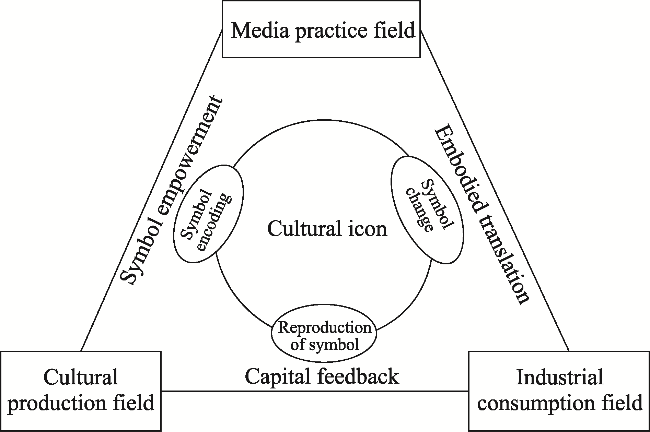
From different perspectives of the social division of labor, the field can be divided into the three “construction fields” of “cultural production field”, “media practice field”, and “industrial consumption field”. The cultural production field is the main production base of cultural capital and serves as the cornerstone for the integration of culture and tourism. The media practice field is the intermediary for the integration of culture and tourism, which undertakes the function of promoting the reproduction and dissemination of cultural content through cross-media narratives. The industrial consumption field is an important field for the transformation of cultural capital into material capital. These three different fields achieve field transformation through three processes: cultural symbol empowerment, embodiment translation, and capital feedback (Figure 1).
Figure 1 Schematic diagram of “field construction” transformation
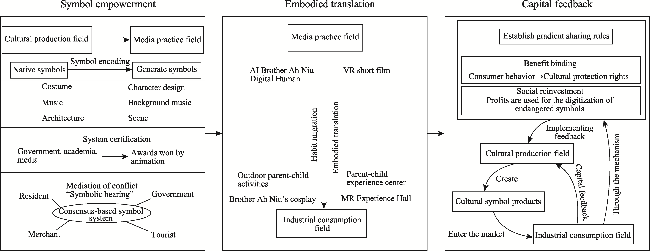
A dynamic circular mechanism is formed by the empowerment, translation, and feedback of cultural symbols, in which the interaction among actors within the field constitutes the driving force for field transformation. The legitimization of cultural symbols occurs within the field of cultural production, where institutions recognize certain symbols and transform them into “legitimate cultural capital”. This process involves three mechanisms: symbol encoding, which embeds values into symbols (e.g., bronze drums for power, tigers for evil); institutional certification, where authorities grant legitimacy (e.g., “prestigious school diplomas” as class passports); and conflict mediation, which uses mechanisms like “symbol hearings” to resolve disputes over interpretive rights among parties such as the government, villagers, and businesses. For example, the cultural relics of Sanxingdui are endowed with the legitimacy of the “ancient Shu civilization” symbol through archaeological research, and have become a super IP in cultural tourism; and similarly, the cultural symbols in “Black Myth: Wukong”— including classic figures, traditional architectural elements, and musical instruments—are reshaped and reproduced through the game itself and digital technology (Liu and Wang, 2025), making them two successful cases.
The key to embodying translation, which transforms symbols from abstract cognition into concrete bodily actions, lies in the transformation of cultural symbols into individual “habitus” through bodily sensory experiences and motor operations. This facilitates the shift from the field of cultural production to the field of media practice, which primarily relies on sensory embedding. AR and MR are used to turn symbols into interactive bodily sensations. For instance, scanning a rock painting triggers an animation of a warrior fighting, where ritualized operations plan bodily movements that embody cultural meanings, and games like drumming rhythm games turn “bravery” into muscle memory. Emotional labor stimulates tourists to participate in the regeneration of symbols through UGC creation, such as drawing a guardian story, thereby creating emotional connections. For example, in the VR project “Only This Zhouzhuang”, motion capture is used to reproduce traditional dance, and the tourists’ bodily imitations trigger the “blessing” spirit. Anime IP tourists cosplay characters, transforming them from “viewers” to “narrative participants”.
Capital feedback is a crucial component in maintaining the sustainable reproduction of the symbol system. Its essence lies in the institutional design that channels economic returns from the cultural industry consumption field back to the source of symbol production, namely the cultural production field. Essentially, it aims to “break the capital conversion gap” and achieve a virtuous cycle between cultural capital and economic capital. Its operational mechanisms include establishing gradient sharing rules, binding consumption behavior to cultural protection rights, and reinvesting company profits into the communities where endangered symbols are digitized. For example, Shanghai’s intangible cultural heritage enterprises transform the “physical capital” of artisans into high-end craftwork “symbol capital”, and the proceeds are used to fund the training of inheritors. Shanxi’s cultural tourism department collaborates with “Black Myth: Wukong” to allocate 20% of ticket revenue toward the maintenance of ancient buildings, forming a closed loop of “symbol consumption-physical protection”. These are all typical examples of capital feedback. These three elements are interdependent and jointly promote the vitality and value realization of cultural symbols (Figure 2).
Figure 2 The mechanism of field transformation

3 The IP field characteristics of “Brave Brother Ah Niu” and the current situation of the integration of culture and tourism

3.1 Cultural production field: Achievements and limitations of symbolic empowerment

3.1.1 Empowerment foundation and cultural capital accumulation

“Brave Brother Ah Niu” is rooted in Zhuang folklore, and it incorporates a wealth of distinct symbolic elements such as terraced farming culture, stilt houses, bronze drum totems, and Zhuang brocade patterns during its creation. This ap-proach shapes a narrative core centered around the concept of “harmonious coexistence between humans and nature”. From an institutional perspective, the “Brave Brother Ah Niu” has achieved significant recognition for its cultural symbols through various means (Wen, 2019). The IP “Brave Brother Ah Niu” has also received significant endorsement at the policy level. It was selected as a key project for Guangxi’s radio and film industry for the years 2020 to 2022 and was approved as a government cultural project. This demonstrates its official recognition at the cultural level. Furthermore, it has earned recognition from authoritative institutions. In 2022, it was officially collected by the National Library, becoming the first original animated work from Guangxi to receive national-level archival honors, which greatly enhanced its cultural status (Fu, 2023). This IP has also won many important industry awards such as the Silver Award of the Golden Rhino Award and the Third Prize of the National Film and Television Awards. With the support of these awards, this IP has come to occupy a benchmark position in the industry, so it has accumulated a certain amount of cultural capital (Fu, 2021).

3.1.2 Structural defects in the empowerment mechanism

Despite the rich cultural capital accumulated by the animated character IP “Brave Brother Ah Niu”, the process of symbol empowerment in the cultural production field exhibits several structural defects that are primarily centered on the overly singular empowerment subject, which is highly dependent on the promotion by government agencies and specific institutions such as Beihai University of Art and Design. Meanwhile, core members of the local communities, including Zhuang villagers and intangible cultural heritage inheritors, generally lack substantial participation channels and discourse power. This imbalance in subject structure leads directly to the monopoly of cultural interpretation rights, making it difficult for the practical experience and localized perspectives of local communities to participate in the construction of diversified symbols. At the same time, it also ignores the perception and interpretation of cultural symbols from the perspective of children. In addition, the interpretation of the core spirit of the IP, “heroic protection”, is limited to traditional heroic narratives and fails to deeply explore its profound connection with modern ecological values. In summary, although the IP “Brave Brother Ah Niu” has completed its preliminary symbol encoding work in the cultural production field, the absence of diversified empowerment subjects and insufficient depth in exploring cultural connotations have resulted in its accumulated cultural capital remaining mainly at the level of meeting policy orientation, while failing to effectively transform it into cultural capital that can be deeply empathized with by parent-child groups and perceived and participated in by children.

3.2 Media practice field: The absence and potential of embodied translation

The current issues in the field of media practice mainly focus on three aspects. 1) The media is monotonous, primarily consisting of animated series and short films and lacking a cross-media matrix such as picture books, nursery rhymes, and interactive games that are suitable for children’s cognition. 2) The integration of cultural tourism is extensive, with the IP “Brave Brother Ah Niu” represented by static signs (sculptures, logos) in scenic spots, but without operable devices for children (such as climbable characters) or parent-child collaborative task designs (such as the “Driving School” children’s practical operation and badge earning activity at Shanghai Legoland). 3) The UGC ecosystem is weak, with no official creative activities for children to participate in (such as Brother Ah Niu painting competitions), and the fan content focuses on emojis while failing to stimulate the vitality of family cultural expression.

3.3 Industrial consumption field: Homogenized development and feedback fracture

3.3.1 Analysis of the current developmental status of cultural and tourism products

The cultural tourism development of the IP “Brave Brother Ah Niu” is currently still in the planning stage, but the existing plan has revealed several key issues. Currently, the project tends to integrate existing scenic spots in Guilin, Hechi, and other places as scattered visual embellishments, so it has failed to construct a systematic design for immersive themed areas centered around IP narratives. Specifically, it fails to plan exclusive exploration routes and safe interactive spaces that are suitable for the cognitive and physical abilities of young children. At the same time, the planning lacks specific ideas for designing interactive and ceremonial experience activities based on storylines such as fighting tigers and working on terraces. The product derivation ideas are overly focused on low-value-added physical goods, such as stationery and T-shirts, while failing to explore the deep integration of the IP’s spiritual core with intangible cultural heritage crafts, such as Zhuang brocade and bronze drum decorations, or to develop distinctive products or handmade experience projects that combine high cultural recognition with educational and entertaining functions. More critically, the plan fails to respond to the core demands of parent-child families, namely creating immersive experiences that promote intergenerational collaboration, emotional connection, and are in line with children’s cognitive levels, resulting in insufficient appeal to the target customer base.

3.3.2 Vicious cycle of capital feedback disruption

The absence of a revenue distribution and feedback mechanism in the IP cultural tourism development plan of “Brave Brother Ah Niu” poses a major risk of a potential vicious cycle. The existing plan does not clearly outline how future cultural tourism revenues, ticket sales, derivatives, and experience project revenues will be institutionalized to support the cultural origins, nor does it establish any preliminary framework to ensure the rights and interests of local communities, intangible cultural heritage inheritors, or IP content updates. This fundamental deficiency leads directly to the risks of multiple disruptions. Cultural holders, such as Zhuang villagers and intangible cultural heritage inheritors, may be excluded from value distribution, so their motivation and ability to maintain cultural authenticity may gradually weaken. Without capital injection, the in-depth exploration and updating of cultural symbols will stagnate, making it difficult to deepen the symbiotic relationship between IP narratives and regional culture, such as the creation of a Zhuang brocade pattern library or new folklore collection plans. The emphasis on low-value-added products in the plan, coupled with the lack of attractive experience projects, is likely to result in low market consumption levels, making it difficult to achieve scaled industrial revenue. Furthermore, low revenue expectations will further reduce the motivation and willingness of all parties to establish a feedback mechanism, leading to a closed-loop dilemma of “cultural holder marginalization-stagnant symbol updates-insufficient consumer attraction-low revenue-insufficient feedback motivation”, which will greatly limit the vitality of IP as cultural capital and the sustainability of cultural tourism integration.

3.4 Systematic attribution of field transition barriers

In the three related fields of cultural production, media practice, and industrial consumption, the core contradiction of the integration of the IP “Brave Brother Ah Niu” in cultural tourism can be attributed to the systematic fracture of the field transformation chain. The “guardian” symbol constructed in the field of cultural production has not been effectively transformed into an experiential bodily ritual in the field of media practice, resulting in the symbol capital being idle and unable to establish deep emotional connections. The potential bodily experience in media practice lacks a value guidance mechanism toward the field of industrial consumption, making it difficult to transform bodily participation into consumption momentum, thus forming a disconnect between translation and consumption. Most fundamentally, the expected revenue in the field of industrial consumption has not been institutionally fed back to the field of cultural production, which not only weakens the sustainable development capacity of the symbol but also exacerbates the depletion of symbol connotation and the decline of its attractiveness due to the lack of support for cultural origins. These three fractures—the disconnect between empowerment and translation, the disconnect between translation and consumption, and the absence of consumption and feedback—are nested and reinforced, and they collectively constitute the core obstacle that hinders the deep integration and sustainable value cycle of the IP “Brave Brother Ah Niu” in cultural tourism (Table 1).
Table 1 Core issues in different fields
Field Core issue Specific manifestations Direct consequence/risk
Cultural production field Structural defects of empowerment
mechanism
1. Single subject
2. Monopoly of interpretation
3. Insufficient exploration of connotation
The accumulation of cultural capital remains superficial, leading to failure to evoke empathy among parent-child groups and thus hindering the transformation into cultural capital that children can perceive and participate in
Media practice field Lack of bodily
translation
1. Media homogeneity
2. Extensive integration of culture and tourism
3. Weak UGC ecosystem
The IP experience remains at the “watching” level and has been unable to achieve the transformation from “cognition” to “habitus”, thus losing the potential for deep interaction and dissemination with users
Industrial
consumption field
Fracture of capital
feedback mechanism
1. Lack of income distribution
2. Lack of protection for rights and interests
3. Limited development ideas lead to a “vicious cycle”
Marginalization of cultural holders → Stagnation of symbol renewal → Insufficient consumer appeal → Low profits → Weaker feedback motivation, ultimately leading to unsustainable projects

4 Path design for the deep integration of culture and tourism empowered by the IP “Brave Brother Ah Niu” from the perspective of field transformation

4.1 Cultural production field: Strengthening symbol empowerment and value consensus

(1) Deep symbol mining and reconstruction involves systematically sorting out and deconstructing the cultural symbols embodied by the IP “Brave Brother Ah Niu”, with a focus on the spiritual values inherent in the hero archetype, the wisdom contained in the terrace ecology, the cultural implications embedded in clothing patterns, and the philosophical ideas of harmonious coexistence between humans and nature. These cultural symbols are the representation and reproduction materials of national community consciousness. They are not static and will generate new forms and contents through collision and fusion as political and social development progresses. Among them, the cultural symbols with stronger dissemination power and greater attention-grabbing ability will become the new cultural IPs for national community consciousness (Xie and Wu, 2025).
Through careful analysis of these symbols, we have refined a spiritual core that is rooted in the traditional essence of the Zhuang ethnic group, yet also possesses modern universality and is easily comprehensible to children. This process has also facilitated the accumulation of certain cultural capital. For instance, the protagonist’s heroic actions are sublimated into “the courage to protect the homeland”, which emphasizes his responsibility towards his family and community. The wisdom of terrace farming is distilled into “the wisdom of ecological balance”, which conveys the concept of sustainable development.
This process transcends superficial narratives and lays a solid foundation of connotation for subsequently transforming abstract culture into experiential cultural tourism content. It ensures depth and appeal, particularly in conveying clear and positive value orientations to children.
(2) In the context of media narrative, technological empowerment blurs the boundaries of anime IP content production, which puts animation audiences in an equal position of content production and reception alongside creators in the power transformation of the media narrative field. The process of building an anime IP story world through cross-media narrative also involves the collaborative narrative of multiple creators and participants, and audiences should be encouraged to shift from being passive receivers to active participants (Yao and Liao, 2025).
Empowering multiple stakeholders and building consensus are precisely aimed at breaking the dilemma of a single empowering entity and the monopoly of cultural interpretation rights in the IP “Brave Brother Ah Niu”. The main approach is to establish a “Hearing for Brother Ah Niu Cultural Symbols”. Its membership should not only include representatives from local governments, cultural research scholars, Zhuang ethnic group intangible cultural heritage inheritors, local community residents, cultural tourism development enterprises, and important stakeholders, but also tourists who are the observers.
The main function of this committee is to provide a deep-level dialogue and collaboration platform for different stakeholders through a series of thematic seminars and immersive workshops. Committee members can jointly participate in the in-depth interpretation, meaning elaboration, and certification of IP cultural values. The committee would explore and establish an institutionalized consultation mechanism for the “Symbol Hearing”, which can effectively identify potential conflicts in cultural interpretation rights among different stakeholders, such as differences between official narratives and folk oral traditions, or divergences between traditional interpretations and the perspective of children’s understanding. This process will form a consensus-based symbol system that aligns with cultural authenticity and modern communication power, while specifically accommodating children’s cognitive characteristics and value acceptance. This will lay a widely accepted foundation for the cross-field application of the IP.

4.2 Media practice field: Promoting immersive embodiment translation

(1) Creating a themed immersive experience space. The embodied form of cultural capital refers to cultural products such as the knowledge, upbringing, skills, tastes, and sensibilities that actors acquire through family environments and school education and become part of their spirit and body. The process of cultural capital embodiment inevitably involves a significant consumption of time. Like any material wealth, the embodied cultural capital acquired in this way can also be invested in various markets to obtain corresponding returns (Zhu, 2005). In the field of media practice, this embodied habitus transfer can be achieved through offline physical facilities.
The core of creating a themed immersive experience space lies in selecting core scenic spots that are highly aligned with the IP narrative (such as Longji Rice Terraces or typical Zhuang villages) and constructing a “hometown of Brother Ah Niu” themed area, and its design must closely revolve around the core narrative of the IP.
This involves deeply utilizing AR and MR technologies to achieve sensory embedding, such as setting scanning points on the terraces to trigger Brother Ah Niu’s tiger-fighting animation or ecological knowledge explanations, providing VR equipment for visitors to experience the immersive adventure of “saving the homeland”, and arranging scene- specific sound effects (such as insect chirps, bird songs, and Zhuang folk songs) to enhance the environmental atmosphere.
Furthermore, this involves carefully designing ritualized practices to guide physical participation, developing a parent-child task line for “Brother Ah Niu’s Courage Challenge” (that combines terrace hiking, searching for specific plant and animal symbols, and learning simple self-defense moves), creating an interactive ritual of “Terrace Harvest Festival” (that simulates farming, threshing rice, praying, and incorporates simple song and dance learning), and setting up a “making my talisman” workshop (that incorporates Zhuang brocade pattern elements). At the same time, it also includes actively encouraging emotional labor, setting up a corner for “Brother Ah Niu in my heart” painting or story creation and displaying excellent works, encouraging family role-playing (Cosplay) photo sharing, and developing a simple App for young visitors to record “my terrace guardian diary”.
These measures can jointly create a multi-sensory, participatory, and creative immersive child-friendly environment that promotes the reproduction of cultural capital.
(2) Develop narrative-driven interactive performances and activities. This is an important supplement for enriching the experience level. On the one hand, a small-scale live performance titled “The Story of Brother Ah Niu” can be created and rehearsed. The performance venue can be chosen in a natural environment or a characteristic village, with the focus on breaking the traditional viewing and performance mode. Some strong interactive segments can be designed, such as asking young audience members to help characters complete a certain task or participate in a blessing ceremony together, which will allow the audience to transform from being spectators to participants in the story.
On the other hand, “Zhuang Little Warriors” parent-child camp theme activities should be held regularly. This activity should deeply integrate the IP storyline, the essence of Zhuang folk culture, and the concept of natural education. It can include role tasks guided by stories, hands-on folk craft experiences such as simple weaving, learning to sing folk songs, and interactive natural observation courses based on terrace ecology. Through such educational and entertaining project planning involving parent-child collaboration, these activities will transform the spiritual connotations of “courage”, “wisdom”, and “protection” of Brother Ah Niu into valuable experiences that can engage the children personally, and strengthen intergenerational cultural transmission and emotional connection.
(3) Establish the official short video account for “Brother Ah Niu + Guilin Scenery”. The current media landscape is exhibiting a pronounced trend toward “fast-food” consumption. Short videos, with their accompanying and fragmented adaptability, as well as their powerful ability to evoke visual emotions, are a potent tool for urban cultural and tourism dissemination. Their high interactivity instantly narrows the temporal and spatial distance, which enables shared experiences. Under the algorithm’s push, the city’s historical and cultural customs can easily reach users and form a labeled impression. The city’s long-accumulated embodied cultural capital is quickly embedded in the tourists’ memories, and through popular amplification and association, it forms a tremendous attraction that helps the city to stand out in tourism competition (Yang and Gao, 2025).
Against this backdrop, we have created the official short video account “Brother Ah Niu + Guilin”, which aims to transform cultural symbols into an audiovisual language comprehensible to children by creating informative content such as animated character commentaries on terrace ecology and the symbolism of Zhuang brocade, as well as sharing immersive clips of tourists participating in courage challenges or harvest festivals. At the same time, we have launched online challenge competitions to guide users in completing real-life photo and video tasks and developed a story continuation function to encourage the co-creation of plotlines, thereby activating user participation. We also utilize algorithms to precisely push content based on geographic and interest tags, and collaborate with influencers to release experience vlogs, thus jointly reinforcing the symbolic impression of “Guilin—the hometown of Brother Ah Niu”. By leveraging the fragmented dissemination and instant interaction advantages of short videos, we can quickly reach potential tourists and form memory anchors.
However, it is important to clarify that this superficial symbolic contact needs to be complemented by in-depth on-site experiences in order to truly internalize the cultural capital.

4.3 Industrial consumption field: Building a sustainable ecosystem and capital feedback

(1) Build a themed and tiered consumption ecology. According to Bourdieu’s theory of cultural capital, the key to a themed consumption ecology is to shape a field for the transformation of cultural capital.
High-premium experience projects like “Brother Ah Niu’s Courage Challenge Camp” should be regarded as venues for the accumulation of cultural capital. Through activities such as collaborative terrace farming and bronze drum rhythm teaching, participants are encouraged to transform Zhuang ecological wisdom (objectified cultural capital) into their own cultural capital (embodied state), achieving what Bourdieu refers to as “covert intergenerational transmission”. The “Terrace Fantasy Night” AR experience creates a symbolic transformation space, where the immersive participation of tourists not only consumes cultural capital but also completes capital reproduction through social media dissemination.
The development of specialty derivatives revolves around capital mutual transformation. The “Brother Ah Niu’s Guardian” gift box transforms terrace rice from economic capital into a spiritual symbol that carries narrative, and the interactive task of accompanying picture books allows cultural decoding to be completed within the family sphere. The “My Zhuang Brocade Story” DIY package turns intangible cultural heritage patterns (institutionalized capital) into embodied capital for children through manual practice. The welcoming ceremony of song masters in themed homestays provides participants with “cultural certification” (symbolic capital), thus completing the closed loop of capital transformation.
(2) Establish a closed-loop capital feedback mechanism, where short video platforms should be reshaped into structural fields for cultural capital reproduction. This approach uses a threefold mechanism to adjust the inequalities in cultural capital inheritance.
The first mechanism is to establish institutionalized obligations for cultural capital reinvestment. This requires short video creators who commercially use the Brother Ah Niu IP to fulfill cultural reproduction responsibilities. They then convert their economic gains into cultural capital reinvestment funds in proportion and inject these funds into a special fund dedicated to two types of reproduction activities: preserving the skills of intangible cultural heritage inheritance groups to compensate for their structural disadvantages in intergenerational transmission, and funding cultural acquisition projects for marginalized community youth to break the inequality in cultural capital inheritance.
The second mechanism is to construct an empowering design for cultural capital circulation. This involves adjusting algorithm weights to empower the accurate transmission of short video content that embodies core Zhuang cultural symbols, thereby weakening the monopoly of elites on discourse power. A targeted return mechanism for users’ secondary creation earnings should be established, to return these earnings to the holders collectively based on the traceability of cultural materials. A virtual apprenticeship system should be created to support young groups in transforming their learning outcomes into cultural capital credentials through “digital apprenticeship”, thus reshaping the upward mobility path for groups excluded by traditional inheritance.
The third mechanism is to implement corrective interventions for cultural capital distribution. This includes developing algorithmic tools to enhance the visibility of non-mainstream cultural practice content to counteract the solidification of symbolic class, as well as establishing compensation projects to invite left-behind children to participate in creation and convert their income into educational reserves, thereby achieving a step-by-step transformation from economic capital to cultural capital and then to symbolic capital.
By forcibly converting economic gains, broadening capital acquisition channels, and breaking the monopoly of cultural interpretation, this closed-loop mechanism reconstructs the power structure while maintaining the essence of cultural capital inheritance and reproduction, so it enables the marginalized groups’ cultural practices to gain market pricing power.

5 Conclusions and implications

5.1 Conclusions

This study once again demonstrates the unique value of child-oriented animation IPs in the deep integration of cultural tourism through a case study of “Brave Brother Ah Niu”. The core lies in effectively connecting young people, especially the younger generation of children, activating regional traditional culture, and tapping into the huge market potential of the children’s parent-child tourism. The main conclusion drawn from this study is that the important factors for achieving the successful integration of cultural tourism are the establishment of value identity in the cultural production field (deep empowerment), the construction of immersive translation in the media practice field (embodied translation), and the feedback of thematic ecology and a closed loop in the industrial consumption field. For the Brother Ah Niu IP, this study specifically presents a path based on the theory of field transformation, namely, diversified empowerment to deepen symbolic value, innovative media practice for embodied translation, and the construction of a consumption ecology to ensure capital feedback. At the same time, it discusses the prevalent issues of fragmentation and superficiality in the current development of children’s animation IPs in cultural tourism, which are due to the breakdown of the field transformation chain, especially the lack of embodied translation and capital feedback.

5.2 Practical implications

From a practical perspective, this study provides specific and operable solutions for the in-depth cultural and tourism development of the “Brave Brother Ah Niu” IP, including the creation of an empowerment committee, immersive experience planning, the establishment of a gradient consumption ecosystem, and a closed-loop feedback mechanism. More importantly, it extracts a replicable “deep mining empowerment-narrative drive translation-ecological closed-loop feedback” model for other regional and ethnic children’s animation IPs (such as works adapted from ethnic minority legends or local hero stories), that can be used to carry out in-depth exploration, narrative-driven translation, and ecological closed-loop feedback models for culture and tourism integration projects. The successful implementation of this model largely depends on the comprehensiveness of top-level design, the effectiveness of multi-subject co-governance, the depth of local community participation, the appropriate use of technology empowerment, and the strict protection of cultural authenticity.

5.3 Limitations and prospects

The limitations of this study lie in the fact that its conclusions are mostly based on theoretical deduction and the path design of the Brother Ah Niu case. Assessing the accurate implementation effect and adaptability will require further empirical research in the future. Moreover, this study focuses on child-oriented IP, so the applicability of the proposed framework and path to other types of IP (such as youth- oriented or adult-oriented) remains to be further explored. Future research can be conducted in these directions to explore differences in the acceptance of animation IP cultural tourism experiences among children of different ages and the underlying reasons, as well as to explore how emerging technologies such as artificial intelligence and the metaverse may give rise to new application models and effects during the field transformation process. The “empowerment-translation-feedback” path proposed in this study should undergo long-term, multi-case effect evaluation and improvement.
[1]
Fu C W, Wang Y F. 2021. Urban nighttime tourism consumption space from the perspective of scene—A study based on the cultural scene of super Wenheyou in Changsha. Wuhan University Journal (Philosophy & Social Sciences), 74(6): 58-70. (in Chinese)

[2]
Fu Z Y. 2021. Original large-scale 3D animated film “Brave Brother Ah Niu” featuring Beihai Zhuang ethnic theme. Beihai, China: Beihai University of Art and Design. https://jgxy.sszss.com/sjxm/8781.htm?site_id=11. Viewed on 2025-05-10.

[3]
Fu Z Y. 2023. The original online animated film “Brave Brother Ah Niu” produced by Beihai University of Art and Design has been added to the National Library. Beihai, China: Beihai University of Art and Design. https://mdc.gzu.edu.cn.sszss.com/xyxw/12141.htm?site_id=11. Viewed on 2025-05-13.

[4]
Ge Z. 2025. Research on the path of empowering rural revitalization in the new era through cultural and tourism integration from the perspective of industrial integration. Agricultural Economy, (3): 114-116. (in Chinese)

[5]
Guo W, Huang Z F. 2013. A field theory to the production of multi-dimensional space of cultural heritage tourism destination—A case study of Zhouzhuang Ancient Town. Human Geography, 28(2): 117-124. (in Chinese)

[6]
Liao Y Y, Gao Y S. 2025. Digital technology dual network embeddedness a)impacts on the integrated development of culture and tourism. Human Geography, 40(1): 71-77. (in Chinese)

[7]
Liu M Y, Wang C Y. 2025. Integration of culture and tourism enabled by the gaming industry from the perspective of field transformation: A case study of “Black Myth: Wukong”. Tropical Geography, 45(7): 1-13. (in Chinese)

[8]
Lu M X. 2025. Interpretation of the 2025 Report on the development of parent-child. Beijing, China: Chinese Amusement. https://mp.weixin.qq.com/s?_biz=MzA3NTAyNDcxNw=&mid=2651265942&idx=1&sn=a1329d5c426aa9c36afd9c1a1e1680d1&chksm=85ff59efa4d99cd893fc6182c2f10b17362a43e3aee9359be3b0ec909d64e204c45be876b13e&scene=27. Viewed on 2025-05-13.

[9]
Lu Y, Wang Z X. 2025. Cultural tourism in many places leverages popular trends and animation IPs to expand its influence. Consumption Daily. http://www.xfrb.com.cn/article/tour/10112060315212.html?btwaf=75507542. Viewed on 2025-06-01.

[10]
Ma X F, Xie X J. 2025. Pathway and mechanism for improving the livelihood of ethnic minorities through cultural and tourism integration: A case study of Chashan Village in Fuchuan Yao Autonomous County. Economic Geography, 45(5): 202-212. (in Chinese)

[11]
Wen Y. 2019. The animation crew of “Brave Brother Ah Niu” from our school’s animation college went to northern Guangxi to collect folk songs. Beihai, China: Beihai University of Art and Design. https://jgxy.sszss.com/zonghezixu/2662.htm?site_id=2. Viewed on 2025-05-10.

[12]
Wu C Z, Chen P. 2025. Impact effect and mechanism of local government attention to culture and tourism integration on tourism economy development. Shenzhen University Journal (Humanities & Social Sciences), 42(3): 44-56. (in Chinese)

[13]
Xie S L, Wu L C. 2025. From cultural symbols to cultural IP: Innovating the path for forging a strong sense of community for the Chinese nation— Taking the development of “Village BA” in Taijiang County, Guizhou as an example. Journal of Ethnology, 16(5): 17-25, 153. (in Chinese)

[14]
Yang H, Gao Y S. 2025. Hub, carrier, and catalyst: Short videos in the cultural tourism industry in the new media era—An analysis based on cultural capital theory. Contemporary TV, (4): 71-77. (in Chinese)

[15]
Yang L, Rao J T. 2025. Digital media empowers the integration of digital and physical elements in cultural tourism: Logical mechanism and practical path. Journal of Capital Normal University (Social Sciences Edition), (1): 113-123. (in Chinese)

[16]
Yao L, Liao Y X. 2025. An analytical exploration of transmedia storytelling and communication of Chinese-style anime IP from the perspective of affordance. Publishing Journal, 33(2): 90-98. (in Chinese)

[17]
Zhang B Q. 2025. Animation empowerment, Qingdao explores the deep integration of “culture+scene” animation IP and cultural tourism. Pengpai News. https://m.thepaper.cn/newsDetail_forward_31325676. Viewed on 2025-05-11. in Chinese).

[18]
Zhao H L, Zhang P T. 2025. Research on national park protection strategies from the perspective of cultural and tourism integration: Taking the protection and development zone around Wuyi Mountains National Park as an example. Journal of Fujian Provincial Committee Party School of CPC (Fujian Academy of Governance), (2): 148-154. (in Chinese)

[19]
Zhou C Q. 2024. Agency Communiqué of the Third Plenary Session of the 20th Central Committee Xinhua News.. http://www.news.cn/politics/leaders/20240718/a41ada3016874e358d5064bba05eba98/c.html. Viewed on 2025-05-01. in Chinese)

[20]
Zhu W J. 2005. A non-economic interpretation of “capital”—Bourdieu’s concept of “cultural capital”. Journal of Social Sciences, (6): 117-123. (in Chinese)

Outlines

/