Special Column: Digital Empowerment and Human Settlements Environment

Impact Mechanism of the Digital Economy in Promoting Carbon Emission Reduction in the Yangtze River Delta Urban Agglomeration: A Moderated Mediation Effect Approach

  • JIANG Yueting , 1, 2 ,
  • WANG Ruqi , 3, 4, * ,
  • MEI Yulin 1
Expand
  • 1. School of Management Engineering, Anhui Institute of Information Technology, Wuhu, Anhui 241199, China
  • 2. School of Economics and Management, Wuhan University, Wuhan 430072, China
  • 3. Center for Energy and Environmental Policy Research, Beijing Institute of Technology, Beijing 100081, China
  • 4. School of Management, Beijing Institute of Technology, Beijing 100081, China
* WANG Ruqi, E-mail:

JIANG Yueting, E-mail:

Received date: 2025-05-14

  Accepted date: 2025-09-25

  Online published: 2025-11-28

Supported by

The National Social Science Fund of China(23BGL222)

The Key Project of Anhui Provincial Scientific Research Planning(2022AH051882)

The Key Project of Anhui Provincial Scientific Research Planning(2024AH050632)

Abstract

As global efforts to achieve carbon neutrality accelerate, understanding how digital economy development contributes to urban carbon reduction is crucial for achieving sustainable development. This study examines the impact of digital economy expansion on carbon emission intensity in the Yangtze River Delta urban agglomeration, a key economic hub in China. Using panel data from 41 cities (2011-2021) and a moderated mediation model, we analyze how industrial upgrading and Green Total Factor Productivity (GTFP) mediate this relationship. Our findings confirm that the digital economy significantly reduces carbon intensity both directly and indirectly through these two pathways. In addition, government investment in science and technology positively moderates this effect by strengthening the carbon reduction impact via industrial transformation. Spatial heterogeneity analysis reveals that these effects are more pronounced in cities within the “one core, five circles, and four belts” framework and in non-resource-based cities, highlighting regional disparities. These results underscore the need for targeted policy measures, including enhanced digital infrastructure, green finance mechanisms, and regional collaboration to maximize the decarbonization benefits of digitalization. By integrating digital and low-carbon strategies, policymakers can drive high-quality, green urban transformation.

Cite this article

JIANG Yueting , WANG Ruqi , MEI Yulin . Impact Mechanism of the Digital Economy in Promoting Carbon Emission Reduction in the Yangtze River Delta Urban Agglomeration: A Moderated Mediation Effect Approach[J]. Journal of Resources and Ecology, 2025 , 16(6) : 1613 -1625 . DOI: 10.5814/j.issn.1674-764x.2025.06.001

1 Introduction

The climate crisis poses a significant threat to human society in the 21st century. According to the Global Climate Status Report 2023, greenhouse gas concentrations are continuing to rise, exacerbating global warming. Similarly, the China Climate Change Blue Book 2023 highlights the growing frequency of extreme high-temperature events in China, which have escalating societal repercussions. Furthermore, according to the Global Carbon Budget 2023, CO2 emissions generated by fossil fuel use hit their highest level on record (Ripple et al., 2024). These findings underscore the urgent need to curb greenhouse gas emissions as a critical challenge in achieving sustainable global development.
China is at a pivotal moment in its transition toward a more sustainable economic development model. Amidst the current wave of global technological advancement, the digital economy, propelled by big data, the Internet of Things (IoT), and Information and Communication Technology (ICT), is experiencing rapid growth. As outlined in China’s 14th Five-Year Plan released in 2021, the digital economy is regarded as a core component for achieving carbon neutrality. In 2024, national authorities introduced key directives on digital economy development that emphasized the cultivation of new high-quality productivity through digital innovations, the realization of digital dividends, the optimization of the development environment, and the enhancement of digital governance capacities. The question of how digital economic development can contribute to carbon reduction has garnered widespread attention. As China strives to meet its “dual carbon” targets, it is essential to explore the pathways and mechanisms through which digital economic development can facilitate carbon emission reductions.
The Yangtze River Delta (YRD) urban agglomeration is a key driver of China’s economic growth and digital transformation. Since the official launch of the Digital Yangtze River Delta Construction Plan in late 2021, digital economy development (DIG) in this region has expanded rapidly. In 2022, the YRD contributed close to 30% of China’s total digital economic output, underscoring its strategic importance in promoting integrated development. At the same time, the YRD remains a major hub of industrial and economic activity, making it one of China’s largest energy- consuming regions. Its entrenched dependence on high- carbon economic growth models creates considerable structural inertia. While economic expansion and rising living standards have increased energy demand, this trend conflicts with the overarching goal of carbon reduction. Therefore, building a green, low-carbon, and circular economic system across the region is essential for achieving sustainable development.
Given this context, the present study examines carbon emissions and DIG across 41 cities in the Yangtze River Delta urban agglomeration. It aims to uncover the pathways through which DIG influences carbon emissions, thereby providing valuable policy insights for both regional sustainability efforts and China’s broader “dual carbon” strategy.

2 Literature review

2.1 Carbon reduction effects of the digital economy

Since 2021, research on the relationship between the digital economy and carbon emissions has made notable progress, yet it remains in its early stages overall (Li and Wu, 2022). Existing studies largely concur that the digital economy significantly contributes to carbon emission reduction (Ma et al., 2022). Specifically, it has been shown to reduce urban carbon emission levels and suppress carbon emission intensity (CI). However, this relationship is not universally linear. Some studies have identified an inverted U-shaped, nonlinear relationship that is characterized by an early inhibitory stage and a later facilitative phase (Kwilinski, 2024; Wu et al., 2024a). Moreover, these effects exhibit cross-border characteristics, resulting in negative spillover effects on carbon emissions in spatially connected regions (Cheng et al., 2023). These effects operate through a cyclical feedback mechanism, ultimately reducing local carbon emission levels. Regarding heterogeneity, scholars have explored various influencing factors such as economic development levels (Shahbaz et al., 2022), geographical distribution (Wang et al., 2023), human capital (Khan, 2020), urban resource endowments, and city size. While their conclusions vary, there is a broad consensus that carbon reduction effects tend to be more pronounced in the eastern and central regions, particularly in non-resource- based cities.

2.2 Multidimensional mechanisms of carbon reduction in the digital economy

The research mechanisms can be categorized into three levels. At the macroeconomic level, research suggests that the digital economy generates positive externalities through economic agglomeration effects, thereby promoting carbon emission reduction. In addition, the digital economy facilitates the establishment of a national carbon trading market, which effectively curbs total energy consumption by monitoring energy market trends and price fluctuations, leading to reduced carbon emissions (Shahbaz et al., 2022; Ferdaus et al., 2024). At the meso-industrial level, the digital economy accelerates industrial transformation and upgrading, so it serves as a key intermediary mechanism for reducing urban carbon emissions (Ramirez-Rodriguez et al., 2024). By promoting advanced and rational industrial structures, the digital economy reduces the share of high-carbon-emission industries, thereby achieving notable emission reductions. At the micro-enterprise level, digital technologies enhance end-of-pipe carbon control, which enables the precise detection, measurement, and prediction of carbon emissions while optimizing energy resource allocation (Rowan et al., 2022; Kurniawan et al., 2023). The development of green technologies further amplifies this effect, as technological dividends strengthen the carbon reduction potential of the digital economy (Yi et al., 2022).

2.3 Research gaps and extensions from a regional perspective

China’s digital economy development exhibits pronounced regional disparities that result in significant variations in carbon emission reduction effects across economic regions. Scholars have conducted regional studies on areas such as the Beijing-Tianjin-Hebei urban agglomeration, the YRD region, and the Yellow River Basin (Zhang et al., 2018; Yuan et al., 2022). However, unlike national-level analyses, these regional studies often lack comprehensive and in-depth discussions. For instance, in the Beijing-Tianjin-Hebei region, mechanisms such as financing capacity, industrial agglomeration, and foreign direct investment have been identified as key drivers of the digital economy’s contribution to carbon emission reduction (Cheng et al., 2023). Notably, economic development levels do not appear to significantly influence this effect. In contrast, in the YRD region, industrial optimization, green technological innovation, and green finance have been identified as the primary pathways through which the digital economy mitigates carbon emissions. However, no consensus has emerged on whether factors such as economic development, human capital, and city size contribute to the heterogeneity of these effects.
Achieving carbon peaking and carbon neutrality represents a profound and systemic transformation of socio-economic structures. As China’s economic and financial hub, the YRD is expected to play a leading role in realizing these “dual carbon” goals. Spanning 41 cities across Shanghai, Jiangsu Province, Zhejiang Province, and Anhui Province, the YRD is the world’s sixth-largest urban agglomeration, and it is characterized by early industrialization and rapid economic expansion. Over the past decade, the carbon emissions in this region have continued to rise (Xu et al., 2024). Although kernel density estimation and emission coefficient analyses suggest improvements in carbon emission efficiency, significant regional disparities persist. The YRD still faces several major challenges in its pursuit of dual carbon goals, including uneven regional development, imbalanced energy supply and demand, and industrial structural adjustment pressures (Xu et al., 2024). Prior research highlighted factors such as city size, urbanization, economic development, energy consumption, population size, and industrialization levels as the key drivers of carbon emissions (Wu et al., 2024b). As a national model for economic transformation, the YRD provides valuable empirical insights for achieving China’s “dual carbon” goals (Chen et al., 2023). However, existing studies reveal gaps in our understanding of how digitalization shapes emissions in this region, as well as discrepancies in perspectives on various related issues.
Against this backdrop, this study makes two key contributions. First, it enriches the literature by examining how the digital economy influences carbon emissions in the YRD urban agglomeration and offering actionable insights for regional integration and national sustainability strategies. Second, from a mechanism analysis perspective, it investigates the moderating role of government investment in science and technology in shaping the digital economy’s impact on carbon emissions. In addition, it explores intermediary mechanisms such as industrial structural upgrading and Green Total Factor Productivity (GTFP) to provide a more comprehensive and nuanced understanding of these dynamics.

3 Theoretical analysis and research hypotheses

3.1 Analyzing the impact of the digital economy on carbon emissions

According to the 14th Five-Year Plan for Digital Economy Development, data elements serve as the core production factor of the digital economy, and they are seamlessly integrated with various entities to drive industrial digital transformation, accelerate digital industrialization, and enhance the digitization of public services.
Data elements possess distinct advantages, such as their ability to disseminate information across time and space, promote data openness, and enable data sharing. First, these attributes facilitate the advancement of digital technologies, including cloud computing, data crawlers, and digital twins. By fostering the development of digital industries—such as information technology, communication technology, digital media, and e-commerce—data elements also contribute to the modernization of energy management systems. By optimizing energy supply chains, they reduce carbon emission intensity and total carbon emissions, thereby promoting both digitalization and the green transformation of industries. Second, the circulation of data elements provides essential support for the national carbon trading market (Tian et al., 2024). This enhances carbon information disclosure, source identification, and real-time emissions monitoring. As a market-based mechanism, carbon trading incentivizes enterprises to adopt energy-saving measures and reduce emissions, ultimately regulating the total energy-related carbon emissions (Liu et al., 2019). Third, data openness and sharing drive advancements in digital governance, including e-government initiatives, intelligent transportation systems, and the sharing economy. These developments enhance public awareness and participation through online platforms while strengthening the government’s capabilities in low-carbon governance, regulatory oversight, and public service digitization (Hsu et al., 2024). Moreover, public engagement in carbon reduction efforts further reduces urban carbon emissions.
Based on the above analysis, the following hypothesis is proposed:
H1: Digital economy development reduces urban carbon emission intensity.

3.2 The mediating effect of industrial structure upgrading

Industrial structure upgrading refers to the advancement of specialization, an increase in local product value-added, and the strengthening of forward and backward linkages within an economy. The modernization of industrial structures, characterized by the replacement of outdated industries with emerging high-tech sectors, is driven by economic development and industrial growth imperatives. With the rise of the digital economy, traditional industries are being increasingly transformed by high-tech and information industries, while high-energy-consuming and low-value-added industries are being phased out. This transition promotes industrial structure optimization and carbon emission reduction.
The mediating role of industrial structure upgrading in the relationship between the digital economy and carbon emission intensity manifests in two key ways (Shahbaz et al., 2022). On one hand, the digital economy fosters new business models, service-oriented economies, digital content industries, and clusters of emerging industries. These sectors inherently produce lower carbon emissions, which directly contributes to urban carbon emission intensity reduction. On the other hand, digital technologies enhance traditional industries by integrating resources, promoting vertical value chain integration, and enabling the transformation of manufacturing into service-oriented, intelligent, and flexible production systems. This modernization includes upgrading production equipment, diversifying production methods, and optimizing industrial value chains. Resource utilization improves as factor resources are reallocated from inefficient to efficient sectors, leading to both direct and indirect reductions in carbon emissions (Freire-Gonzalez and Vivanco, 2017).
Based on this analysis, the following hypothesis is proposed:
H2: Industrial structure upgrading mediates the relationship between the digital economy and carbon emission intensity.

3.3 The mediating effect of GTFP

GTFP is a measure of the maximum output achievable by a production system with minimal resource input, and it is driven by technological progress and efficiency improvements. The digital economy is characterized by innovation-driven and technology-integrating attributes, and it not only enhances production efficiency and green value creation but also reduces energy consumption and pollutant emissions (Jiakui et al., 2023). This is achieved through lower transaction costs, optimized resource allocation, improved energy efficiency, and accelerated technological iteration. Collectively, these mechanisms directly enhance GTFP. As a critical intermediary variable, GTFP establishes a bridge between the digital economy and carbon emissions, linking efficiency gains with sustainability outcomes.
Based on this analysis, the following hypothesis is proposed:
H3: GTFP mediates the relationship between the digital economy and carbon emission intensity.

3.4 The moderating effect of government investment in science and technology

Governments play a pivotal role in reducing the costs of green technological innovation for enterprises, while also enhancing product conversion efficiency and operational profitability through fiscal subsidies and strategic investments in science and technology (Li et al., 2024; Shan et al., 2024). The digital economy not only incentivizes but often compels enterprises to adopt green technological innovations at both the macro and micro levels. When governments subsidize green innovation, businesses are better equipped to implement and commercialize green technologies, resulting in substantial reductions in carbon emissions (Owen et al., 2018).
Based on this reasoning, the following hypotheses are proposed:
H4: Government investment in science and technology positively moderates the inhibitory effect of DIG on CI.
H5: Government investment in science and technology positively moderates the mediating role of industrial structure upgrading in the relationship between DIG and CI.
H6: Government fiscal subsidies positively moderate the mediating role of GTFP in the relationship between DIG and CI.

4 Methods and data

4.1 Methods

4.1.1 Baseline regression model

To examine the relationship between DIG and CI, a standard panel regression model was established as follows:
$C I_{i t}=\alpha_{0}+\alpha_{1} D I G_{i t}+\sum_{n=1}^{7} \theta_{n} C O N_{n i t}+\mu_{i}+\gamma_{t}+\varepsilon_{i t}$
$C I=C O_{2} / G D P$
$C O_{2}=\sum_{i=1}^{n} C O_{2 i}=C E_{1}+C E_{2}+C E_{3}=a Q_{1}+b Q_{2}+c Q_{3}$
where i denotes the city; t denotes the year; n denotes the n-th control variable; α0 is the constant term; α1 and θn are regression parameters; CIit is the carbon intensity, calculated as the ratio of total carbon emissions (CO2) to gross domestic product (GDP); DIGit is the level of digital economy development; CONnit represents the set of control variables; CE1, CE2, and CE3 represent the carbon emissions from liquefied petroleum gas (Q1), natural gas (Q2), and total electricity consumption (Q3), respectively. Coefficients a and b represent the carbon emission factors for liquefied petroleum gas and natural gas, as provided by the Intergovernmental Panel on Climate Change (IPCC). Meanwhile, c corresponds to the carbon emission factor for electricity consumption, based on data from the East China Power Grid (2011-2021). μi represents the regional fixed effect; γt represents the time fixed effect, and εit is the random disturbance term.

4.1.2 Intermediate effect model

The mainstream mediation analysis methods currently include the stepwise method, Sobel test, and Bootstrap test. According to the analysis of these three mediation methods (Wen and Ye, 2014), this study first selected the stepwise method for testing, followed by validation using the Sobel test and Bootstrap test methods. During the testing process, control for time and individual effects was maintained to ensure the accuracy of the results. The stepwise method model is as follows:
$M_{i t}=\beta_{0}+\beta_{1} D I G_{i t}+\beta_{2} C O N_{i t}+\mu_{i}+\gamma_{i}+\varepsilon_{i t}$
$C I_{i t}=\delta_{0}+\delta_{1} D I G_{i t}+\delta_{2} M_{i t}+\delta_{3} C O N_{i t}+\mu_{i}+\gamma_{i}+\varepsilon_{i t}$
where β0 and δ0 are the intercepts, and β1, β2, δ1, δ2, and δ3 are the coefficients to be estimated, and Mit represents the mediating variables, which are IND and GTFP. If β1, β2, δ1 and δ2 are all significant, then the mediation effect is significant.
$\begin{aligned} C I_{i t}= & a_{0}+a_{1} D I G_{i t}+a_{2} T I_{i t}+a_{3} T I_{i t} \times D I G_{i t}+ \\ & a_{4} C O N_{i t}+\mu_{i}+\gamma_{i}+\varepsilon_{i t} \end{aligned}$
$\begin{aligned} M_{i t}= & b_{0}+b_{1} D I G_{i t}+b_{2} T I_{i t}+b_{3} T I_{i t} \times D I G_{i t}+ \\ & b_{4} C O N_{i t}+\mu_{i}+\gamma_{i}+\varepsilon_{i} \end{aligned}$
$\begin{aligned} C I_{i t}= & c_{0}+c_{1} D I G_{i t}+c_{2} T I_{i t}+c_{3} M_{i t}+c_{4} T I_{i t} \times M_{i t}+ \\ & c_{5} C O N_{i t}+\mu_{i}+\gamma_{i}+\varepsilon_{i t} \end{aligned}$
$\begin{aligned} C I_{i t}= & d_{0}+d_{1} D I G_{i t}+d_{2} T I_{i t}+d_{3} T I_{i t} \times D I G_{i t}+d_{4} M_{i t}+ \\ & d_{5} T I_{i t} \times M_{i t}+d_{6} C O N_{i t}+\mu_{i}+\gamma_{i}+\varepsilon_{i t} \end{aligned}$
where a0, b0, c0, and d0 are the intercepts, and the remaining parameters (a1-a4, b1-b4, c1-c5, d1-d6) are the coefficients to be estimated. TIit represents government technology investment, and TIit×DIGit denotes the interaction term between TIit and DIGit. If the interaction term is significant, it indicates a direct moderating effect. In addition, TIit×INDit denotes the interaction between government technology investment and industrial structure, which confirms a moderated mediation effect when it is significant.

4.2 Variables

4.2.1 Core explanatory variable

The core explanatory variable of this study is the level of DIG. The mainstream measurement methods for the level of digital economy are currently divided into three categories: index compilation method, value-added calculation method, and satellite account method. Based on the comprehensiveness and availability of data, the index compilation method is the approach used by most scholars. Some studies directly use third-party statistical data such as New Hua, but this approach has the issue of being too short-term. This study assessed the level of DIG in 41 cities across three provinces and one city in the YRD from four dimensions: digital infrastructure level, digital industry development, industrial digital development, and digital inclusive finance.

4.2.2 Mechanism variables

IND (Industrial Structure), a mediating variable, was measured by the proportion of the tertiary industry’s value added to Economic Development Level (GDP).
GTFP (Green Total Factor Productivity), a mediating variable, was calculated using the undesirable output super-efficiency SBM model, with waste gas, wastewater, and smoke dust as the undesirable outputs, and actual GDP as the desired output. Labor force, capital, and social electricity consumption were used as input factors.
TI (Government Technology Subsidy), a moderating variable, was measured by the logarithm of expenditure on science and technology within the local general public budget.

4.2.3 Control variables

To effectively investigate the relationship between the core explanatory variables and the dependent variable, this study incorporated control variables that prior research had established as pertinent to carbon emissions. The specific measurements of these indicators are as follows:
GDP (Economic Development Level): Log of real GDP, adjusted to 2011 constant prices, divided by regional population;
ENVI (Environmental Investment): Proxied by the logarithm of environmental protection expenditures in regional government budgets;
IVM (Fixed Asset Investment Scale): Logarithm of per capita fixed asset investment;
FDI (Foreign Direct Investment): The ratio of actual utilized foreign capital to GDP, with foreign capital converted at the annual exchange rate;
ENT (Number of Large-Scale Industrial Enterprises): Logarithm of the total number of large-scale industrial enterprises;
URB (Urbanization Level): The proportion of urban population to total permanent population.

4.3 Data sources

The data for CI originated from the China City Statistical Yearbook, the China Energy Statistical Yearbook, and various municipal statistical yearbooks. Carbon conversion factors were based on IPCC energy carbon emission coefficients and East China Grid data. The DIG index was compiled using the aforementioned yearbooks and the Peking University Digital Inclusive Finance Index (Guo et al., 2020). Data for the mechanistic and control variables came primarily from the same sources. To address missing data, interpolation and moving average techniques were employed in line with established methodologies.

5 Results

5.1 Evolution of carbon emissions in the YRD

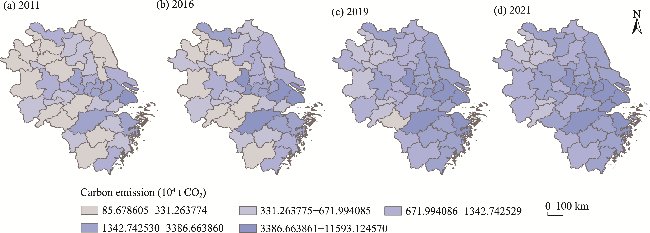
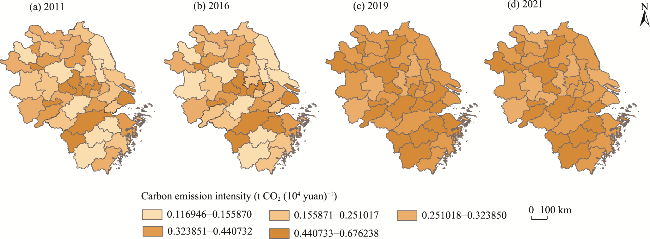
Using ArcGIS, the carbon emission volume and CI data for the YRD urban agglomeration from 2011, 2016, 2019, and 2021 were plotted. The natural breaks classification method was applied to divide the data into five stages.
Figure 1 illustrates the evolution of carbon emissions in the YRD urban agglomeration. The findings reveal an overall upward trend in carbon emissions, with higher emissions concentrated in the more developed eastern cities. Major urban centers such as Shanghai, Nanjing, Hangzhou, Suzhou, and Ningbo consistently exhibited the highest carbon emissions, reflecting the influence of industrial and transportation activities. In addition, secondary cities such as Hefei, Wenzhou, Taizhou, and Shaoxing have experienced gradual increases in carbon emissions, likely due to economic development and industrialization.
Figure 1 Evolution of carbon emission levels in the YRD
Figure 2 presents the evolution of CI in the YRD. The intensity maps for 2019 and 2021 appear darker than those for 2011 and 2016, indicating an increase in overall CI over the decade. However, the number of deepest-colored regions dropped from 17 in 2019 to 15 in 2021, suggesting a slight reduction in high-intensity areas. Notably, major cities such as Shanghai, Nanjing, Hangzhou, Suzhou, Nantong, Changzhou, and Ningbo displayed declining trends in CI, while less developed cities experienced increases. Compared to carbon emission volume, CI more accurately reflects energy efficiency and economic structural optimization. The observed declines in intensity in major developed cities may be attributed to higher levels of DIG, enhanced energy efficiency, expansion of high-tech industries, and increased TI.
Figure 2 Evolution of carbon emission intensity in the YRD

5.2 Descriptive statistical analysis

The descriptive statistical results presented in Table 1 indicate substantial variations in the dependent variable CI and core explanatory variable DIG. This suggests considerable differences in both CI and DIG levels among the 41 cities in the YRD. For both variables, the means being higher than the medians suggest that higher values are inflating the averages, highlighting their skewed distributions.
Table 1 Descriptive statistical results
Variable Observations Maximum Minimum Mean Median Standard deviation VIF
CI 451 0.689 0.115 0.364 0.344 0.143 -
DIG 451 0.922 0.0491 0.220 0.163 0.174 5.98
IND 451 2.766 0.313 1.008 0.967 0.349 2.54
GTFP 451 1.184 0.199 0.611 0.508 0.308 1.55
TI 451 15.18 9.225 11.75 11.67 1.208 9.63
GDP 451 2.839 0.351 1.794 1.836 0.575 4.96
ENVI 451 14.28 9.732 11.63 11.60 0.842 4.86
IVM 451 8.991 5.926 7.610 7.639 0.755 9.23
FDI 451 14.52 8.718 11.50 11.53 1.246 3.23
ENT 451 9.254 5.852 7.594 7.643 0.875 6.66
URB 451 0.893 0.344 0.616 0.622 0.118 5.72

Note: The variables in the table are dimensionless except CI, and the unit for CI is t CO2 (104 yuan)-1.

The mechanism variables reveal significant disparities in IND and TI, confirming the uneven distributions of industrial development and technology investment across cities. Furthermore, human capital and technology investment exhibit large variations, with high-quality talent being concentrated in economically developed regions. Government subsidies for technology investment also vary considerably, reflecting differences in local economic strength. In contrast, GTFP demonstrates relatively lower variation, indicating a consistent emphasis on green development across the regions. Regarding control variables, there are significant gaps in the GDP and FDI levels among the YRD cities. However, ENVI, ENT, and URB exhibit only moderate fluctuations, suggesting more stable regional trends in these indicators.
A Variance Inflation Factor (VIF) analysis was carried out to assess potential multicollinearity among the variables. As shown in Table 1, all VIF values are below 10, indicating a lack of any substantial multicollinearity in the constructed model.
The descriptive analysis confirms that CI varies significantly across cities, with developed urban centers exhibiting higher efficiency and lower CI due to DIG and industrial upgrades. These findings justify further empirical investigation into the mechanisms driving the impact of DIG on CI in the Yangtze River Delta urban agglomeration.

5.3 Benchmark regression results

Based on the Hausman test results, a fixed effects model was selected. To control for macroeconomic conditions and time-invariant individual differences, a two-way fixed effects model was employed in the benchmark regression analysis.
For the data presented in Table 2, Column (1) does not include the control variables, whereas Column (2) incorporates them. The findings indicate that DIG exhibits a significant negative correlation with CI at the 1% level, implying that an increase in DIG reduces CI across the 41 cities in the YRD, thereby supporting Hypothesis H1.
Table 2 Benchmark regression results
Variable (1) (2) (3)
DIG -0.533*** -0.597*** -0.614***
(0.136) (0.127) (0.126)
GDP 0.130** 0.332***
(0.056) (0.085)
GDP2 -0.063***
(0.020)
ENVI -0.014 -0.020
(0.014) (0.014)
IVM 0.142*** 0.079**
(0.035) (0.040)
FDI 0.008 0.012
(0.010) (0.010)
ENT 0.098*** 0.088**
(0.035) (0.035)
URB 0.431*** 0.385***
(0.124) (0.124)
_cons 0.452*** -1.605*** -1.180***
(0.037) (0.297) (0.323)
N 451 451 451
adj. R2 0.382 0.478 0.490

Note: Standard errors are shown in parentheses; * P<0.1, ** P<0.05, *** P<0.01.

Among the control variables, GDP, IVM, ENT, and URB all positively contribute to CI. ENT and ENVI tend to increase carbon emissions, while URB elevates energy consumption, fosters infrastructure development, and can lead to urban heat island effects, further exacerbating emissions. The observed positive relationships between GDP, FDI, and CI can be interpreted through the Environmental Kuznets Curve (EKC) framework.
Further UTEST analysis confirmed that the economic development inflection point lies within the data range, validating an inverted U-shaped relationship (Column 3). This suggests that economic growth initially increases CI, but further economic growth beyond a certain threshold leads to carbon emission reductions, consistent with the EKC hypothesis. Conversely, INV does not exhibit an inverted U- shaped pattern, indicating that current INV levels in the 41 YRD cities predominantly contribute to increasing carbon emissions, likely due to investments not being directed towards green or low-carbon industries. Although environ-mental investment (ENVI) has a negative coefficient, suggesting its potential to reduce CI, this result is not statistically significant. Similarly, foreign direct investment (FDI) shows a positive positive association with carbon emissions that is not statistically significant, partially supporting the pollution haven hypothesis; however, sample size limitations may have influenced this outcome.

5.4 Robustness test

To validate the benchmark regression results, a robustness test was conducted using alternative specifications. For the data in Table 3: Column (1) replaces CI with the logarithm of total CO2 emissions (lnC) as an alternative metric; Column (2) adopts per capita CO2 emissions (perC) as the dependent variable; Column (3) uses a lagged one-period DIG variable (L.DIG) to address endogeneity concerns; and Column (4) excludes direct-controlled municipalities and provincial capital cities for sample robustness.
Table 3 Robustness test results
Variable (1) (2) (3) (4)
lnC perC CI CI
DIG -1.461*** -4.592*** -0.397***
(0.434) (1.035) (0.143)
L.DIG -0.405***
(0.133)
Control variable Yes Yes Yes Yes
Fixed time Yes Yes Yes Yes
Urban fixed Yes Yes Yes Yes
_cons -7.427** -22.245*** -3.257*** V4.046***
(3.580) (8.539) (1.144) (0.677)
N 451 451 410 407
adj. R2 0.731 0.645 0.492 0.555

Note: Standard errors are shown in parentheses; * P<0.1, ** P<0.05, *** P<0.01.

Across all these specifications, the significance and direction of the digital economy coefficient remain consistent, confirming the robustness of the benchmark regression results.
The robustness test reaffirmed that DIG significantly reduces CI regardless of the alternative specifications employed. These findings provide further empirical support for the view that digital transformation is instrumental in curbing carbon emissions in the YDR.

5.5 Endogeneity test: Instrumental variables method

The potential for reverse causality and unobserved confounders suggests that the estimated relationship between DIG and CI may be subject to endogeneity bias. An interaction term was constructed by multiplying city-level fixed-line telephone density in 1984 by the lagged national internet user count (measured in tens of thousands) (Huang et al., 2019). The reason for choosing this as an instrumental variable is that, historically, the abundance of fixed telephones is related to the core explanatory variable of DIG, but it is unrelated to the dependent variable CI, so it meets the conditions for the use of instrumental variables. The regression employed the two-stage least squares (2SLS) method. Note that the statistical quantity for the instrument’s non-identification test is significant at the 1% level, indicating no evidence of under-identification. In addition, the F-statistic for the weak instruments is 70.539, exceeding the Stock-Yogo 10% critical value of 16.38, thereby ruling out the issue of instrumental weakness and supporting the relevance of the selected instruments. The negative impact of the level of DIG on CI still holds, and the regression coefficients are statistically significant at the 1% level, in alignment with the previous regression findings.

5.6 Exogenous shock test: “Broadband China” policy pilot

The advancement of urban DIG is typically influenced by factors such as economic scale, policy support, technological innovation capabilities, market capacity, and trade maturity, which also significantly impact a city’s ability to reduce carbon emissions. To more accurately assess whether the digital economy of the YRD helps to reduce urban CI, this study selected an exogenous alternative indicator to re-characterize the digital economy for an exogenous shock test. This study used the “Broadband China” pilot policy as an external policy intervention for the digital economy and employed the Difference-in-Differences (DID) method to evaluate its impact on CI. This method was chosen for two reasons. First, the advancement of the digital economy is fundamentally driven by internet technology, and the improvement of network performance and information services are closely related to the upgrading of broadband internet technology. Second, the phased implementation characteristic of the pilot policy provided this study with quasi-natural experimental conditions suitable for a multi-period DID analysis. The identification of “Broadband China” demonstration (pilot) cities came from the Ministry of Industry and Information Technology of China’s documents No. 61 in 2014, No. 65 in 2015, and No. 40 in 2016 .
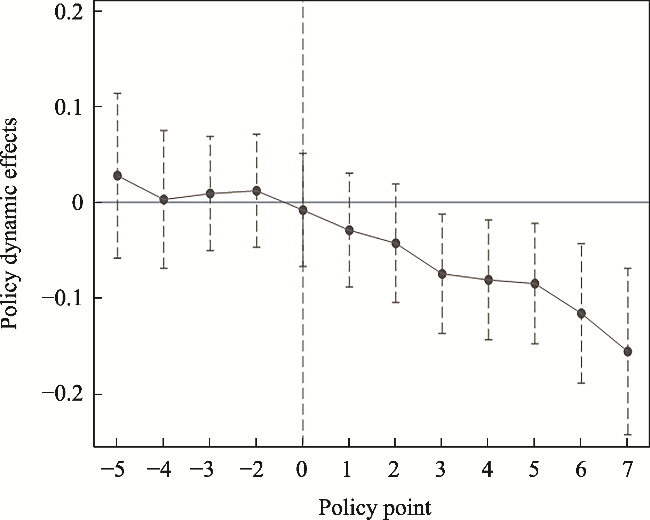
In the first step, a parallel trend test was conducted and the results are shown in Figure 3, which depicts the policy time point on the horizontal axis (with 0 signifying the implementation year) and the dynamic effect coefficients on the vertical axis. Here, the effect sizes before implementation (horizontal axis<0) are close to 0, suggesting no intervention effect, whereas the pattern after implementation (horizontal axis ≥0) visualizes the evolving impact over time, such as a progressively strengthening negative effect. The test results indicate that before the implementation of the “Broadband China” city pilot policy, the CI levels of the 41 cities in the YRD satisfied the parallel trend assumption.
Figure 3 Plot of parallel trends in carbon emission intensity
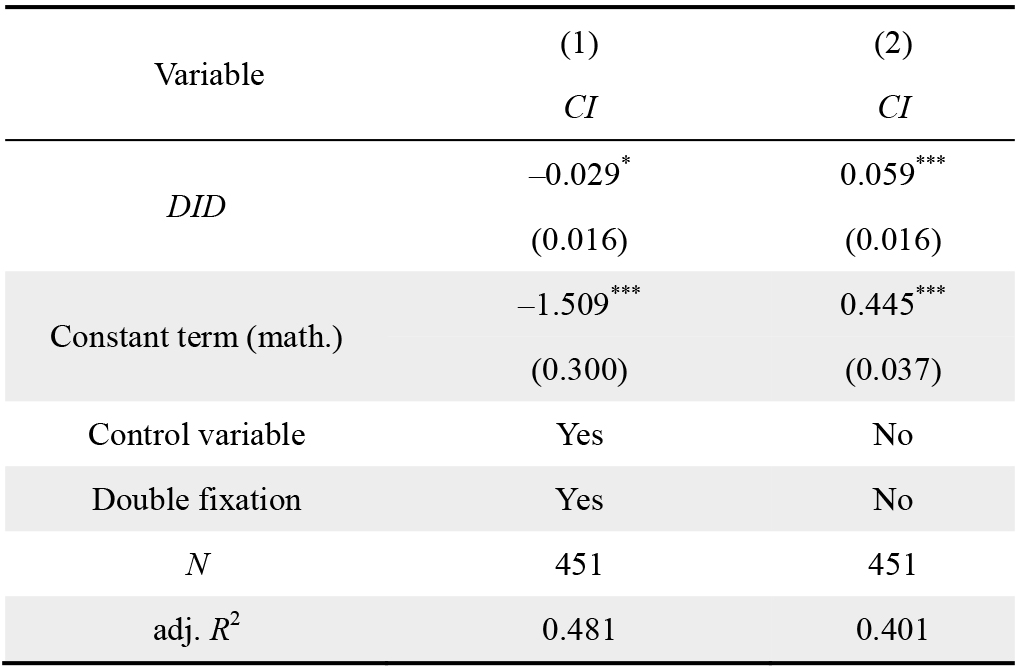
Next, a gradual DID model was employed to empirically estimate the carbon reduction effect of the “Broadband China” pilot policy, as presented in Table 4, Columns (1) and (3). The estimated coefficients for the DID variable are negative and reach significance at the 10% threshold, indicating that policies aimed at promoting DIG could effectively reduce the CI values of the 41 cities in the YRD, and the results are shown to be robust.
Table 4 Impact of the “Broadband China” policy on carbon emission intensity

Note: Standard errors are shown in parentheses; * P<0.1, ** P<0.05, *** P<0.01.

5.7 Mediation effect test

Building upon the benchmark regression, this section examines the mediating effects of IND upgrading and GTFP in the relationship between DIG and CI.
As shown in Table 5, Column (1) corresponds to Equation (1), Columns (2) and (4) correspond to Equation (4), and Columns (3) and (5) correspond to Equation (5). Columns (1), (2), and (3) reflect the mediating effect of IND upgrading, and yield a total effect of -0.597 on CI due to the DIG, with a direct effect of -0.524 and an indirect effect of -0.073 attributed to IND upgrading. Since the direct effect coefficient is significant, this suggests that IND plays a partial mediating role. This implies that DIG facilitates industrial structure transformation, which in turn helps to reduce CI. The mediating role of IND constitutes 12.23% of the total effect. Columns (1), (4), and (5) reflect the mediating effect of GTFP, and yield a total effect of -0.597 on CI due to the DIG, with a direct effect of -0.367 and an indirect effect of -0.230 attributed to green productivity. These findings indicate that GTFP partially mediates the linkage between DIG and CI, with the indirect pathway accounting for 38.36% of the total effect. Thus, the mediating effects of IND upgrading and GTFP between DIG and urban CI are preliminarily verified to be significant.
Table 5 Mediated effects test
Variable (1) (2) (3) (4) (5)
CI IND CI GTFP CI
DIG -0.597*** 0.409** -0.524*** 1.222*** -0.367***
(0.127) (0.189) (0.123) (0.252) (0.122)
IND -0.179***
(0.033)
GTFP -0.188***
(0.024)
Control variable Control Control Control Control Control
Double fixed effect Yes Yes Yes Yes Yes
_cons 1.731*** -1.296*** 2.813*** -1.077***
(0.441) (0.292) (0.587) (0.284)
N 451 451 451 451
adj. R2 0.701 0.514 0.250 0.549

Note: Standard errors are shown in parentheses; * P<0.1, ** P<0.05, *** P<0.01.

Based on the multi-step method to verify the mediating effects and to further prove their rationality, the Bootstrap method was applied to both mediators for 1000 resamples, and the results are shown in Table 6. The 95% confidence intervals for both mediators do not contain “0”, further validating the robustness of the mediation effect results. Hence, Hypotheses H2 and H3 are supported.
Table 6 Bootstrap mediation effect test
Variant Effect Ratio 95% Confidence interval
IND Indirect effect_bs_1 -0.073 [-0.1708, -0.0030]
Direct effect_bs_2 -0.524 [-0.8329, -0.2293]
GTFP Indirect effect_bs_1 -0.230 [-0.3708, -0.1291]
Direct effect_bs_2 -0.367 [-0.6888, -0.0518]

5.8 Moderation effect test

Table 7 examines the direct moderating effect of TI, as well as its moderating effect on the mediating variables. Specifically, Equation (6) is associated with Column (1), Equation (7) corresponds to both columns (2) and (4), and Equation (8) corresponds to both columns (3) and (5), while Equation (9) corresponds to Column (7). According to Column (1), the coefficient of the interaction term between TI and DIG is -0.154, which is in the same direction as the regression coefficient of the core explanatory variable DIG on CI, and is significant at the 1% level. This indicates that TI strengthens the inhibitory effect of DIG on CI. In Column (3), the coefficient of the interaction term between IND upgrading and TI is -0.022, which is significant at the 5% level. Combined with the steps of the moderated mediation model test, the above regression results prove that TI strengthens the mediating effect of IND upgrading and modulates the latter half of the path through which IND upgrading affects CI. This effect may be due to the fact that, on the one hand, an increase in technology investment in government budgets is often accompanied by policy support and market incentive measures that provide a favorable external environment for the development of the digital economy, further strengthening the inhibitory effect of the digital economy on CI. On the other hand, an increase in technology investment in government budgets also helps to promote the development of the industrial structure towards a more environmentally friendly and low-carbon direction, thus enhancing the inhibitory effect of industrial structure upgrading on CI. Hence, Hypotheses H4 and H5 are supported. Columns (5) and (6) show that the interaction term between TI and green productivity is not significant, indicating that TI does not modulate the mediating role of green productivity. Therefore, Hypothesis H6 is not supported.
Table 7 Moderating effect tests for TI
Variable (1) (2) (3) (4) (5) (6)
CI IND CI GTFP CI CI
DIG -0.570*** 0.235* -0.508*** 1.262*** -0.391*** -0.315***
(0.126) (0.183) (0.122) (0.255) (0.121) (0.120)
TI 0.051*** 0.109*** 0.074*** -0.004 0.052*** 0.052***
(0.018) (0.026) (0.018) (0.036) (0.017) (0.017)
TI×DIG -0.154*** 0.361*** -0.113 -0.195***
(0.052) (0.075) (0.105) (0.050)
IND -0.180***
(0.035)
TI×IND -0.022**
(0.010)
GTFP -0.188*** -0.194***
(0.023) (0.023)
TI×GTFP 0.006 0.028
(0.020) (0.020)
Control variable Control Control Control Control Control Control
Double fixed effect Yes Yes Yes Yes Yes Yes
_cons -1.468*** 0.286 -1.429*** 3.119*** -1.350*** -0.901***
(0.332) (0.480) (0.307) (0.670) (0.299) (0.315)
N 451 451 451 451 451 451
adj. R2 0.498 0.727 0.537 0.248 0.558 0.573

Note: Standard errors are shown in parentheses; * P<0.1, ** P<0.05, *** P<0.01.

5.9 Heterogeneity analysis

To further examine the transmission mechanism between the DIG and CI in the YRD, this study conducted a heterogeneity analysis based on the differential characteristics of the 41 cities in the region. According to the “National Resource-based City Sustainable Development Plan (2013- 2020)” issued by the State Council, the sample cities in the YRD were categorized into resource-based cities and non-resource-based cities. In addition, the “Yangtze River Delta Urban Agglomeration Development Plan” outlines a networked spatial pattern of “one core, five circles, and four belts”. This framework—where the “core” is Shanghai; the “five circles” are the Nanjing, Hangzhou, Hefei, Suzhou-Wuxi- Changzhou, and Ningbo metropolitan areas; and the “four belts” encompass the Shanghai-Nanjing-Hefei, Shanghai- Hangzhou-Jinhua, coastal, and Nanjing-Huzhou-Hangzhou development belts—formed the basis for our heterogeneity analysis. This analysis distinguishes between cities that are integrated into this core pattern and those that are not. The results are presented in Table 8.
Table 8 Heterogeneity analysis
Variable Resource-based city Yangtze River Delta “one core, five circles, and four belts” city
Yes No Yes No Yes No Yes No
(1) (2) (3) (4) (5) (6) (7) (8)
DIG -0.398 -0.570*** -0.236 -0.560*** -0.711*** -0.269 -0.682*** -0.452
(0.412) (0.144) (0.379) (0.142) (0.166) (0.239) (0.214) (0.258)
Control variable No No Yes Yes No No Yes Yes
Double fixed effect Yes Yes Yes Yes Yes Yes Yes Yes
_cons 0.439*** 0.462*** -3.271*** -1.182*** 0.561*** 0.304*** -0.775 -1.829**
(0.061) (0.046) (0.739) (0.374) (0.055) (0.039) (0.797) (0.649)
N 121 330 121 330 308 143 308 143
adj. R2 0.340 0.387 0.555 0.443 0.314 0.553 0.434 0.694

Note: “Yes” and “No” in the heading refer to whether it is a resource-based city; Standard errors are shown in parentheses; * P<0.1, ** P<0.05, *** P<0.01.

Columns (1) to (4) report a comparison between resource-dependent and other cities. The results indicate that, even after accounting for control variables, DIG does not has a statistically significant effect on CI in resource-dependent areas. In contrast, the empirical results for non-resource-based cities align with the primary regression findings, suggesting that digital expansion in these areas contributes more effectively to carbon emission reduction. Resource-based cities are more reliant on carbon-intensive industries in both economic structure and employment. Geographically, resource-based cities are primarily located in
northern Anhui Province, where the measured level of DIG is relatively low. Therefore, for resource-based cities in the YRD, the impact of DIG on CI is not pronounced. This indicates that urban transformation is the key for resource-based cities to leverage the suppressive effect of the digital economy on carbon emissions.
Columns (5) to (8) differentiate between cities that are part of the “one core, five circles, and four belts” spatial pattern in the YRD and those that are not. The results show that the impact in cities that are not part of this region is not significant, regardless of the inclusion of control variables. For cities within this spatial pattern, the significance of the test results is consistent with the main regression, but the impact is stronger than that in the main regression results. This suggests that the networked spatial pattern of “one core, five circles, and four belts” effectively enhances the overall competitiveness of cities within this area and strengthens the suppressive effect of the DIG on CI.

6 Conclusions and policy implications

6.1 Conclusions

This study reveals that the development of the digital economy contributes to the reduction of urban CI. Both IND upgrading and GTFP are identified as partial mediators in the relationship between DIG and CI. The digital economy mitigates carbon emissions by promoting industrial transformation and enhancing GTFP. Moreover, government investment in science and technology not only reinforces the direct suppressive effect of the digital economy on emissions but also amplifies the mediating effect of industrial upgrading by strengthening its emission-reducing pathway. However, the analysis indicates that in resource-based cities, the development of the digital economy does not exert a significant carbon reduction effect. Similarly, cities located outside the “one core, five circles, and four belts” strategic zones within the Yangtze River Delta do not experience a notable decline in CI as a result of digital economic development, reflecting spatial disparities in its effectiveness.

6.2 Policy implications

Based on the findings, we propose the following targeted policy recommendations to promote digital economy-driven carbon mitigation in the YRD urban agglomeration.

6.2.1 Strengthen digital infrastructure to support green transformation

The development of new digital infrastructure is essential for enabling the digital economy to contribute to carbon reduction. Efforts should focus on accelerating the deployment of 5G networks, big data centers, and industrial internet platforms to improve data flow efficiency and intelligent energy management. Special emphasis should be placed on closing infrastructure gaps in small and resource-based cities to mitigate regional disparities in emission reduction capacity.

6.2.2 Promote low-energy, high-value-added industries through digital-industrial synergy

Encouraging the growth of low-energy, high-value-added industries is the key to aligning DIG with industrial upgrading. Governments should support the transformation of traditional energy-intensive sectors through tax incentives and fiscal subsidies, while cultivating emerging industries such as integrated circuits, biopharmaceuticals, artificial intelligence, and new energy vehicles to drive innovation-led regional development.

6.2.3 Enhance the green technology system to improve GTFP

Improving GTFP requires advancing the green technology system. This includes refining green production standards, strengthening environmental certification systems, and encouraging the adoption of eco-friendly materials and clean technologies. By building innovation platforms and fostering collaboration among industry, academia, and research institutions, green technologies can be more effectively translated into practice.

6.2.4 Establish dedicated funds for digital-green integration

Creating dedicated funding mechanisms to support the integration of digital technologies and low-carbon development can enhance the coordinated emission reduction capacity. A specific budget line for digital-green initiatives should be included in public R&D investments, targeting technological breakthroughs and pilot projects. Differentiated policy tools, such as tax relief and financial subsidies, can further incentivize enterprise-level green transitions.

6.2.5 Advance regional carbon governance through integrated mechanisms

The Yangtze River Delta should strengthen its regional collaboration in carbon governance by integrating DIG with emission reduction efforts. This involves establishing shared carbon monitoring and early warning systems, harmonizing technical standards for carbon trading, and aligning performance evaluation frameworks. Under the “one core, five circles, and four belts” strategy, inter-city coordination and industrial complementarity can improve the overall carbon mitigation efficiency while avoiding redundant investments and carbon leakage.

6.3 Future research directions

Three key areas for further research are:
(1) Micro-level firm behaviors in adopting digital and green technologies, and assessing their impact on carbon emissions and productivity;
(2) Long-term dynamic effects of digitalization on carbon reduction, utilizing high-frequency data; and
(3) Cross-regional comparative studies that identify best practices for integrating digital economy strategies into global carbon neutrality efforts.
By advancing research in these areas, policymakers can refine evidence-based strategies to ensure that DIG effectively contributes to sustainable urbanization and low-carbon growth in the Yangtze River Delta and beyond.
[1]
Chen S Y, Tan Z X, Mu S Y, et al. 2023. Synergy level of pollution and carbon reduction in the Yangtze River Economic Belt: Spatial-temporal evolution characteristics and driving factors. Sustainable Cities and Society, 98: 104859. DOI: 10.1016/j.scs.2023.104859.

[2]
Cheng Y, Zhang Y, Wang J J, et al. 2023. The impact of the urban digital economy on China’s carbon intensity: Spatial spillover and mediating effect. Resources Conservation and Recycling, 189: 106762. DOI: 10.1016/j.resconrec.2022.106762.

[3]
Ferdaus M M, Dam T, Anavatti S, et al. 2024. Digital technologies for a net-zero energy future: A comprehensive review. Renewable & Sustainable Energy Reviews, 202: 114681. DOI: 10.1016/j.rser.2024.114681.

[4]
Freire-Gonzalez J, Vivanco D F. 2017. The influence of energy efficiency on other natural resources use: An input-output perspective. Journal of Cleaner Production, 162: 336-345.

DOI

[5]
Guo F, Wang J Y, Wang F, et al. 2020. Measuring China’s digital financial inclusion: Index compilation and spatial characteristics. China Economic Quarterly, 19(4): 1401-1418. (in Chinese)

[6]
Hsu A, Li L L, Schletz M, et al. 2024. Chinese cities as digital environmental governance innovators: Evidence from subnational low-carbon plans. Environment and Planning B—Urban Analytics and City Science, 51(3): 572-589.

[7]
Huang Q H, Yu Z Z, Zhang S L. 2019. Internet development and productivity growth in the manufacturing industry: Internal mechanism and China’s experiences. China Industrial Economics, (8): 5-23. (in Chinese)

[8]
Jiakui C, Abbas J, Najam H, et al. 2023. Green technological innovation, green finance, and financial development and their role in green total factor productivity: Empirical insights from China. Journal of Cleaner Production, 382: 135131. DOI: 10.1016/j.jclepro.2022.135131.

[9]
Khan M. 2020. CO2 emissions and sustainable economic development: New evidence on the role of human capital. Sustainable Development, 28(5): 1279-1288.

DOI

[10]
Kurniawan T A, Othman M H D, Liang X, et al. 2023. Decarbonization in waste recycling industry using digitalization to promote net-zero emissions and its implications on sustainability. Journal of Environmental Management, 338: 117765. DOI: 10.1016/j.jenvman.2023.117765.

[11]
Kwilinski A. 2024. Understanding the nonlinear effect of digital technology development on CO2 reduction. Sustainable Development, 32(5): 5797-5811.

DOI

[12]
Li H J, Zhang Y, Li Y. 2024. The impact of the digital economy on the total factor productivity of manufacturing firms: Empirical evidence from China. Technological Forecasting and Social Change, 207: 123604. DOI: 10.1016/j.techfore.2024.123604.

[13]
Li Z Q, Wu H Y. 2022. Zero-carbon evaluation of cities in the Yangtze River Delta. Fudan Journal (Social Sciences Edition), 64(5): 142-151. (in Chinese)

[14]
Liu X, Shen B, Price L, et al. 2019. A review of international practices for energy efficiency and carbon emissions reduction and lessons learned for China. Wiley Interdisciplinary Reviews—Energy and Environment, 8(5): 342. DOI: 10.1002/wene.342.

[15]
Ma Q, Tariq M, Mahmood H, et al. 2022. The nexus between digital economy and carbon dioxide emissions in China: The moderating role of investments in research and development. Technology in Society, 68: 101910. DOI: 10.1016/j.techsoc.2022.101910.

[16]
Owen R, Brennan G, Lyon F. 2018. Enabling investment for the transition to a low-carbon economy: Government policy to finance early-stage green innovation. Current Opinion in Environmental Sustainability, 31: 137-145.

DOI

[17]
Ramirez-Rodriguez L C, Ormazabal M, Jaca C. 2024. Mapping sustainability assessment methods through the industrial symbiosis life cycle for a circular economy. Sustainable Production and Consumption, 50: 253- 267.

DOI

[18]
Ripple W J, Wolf C, Gregg J W, et al. 2024. The 2024 state of the climate report: Perilous times on planet Earth. Bioscience, 74(12): 812-824.

[19]
Rowan N J, Murray N, Qiao Y, et al. 2022. Digital transformation of peatland eco-innovations (Paludiculture): Enabling a paradigm shift towards the real-time sustainable production of green-friendly products and services. Science of the Total Environment, 838: 156328. DOI: 10.1016/j.scitotenv.2022.156328.

[20]
Shahbaz M, Wang J, Dong K, et al. 2022. The impact of the digital economy on energy transition across the globe: The mediating role of government governance. Renewable & Sustainable Energy Reviews, 166: 112620. DOI: 10.1016/j.rser.2022.112620.

[21]
Shan C X, Zhou W J, Geng Z Z. 2024. Environmental regulation, green technology innovation and sustainable development: An analysis of moderated mediating effect. On Economic Problems, (8): 95-102. (in Chinese)

[22]
Tian H, Zhao T P, Wu X Q, et al. 2024. The impact of digital economy development on carbon emissions-based on the perspective of carbon trading market. Journal of Cleaner Production, 434: 140126. DOI: 10.1016/j.jclepro.2023.140126.

[23]
Wang W G, Wang Y L, Fan D. 2023. Effects and mechanisms of the digital economy for carbon emission reduction. China Environmental Science, 43(8): 4437-4448. (in Chinese)

[24]
Wen Z L, Ye B J. 2014. Different methods for testing moderated mediation models: Competitors or backups? Acta Psychologica Sinica, 46(5): 714-726. (in Chinese)

DOI

[25]
Wu Y N, Al-Duais Z A M, Zhu X Q, et al. 2024a. Digital economy’s role in shaping carbon emissions in the construction field: Insights from Chinese cities. Journal of Environmental Management, 365: 121548. DOI: 10.1016/j.jenvman.2024.121548.

[26]
Wu Y, Zong T, Shuai C Y, et al. 2024b. How does new-type urbanization affect total carbon emissions, per capita carbon emissions, and carbon emission intensity? An empirical analysis of the Yangtze River Economic Belt, China. Journal of Environmental Management, 349: 119441. DOI: 10.1016/j.jenvman.2023.119441.

[27]
Xu Y Y, Liu Z, Walker T R, et al. 2024. Spatio-temporal patterns and spillover effects of synergy on carbon dioxide emission and pollution reductions in the Yangtze River Delta region in China. Sustainable Cities and Society, 107: 105419. DOI: 10.1016/j.scs.2024.105419.

[28]
Yi M, Liu Y F, Sheng M Y, et al. 2022. Effects of digital economy on carbon emission reduction: New evidence from China. Energy Policy, 171: 113271. DOI: 10.1016/j.enpol.2022.113271.

[29]
Yuan X L, Sheng X R, Chen L P, et al. 2022. Carbon footprint and embodied carbon transfer at the provincial level of the Yellow River Basin. Science of the Total Environment, 803: 149993. DOI: 10.1016/j.scitotenv.2021.149993.

[30]
Zhang Y, Wu Q, Zhao X Y, et al. 2018. Study of carbon metabolic processes and their spatial distribution in the Beijing-Tianjin-Hebei urban agglomeration. Science of the Total Environment, 645: 1630-1642.

DOI

Outlines

/