Ecotourism

The Cultural and Tourism Development Path of Linear Corridors in the Spatiotemporal Differentiation of Liao Pagoda Heritage

  • DONG Xiaolong ,
  • TANG Jian , *
Expand
  • Dalian University of Technology, Dalian, Liaoning 116000, China
* TANG Jian, E-mail:

DONG Xiaolong, E-mail:

Received date: 2025-04-29

  Accepted date: 2025-08-11

  Online published: 2025-10-14

Abstract

The unique architectural form and decorative craftsmanship of Liao Pagodas serve as tangible evidence of the diverse unity of Chinese civilization. Research on the existing Liao Pagodas has revealed a clear linear spatiotemporal differentiation. In the temporal dimension, the density and characteristics of their construction align with the rise and fall of the Liao Dynasty's national strength. In the spatial dimension, Liao Pagodas are centered around the five capitals of Liao and show a marked gradient of decline along major transportation routes and the Song-Liao border. This distribution is both constrained by natural geographical conditions and reflective of the Liao dynasty's political wisdom of “governing according to local customs” by implementing a dual-track system of governance that used national systems for the Khitan and Han systems for the Han people. However, in current cultural tourism development practices, Liao Pagodas are often developed in a “scenic spot” manner using a singular, isolated model, leading to their disconnection and fragmentation from the overall layout of Liao cities, regional religious networks, and even historical contexts. This weakens the comprehensive interpretation and depth of experience of their heritage value. To address these issues, this paper proposes a “linear corridor” cultural tourism development approach for Liao Pagoda cultural heritage based on a study of their spatiotemporal differentiation. This approach breaks the isolation of individual heritage sites and constructs a cross-regional cultural heritage corridor. It focuses on exploring operational implementation paths such as “series cultural creations”, “linked research studies”, and “technological narratives”. This perspective not only effectively avoids the risk of cultural context fragmentation caused by individual development but also provides a practical direction for the revitalization and utilization of Liao Pagoda heritage, which supports the coordinated development of the regional culture and economy.

Cite this article

DONG Xiaolong , TANG Jian . The Cultural and Tourism Development Path of Linear Corridors in the Spatiotemporal Differentiation of Liao Pagoda Heritage[J]. Journal of Resources and Ecology, 2025 , 16(5) : 1603 -1612 . DOI: 10.5814/j.issn.1674-764x.2025.05.029

1 Introduction

The Liao Pagodas (constructed between 916 and 1125 AD) stand amidst the northern landscapes, and have endured the elements for a millennium. Their unique architectural form and profound cultural significance serve as a crucial key for decoding Liao Dynasty civilization. As a material testament to the Khitan people's absorption and innovation of Central Plains Buddhist culture, the Liao Pagodas not only fulfil religious worship functions but also embody the construction wisdom and artistic pursuits of Liao craftsmen. From the rhythmic layers of the dense-eaves brick pagoda to the fusion of Hu and Han in brick carvings, these stone-built epics silently narrate the dialogue between nomadic regimes and agrarian civilizations. In the contemporary context, the Liao Pagodas are both valuable specimens for studying the social structure, technological dissemination, and belief systems of the Liao Dynasty, and a temporal link connecting historical memory with modern cultural tourism. An analysis of the intrinsic logic of their spatial and temporal distribution can reveal the interactive mechanisms between Buddhist dissemination and political geography, as well as pave new paths for living heritage transmission.
To systematically analyze their heritage value and spatial pattern, this study comprehensively utilized drone oblique photography technology and GIS spatial analysis technology to conduct high-precision data collection, spatial positioning, and the systematic collection of attribute information for the 104 extant Liao Pagodas (Table 1). The aim was to lay a solid foundation for scientifically interpreting the heritage value of the Liao Pagodas and revitalizing their contemporary vitality through multidisciplinary technical support and innovative pathways of multi-industry integration. Reviving the dormant bricks and stones to new life and continuing to burn the flame of civilization in the integration of culture and tourism reflect the contemporary significance of re-exploring the heritage value of the Liao Pagodas.
Table 1 The 104 existing Liao Pagodas
No. Name Province No. Name Province No. Name Province No. Name Province
1 Nong’an Liao Pagoda Jilin 27 Dachengzi Tower Liaoning 53 Nan’an Tower Hebei 79 Beijing Chaohua Temple Beijing
2 Yongfeng Pagoda Liaoning 28 Eight Pagodas Tower 54 Qing hua Temple Flower Pagoda 80 Zhaota Pagoda
3 Liaoyang WhitePagoda 29 Miaofeng Temple Twin Pagoda 55 The Pagoda of the Sanctuary 81 Yunju Temple South Pagoda Site
4 Tawan Pagoda 30 The pure and spotless Stupa 56 Shuangta Temple Pagoda 82 Yunju Temple Tiger Pagoda
5 Gaoershan Liao Pagoda 31 Dongta Mountain Pagoda 57 Tiangong Temple Pagoda 83 Jade Emperor Pagoda
6 Haichengjin Pagoda 32 Twin Towers Temple Twin Pagoda 58 Xigang Pagoda 84 Repentance Master Zhenghui Spirit Pagoda
7 Liaobin Pagoda 33 Yunjie Temple Pagoda 59 Xingwen Pagoda 85 Whip Pagoda
8 Shifo Temple Pagoda Base 34 Big Pagoda 60 Yanzi Pagoda 86 Yunju Temple Stone Scripture Building
9 Chongshou Temple Pagoda 35 Chaoyang South Pagoda 61 Yong’an Temple Pagoda 87 Changping Half Cut Pagoda
10 Tayingzi Pagoda 36 Chaoyang North Pagoda 62 Zhuozhou Twin Pagoda 88 Tongzhou Lantern Pagoda
11 Tashan Pagoda 37 Huaishu Dong Pagoda 63 Zunhua Security Tower 89 Daxing Tallinn
12 Tieling White Pagoda 38 Xiangyan Temple South Pagoda 64 Wuhou Pagoda 90 Haotian Pagoda
13 Baota Temple Pagoda 39 Shimogou Pagoda 65 Yongqing Pagoda White Pagoda 91 Tianning Temple
14 Chongxing temple Pagoda 40 Siguanyingzi Xiao Pagoda 66 Fengrun Pharmacist Pagoda 92 Haidian Pu’an Pagoda
15 Guangji Temple Pagoda 41 Lingshan Temple in Beizhen, Tallinn 67 Huayan Temple Stone Scripture Building Shanxi 93 Liao Zhaoxian Pagoda Base
16 Panchita 42 Half section Pagoda Inner Mongolia 68 Yangta Village Pagoda 94 Fajun Monk Tomb Pagoda
17 Anchang hyeon Pagoda 43 Daming Pagoda 69 Chanfang Temple Pagoda 95 Fajun Monk's Robe Pagoda
18 Guangsheng Temple Pagoda 44 Jing’an Temple Pagoda 70 Huayan Temple Brick Pagoda 96 Yunju Temple Stone Scripture Palace
19 Qingfeng Pagoda 45 Liao Shakyamuni Buddha Relic Pagoda 71 Nanshangzhai Relic Pagoda 97 Wanfotang Flower Pagoda
20 Shuangtagou Pagoda 46 Shangjing North Pagoda 72 Yingxian Wood Pagoda 98 Liushimin Pagoda
21 Dongping Pagoda 47 Shangjing South Pagoda 73 Jueshan Temple Pagoda 99 Shangshan Pavilion style Pagoda
22 Huanghuatan Pagoda 48 Fifty Family Pagoda 74 Jueshan Temple Small Pagoda 100 The penitent goes to the tomb tower
23 Eight sided observation Pagoda 49 Wu’an Prefecture Pagoda 75 Yunju Temple North Pagoda Beijing 101 The Pagoda of Ancient Buddha Relics Tianjin
24 Baitayu Pagoda 50 Wanbuhuayan Jing Pagoda 76 Kaishan Wangong Pagoda 102 Elder Chegong and Monk Ling Pagoda
25 Avant garde crooked Pagoda 51 Buddhist Lynx Yilunita Hebei 77 Yexian Pagoda 103 Jixian White Pagoda
26 Eighteen Mile Burger Pagoda 52 Lingshan Temple Pagoda 78 Fangshan Tiankai Pagoda 104 Fushan Pagoda Temple

2 Spatiotemporal differentiation characteristics of Liao Pagoda heritage

2.1 The temporal evolutionary characteristics of Liao Pagoda heritage

The spatial and temporal distribution characteristics of Liao Pagodas serve as important empirical evidence for studying the political changes, religious dissemination, and technological developments during the Liao Dynasty. From a temporal perspective, the construction trajectory of the Liao Pagodas is closely intertwined with the rise and fall of the dynasty and exhibits four distinct stages (Table 2).
Table 2 The temporal evolution of Liao Pagodas
Historical period Liao Pagoda name Construction year Pagoda layer type Number of layers Floor height (m)
Inheritance and development period
(907-982);
approximately three Liao Pagodas
Shangjing South Pagoda Early Liao Dynasty
(Mid-10th century)
An octagonal hollow seven-story brick tower with multiple eaves 7 25
Shangjing North Pagoda Early Liao Dynasty
(Mid-10th century)
Hexagonal solid five-story multi-eaved brick tower 5 13
Wu’an Prefecture Pagoda Early Liao Dynasty
(Late 10th century)
An octagonal hollow 13-story brick tower with multiple eaves 13 29.97
The peak period of shaping(983-1055); approximately 40 Liao Pagodas Nong’an Liao Pagoda In the third year of Taiping of Emperor Shengzong of Liao (1023) Octagonal solid 13-story multi-eaved brick tower 13 44
The pure and spotless Stupa In the thirteenth year of the Chongxi reign of the Liao Dynasty (1044) An octagonal hollow 13-story brick tower with multiple eaves 13 31.59
Yongfeng Pagoda In the thirteenth year of the Chongxi reign of the Liao Dynasty (1044) Octagonal solid 13-story multi-eaved brick tower 13 23.4
Liaoyang White Pagoda Middle period of the Liao Dynasty
(Approximately the early 11th century)
Octagonal solid 13-story multi-eaved brick tower 13 59.58
Huanghuatan Pagoda Middle period of the Liao Dynasty
(Approximately the early 11th century)
Octagonal solid 13-story multi-eaved brick tower 13 33.83
Continue the period of decline (1032-1125);
approximately 20 Liao Pagodas
Tiangong Temple Pagoda In the first year of Qingning of Emperor Daozong of Liao (1055) An octagonal and 13-story brick tower with multiple eaves 13 23.99
Chaoyang South Pagoda In the second year of the reign of Emperor Daozong of Liao (1076) A square hollow 13-story brick tower with multiple eaves 13 48.63
The Pagoda of the Sanctuary In the third year of the reign of Emperor Tianzuo of the Liao Dynasty (1103) An octagonal and 13-story brick tower with multiple eaves 13 23.64
Buddhist Lynx Yilunita In the seventh year of the Tianqing era of the Liao Dynasty (1117) Hexagonal, 13-story hollow, multi-eaved brick tower 13 16.09
The pagoda of Zen House Temple In the thirteenth year of the Chongxi reign of Emperor Xingzong (1044) An octagonal hollow three-story pavilion combined with a multi- eaved brick tower 3 12.29
Multi-variable period
(1125-1912); approximately 10 or more Liao Pagodas
Chongshou Temple Pagoda In the Yuanlong year of the Jin Dynasty (1156) Octagonal solid 13-story multi-eaved brick tower 13 41.51
Anchang hyeon Pagoda In the fourth year of the Jintiande era (1152) Octagonal solid seven-story multi-eaved brick tower 7 12.5
First, the inheritance and development period of the construction of the Liao Pagodas spanned 907-984. During this period, most of the pagodas were located in core ruling areas such as Shangjing Linhuang Prefecture. Currently, only three pagodas with clear chronological records are known. In terms of design, they departed from the quadrilateral structure of Tang pagodas, while in decoration, they continued the simple and unadorned style of Tang pagodas. The style is rustic, reflecting the cautious exploration of a nomadic regime's initial engagement with settled civilization. The emergence of the Liao Pagoda was related to Liao Taizu Yelü Abaoji's establishment of Shangjing in Linhuang Prefecture in the third year of the Shence era (918 AD) (Cui, 2024). Over the course of more than a hundred years, the Liao Dynasty completed the establishment of the Five Capitals system (Ju, 2021). In terms of administrative management, the Liao Dynasty adopted the “dual administration system” to govern the country, which showcased a unique blend of nomadic and agricultural civilizations. During this process, not only were the connections and exchanges between the Liao Dynasty and the Central Plains strengthened, but contact with Buddhist culture also gradually developed, leading to the initial emergence of pagoda construction.
Second, the finalized and heyday period of the construction of Liao Pagodas (984-1055) corresponds to the reigns of Emperor Shengzong and Emperor Xingzong. During this time, the number of pagodas increased significantly compared to earlier periods, and the multi-eaved brick pagoda design gradually became a symbolic architectural form, with the number of tiers exceeding 13. This development was due to the signing of the “Treaty of Chanyuan” between the Song and Liao, which marked the beginning of a prosperous era for the Liao Dynasty. Emperor Shengzong had a profound understanding of Buddhism and implemented Buddhist governance policies, leveraging the strong national power. Emperor Xingzong implemented the “Chongxi Zengbi” policy to strengthen trade relations with the Song Dynasty, which provided a solid material foundation for large-scale construction projects. Driven by the ruling class's policy of promoting Buddhism, “Buddhist activities were initiated everywhere in the Liao realm, and temples and monasteries were established in various places”.
Third, the continuous decline period of the construction of Liao Pagoda (1032-1125) spans the reigns of Emperor Daozong to Emperor Tianzuo of the Liao Dynasty. Most of the existing Liao Dynasty Pagodas in Northeast China, Inner Mongolia, and North China were constructed during this time (Gu, 2013). According to the statistics, there are 19 Liao Pagodas in this group with distinct periods and precise geographical coordinates. By the time of Emperor Tianzuo, the Liao dynasty had entered its later period, with increasing internal and external troubles. The rulers hoped to maintain the tradition of Buddhism by building pagodas to pray for the protection of the nation and the stabilization of public sentiment. The construction of Liao Pagodas was possibly imbued with the wish to “guard the land”, in an attempt to use religious power to save the fate of the nation. However, with the fall of the Liao to the Jin in 1125, the tradition of constructing Liao Pagodas was gradually inherited by the Jin Dynasty, and the pagodas changed in form and function.
Fourth, the period of diverse and complex changes in the construction of the Liao Pagodas spanned from the Jin and Yuan dynasties to the Ming and Qing dynasties (1128-1912). Starting from the Yuan Dynasty, the Mongolian ethnic group settled in the Central Plains, and Lamaism began to spread. Influenced by religion, the form of the towers also changed. During this period, the construction of towers was no longer purely for Buddhist purposes. The types of towers increased, and their forms became more diverse. Chinese towers began to enter a period of hybrid variation. The number of newly built Buddhist towers decreased sharply, but the continuity of cultural integration can still be identified in the existing structures. The wall paintings of the Prajna Hall in the Huayan Temple in Datong, which were rebuilt during the Yuan Dynasty, clearly retain the characteristics of the Liao Dynasty in the construction method of the Heavenly Palace Pavilion, thus confirming the tenacious vitality of the Liao Pagoda technical tradition.

2.2 Spatial distribution characteristics of Liao Pagoda heritage

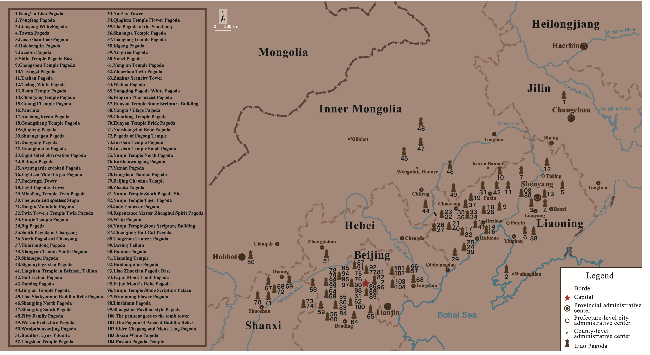
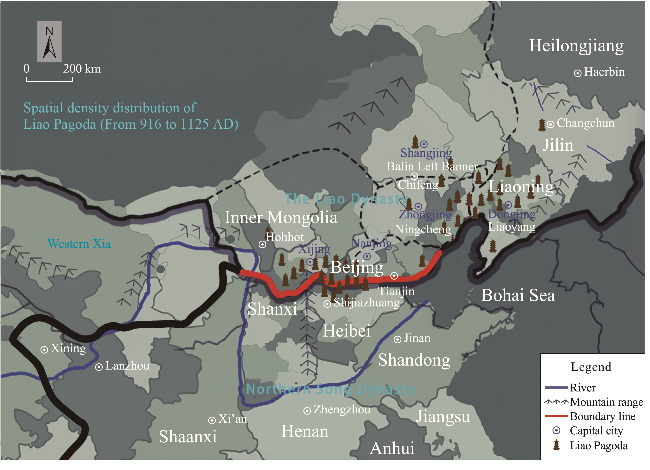
The spatial distribution of the Buddhist pagoda clusters in the Liao Dynasty represents a three-dimensional chronicle etched into the vast expanse of northern China. The characteristics of their pattern deeply reflect the evolution of the political economy and religious culture during the Liao Dynasty. Employing high-precision 3D data collected by drone oblique photography technology, combined with GIS spatial analysis methods, this study found that the more than 100 existing Liao Pagodas are mainly scattered along the intersection of the Northeast Plain, North China Mountains, and Inner Mongolia grasslands. They form a dual-core agglomeration centered on the Zhongjing Circuit and Nanjing Circuit of the Liao Dynasty. The former is centered on the Daming Pagoda in Ningcheng, Inner Mongolia, and extends along the Xilamulun River, while the latter is centered on the Tianning Temple Pagoda in Beijing, and radiates to northern Hebei. At a macro level, the distribution presents a clear trend of “dense in the southeast and sparse in the northwest”, specifically showing a pattern that gradually decreases from the five capitals of the Liao Dynasty as core nodes to the periphery and major transportation routes, as well as the border between the Song and Liao Dynasties. This distribution is actually a result of the dual effects of geographical environment and civilization progress.
The geographical foundation profoundly shapes the logic behind the selection of Buddhist pagoda locations. All five capitals of the Liao Dynasty were situated in the valley plains north and south of the Yanshan Mountains. This area not only served as a commercial corridor connecting the Central Plains and the grasslands but also provided the material foundation to support large religious buildings. The water system network, like the capillaries of cultural dissemination, connects the spatial map of the Liao Pagoda clusters. The Chaoyang North Pagoda and the Fengguo Temple Pagoda clusters in the Daling River Basin constitute the axis for the eastward spread of Buddhism. The orientation of each pagoda's spire subtly aligns with the direction of trade routes, which provided continuous momentum for the construction of Buddhist pagodas (Figure 1).
Figure 1 Spatial distribution pattern of the Liao Pagodas
The process of civilization altered the distribution pattern of the Liao Pagodas. Before Emperor Shengzong's reign, the Liao Pagodas were predominantly concentrated around the five capitals. During Emperor Xingzong's period, they extended toward military garrisons, and after Emperor Daozong's reign, they penetrated deeper into tribal nomadic areas. Following the Treaty of Chanyuan, the prosperity of border trading hubs gave rise to a unique “monastery economy”, which provided ample financial resources for the construction of Buddhist pagodas. This pattern, which is distributed along major transportation routes and along the border between the Song Dynasty and Liao, reveals a high degree of coupling between the spread of Buddhism and trade routes in the Liao Dynasty. The pattern of decreasing spatial density from the core to the edge is not only a geographical reflection of the localization of Buddhism but also a historical testimony to the process of cultural integration in the Liao Dynasty (Figure 2).
Figure 2 Spatial density distribution of the Liao Pagodas

2.3 Factors influencing the distribution of Liao Pagoda heritage

The spatial and temporal distribution pattern of the Liao Pagodas is essentially a historical product of the combined effects of political and religious strategies during the Liao Dynasty, as well as geographical and economic conditions. The ruling class of the Liao Dynasty implemented the policy of “strengthening the country through Buddhism” politically, and incorporated Buddhist architecture into the national governance system. The capital cities under the Five-Capital System were not only administrative centers but they were also shaped as the cradle of Buddhist dissemination (Lai, 2015).
The construction and distribution of Buddhist pagodas in the Liao Dynasty were always closely linked to the fate of the dynasty. During the reign of Emperor Shengzong, the country was prosperous and the construction of Buddhist pagodas reached its first peak. They were concentrated in the central capital area, accounting for both the control of the four directions and the response to external military pressure. In the era of Emperor Xingzong, as external threats shifted to the northwest, the focus of pagoda construction shifted southward. The southern capital area became the new core, and Buddhist pagodas were not only seen in military towns but also began to expand to places with prosperous commerce and thriving temples, indicating that Buddhist beliefs had penetrated the lives of the common folk. The period of Emperor Daozong marked the heyday of Buddhist pagoda construction, with pagodas spreading across grasslands, agricultural areas, and even border regions. This was not only a means for the court to consolidate its rule through religion but also reflected the deep integration of Buddhism with local culture. In the early days of Emperor Tianzuo, the construction of Buddhist pagodas was still concentrated in the traditional central and southern regions. However, as the Jin army continuously conquered more cities and territories from east to west, construction activities were forced to move westward step by step, and their trajectory coincided with changes in the territory of the Liao Dynasty. Eventually, on the eve of the dynasty's fall, the western border became the last concentrated construction site for Buddhist pagodas. This dynamic spatial change clearly reflected the entire process of the Liao Dynasty's decline from its heyday.
Geographical and economic factors objectively support the spatial agglomeration of the tower clusters. The Liao River Basin, known as the “land of dragon ascendancy” for the Khitan people, boasts fertile soil on its alluvial plain, which nurtured a thriving agricultural economy. The water transportation network formed by the Silamulun River and the Daling River facilitated efficient transportation and brough skilled architects and artisans from the Central Plains and the Western Regions, fostering technological integration.
Based on the above summary, the evolution of the tower construction centers in the Liao Dynasty was influenced by a combination of factors, including cultural and educational trends, political demands, external pressures, and local economic strength (Chen and Tong, 2012). The synergistic effect of political will and geographical endowments ultimately shaped the unique landscape of Liao Pagoda distribution. This agglomeration is not only a manifestation of resource concentration, but also powerful proof of the Khitan rulers’ cultural domination through spatial planning. When merchants traveled along the river and saw the continuous shadows of pagodas, they experienced not only the solemnity of Buddhism, but also the projection of power everywhere in the Liao Empire.

3 The current situation and challenges in the integration of culture and tourism

3.1 The development model is becoming monotonous, and the user experience is becoming superficial

The cultural heritage of the Liao Pagodas is facing challenges from modern tourism development, with contradictions between traditional protection models and emerging demands. Although the integration of cultural tourism in the Liao Pagodas has begun to be explored, many issues remain such as insufficient practice and structural contradictions.
In terms of the development model, most regions still continue to develop individual Liao Pagodas as isolated objects. The mainstream model centers on cultural relic protection, opening to the public through repair and reinforcement, site identification, and basic guided tours which focus on showcasing their construction dates and architectural features. A few scenic spots attempt to combine traditional festivals that hold blessing activities to attract tourists. Although this model has improved the visibility of Liao Pagodas to some extent, it still fails to break free from the limitations of “static display”. As a result, tourist experiences mostly remain at the level of appearance appreciation and superficial cultural cognition, which makes it difficult to evoke deep emotional resonance and value recognition.
Despite some initiatives in the development of cultural tourism around the Liao Pagodas, they are constrained in some regions by the development approach of individual buildings, resulting in a relatively monotonous model. For instance, in Chaoyang, Liaoning, although archaeologists have successfully restored the exhibition system of cultural relics in the underground palace of the North Tower, visitors can only peer through the glass between steel fences to glimpse the gilded Buddhist tower from a thousand years ago. The construction wisdom of Khitan craftsmen, based on “sun the earth for three years and build a golden city with glutinous rice”, has been reduced to cold text on display boards. When a local government builds a simulated Khitan market around the Liao Pagodas to enhance tourism appeal, and vendors dressed in chemical fiber “antique costumes” hawk industrial souvenirs, the distorted reconstruction of historical scenes undermines the solemnity of their true cultural heritage.
If this situation persists, the tourists’ understanding of the overall value of the Liao Pagoda cultural heritage will be limited, which is not conducive to the dissemination and inheritance of Liao Pagoda culture over a wider range.

3.2 Imbalance in protection and utilization, and contradictions in development

After thousands of years of erosion by wind and rain, the existing Liao Pagodas generally face potential risks such as weathered bricks and stones, structural instability, and other issues. Especially for those located in remote areas or lacking continuous maintenance, the degree of damage has been intensifying year by year. Some towers have holes formed by theft and excavation in the early years, and the inclination and cracks of the tower bodies are shocking. However, due to the high threshold of professional restoration technology and limited funding channels, rescue projects often progress slowly.
Although some regions have incorporated the Liao Pagodas into their tourism development plans, the single-minded pursuit of short-term benefits and neglect of scientific evaluation and long-term maintenance have led to the risk of secondary damage to the repaired towers under the pressure of tourist traffic. This tendency to “emphasize development and neglect protection” reflects deeper institutional and conceptual contradictions. On the one hand, the long-term, professional, and high-cost nature of conservation work is no match for the pursuit of “quick and easy” achievements in cultural and tourism development for some decision-makers. On the other hand, the refined management and continuous investment required for sustainable utilization are often neglected in practice. The harm lies not only in the direct threat to the authenticity and integrity of the physical body of the Liao Pagodas, but also in the potential for complete interruption of the inheritance of historical information and craftsmanship memory attached to the tower. When the heritage body and its core values continue to be damaged, the so-called integration of culture and tourism becomes like water without a source, depriving it of the cultural foundation and sustainability upon which it relies for survival.

3.3 Fragmentation of cultural context and loss of relevance

The most subtle challenge faced by the integration of cultural tourism in the Liao Pagodas lies in the systematic fragmentation of the profound cultural context and the break in spatial connection. As a symbol of faith in the Khitan Dynasty, the value of a Liao Pagoda lies not only in its architectural entity, but also in the history of multicultural integration that it carries. However, in current cultural tourism development, the Liao Pagoda is often isolated as a scenic spot, thereby severing its connection with the urban layout, religious network, and cultural dissemination paths of the Liao Dynasty, thus reducing it to an isolated cultural fragment.
The physical disruption of cultural context is particularly prominent at the planning level. Taking the “Liao Pagodas Cultural Corridor” that Inner Mongolia has made great efforts to build as an example, its original intention to connect scattered towers is commendable, but due to the low quality of roads and the lack of a guide system, the historical connection between the towers is fragmented by physical distance. Although the Daming Pagoda in Ningcheng and the Wu’an Prefecture Pagoda are less than 100 km apart in a straight line, the “island effect” phenomenon caused by traffic bottlenecks makes it difficult for tourists to perceive the relationship between these two towers in religious rituals during their journey.
The shallowness and homogenization of cultural interpretation further exacerbate the disappearance of context. Most scenic spots simply classify the Liao Pagodas as “ancient architectural sightseeing”, focusing on the pagoda body design with similar photo options or prayer ceremonies, while neglecting the exploration of the systematic context of Khitan culture. There is little mention of the cultural symbols contained in the brick carving patterns of the densely eaved brick towers, and limited popular narrative or interactive experiences, resulting in fragmented cultural scenes and the failure to form a relatively unified cultural context system.
At the same time, homogenization has become a prominent bottleneck restricting the cultural and tourism value of the Liao Pagodas. Although some cultural and tourism industries have introduced digital displays, the content is mostly a checklist of historical data, which lacks any systematic explanation of the construction technology, religious rituals, or social background. Tourists find it difficult to perceive the cultural dialogue and ingenuity behind the Liao Pagodas. In the long run, Liao Pagoda Culture and Tourism will fall into the brand dilemma of being one size fits all, as it is difficult to attract young audiences due to the limited depth of experience, and it is also trapped in the regional customer market due to insufficient cultural recognition.
Finding the balance between modern tourism demand and the authenticity of cultural heritage is still a difficult problem that urgently needs to be solved in the integration of Liao Pagoda culture and tourism. Solving these problems will require developing an integrated perspective of linear cultural heritage through GIS spatial analysis, creating themed corridor routes, breaking through the thinking pattern of simply treating Liao Pagodas as a tourism resource, and exploring the way to balance in technological innovation and value reconstruction, in order to create cultural experiences that go beyond physical limitations. Only by placing the Liao Pagoda in a macro perspective of cultural exchange can we find a sustainable path of coexistence between protection and revitalization.

4 The linear corridor development path for the integration of culture and tourism

4.1 Line type as pulse: Cultural and creative design and integration of cultural tourism for Liao Pagoda heritage

The key to the revitalization and utilization of the cultural heritage of the Liao Pagodas lies in deeply grasping their unique spatial and temporal distribution pattern, and using this as the foundation to deepen the “cultural tourism plus cultural creativity” strategy. The Liao Pagodas exhibit distinct linear corridor characteristics in space, providing a natural framework for constructing a development system with clear layers and distinctive features. As a material crystallization of Khitan civilization, the Liao Pagodas themselves are a treasure trove of cultural genes. For example, the number of layers of dense eaves subtly reflects Buddhist cosmology, the brick carvings are engraved with vivid marks of the fusion of Hu and Han cultures, and the relic containers in the underground palace carry unique stylistic language. These elements together constitute rich material that can be visually refined and creatively translated (Gu, 2025).
Based on this concept, cultural and creative design that closely follows the “linear” context is the soul of the development path. These efforts can rely on the uniqueness of the existing 104 Liao Pagodas for differentiated development, since each Liao Pagoda possesses a unique cultural identity due to its historical background, architectural features, artistic value, and/or geographical location. Developing exclusive cultural and creative products around the core characteristics of each pagoda would ensure that the products vividly reflect the personality of that pagoda. At the same time, these products developed around individual pagodas can collectively form an internally connected overall cultural and creative series that covers all the Liao Pagodas. This “one pagoda, one product, hundreds of pagodas forming a series” model can effectively avoid the homogenization and repeated development of cultural and creative products and fully demonstrate the richness and diversity of Liao Pagoda resources.
Regarding the linear corridors presented spatially by the Liao Pagodas and the evolution of construction techniques and cultural integration processes exhibited in the temporal dimension, a series of cultural and creative products reflecting different spatiotemporal themes can be designed. For instance, products that integrate basin forms and connect tower shadows along the main water systems and transportation lines can be designed for the linear corridors formed around these systems. For the clustered theme series formed in core agglomeration areas, differentiated theme products focusing on carving inheritance, form evolution, or cultural integration can be designed for each of the different regions. This vertical development model can systematically present the core cultural genes of the Liao Pagodas, such as construction wisdom, Buddhist doctrines, and ethnic integration, through a series of products with a sense of spatiotemporal depth.
This series of cultural and creative designs would be precisely based on the macro framework of “linear” heritage corridors, with regional themes deepened by clustered groups, thereby cleverly translating and activating the heritage of the Liao Pagodas through modern design language. They are not only objects that carry memories, but also cultural media that can guide the public to understand the spatial pattern of the Liao Pagodas and touch the historical context, thus allowing the thousand-year-old heritage to become truly integrated into contemporary life scenes and radiate continuous vitality in the integration of culture and tourism (Li and Li, 2025).

4.2 Corridor as axis: Research and learning paths and the cultural tourism construction of Liao Pagoda heritage

The spatiotemporal distribution of Buddhist pagodas in the Liao Dynasty forms a cultural corridor that spans mountains and rivers. Their construction trajectory deeply reflects the cultural integration of ethnic groups in the northern frontier. In terms of time, the Liao Pagodas have witnessed the historical process of the localization of Buddhism from the establishment of the Khitan kingdom to the decline of the dynasty. In terms of spatial layout, they extend in a strip along the axis of the Five Capital Routes, forming a radiating “core-periphery” cultural geographical pattern. Among them, the Liaoxi Corridor centered on Chaoyang, Liaoning, is particularly prominent. It includes 14 existing Liao Pagodas standing tall, forming the largest group of Liao Pagoda in the country. Places such as Chifeng in Inner Mongolia and Ying County in Shanxi are known for their singular giant structures, collectively outlining a cultural heritage corridor extending from the core to the periphery. This spatiotemporal distribution lays the foundation for constructing a research and learning system based on the corridor as a carrier.
Therefore, the development of “cultural tourism+research and study” should construct a narrative system of “spatio-temporal convergence” that closely adheres to the logic of corridor space. Taking the western Liaoning corridor as an example, a themed research and study route can be designed. It would start from the Chaoyang North Pagoda, and the relics unearthed from its underground palace and the esoteric Buddhist instruments of the Liao Dynasty's Heavenly Palace would link up the history of Buddhist dissemination in the Liao Dynasty. Then, visitors would head west to the Eight sided observation tower in Dapingfang Town, where the Buddha statues and brick carvings of warriors on the tower vividly showcase the Khitan image and the nationalization characteristics of Liao Dynasty statues. Continuing to the Guangji Temple Tower in Jinzhou, which combines the diplomatic stories of relics in the Song and Liao dynasties, we can deeply analyze the political metaphors behind the eight-bodhisattva mandala reliefs on the tower. This route would not only clearly connect the evolution of Liao Dynasty Pagodas from square to octagonal dense eaves, but also visually demonstrate the ruling wisdom of “governing according to customs” in the Liao Dynasty through the architectural details. At the same time, for the cross-regional Liao Dynasty Pagoda clusters, the characteristics of the corridor can empower differentiated research and studies of scene design. According to the chronological order of the Nabo system, flower pattern sketches can be carried out in the Chifeng tower group in spring, and snow accumulation and light records in the dense eaves of the Chaoyang Pagoda area can be organized in winter, thereby integrating the interpretation of Liao Dynasty cultural heritage into natural rhythms and creating an immersive experience corridor for religious art.
The linkage between micro-symbols and macro-history constitutes the deep logic of research and study. On the path of such studies, we can correlate the five-capital location system recorded in “Liao History Geographical Records”, compare the mathematical differences between the eaves of the pagodas, and deeply explore the correlation between the mathematical principles of the eaves and political spatial planning. In the underground palace of the Liao Pagodas ruins, we can understand the material transformation of the relic containers from gold coffins in the Tang Dynasty to stone boxes in the Liao Dynasty, explore the technological evolution from gold gilding and engraving to stone carving and line engraving, and immerse ourselves in experiencing the creative transformation of the nomadic peoples’ etiquette system in the Central Plains. This interpretation method, from the texture of bricks and stones to the pedigree of civilization, enables the research and study process to not only take the temperature of the architectural body but also perceive the collision and rebirth of diverse cultures on the Silk Road of the grasslands (Liu et al., 2015).
The corridor of the Liao Pagoda is like a chronicle carved into the earth, and the construction of the study path is the key to activating these annals. The civilization genes contained in the Liao Pagodas have gained eternal vitality through creative transformation. This may be the ultimate significance of cultural heritage education: allowing the solidified history to become a mirror for the future and revitalizing the wisdom of millennia in the pulse of the times.

4.3 Timing as network: Technological empowerment and cultural tourism innovation of Liao Pagoda heritage

The construction sequence of the cultural heritage of the Liao Pagodas deeply reflects the rhythm of dynastic life. The intervention of digital technology has made the time dimension the core thread for analyzing heritage. By designing a geographic information system and constructing a digital dynamic model of the Liao Pagodas, the phased characteristics of Liao Pagoda construction as it followed the rise and fall of dynasties are clearly presented.
In the field of cultural heritage exhibition, the innovation of immersive experience can be driven by the chronological sequence. Augmented Reality (AR) technology based on location services can be constructed to reshape the touring experience. When tourists drive along the axis of the Liao Pagoda distribution, the mobile AR application can automatically recognize the geographical location and overlay historical scenes on the screen. For instance, when driving to the Chifeng grassland area, the application can present the brick structural characteristics of early Liao Pagodas, which absorbed the skills of the Tang Dynasty. Upon entering the dense tower cluster area in Chaoyang, Liaoning, it can display the complex construction techniques of the dense-eave brick towers during their heyday. Upon arriving at the coastal area of Jinzhou, it can switch to a diagrammatic representation of the evolution of the tower spire in its simplified form during the later period. This dynamic spatiotemporal guide could transform the 500 km cultural linear corridor into a flowing architectural history classroom, where the real-life scenery outside the car window and the historical scenes on the screen complement each other (Zhang et al., 2022).
At the same time, the temporal network can reconstruct the cognitive framework of cultural tourism. By designing a geographic information system and building a digital dynamic model of the Liao Pagodas, it could clearly present the phased characteristics of the construction of the Liao Pagodas as the dynasty rose and fell. For example, a “spatio-temporal chain” platform could be designed for the Liao West Corridor, connecting the dome scanning data of the Chifeng Liao Shakyamuni Buddha Relic Pagoda with the mechanical simulation program of the Yingxian Wood tower's arch of wooden architecture, bringing together the scattered construction techniques to complete a cross-century dialogue in virtual space. At the same time, a digital twin system could be built in key protected areas by constructing a three-dimensional model of the tower body through high-precision scanning, which would be able to display the repair traces of different periods in layers. Visitors could scan the QR code at the site of the ruins to disassemble the structure of the tower on their mobile devices. From the evolution of the shape of the underground palace's relic container, to the religious symbolism of the number of dense eaves, to the cultural fusion characteristics of brick carvings, the wisdom of millennia-old construction can become tangible through visual models. The introduction of modern digital technology has opened up a new perspective for interpreting such spatial-temporal features (Li et al., 2025).
Current practices demonstrate that digital technology is breaking down the spatial and temporal barriers of linear cultural heritage. This innovation in cultural tourism, empowered by technology, is reshaping the experiential dimension of cultural heritage. The technological matrix consisting of GIS spatial analysis, AR scene reproduction, and BIM architectural analysis can allow the linear distribution of Liao Pagodas to transcend geographical constraints and establish an organically connected cultural context in digital space. The genes of millennia-old civilizations are dynamically inherited in contemporary cultural tourism experiences, and the cultural heritage of millennia continues to pulse within the contemporary cultural tourism context, radiating new vitality and vigor (Sun, 2025).

5 Conclusions

The Liao Pagodas have stood for a thousand years and serve not only as a solidified cultural landmark but also as a dynamic repository of cultural genes. Their spatiotemporal differentiation characteristics are akin to a key that decodes the Khitan civilization, thereby reflecting the trajectory of multicultural integration during the Liao Dynasty. This study proposes a cultural tourism development path centered on “linear corridors” that breaks away from the traditional model of the isolated development of individual heritage sites. By reconstructing the interconnected network of cross-regional heritage, three breakthroughs have been achieved: first, transforming gradient distribution characteristics into a “series of cultural creations”, thereby converting spatial differences into narrative dimensions of products; second, integrating transportation artery networks through “sequential research and learning”, thereby making history a channel for cultural cognition; and third, restoring dynamic evolutionary processes through “scientific narratives”, thus overcoming the interpretation dilemma of spatiotemporal separation. This path fundamentally reverses the limitations of traditional “attraction”-based development and repositions the Liao Pagoda heritage within its original political-geographical framework and religious-cultural ecology. Its innovative value lies not only in avoiding the risk of cultural context disintegration caused by the isolated development of individual sites, but also in transforming the unique governance concepts, geopolitical relations, and mechanisms of cultural exchange from the Liao Dynasty into perceivable contemporary language through the corridor carrier. With the deepening implementation of this model, the Liao Pagoda heritage is expected to transition from a static protection object to an active gene driving regional cultural identity and economic collaborative development, ultimately achieving the dynamic inheritance of cultural memory in the dialogue between history and reality.
[1]
Cui Y Y. 2024. Research on the spatial distribution characteristics of Liao Pagoda research. Diss., Hohhot, China: Inner Mongolia University of Technology. (in Chinese)

[2]
Chen S S, Tong Q. 2012. Overview of investigation and research on Liao Pagoda. Research on Chinese Cultural Relics Science, (2): 22-25, 53. (in Chinese)

[3]
Gu G Y. 2025. The integration and development of intangible cultural heritage and modern cultural industry. China Ethnic Expo, (4): 62-64. (in Chinese)

[4]
Gu Z. 2013. Liao Pagoda research. Diss., Beijing, China: Central Academy of Fine Arts. (in Chinese)

[5]
Ju H. 2021. Research on Buddhist beliefs in the Liao Dynasty. Diss., Changchun, China: Jilin University. (in Chinese)

[6]
Lai B H. 2015. A glimpse into the religious beliefs of the Khitan people from the remains of Liao Pagoda Temple in Fuxin. Journal of Vocational College, 2015(4): 70-73. (in Chinese)

[7]
Li N, Li J. 2025. The value implications of high quality development of cultural tourism integration in the new era. Journal of Qiqihar University (Philosophy and Social Sciences Edition), 2025(3): 25-30. (in Chinese)

[8]
Li Q S, Ni T, Luo X. 2025. Research progress on digitalization of cultural heritage and digital cultural tourism visualization service technology. Journal of Image and Graphics, 30(6): 2304-2324. (in Chinese)

[9]
Liu Z L, Gao H H, Zhang W. 2015. The “Sensory Strategy” for the design and development of Liao Pagoda cultural and creative products. Journal of Shenyang University (Social Sciences Edition), 20(4): 528-532. (in Chinese)

[10]
Sun J X. 2025. The iterative and innovative driving force of cultural and tourism consumption driven by digital technology. Crowdtalk, (6): 4-7. (in Chinese)

[11]
Zhang M Z, Yan N N, Yuan Y H. 2022. A 3D modeling method for unmanned aerial vehicle video loop shooting of towering ancient towers. Bulletin of Surveying and Mapping, (9): 86-92. (in Chinese)

Outlines

/