Ecotourism

Efficiency of the Tourism Economy in Northeast China: Evolution, Influencing Factors and Insights

  • JIANG Yale 1 ,
  • SUN Guoxia , 1, 2, *
Expand
  • 1. Jilin Province Research Center for Cultural Tourism Education and Enterprise Development, The Tourism College of Changchun University, Changchun 130607, China
  • 2. School of Tourism Culture, The Tourism College of Changchun University, Changchun 130607, China
* SUN Guoxia, E-mail:

JIANG Yale, E-mail:

Received date: 2024-11-01

  Accepted date: 2025-05-26

  Online published: 2025-10-14

Supported by

The Social Science Research Project of The Education Department of Jilin Province(JJKH20241595SK)

The Social Science Research Project of The Education Department of Jilin Province(JJKH20251755SK)

Innovation and Entrepreneurship Development Fund of the Tourism School of Changchun University(JS2023022)

Abstract

Effectively enhancing the efficiency of the regional tourism economy is a key issue in advancing high-quality tourism development in Northeast China and implementing the Northeast China Revitalization Strategy. Based on a tourism efficiency indicator system, this study employed an SBM super-efficiency model to calculate the tourism efficiency in Northeast China from 2003 to 2022 and analyzed the characteristics of its spatiotemporal evolution. A Tobit model was subsequently used to investigate the influencing factors, which can inform targeted measures to promote the high-quality development of the tourism industry. The results reveal that the tourism efficiency is relatively low overall, and it has been shaped by many factors other than policies. (1) Tourism efficiency in Northeast China remains relatively low overall. Over time, it exhibited a spiralling upward trend that moved through three developmental stages: the stable stage, the stage of rapid growth, and the stage of fluctuations. Spatially, there are two high-efficiency clusters, the Changchun-Harbin urban agglomeration and the Southeast Liaoning urban agglomeration. However, the agglomeration effect waned accordingly as tourism efficiency gradually shifted from a polarized pattern toward a more balanced distribution. (2) While policy plays a role, tourism efficiency in Northeast China is also significantly shaped by factors such as resources, location, industry, science and technology, and education. Its correlation with the level of economic development has been comparatively minor, and there are marked differences in the factors influencing tourism efficiency across the region. According to the research conclusions, a joint development system for the regional tourism economy should be constructed at the macro level. At the micro level, efforts should focus on enhancing market competitiveness through “push-pull” strategies, while each province should pursue differentiated development models tailored to its unique characteristics.

Cite this article

JIANG Yale , SUN Guoxia . Efficiency of the Tourism Economy in Northeast China: Evolution, Influencing Factors and Insights[J]. Journal of Resources and Ecology, 2025 , 16(5) : 1554 -1566 . DOI: 10.5814/j.issn.1674-764x.2025.05.025

1 Introduction

The efficiency of the tourism economy is a key indicator of tourism industry development. Its enhancement is the essential pathway toward high-quality tourism development, and it constitutes a vital link in the Chinese path to modernization (Li and Deng, 2023). General Secretary Xi Jinping has emphasized that the efficiency revolution is an effective means to drive quality transformation. Only by advancing its efficiency revolution can China vigorously promote quality transformation and ultimately realize high-quality development (Wang et al., 2023; Sun, 2024). Northeast China is a traditional industrial base and a major grain-producing region in China, but it is also home to many cities struggling with resource depletion. Its development constitutes a vital part of the urban transformation and development challenges along the Chinese path to modernization. Often hailed as a “people's livelihood industry” and a “happiness industry”, the tourism industry presents an effective solution to these issues. Advancing tourism development in resource-depleted regions is a key aspect for building China into a strong tourism country. The three provinces in Northeast China (namely Jilin, Heilongjiang and Liaoning) have traditionally focused on industry and agriculture, but in recent years they have vigorously developed tourism by making use of their unique resources like ice and snow landscapes and folk customs. As a result, the region's overall tourism economy has seen a marked improvement (Shi et al., 2018). However, several underlying issues have gradually come to light. Existing research indicates that tourism quality in Northeast China remains generally low (Song and Song, 2019), with significant disparities in development among the cities (Pan et al., 2023). This region also struggles with issues like underdeveloped institutional mechanisms (Huo et al., 2020) and poor coordination between tourism resources and the spatial development of its economy (Zhu et al., 2023), which pose significant challenges to both the regional tourism industry and economic development. Therefore, building on the region's distinctive development characteristics and adopting sustainable development are necessary as guiding objectives when exploring strategies for high-quality tourism development that will fuel regional economic development. Meanwhile, such regions need a transformative development model led by the tourism industry in which all sectors are highly integrated.
In the 1950s, British economist Farrell first introduced the concept of “efficiency” into the social sciences sector. Since then, scholars both at home and abroad have turned their attention to tourism efficiency (Tang et al., 2022). Early studies predominantly adopted an economic lens to measure and assess tourism efficiency among various entities within the tourism industry. These included assessments of tourist attractions (Cao et al., 2015), hotels (Han et al., 2015), the operational efficiency of listed tourism-related companies such as travel agencies (Ren et al., 2017), market-wide tourism efficiency (Liu et al., 2017), and the conversion efficiency of tourism resources (He and Wang, 2020). Over time, the concept of tourism efficiency has broadened to encompass economic, social, and environmental dimensions (Ma and Liu, 2016). On this basis, scholars have developed more comprehensive systems of measurement indicators (Sun and Xia, 2014). Accordingly, research has gradually shifted from a narrow focus on the efficiency of the tourism economy to broader considerations of the social and ecological efficiency of tourism. In the realm of social efficiency, key areas of study include the efficiency of tourism services (Liu, 2012), the efficiency of tourism-driven urbanization (Wang and Wu, 2016), and the efficiency of tourism-driven poverty reduction (Feng et al., 2020). Regarding environmental efficiency, research hotspots have emerged around the green innovation efficiency of tourism with respect to carbon emissions (Song and Song, 2018) and the efficiency of ecological tourism within the context of sustainable development (An and Yuan, 2023). Early measurements and studies of tourism efficiency primarily concentrated on technical efficiency. However, as the tourism industry has experienced holistic progress and continued its high-quality development trajectory, current studies focus increasingly on the total factor productivity of the tourism industry.
Moreover, growing scholarly attention has focused on investigating the factors that influence tourism efficiency and examining their coupled coordination. When exploring the factors influencing tourism efficiency, Ane and Josep (2020) discovered that geographic location significantly impacts airport efficiency within tourism zones, underscoring the critical role of airport siting in attracting tourists and enhancing tourism efficiency. Wu and Liang (2023) demonstrated that enhanced environmental regulations have a positive impact on the ecological efficiency of tourism, suggesting that stronger environmental protection measures can help improve the sustainability and efficiency of the tourism industry. Furthermore, existing research shows that tourism efficiency is markedly influenced by factors like the level of economic development, degree of marketization, and industrial structure (Su et al., 2023; Wu et al., 2024; Yao et al., 2024). From the perspective of the tourism industry as a catalyst for regional economic development, the efficiency of the tourism economy in western China coincides with the regional economic center of gravity (Zheng et al., 2022). For optimizing supply-demand relations in the tourism industry, China's advantage in the distribution of inbound tourist flows exhibits a moderate level of coordination with the efficiency of the tourism economy (Wang and Li, 2021). Viewed through the lens of quality and efficiency enhancement within the tourism industry, the coupled coordination among the scale, structure, and efficiency of China's tourism industry has shown a significant upward trend (Wang and Xie, 2023). Regarding tourism-driven rural development, tourism efficiency shares similar spatial patterns with rural revitalization and demonstrates pronounced positive spatial correlations and agglomeration effects (Wu, 2023). While studies on tourism efficiency have been conducted at the national, regional, provincial/municipal and township/village scales, the bulk of existing research remains focused on the regional scale. International research has largely concentrated on Europe and North America, while domestic studies span the Yangtze River and Yellow River basins, the economically stronger eastern and central regions with a well-developed tourism industry, and the resource-rich but less developed western areas.
The existing research on tourism efficiency has led to a comparatively well-established theoretical system. However, in the broader context of the Chinese path to modernization, future studies should place greater emphasis on the demands of high-quality development, ultimately aiming to improve people's well-being and contribute to the comprehensive economic, social, and environmental development of regional areas. To this end, studies must fully account for the uniqueness of each region and develop differentiated systems of measurement indicators tailored to the local features, and then based on these features, conduct in-depth analyses of the interrelationship between tourism efficiency and regional development. Northeast China is one of China's key industrial and agricultural bases that is marked by a comparatively underdeveloped tertiary industry, a high concentration of resource-depleted cities, and distinct characteristics of the era. This region exemplifies an uncoordinated industrial structure and an underdeveloped regional economy. In this context, it is particularly important to explore high-quality development strategies for the regional tourism industry from a holistic development perspective that accounts for the unique resource endowments in Northeast China, the spatiotemporal evolutionary characteristics of tourism efficiency, and its influencing factors. This approach addresses the gap in current research on tourism development efficiency in resource-depleted regions like Northeast China that remain heavily reliant on industry and agriculture and face limited economic growth momentum while also offering a practical reference for the economic development and transformation of these regions.

2 Research methods and data sources

2.1 Research methods

Efficiency is most commonly measured using Data Envelopment Analysis (DEA) and Stochastic Frontier Analysis (SFA). SFA is suited for efficiency calculations involving multiple inputs and a single output, while DEA accommodates cases with multiple inputs and outputs. One limitation of conventional DEA is that it can only determine the number of effective decision-making units (DMUs), but it does not support comparisons between those efficient DMUs. The Slacks-Based Measure (SBM) super-efficiency model, which accounts for slack variables, addresses this limitation by allowing for the comparison of efficient DMUs. The SBM model was employed in this study to calculate and compare tourism efficiency across the three provinces in Northeast China and their cities. Since the super-efficiency model produces only non-negative results, the Tobit model is appropriate for regression analysis. This study therefore used a Tobit model to investigate the factors influencing tourism efficiency across the three provinces in Northeast China.

2.2 Selection of indicators

The accuracy of tourism efficiency calculations depends largely on the scientific rigor of the indicators and data selected. In developing the measurement indicator system for tourism efficiency across the three provinces in Northeast China, this study grounded its approach in the fundamental economic theory, aligned with both national and regional policies for promoting high-quality tourism development in Northeast China, and gave full weight to data reliability through a multifaceted indicator selection process. Considering data completeness and availability, this study finally selected 34 prefecture-level cities in Liaoning, Jilin, and Heilongjiang provinces in Northeast China as the case study regions.
In terms of input indicators, capital, labor, and land are the most fundamental factors of production in economics (Ji et al., 2021). Given the service-oriented nature of the tourism industry, which prioritizes service and tourist experience and relies far less on land resources (Zhao, 2024), land was not considered in this study. For labor input, due to the unavailability of actual employment data specific to the tourism industry, this study approximated the tourism-related workforce by aggregating the workforce employed in its pillar sectors, namely accommodation and transportation, as well as the culture, sports, and entertainment sectors. Regarding capital input, the tourism industry is characterized by a high degree of integration and a broad range of contributing factors (Choi et al., 2021). Based on the six fundamental factors of the tourism industry—food, accommodation, transportation, sightseeing, shopping, and entertainment—and to align with policies promoting cross-sectoral integration, this paper incorporated food and accommodation facilities, sightseeing facilities, and transportation facilities as the capital input indicators. These were respectively measured by the number of star-rated hotels, the number of 4A- and 5A-rated tourist attractions, and the total length of regional highways. In addition, the Domestic Tourism Enhancement Plan (2023-2025), which was issued by the Ministry of Culture and Tourism in 2023, identified improving tourism quality and elevating tourists’ consumption experience and satisfaction as key objectives, while also emphasizing the development of cultural infrastructure to support tourism. Accordingly, this study incorporated comprehensive reception and cultural capital into the tourism input indicator system, which were measured respectively by the number of travel agencies and the combined total of libraries, museums, and gymnasiums.
With respect to output indicators for the tourism industry, tourism output should essentially encompass all the needs and service benefits experienced by tourists throughout their journey. However, considering indicator measurability and data availability, most existing studies adopt the number of tourist visits and total tourism revenue as indicators of tourism service output. On this basis, this study categorized tourism output indicators into scale output and revenue output, which were measured respectively by total tourist visits and total tourism revenue.

2.3 Data sources

All data used in this study were sourced from the China Statistical Yearbook, the China Cultural and Tourism Statistical Yearbook (formerly the China Tourism Statistical Yearbook), and the China City Statistical Yearbook, as well as the statistical yearbooks and national economic and social development bulletins of the relevant provinces and municipalities. Missing values were filled in according to the nature of each dataset, using approaches such as mean substitution, Last Observation Carried Forward (LOCF), Baseline Observation Carried Forward (BOCF), and linear interpolation.
Table 1 Indicator system for the efficiency of the tourism economy and descriptive data statistics
Index type Primary
indicator
Secondary indicator Indicator definition Descriptive data statistics
N Min Max Mean SD
Input Labor input Workforce scale Total workforce in the accommodation, transportation, and entertainment sectors (104 persons) 680 0.147 19.970 2.503 3.611
Capital input Food and accommodation facilities Number of star-rated hotels (units) 680 1.000 191.000 23.925 29.667
Comprehensive
reception
Number of travel agencies (units) 680 7.000 1521.000 159.496 286.894
Sightseeing facilities Number of 4A- and 5A-rated tourist attractions (units) 680 0.001 33.001 4.464 5.175
Transportation
facilities
Total length of regional highways (104 km) 680 0.201 2.797 1.089 0.642
Cultural capital Total number of public libraries, museums, and gymnasiums (units) 680 5.000 409.000 39.738 46.272
Output Scale output Total tourist visits Total of inbound and domestic tourist visits (106 person-trips) 680 0.052 150.002 16.694 20.004
Revenue output Total tourism revenue Total of inbound and domestic tourism revenue (108 yuan) 680 0.092 2174.530 164.875 268.854

3 Analysis of the spatiotemporal evolution of tourism efficiency in Northeast China

3.1 Temporal evolutionary characteristics of tourism efficiency in Northeast China

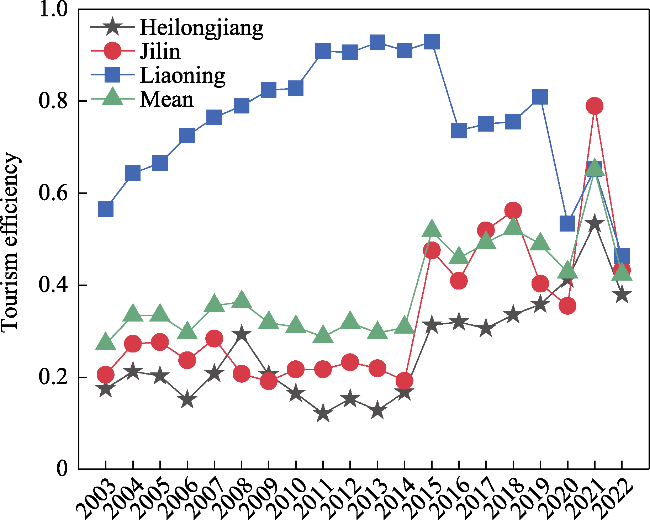
This study employed MATLAB and the SBM model to calculate tourism efficiency in the three provinces in Northeast China from 2003 to 2022. The results revealed that while tourism efficiency exhibited a generally spiralling upward trend over time, it remained in an inefficient state overall during the study period (Figure 1). Specifically, before 2015, the average tourism efficiency across the three provinces in Northeast China exhibited an initial increase followed by a decline, and it remained generally low with minor fluctuations, consistently hovering between 0.2 and 0.4. From 2015 to 2018, tourism efficiency increased markedly, with the average holding steady at 0.5. From 2019 onward, tourism efficiency experienced greater fluctuations and reached its peak in 2021.
Figure 1 Tourism efficiency in Northeast China
At the provincial level, the three provinces demonstrated significant disparities in tourism efficiency. However, these disparities steadily narrowed from 2015 to 2022, indicating a trend toward greater uniformity. Liaoning Province consistently outperformed the regional average in tourism efficiency and followed a temporal pattern of initial growth followed by a decline. The development of tourism efficiency in Jilin Province can be divided into two distinct stages: the stable stage before 2015 and the optimization and improvement stage from 2015 onward. The evolution of tourism efficiency in Heilongjiang Province followed a pattern similar to that of Jilin Province, but with smaller fluctuations. Before 2008, tourism efficiency in Heilongjiang Province showed modest growth, followed by a period of slow but continuing increase. A more pronounced and sustained improvement began to emerge after 2014. Over the past two decades, Liaoning Province consistently maintained a comparatively high level of tourism efficiency in Northeast China; Jilin Province experienced the greatest variability, starting at a lower level but growing quickly in the past two decades; and Heilongjiang Province exhibited a comparatively steady upward trend in tourism efficiency. According to the lifecycle theory for tourism destinations and the observed development patterns of each province, Northeast China as a whole is currently in the tourism development stage, while Liaoning Province is in the maturity stage, and Jilin and Heilongjiang provinces are in the stage of rapid growth.
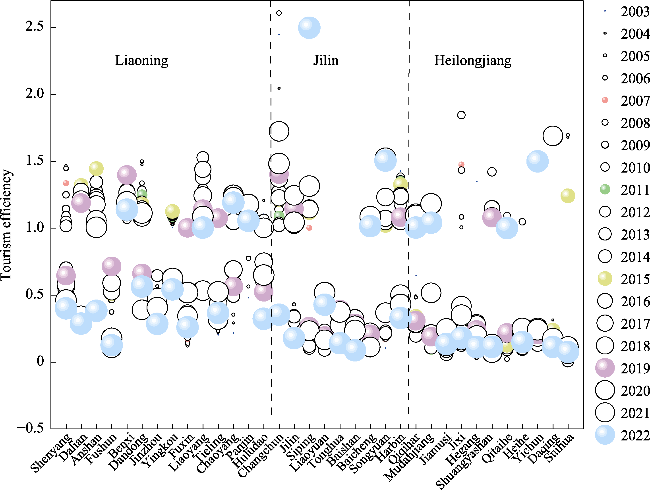
At the city level (Figure 2), all cities showed some level of improvement in tourism efficiency in 2022 relative to 2003. Throughout the 20-year span, the number of cities classified as efficient in each year consistently exceeded 10, with an annual average of 12 cities, accounting for about one-third of the total. While the number of efficient cities varied from year to year, the overall trend was upward, punctuated by a sharp increase occurring in 2015. Among the cities, Changchun stands out with both overall high tourism efficiency and rapid growth. It is followed by some cities in Heilongjiang Province, including Harbin, Jixi, and Suihua, which have shown steady improvements. In contrast, high-efficiency tourism cities in Liaoning Province such as Shenyang, Anshan, Liaoyang, Benxi, and Dandong have shown a noticeable slowdown in the pace of tourism efficiency growth.
Figure 2 Tourism efficiencies of individual cities in Northeast China from 2003 to 2022
In 2015, the former “4+1” urban tourism consortium in Northeast China (Changchun, Harbin, Shenyang, Dalian, and Anshan) jointly launched the Northeast China Tourism Promotion Alliance. This initiative advanced the overall tourism branding of Northeast China, expanded both domestic and international market development, and facilitated resource sharing and mutual benefit among the cities in Northeast China. As a result, it contributed to a substantial improvement in tourism efficiency and shifted Northeast China away from its long-standing pattern of a low-efficiency tourism economy. At the provincial level, Liaoning Province experienced a steady increase in tourism efficiency before 2015, remaining above 0.5 and gradually approaching 1. However, from 2015 onward, it entered a downward trajectory, with the rate of decline significantly outpacing previous growth and marked by three pronounced drops. As reported in the 2016 document entitled The Cultural and Tourism Industry in Liaoning Province: Development Status, Challenges, and Solutions by the People's Government of Liaoning Province, a total of 242.60 million yuan was invested between 2013 and 2015 by the provincial treasury. Although fiscal support for culture and tourism increased during this period, the short-term investment failed to yield immediate results, which may have contributed to the noticeable decline in tourism efficiency. The global health crisis that emerged at the end of 2019 dealt a severe blow to the tourism industry in Liaoning Province, leading to a pronounced downturn. The resulting market instability caused tourism efficiency to exhibit an erratic pattern overall. In July 2014, Jilin Province formally articulated its overall objective and key tasks for elevating tourism to a pillar industry. This development objective provided clear direction and a rallying call for a new wave of tourism development in the province and powerfully advanced the development of its tourism industry. After this, the “Service Sector Campaign” further propelled Jilin's evolution from a tourism resource-rich province into one characterized by a robust tourism economy, leading to continuous improvements in the efficiency of its tourism industry. Heilongjiang Province and Jilin Province are geographically adjacent and share similar patterns of tourism development, but they remain in an intense rivalry. Initially, Heilongjiang Province capitalized on its solid industrial foundation while overlooking the development of its tertiary industry. However, with the advent of the information age and increasingly market-driven dynamics, its resource advantages came to the forefront and attracted growing tourist interest. Meanwhile, local governments seized this opportunity by promoting the ice-and- snow economy and launching cross-border tourism services. They implemented a series of policies to gradually enhance infrastructure, improve tourism services, and intensify promotional efforts, resulting in a steady increase in tourism efficiency.

3.2 Spatial evolutionary characteristics of tourism efficiency in Northeast China

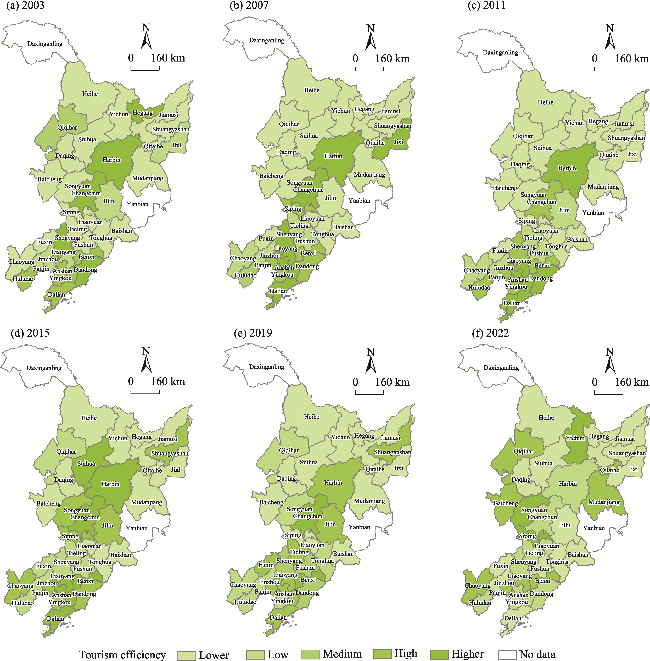
To visually present the distribution of tourism efficiency across the three provinces in Northeast China and investigate its spatial evolutionary characteristics, distribution maps for the period from 2003 to 2022 were generated using ArcGIS software (Figure 3). Previous scholars typically used threshold values of 0.25, 0.5, 0.75, and 1 to classify regional efficiency levels (Sun et al., 2024). Considering the generally low tourism efficiency in Northeast China and the pronounced polarization within the region, and in order to both highlight intra-regional differences and keep the number of categories manageable, this study divided tourism efficiency across the three provinces in Northeast China into five levels based on efficiency scores: low efficiency (0-0.3), relatively low efficiency (0.3-0.6), moderate efficiency (0.6-0.9), relatively high efficiency (0.9-1.2), and high efficiency (≥1.2).
Figure 3 Spatial distribution of tourism efficiency in Northeast China from 2003 to 2022
Before 2019, tourism efficiency in Northeast China was highly polarized, with cities like Changchun, Harbin, Dalian, and Liaoyang consistently at the forefront. High-efficiency tourism zones showed a northward tendency. Although these zones remained largely in the south, industrial development gradually narrowed the regional disparities in tourism efficiency. This indicates that the overall allocation of tourism resources has improved across the three provinces in Northeast China, leading to a more balanced industry development and enhanced integration of tourism with related regional industries. Since the founding of the People's Republic of China, regional integration has been consistently advanced to foster inter-regional coordinated development. This coordinated regional economic growth has, in turn, propelled the development of all-region tourism, contributing to a more balanced distribution of tourism efficiency. Specifically, the high-efficiency zones are mainly clustered in the southeastern and central parts of Northeast China, likely due to urban geographic characteristics. The southeastern area is dominated by port and coastal cities with convenient international exchange, developed economies, high accessibility, and advantageous spatial proximity to both domestic and overseas source markets. The central area, anchored by the provincial capitals Changchun and Harbin, serves as the economic, cultural, political, and transportation hub of the region. It commands premium resources, possesses core appeal unmatched by other cities, and enjoys substantial advantages in both tourism resource appeal and tourism industry management. After 2019, the spatial distribution of tourism efficiency underwent a significant change in which cities with higher levels of economic development were no longer those with the top tourism efficiency, while high-efficiency cities became more concentrated around provincial capitals. This shift suggests that the COVID-19 pandemic had a more pronounced impact on destinations with larger-scale tourism development.

3.3 Spatial agglomeration and dispersion characteristics of tourism efficiency across the three provinces in Northeast China

To further investigate whether tourism efficiency in Northeast China exhibits spatial correlation, ArcGIS software was used to perform a global spatial autocorrelation analysis of the tourism efficiency in Northeast China. The results are presented in Tables 2 and 3. From 2007 to 2019, Moran's I values were consistently positive, and their P-values were all below 0.05, indicating a significant spatial agglomeration effect of tourism efficiency within the region. After 2019, this spatial agglomeration effect was no longer significant, indicating that the COVID-19 pandemic also impacted the spatial agglomeration effect of tourism efficiency. A subsequent high/low clustering analysis of tourism efficiency in Northeast China yielded positive General G statistics with P-values below 0.05 during the periods of significant spatial clustering. This indicates a clear high-value clustering pattern of tourism efficiency in the region, which is consistent with the earlier results regarding tourism efficiency distribution.
Table 2 Spatial autocorrelation of tourism efficiency
Year Moran's I Z-score P-value Year Moran's I Z-score P-value
2003 0.102 1.210 0.226 2013 0.465 4.385 0.001
2004 0.208 2.134 0.033 2014 0.455 4.295 0.001
2005 0.104 1.319 0.187 2015 0.302 2.925 0.003
2006 0.181 1.942 0.052 2016 0.299 2.892 0.004
2007 0.337 3.245 0.001 2017 0.323 3.111 0.002
2008 0.211 2.116 0.034 2018 0.363 3.468 0.001
2009 0.283 2.781 0.005 2019 0.203 2.061 0.039
2010 0.354 3.398 0.001 2020 -0.001 0.258 0.797
2011 0.507 4.764 0.001 2021 0.208 2.099 0.036
2012 0.515 4.831 0.001 2022 -0.040 -0.113 0.910
Table 3 High/Low clustering of tourism efficiency
Year General G Z-score P-value Year General G Z-score P-value
2003 - - - 2013 0.043 4.067 0.001
2004 0.037 2.255 0.024 2014 0.042 3.827 0.001
2005 - - - 2015 0.035 2.849 0.004
2006 0.036 1.927 0.054 2016 0.036 2.722 0.007
2007 0.039 3.131 0.002 2017 0.036 2.937 0.003
2008 0.036 2.467 0.014 2018 0.036 3.037 0.002
2009 0.038 2.648 0.008 2019 0.033 1.791 0.073
2010 0.039 3.116 0.002 2020 - - -
2011 0.045 4.474 0.001 2021 0.032 1.664 0.096
2012 0.044 4.509 0.001 2022 - - -

Note: “‒” is a null value, indicating that the spatial aggregation effect is not significant.

Based on spatial autocorrelation and the geographic distribution of tourism efficiency, two spatially high-efficiency clusters can be identified in Northeast China: the Changchun-Harbin urban agglomeration centered on Changchun and Harbin, and the Southeast Liaoning urban agglomeration dominated by coastal and port cities. The agglomeration effect of these two high-efficiency clusters followed a rise- then-fall trajectory and exhibited an overall inverted-V-shaped development pattern over time. The year 2012 was the turning point. After 2012, the high-efficiency agglomeration effect gradually waned, inter-city disparities in tourism efficiency within each cluster narrowed, and the efficiency of the regional tourism industry steadily approached a balanced state. A comprehensive comparative analysis of tourism efficiency trends shows that, as the high-efficiency agglomeration effect waned, tourism efficiency in Northeast China has been progressively becoming more coordinated.

4 Factors influencing tourism efficiency across the three provinces in Northeast China

4.1 Indicators of factors influencing tourism efficiency

The tourism industry is comprehensive, and its efficiency is shaped by multiple factors. Drawing on prior studies and taking into account the specific characteristics of Northeast China, such as the prevalence of resource-depleted cities, a robust industrial and agricultural foundation and its status as a border region, this study investigated the key factors influencing tourism efficiency across the three provinces in Northeast China from nine perspectives: endowment of tourism resources (res), level of economic development (eco), opening-up level (ope), urban industrial structure (ind), informatization level (inf), marketization level (mar), level of educational development (edu), infrastructure development (infr), and geographical location (geo) (Sheng and Liu, 2020; Guo et al., 2021; Yu and Zuo, 2022; Sheng et al., 2023). To provide a systematic and comprehensive assessment of the endowment of tourism resources in Northeast China, this study selected certain indicators including the numbers of national nature reserves, national scenic areas, parks, key rural tourism villages (towns/townships), national historical and cultural towns, national historical and cultural blocks, and 4A- and 5A-rated tourist attractions. The relevant data and their descriptive statistical analysis results are presented in Table 4.
Table 4 Influencing factor indicators and descriptive data statistics
Influencing factor Measurement indicator Descriptive data statistics
N Minimum Maximum Average S.D.
res Number of high-level natural and humanistic resources (units) 680 0.001 40.001 7.523 6.851
eco Per capita GDP (104 yuan per person) 680 0.445 26.614 4.635 3.464
ope Amount of actual utilized foreign capital (104 USD) 680 0.001 1062260.000 41899.520 122314.110
ind Share of tertiary industry value added in GDP (%) 680 10.420 82.500 45.586 12.789
inf Number of broadband connections (104 households) 680 0.001 356.443 48.930 53.246
mar Marketization index 680 2.818 19.131 10.183 3.324
edu Number of students enrolled in regular higher education institutions (104 persons) 680 0.001 80.230 6.530 12.821
infr Total fixed-asset investment (108 yuan) 680 4.090 13182.710 838.168 1422.806
geo Distance to central city (km) 680 0.001 258.837 126.874 76.937

4.2 Factors influencing tourism efficiency

Stata was employed to run random-effects panel Tobit models on the factors influencing tourism efficiency for Northeast China as a whole and for each of its provinces. The results (Table 5) reveal that urban industrial structure, opening-up level, informatization level, marketization level, endowment of tourism resources, level of educational development, infrastructure development, and geographical location all exert significant influences on tourism efficiency in Northeast China, whereas the level of economic development does not exhibit a significant impact.
Table 5 Results of random-effects panel Tobit models
Influencing factor All three north-eastern provinces Liaoning Jilin Heilongjiang
Coef. St. Err. Coef. St. Err. Coef. St. Err. Coef. St. Err.
res ‒0.013** 0.005 0.001 0.009 ‒0.009 0.012 ‒0.006 0.008
eco ‒0.001 0.009 0.057** 0.023 ‒0.050*** 0.017 0.001 0.012
ope 0.001*** 0.001 0.001*** 0.001 0.001*** 0.001 0.001*** 0.001
ind 0.009*** 0.002 0.010*** 0.003 0.001 0.002 0.013*** 0.003
inf ‒0.003*** 0.001 ‒0.005** 0.002 0.003 0.003 ‒0.004* 0.002
mar 0.031*** 0.010 ‒0.005 0.017 0.066*** 0.014 0.029* 0.015
edu ‒0.016** 0.008 ‒0.012 0.017 0.018* 0.010 0.072*** 0.012
infr 0.001** 0.001 ‒0.001 0.001 ‒0.001 0.001 0.001 0.001
geo ‒0.003** 0.001 ‒0.001 0.001 ‒0.001 0.001 ‒0.002 0.001
Constant 0.553** 0.228 0.511** 0.236 ‒0.070 0.200 ‒0.284 0.233
Observations 680 280 160 240

Note: ***, **, and * indicate significance at the 1% level, 5% level, and 10% level, respectively.

The results indicate that the level of openness, degree of marketization, optimization of urban industrial structure, and infrastructure development have significant positive effects on the tourism economic efficiency in Northeast China. Among these, openness and marketization have been widely recognized in academic circles as the core driving forces behind tourism industry efficiency. Specifically, openness contributes to a favorable environment for the development of regional tourism by facilitating capital agglomeration, talent mobility, managerial knowledge spillovers, and the introduction of international capital. Meanwhile, improvements in marketization significantly enhance overall tourism industry efficiency through more effective resource allocation, the promotion of labor specialization, and the stimulation of vitality among market entities. Leveraging its geographic advantages—bordering Russia, North Korea, South Korea, and Japan—as well as its role as a central hub in the Northeast Asia region, Northeast China enjoys inherent locational benefits for cross-border tourism cooperation and international exchanges. At the same time, industrial upgrading, marked by a rising share of the tertiary sector, has driven the continuous improvement of tourism infrastructure and supporting service systems. The resulting enhancement in service quality strengthens the region's tourism appeal, further stimulating tourism demand and output growth, and fostering a virtuous cycle of “industrial upgrading-service optimization-efficiency improvement”.
However, the endowment of tourism resources, geographical distribution, level of informatization, and educational development exert significant restraining effects on the tourism economic efficiency in Northeast China. From the perspective of resource economics, although high-grade tourism resources possess strong attractiveness, their spatial immobility and the high costs required for development and management often lead to a “resource curse” phenomenon. In the Northeast, while winter ice-and-snow tourism resources have been relatively well-developed, summer resort and border tourism resources still face issues such as product homogenization, low-end service offerings, and imbalanced spatial allocation. These challenges have hindered the full realization of the economic value of high-quality resources. In terms of geographical location, tourism efficiency demonstrates a clear spatial clustering effect. Areas within a half-hour economic radius of central cities benefit from proximity to source markets and achieve efficiency premiums by developing cost-effective, high-efficiency models such as urban micro-vacations and suburban rural tourism. In contrast, due to poor accessibility, the remote areas often fall into efficiency troughs. The negative impacts of informatization and education manifest as dual constraints. On one hand, the outflow of talent results in an insufficient supply of professional tourism service personnel, thereby limiting the standardization of services and the modernization of management. On the other hand, the mismatch between investment in digital infrastructure and its actual application effectiveness fails to meet the tourists’ demand for intelligent experiences and cannot support refined industry management. Instead, it exacerbates competition in the regional tourism markets.
It is noteworthy that the level of economic development does not exert a significant effect on tourism efficiency in Northeast China, distinguishing it from other regions in the country. From the perspective of industrial economics, this region's tourism sector remains in a resource-driven development phase. Its characteristic resources centered on ice-and-snow and summer resort tourism have not been fully exploited, and weak infrastructure combined with insufficient factor inputs has prevented tourism from becoming deeply embedded in the regional economic system. According to Rostow's stages-of-growth theory, a nascent industry depends little on the broader economic base; and only upon reaching maturity does economic development emerge as a key driver of efficiency gains. As a traditional industrial heartland, Northeast China boasts a strong agricultural and manufacturing foundation but lags in service-sector development. The tourism industry has yet to form a complete value chain or achieve economies of scale, and these industrial-stage characteristics attenuate any direct impact of overall economic development on tourism efficiency.

4.3 Differences in the factors influencing tourism efficiency across Northeast China

Further regional heterogeneity analysis indicates that the mechanisms influencing tourism efficiency vary significantly among the three northeastern provinces. While the advantage of border location consistently promotes tourism efficiency throughout the region, the dominant influencing factors differ among the provinces. In Liaoning Province, tourism efficiency is primarily influenced by the level of openness, urban industrial structure, economic development, and informatization. The dual-core urban cluster centered around Shenyang and Dalian generates strong economic spillover effects, and the advanced industrial structure supports tourism efficiency. However, the diminishing marginal returns on informatization investment warrant more attention. The application of digital technologies has led to rising marketing costs and the dispersion of tourist flows, thereby weakening the competitive advantage of traditional tourist destinations. In Jilin Province, tourism efficiency is more sensitive to marketization, economic development, openness, and educational development. Under its dual-engine model driven by both market forces and resource endowment, this province faces pronounced structural contradictions between the monopolistic nature of top-tier resources—such as Changbai Mountain—and the upgrading demands of service consumption. Moreover, rising factor prices resulting from rapid economic growth have created additional constraints on efficiency improvement. In Heilongjiang Province, the key influencing factors include openness, industrial structure, informatization, marketization, and education level. The transformation of its industrial heritage and the exploitation of border tourism potential have been facilitated by adjustments to this province's industrial structure. Nonetheless, challenges remain in fully harnessing the potential of the digital economy, and the persistent developmental imbalance between the northern and southern regions still requires urgent resolution.
In summary, the differences among the three provinces are primarily reflected in their respective modes of factor combinations: Liaoning follows an “economy + structure” driven model, Jilin relies on a “market + resource” approach, and Heilongjiang adopts an “industry + education” synergy. These patterns vividly reflect the unique resource endowments and developmental stages of each region, which provides a scientific basis for formulating differentiated tourism development strategies. Liaoning should focus on strengthening the integration of digital technology with culture and tourism through innovative models, while Jilin needs to address the structural contradiction between resource dependence and consumption upgrading, and Heilongjiang should accelerate the development of industrial heritage tourism and promote service sector upgrading through educational empowerment.

5 Discussion, conclusions and recommendations

5.1 Discussion

Along the Chinese path to modernization, even as the country encounters new development stages and opportunities, uneven and insufficient regional economic development remains an issue that cannot be ignored. In regions endowed with rich cultural capital but burdened by a high proportion of resource-depleted cities, industrial transformation and development are imperative. These regions typically possess substantial cultural capital and premium natural assets and exhibit distinctive local characteristics, so they offer an excellent resource foundation for the development of the tourism industry. Therefore, such regions should capitalize on their distinctive regional characteristics, align with the “Grand Tourism” development framework and the requirements for high-quality regional development, profoundly explore the uniqueness of their cultural heritage, integrate cultural and tourism resources, and promote local economic prosperity through the development of the tourism industry. In developing the tourism industry, priority must first be given to attracting and nurturing talent to shore up regional shortcomings. Second, the driving potential of advantaged areas should be fully leveraged, with economic core zones stimulating growth in peripheral zones to achieve balanced regional economic development. Lastly, policies and regulations should be further refined. Policy guidance and support must be strengthened at the macro level to provide robust safeguards for the healthy development of the tourism industry.
This study addresses the major limitation of existing tourism efficiency research, which has largely focused on regions with well-developed tourism economies and consequently offers limited generalizability. Moreover, this study examines strategies for achieving high-quality development in resource-depleted regions from the perspective of tourism efficiency, thereby offering valuable practical reference for their economic transformation. Despite these contributions, this study still includes several potential research areas that warrant further investigation. First, this study did not account for undesirable outputs such as carbon emissions and other environmental issues that may emerge during tourism industry development. Given the growing attention to these issues within the tourism industry, now hailed as a “green industry”, future research should incorporate these environmental indicators into the evaluation system for tourism efficiency. Second, due to data availability constraints, this study covered only up to 2022 and thus could not fully dissect the marked changes in tourism efficiency that occurred during the post-pandemic period. The COVID-19 pandemic not only altered consumption patterns and lifestyles but also profoundly reshaped the operating model of the tourism industry. Therefore, there is a pressing need for more in-depth analysis and research into the underlying mechanisms driving the evolution of tourism efficiency in Northeast China during this key period.

5.2 Conclusions

(1) Temporally, tourism efficiency in Northeast China followed a spiralling upward trajectory during the study period. However, overall efficiency remained low and far below effective levels, indicating that this region is currently in the growth stage. The tourism industry in Northeast China overall exhibited three stages of evolution: a stable low-efficiency stage before 2015; a swift efficiency enhancement stage between 2015 and 2018; and a growth stage with significant fluctuations from 2019 to 2022. During the study period, Liaoning Province recorded the highest tourism efficiency, albeit with a relatively modest growth rate, indicating that it has entered a mature stage of tourism development. In contrast, Jilin and Heilongjiang Provinces demonstrated lower tourism efficiency but considerable development potential, suggesting that they remain in the tourism development stage.
(2) Spatially, tourism efficiency in Northeast China shows two high-efficiency clusters—the Changchun-Harbin urban agglomeration and the Southeast Liaoning urban agglomeration. Moreover, tourism efficiency within the region has gradually shifted from a polarized pattern, which was extremely high at cluster cores and extremely low at the margins, toward a more balanced distribution. Tourism efficiency across different regions exhibits a pronounced convergence as the agglomeration effect of high-efficiency zones wanes.
(3) The evolution of tourism efficiency has exhibited a strong temporal alignment with the implementation of policies and measures such as the Northeast China Revitalization and regional cooperation. It has been shaped by factors such as resources, location, industry, science and technology, and education, while it exhibits only a weak correlation with the level of economic development. While tourism efficiency and its influencing factors vary significantly across provinces, they are all closely tied to local policies, hygienic conditions, and the opening-up level.
In summary, to achieve high-quality economic development in the Northeast region, a regional tourism economic joint development system should be established at the macro level, while the “push-pull” strategy can be employed to enhance market competitiveness at the micro level. Meanwhile, each province should explore differentiated development models based on its own characteristics.

5.3 Recommendations

In the era of high-quality development, enhancing both the efficiency and quality of tourism industry development, while shifting away from the traditional extensive development model, represents a key pathway toward sustainable tourism development. At present, the regions represented by Northeast China that have long been dominated by industry and agriculture have built up considerable tourism potential and are now poised for take-off, so they stand at a critical juncture in their development. These regions should adhere to the concept of “culture as the cornerstone, green development as the guide”, continually tap into their local cultural heritage, showcase their distinctive humanistic features, implement the “Two Mountains” theory, pursue market-oriented approaches, and enhance policy support to elevate their regional tourism efficiency and achieve high-quality tourism development.
From a macro perspective, the developmental trajectory of the tourism industry in Northeast China is heavily shaped by policies. Within the framework of China's current strategic planning for the tourism industry, the relevant regions should undertake reasonable planning to define their development direction and strategies. These efforts should specifically include the following considerations. First, it is essential to strengthen regional cooperation systems, optimize the allocation of resources, and harness the advantages of regional synergy mechanisms. During the study period, regional joint development demonstrably enhanced tourism efficiency in Northeast China. Therefore, going forward, the region should further strengthen inter-city tourism cooperation, create distinctive regional tourism brands, and construct a joint system for regional tourism development. Through multi-dimensional, multi-faceted cooperation in brand building, resource planning, service management, and image promotion, this region can counteract the decline in tourism appeal caused by rising costs. Meanwhile, resource allocation should be optimized to prevent the malicious intra-regional competition and resource waste resulting from product homogenization. Second, it is essential to continuously advance the deep integration of culture and tourism, while simultaneously expanding opening-up. High-quality tourism development requires a strong emphasis on the local cultural core and highlighting local cultural features. Northeast China's unique humanistic features and profound industrial heritage confer upon it an irreplaceable identity. By embracing the principle of “advancing tourism through culture and enriching culture through tourism”, this region can shape its distinctive cultural tourism identity and launch both cultural and industrial tourism initiatives to enhance tourism efficiency. Meanwhile, this region should expand its opening-up, promote its local cultural spirit, and enhance tourism efficiency through cultural exchanges. Third, it is essential to strongly emphasize the construction of ecological civilization and capitalize on the region's advantages in ecological resources. Building on its natural resource advantages, Northeast China should reinforce the “winter snowplay, summer retreat” tourism brand and develop green, eco-leisure tourism region wide. By advancing initiatives in regional ecological civilization construction, it can create a favorable tourism environment, enhance the residents’ well-being, and ensure the sustainable development of the tourism economy. Besides, as one of China's key grain-producing regions, regional efforts to develop its tourism economy should concentrate on rural areas where the opportunities lie. Since tourism efficiency in Northeast China is only marginally influenced by economic development, this region should capitalize on its indigenous qualities and continually promote the high-quality development of rural tourism.
From a micro perspective, the industry's overall layout should address both supply and demand. On the one hand, it must meet market needs, prioritize the tourist experience, and offer demand-driven, high-demand tourism products; on the other hand, it should capitalize on the domestic tourism boom by introducing innovative travel offerings that invigorate the market and elevate regional competitiveness. In addition, greater emphasis should be placed on talent management and the adoption of information technologies to improve service quality in the tourism industry. Local advantages in educational resources should be leveraged to enhance the talent retention mechanism and prevent excessive brain drain. Simultaneously, efforts should be made to strengthen the application of information technology by talent, and its negative impact on regional tourism efficiency should be reversed through the high-efficiency utilization of informationalized services. Lastly, tourism infrastructure, supporting facilities, and policy support should be improved. Under policy guidance, efforts should focus on improving service quality, gradually advancing the digitalization and intelligentization of tourism services, and offering more convenient and comfortable travel experiences. Since it is now in the mature stage of tourism development, Liaoning Province should foster new economic growth drivers in its tourism economy to stay competitive amid the informatization wave of the digital age. Jilin Province, which remains in the development stage of its tourism economy, should prioritize building a strong tourism brand and boosting market competitiveness with a premium brand image, while also taking care to prevent cost increases resulting from economic development. Similarly positioned in the development stage of its tourism economy, Heilongjiang Province should further enhance its infrastructure, capitalize on its resource endowments and geographic advantages, and develop ice-and-snow tourism along with border tourism.
[1]
An N, Yuan Y M. 2023. Analysis on dynamic coupling and influence mechanism of tourism ecological efficiency and tourism ecological network in Yangtze River delta region. Areal Research and Development, 42(6): 79-85, 107. (in Chinese)

DOI

[2]
Ane E R-Z, Josep M R. 2020. Tourism indicators and airports’ technical efficiency. Annals of Tourism Research, 80: 102819. DOI: 10.1016/j.annals.2019.102819.

[3]
Cao F D, Huang Z F, Xu M, et al. 2015. Spatial-temporal pattern and influencing factors of tourism efficiency and the decomposition efficiency in Chinese scenic areas: Based on the Bootstrap-DEA method. Geographical Research, 34(12): 2395-2408. (in Chinese)

[4]
Choi K, Kang H J, Kim C H. 2021. Evaluating the efficiency of Korean festival tourism and its determinants on efficiency change: Parametric and non-parametric approaches. Tourism Management, 86: 104348. DOI: 10.1016/j.tourman.2021.104348.

[5]
Feng F, Tang R, Feng X G. 2020. Study on efficiency of tourism poverty alleviation and its influencing factors in Western China: A case study of Pingliang City, Gansu Province. Areal Research and Development, 39(2): 105-110. (in Chinese)

[6]
Guo X Y, Mu X Q, Ding Z S, et al. 2021. Spatial spillover effect and its influence mechanism of traffic service function on tourism efficiency: A case study of Yunnan Province. Geography and Geo-Information Science, 37(1): 126-134. (in Chinese)

[7]
Han G S, Li H, Alan L. 2015. Spatial distribution characteristics and influencing factors of star hotels’ operation efficiency in developing tourist site: An empirical study based on DEA and Tobit. Tourism Science, 29(5): 51-64. (in Chinese)

[8]
He Z L, Wang S M. 2020. Spatial-temporal evolution of China's tourism resource conversion efficiency and its impact mechanism. China Population, Resources and Environment, 30(11): 185-193. (in Chinese)

[9]
Huo H, Bai Y C, Zhan S. 2020. Analysis on the spatial mismatch between tourism resources and tourism economy in northeast China. Journal of Northwest Normal University (Natural Science), 56(4): 106-111, 126. (in Chinese)

[10]
Ji X M, Qin W S, Li S T, et al. 2021. Development efficiency of tourism and influencing factors in China's prefectural-level administrative units. Resources Science, 43(1): 185-196. (in Chinese)

[11]
Li P, Deng A M. 2023. The new mission and new path of tourism on the new journey of Chinese modernization. Social Scientist, (8): 41-46. (in Chinese)

[12]
Liu C S. 2012. On the evaluation approach of “low-carbon tourism” service providing efficiency and its empirical study—Based on the empirical inspection of environmental protection and transport tourism service in Zhangjiajie. Tourism Tribune, 27(3): 90-98. (in Chinese)

[13]
Liu J, Zhang J F, Fu Z B. 2017. Tourism eco-efficiency of Chinese coastal cities—Analysis based on the DEA-Tobit model. Ocean & Coastal Management, 148: 164-170.

[14]
Ma Y, Liu J. 2016. The core value and improvement strategy of tourism ecological efficiency under the background of green development. Tourism Tribune, 31(9): 1-3. (in Chinese)

[15]
Pan Z C, Ma L Y, Tian P P, et al. 2023. Spatiotemporal evolution, regional differences and convergence of urban-rural integrated development in Northeast China. Journal of Natural Resources, 38(12): 3093-3115. (in Chinese)

[16]
Ren Y, Liu W Q, Zhao K, et al. 2017. The measurement and evaluation of the operating efficiency of China's listed tourism companies: An empirical analysis based on the mixed DEA model. Tourism Tribune, 32(7): 27-36. (in Chinese)

[17]
Sheng Y C, Liu Q, Li Q. 2023. Research on the mechanism of promoting tourism economic efficiency through opening to the outside world: An empirical study based on China's panel data from 2000 to 2019. Tourism Forum, 16(2): 50-65. (in Chinese)

[18]
Sheng Y C, Liu Q. 2020. Spatial difference of human capital promoting regional tourism economic efficiency: Empirical research based on “Hu Line”. Scientia Geographica Sinica, 40(10): 1710-1719. (in Chinese)

[19]
Shi Q B, Xie Y S, Han Z L, et al. 2018. Spatial structure and spatial development patterns of urban tourism economic connections in northeast China. Economic Geography, 38(11): 211-219. (in Chinese)

DOI

[20]
Song J, Song Q Y. 2018. Space network structure and formation mechanism of green innovation efficiency of tourism industry in China. China Population, Resources and Environment, 28(8): 127-137. (in Chinese)

[21]
Song Y Y, Song Y X. 2019. Spatio-temporal pattern evolution and driving factors of tourism efficiency in northeast China. Areal Research and Development, 38(5): 85-90. (in Chinese)

[22]
Su Z, Zhang X J, Song K F, et al. 2023. The impact of market competition and marketization process on the efficiency of green innovation in the tourism industry. Resource Development & Market, 39(6): 739-746. (in Chinese)

[23]
Sun G X, Zhang M, Zhao F. 2024. Evaluation and improvement strategy of efficiency of snow-ice tourism development in typical regions of China. Scientia Geographica Sinica, 44(12): 2144-2154. (in Chinese)

DOI

[24]
Sun J J. 2024. The transformation of tourism resource research in the context of high-quality development: New attributes, new framework and new directions. Journal of Natural Resources, 39(2): 245-258. (in Chinese)

[25]
Sun P P, Xia C J. 2014. Chinese provincial tourism industry efficiency: Indices construction and empirical analysis. Research on Economics and Management, (12): 70-79. (in Chinese)

[26]
Tang J X, Li S S, Liu Y Q, et al. 2022. Spatial pattern evolution of tourism industry's efficiency and its club convergence. Areal Research and Development, 41(1): 79-84, 97. (in Chinese)

[27]
Wang E X, Wu D. 2016. A study on spatial-temporal differences of tourism urbanization efficiency of tourism-driven city. Nanjing Journal of Social Sciences, (10): 29-35. (in Chinese)

[28]
Wang K, Hu M D, Guan R, et al. 2023. Interactive relationship between high-quality tourism development and common prosperity in China. Resources Sciences, 45(5): 1020-1033. (in Chinese)

[29]
Wang K, Li T. 2021. Spatiotemporal coupling analysis of China's inbound tourism distributive superiority and tourism economic efficiency. Human Geography, 36(5): 157-166. (in Chinese)

[30]
Wang Z H, Xie J L. 2023. Spatiotemporal coupling relationship and influencing factors of China's tourism industry organization. Acta Geographica Sinica, 78(4): 961-979. (in Chinese)

DOI

[31]
Wu R L. 2023. Measurement and spatio-temporal evolution of coupling coordination between tourism efficiency and rural revitalization system in China. Geography and Geo-Information Science, 39(1): 111-119. (in Chinese)

[32]
Wu X N, Guan W H, Zhang H, et al. 2024. Spatio-temporal coupling characteristics and driving factors of provincial economic efficiency and economic resilience in China. Geography and Geo-Information Science, 40(2): 116-125. (in Chinese)

[33]
Wu X Y, Liang X. 2023. Tourism development level and tourism eco-efficiency: Exploring the role of environmental regulations in sustainable development. Sustainable Development, 31(4): 2863-2873.

[34]
Yao M, Yan F, Ning Z Z, et al. 2024. The impact of tourism industry agglomeration on the high-quality development of China's tourism economy: Testing based on the spatial Durbin and threshold models. Journal of Resources and Ecology, 15(3): 769-781.

[35]
Yu T T, Zuo B. 2022. Influence mechanism of information communication technology in the economic efficiency of tourism. Scientia Geographica Sinica, 42(10): 1717-1726. (in Chinese)

DOI

[36]
Zhao J C. 2024. Industrial structure upgrading and tourism efficiency: Based on inter-provincial panel data from 2003 to 2022. Areal Research and Development, 43(1): 67-73. (in Chinese)

DOI

[37]
Zheng B M, Ming Q Z, Liu A L, et al. 2022. Research on the center of gravity coupling and interactive response between tourism economic efficiency and regional economic level in Western Provinces. World Regional Studies, 31(2): 350-362. (in Chinese)

DOI

[38]
Zhu Z S, Li P B, Chang W. 2023. The dilemma and breakthrough of the coordinated development of tourism in Northeast China: The perspective of kinetic energy transformation. Tourism Tribune, 38(5): 8-10. (in Chinese)

Outlines

/