Agro-ecosystem and Rural Revitalization

Digital Intelligence Empowerment for Optimizing Rural Human Settlement Environments: An Ecological Strategy Based on Bionic Design and Fuzzy Semantic Computing

  • CHEN Liwei ,
  • LIN Xiaohong , *
Expand
  • College of Design, Hebei Academy of Fine Arts, Shijiazhuang 050700, China
* LIN Xiaohong, E-mail:

CHEN Liwei, E-mail:

Received date: 2025-05-01

  Accepted date: 2025-08-25

  Online published: 2025-10-14

Abstract

This study explores the impact of bionic design features on the emotional resonance and ecological identity of residents in the optimization of rural human settlement environments, by employing quantitative analysis based on a fuzzy semantic computing model. An examination of three bionic design features—morphological differences, material integration, and functional interaction—showed that these features significantly influence the emotional resonance and ecological identity of residents. While fulfilling aesthetic and functional needs, morphological differences and material integration foster emotional connections between residents and their environment, thereby enhancing ecological identity. Functional interactivity plays a key role in promoting social interactions and improving the overall living experience. The effects of these design features on emotional resonance and ecological identity were quantified using fuzzy semantic computing, with the results further verifying their effectiveness. Fuzzy semantic computing offers a novel perspective and methodology for the quantitative evaluation of complex design features. This study provides a theoretical foundation for the design and optimization of rural human settlements in the future, and offers valuable insights for both academic research and practical applications in related fields.

Cite this article

CHEN Liwei , LIN Xiaohong . Digital Intelligence Empowerment for Optimizing Rural Human Settlement Environments: An Ecological Strategy Based on Bionic Design and Fuzzy Semantic Computing[J]. Journal of Resources and Ecology, 2025 , 16(5) : 1528 -1539 . DOI: 10.5814/j.issn.1674-764x.2025.05.023

1 Introduction

With the comprehensive advancement of the “Rural Revitalization” strategy, the optimization of rural human settlements has become a key issue in promoting integrated urban-rural development. For many years, traditional rural planning and design have largely focused on spatial layout and infrastructure improvement, while often neglecting the systemic coordination among ecological, social, and cultural dimensions. This imbalance has resulted in ecological degradation, cultural disconnection, and a decline in the residents’ quality of life (Qin and Leung, 2021). Therefore, exploring a development path for rural living environments that aligns with the principles of ecological civilization and integrates ecological aesthetics with human-centered care has become a focal point of both academic research and practical innovation.
In recent years, with the convergence of digital and intelligent technologies, “intelligent digital technologies” have been increasingly applied in fields such as urban-rural planning and environmental design (Ahmad et al., 2022). The empowerment of rural development through smart technologies not only enhances the scientific precision of environmental governance but also brings new vitality to ecological design practices. Among these technologies, biomimetic design and fuzzy semantic computation are emerging as innovative approaches for optimizing rural human settlements.
Biomimetic design draws inspiration from natural forms, structures, and ecological mechanisms, allowing the designs to more closely reflect nature's essence. This approach strengthens the emotional connection between humans and their environment and contributes to the restoration and enhancement of ecosystem functions (Lin et al., 2023; Lin and Sayuti, 2023). Meanwhile, fuzzy semantic computation is grounded in the inherent uncertainty of human language cognition, and it constructs quantitative evaluation models to interpret the residents’ subjective emotional experiences, sense of place, and ecological resonance within their environments. It provides a theoretical tool for understanding the complex relationship between environmental design and psychological response.
On the international front, Western countries have taken the lead in integrating ecological design with artificial intelligence, particularly in community renewal and green infrastructure development. For example, Germany's “Ökodorf Sieben Linden” (Eco-village) applies biomimetic systems to improve environmental quality, while the “Smart Village” initiatives of the United States explore the use of AI in community governance and environmental experience design. In contrast, the application of smart technologies in China's rural areas is still in its early stages of transitioning from urban contexts. Most existing studies remain focused on basic infrastructure and lack systematic theoretical models that address ecological perception and emotional interaction. In particular, there is a notable gap in research that connects biomimetic design, emotional identification, and ecological optimization into an integrated framework.
In summary, there is an urgent need to develop a multidimensional ecological optimization strategy that integrates biomimetic design with fuzzy semantic computation, in order to shift rural human settlement development from mere functional improvement toward deeper ecological perception and emotional identification. This study is framed within this context and aims to contribute to the theoretical and practical advancement of digitally empowered rural ecological design.
In recent years, the optimization of rural human settlement environments and the implementation of rural revitalization strategies have become key areas of focus in global sustainable development research. With the rapid advancement of digital and intelligent technologies, the design and optimization of rural living environments have entered a new era. Digital intelligence can provide innovative solutions for rural ecological design and environmental optimization, and bionic design and fuzzy semantic computing have become integral components, attracting significant attention in both academic and practical fields.

2 Literature review

2.1 Relationship between digital intelligence empowerment and rural revitalization

With the advancement of digital and intelligent tools, digital intelligence empowerment has become a key concept in rural revitalization, and it is being widely applied in rural planning and design (Tim et al., 2021). Digital intelligence enhances rural development efficiency through digital technologies and smart tools, fostering a sense of participation and belonging among residents while promoting sustainable development (Goel and Vishnoi, 2022). Tools like BIM (Building Information Modeling) and GIS (Geographic Information System) enable the accurate planning and optimization of rural environments (Marzouk and Othman, 2020), while big data and AI technologies provide real-time ecological monitoring and design support. Smart infrastructure, such as smart lighting and waste disposal systems, can improve rural life quality and promote sustainability.
Although digital intelligence has made progress in rural revitalization, integrating bionic design with digital technologies and quantifying the optimization of rural human settlements remain challenging. This study offers a new theoretical framework and application path for optimizing rural human settlements by combining bionic design, fuzzy semantic computing, and other digital intelligence technologies.

2.2 Fuzzy semantic computing in rural human settlement environment optimization

Fuzzy semantic computing is a computational method that combines fuzzy logic with semantic networks, and it is widely used in artificial intelligence, data analysis, emotion computing, and other fields (Vashishtha et al., 2023). Unlike traditional quantitative analysis methods, fuzzy semantic computing effectively handles fuzzy, uncertain, and qualitative information, so it is particularly suitable for studying human emotional experiences and psychological cognition (Liu et al., 2024).
In the context of rural human settlement environment optimization, fuzzy semantic computing is increasingly being used to assess the impacts of subjective factors, such as the emotional resonance and ecological identity of residents, on design outcomes (Fang et al., 2024). By using fuzzy semantic computing, qualitative perception data can be converted into quantitative evaluation results, which provides more accurate feedback for design solutions (D’Aniello et al., 2018). For instance, Zhang et al. (2018) applied fuzzy semantic computing to develop an urban ecological environment quality assessment model based on the residents’ perceptions, effectively capturing the impact of environmental design on their emotions and ecological identity, which served as a theoretical foundation for urban greening design.
As a technology for handling complex and fuzzy information, fuzzy semantic computing holds significant potential for optimizing rural human settlement environments (Ibeh et al., 2025). By using fuzzy semantic computing, qualitative emotional and cognitive data can be transformed into quantitative information, thus providing a scientific and comprehensive evaluation and optimization path for rural design (Jetter and Kok, 2014). Although the application of fuzzy semantic computing in rural revitalization still faces some challenges, with further advances in technology and data accumulation, it is expected to become a vital tool for optimizing rural human settlements in the future and generating more sustainable solutions for rural revitalization.

2.3 Existing research and deficiencies

Current research on the optimization of rural human settlement environments mainly focuses on individual disciplines, such as architecture, landscape science, or ecology, and lacks interdisciplinary theoretical integration. Many studies are limited to the practical level and lack a unified theoretical framework to guide specific design methods and technical approaches. Particularly in the application of advanced technologies like bionic design and fuzzy semantic computing, theoretical research is still in its early stages and lacks systematic theoretical support and standardized implementation paths.
The optimization of rural human settlement environments requires extensive empirical data, especially regarding subjective factors such as emotions, ecological identity, and environmental satisfaction of residents. However, most current studies rely on expert assessments or a limited number of surveys and lack large-scale, systematic survey data. In addition, the existing evaluation systems have limitations, especially in the quantitative evaluation of qualitative factors like emotional resonance and ecological identity, which remain underdeveloped.
While digital intelligence technologies such as big data, artificial intelligence, and fuzzy semantic computing have made remarkable progress in other fields, their application in optimizing rural human settlements is still lagging. Most existing research focuses on single design methods or traditional ecological optimization techniques, and lacks the deep integration of digital intelligence technology. In particular, the combination of bionic design and fuzzy semantic computing still lacks systematic research and effective examples of applications.
In conclusion, research in the field of rural human settlement environment optimization has gradually expanded from infrastructure construction to ecological, emotional, and other multi-dimensional aspects. As emerging design and evaluation methods, bionic design and fuzzy semantic computing are introducing innovative research pathways in this field. However, gaps and challenges in the theoretical frameworks, empirical analysis, and technical applications remain. The integration of digital intelligence technology, bionic design, and fuzzy semantic computing for optimizing rural human settlements holds important theoretical value and practical significance, making it the core innovation of this research.

3 Research methods

The aim of this study was to explore the application of digital intelligence empowerment technologies, particularly bionic design and fuzzy semantic computing, in optimizing rural human settlement environments. This study built a fuzzy semantic evaluation model based on bionic design features and analyzed their impact on the emotional resonance and ecological identity of residents. To achieve this research goal, a combination of quantitative and qualitative methods was adopted for integrating questionnaire survey data, fuzzy semantic computing models, and ecological benefit assessments. The research methods included research design, data collection and sample selection, questionnaire design, fuzzy semantic computing model construction, and data analysis methods.

3.1 Research questions and objectives

Although some studies have explored the application of digital intelligence technology in rural planning, there is still a lack of systematic theoretical research and practical guidance on how to integrate bionic design and fuzzy semantic computing to develop a comprehensive optimization strategy that aligns with rural ecological characteristics and enhances the emotional resonance and ecological identity of residents. Therefore, this study aimed to address two core issues:
The specific mechanisms by which bionic design characteristics influence rural human settlement optimization.
The feasibility and effectiveness of using fuzzy semantic computing to model emotional and identity relationships.
The primary goal of this study was to develop an ecological optimization strategy that combines bionic design and fuzzy semantic computing from the perspective of digital intelligence empowerment. This approach aims to provide a scientific foundation and practical pathway for improving rural human settlements. Hopefully, this study can offer a new perspective and methodology for optimizing rural human settlement environments and promote rural ecological design and human settlement construction along a more scientific, intelligent, and sustainable development path. This study also aims to provide theoretical references and practical experiences for future research in the field of rural revitalization and green development.

3.2 Overview of research methods

This study employed a variety of research methods to systematically explore the theoretical construction and practical application of bionic design and fuzzy semantic computing in the optimization of rural human settlement environments. The research design not only focused on constructing the theoretical framework but also emphasized the analysis and verification of actual data to ensure that the optimization strategy of rural human settlement environments under digital intelligence empowerment was explored comprehensively from different dimensions. Through a combination of literature review, questionnaire surveys, fuzzy semantic computing, data analysis, and ecological benefit assessments, this study constructed a comprehensive research framework for optimizing rural human settlement environments. This paper also discusses the application value of bionic design and fuzzy semantic computing in improving rural human settlements by integrating quantitative and qualitative methods, offering a scientific basis and operational strategies for optimizing rural human settlements within the context of rural revitalization.
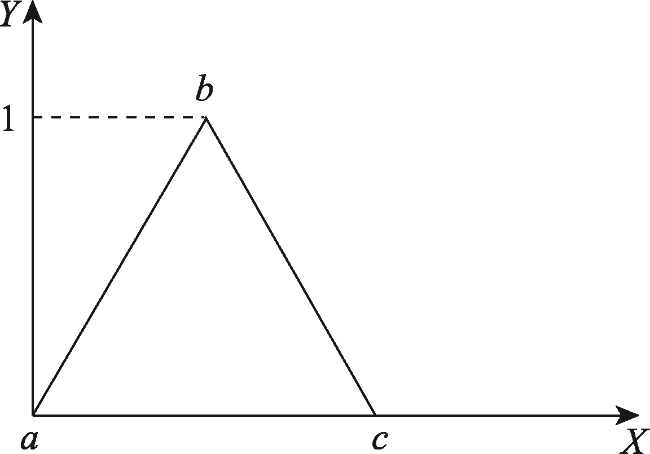
This study primarily used triangular fuzzy numbers to calculate membership degrees. Triangular fuzzy numbers are a common approach in fuzzy semantic computing for representing the membership degree of fuzzy sets (Lee, 2014). These numbers define a membership function in the shape of a triangle, which is used to describe the degree to which a variable belongs to a fuzzy set. To represent the membership degree of each evaluation, a triangular fuzzy number is defined by three parameters: a, b, and c, where a denotes the lower bound of the fuzzy number, b represents the peak value (i.e., the point where the membership degree equals 1), and c indicates the upper bound of the fuzzy number. These three parameters are used to determine the membership degree µ(x) of each evaluation value x calculated using the following formula:
$\mu \left( x \right)=\left\{ \begin{matrix} 0\ \ \ \ \ \ \ \ \ \ \ \ \ \ \ \ \ x<a \\ \frac{x-a}{b-a}~~~~~~~~~~~~a\le x\le b \\ \frac{c-x}{c-b}~~~~~~~~~~~~~b\le x\le c \\ 0\ \ \ \ \ \ \ \ \ \ \ \ \ \ \ \ \ x>c \\\end{matrix} \right.$
When x<a, µ(x)=0; this indicates that when x is less than a, the membership degree is 0, meaning that $x$ does not belong to this fuzzy set. When $a\le x\le b$, $\mu \left( x \right)=\frac{x-a}{b-a}$; this indicates that when $x$ is between $a$ and $b$, the membership degree increases linearly from 0 to 1. When $~b\le x\le c$, $\mu \left( x \right)=\frac{c-x}{c-b}$; this indicates that when $x$ is between $b$ and $c$, the membership degree decreases linearly from 1 to 0. When $~x>c$, $\mu \left( x \right)=0$; this indicates that when $x$ is greater than $c$, the membership degree is 0, meaning that $x$ does not belong to this fuzzy set.
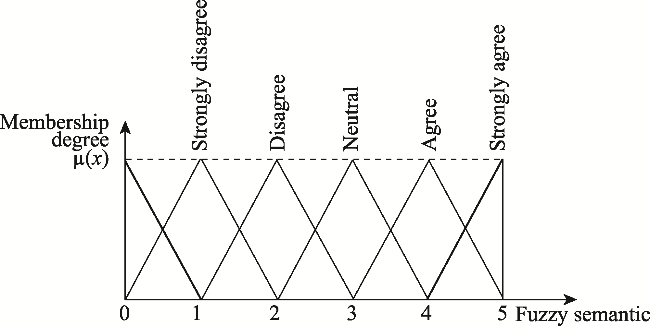
The triangular fuzzy number is used to define the membership degree of elements in a fuzzy set, and to describe the membership degree of variables within the set using parameters $a$, $b$, and $c$ (Pedrycz, 1994). Fuzzy semantic computing employs these membership functions to process and analyze fuzzy information (Zadeh, 1971). In fuzzy semantic computing, the membership function plays a key role in fuzzy reasoning and decision-making (Dubois and Prade, 1997). For example, fuzzy inference can be performed by calculating the membership function of an input variable and combining it with fuzzy rules to yield an inference result (Guillaume, 2001). In fuzzy decision-making, the membership degrees of different options are calculated by defining the membership functions of decision variables. The triangular fuzzy number is commonly used to represent the uncertainty of various decision options, as illustrated in Figures 1 and 2, which show the membership degree and fuzzy semantic relationship diagrams. Triangular fuzzy numbers are widely applied in fields such as fuzzy logic, fuzzy control, decision analysis, and other areas that deal with uncertainty and fuzziness.
Figure 1 Diagram of the triangular fuzzy number membership degree
Figure 2 Diagram of the membership degree and fuzzy semantic relationships

3.3 Research design

To ensure the comprehensiveness and accuracy of this research, a mixed research method combining questionnaire surveys with fuzzy semantic analysis was used. This study was divided into three main stages: first, data on the residents’ responses to the living environment was collected through a questionnaire survey; second, fuzzy semantic computing was applied to process the questionnaire data; and finally, fuzzy semantic computing methods were used for quantitative analysis to reveal the role of bionic design in optimizing rural human settlement environments and its ecological benefits.
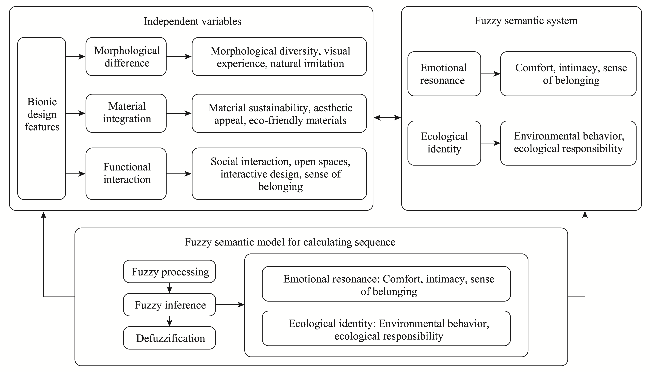
To quantify and analyze the impact of bionic design features on the emotional resonance and ecological identity of rural residents, a relational model based on fuzzy semantic computing was developed. This model was designed to handle complex and multi-dimensional evaluation factors and reveal the relationship between bionic design features and the emotional experiences and ecological identity of residents through fuzzy logic reasoning. The fuzzy semantic relation model in this study was built using Fuzzy Comprehensive Evaluation (FCE) and Fuzzy Inference System (FIS). By the fuzzy processing of multi-dimensional evaluation factors, this model reflects the impact of bionic design features—such as morphological differences, material integration, and interactive functions—on the emotional resonance and ecological identity of residents, and it quantifies the relationship, as shown in Figure 3. In this model, bionic design features serve as independent variables, which are used for subsequent reasoning and evaluation through fuzzy semantic computing models (including fuzzy processing, fuzzy reasoning, and defuzzification). The output layer mainly includes the emotional resonance and ecological identity of residents. Through fuzzy reasoning, the model analyzes how bionic design features influence these two outcomes, ultimately assisting in the optimization of rural human settlements.
Figure 3 Fuzzy semantic relationship model of the impact of bionic design features on the emotional resonance and ecological identity of residents
The model uses fuzzy semantic computing to analyze how bionic design features influence the emotional resonance and ecological identity of rural human settlements. Through fuzzy reasoning, the model processes complex, multidimensional data to determine the specific impact of the emotional responses of residents to the environment and their ecological identity, providing a scientific basis for environmental optimization in rural revitalization.

3.4 Research object

This study investigated the impact of bionic design features on the optimization of rural human settlements and quantified their effects on the emotional resonance and ecological identity of residents through fuzzy semantic computation. To ensure the scientific validity and representativeness of the findings, the selected samples encompassed rural areas in China's eastern, central, western, and northeastern regions, and covered diverse economic and geographical contexts, including plains, hills, and mountainous areas, in order to reflect the environmental characteristics of different localities.
When selecting villages in each region, priority was given to sites that varied in population size, economic development level, cultural traditions, and architectural styles, thereby ensuring that the survey results captured a wide range of rural contexts. In total, 600 questionnaires were distributed, with 576 returned and 560 deemed valid, resulting in an effective response rate of 93.3%. Approximately 80-100 rural residents were surveyed in each region, representing a balanced distribution across gender, age, educational background, and occupational categories, in order to maintain demographic representativeness. The questionnaire primarily focused on the residents’ emotional evaluations of the rural living environment, perceptions of ecological identity, and subjective impressions of bionic design features, thereby providing a robust data foundation for subsequent quantitative analysis.

3.5 Questionnaire design and implementation

In this study, a questionnaire survey and fuzzy theory were employed to collect feedback from rural residents on the optimization of the human settlement environment, with a focus on the impact of bionic design features on emotional resonance and ecological identity. To ensure the scientific validity and reliability of the data, the questionnaire design and execution process included the steps of construction, pre-testing, formal survey execution, and data collection and processing.
Questionnaire design was a critical step in the entire research process. Its purpose was to accurately gather feedback from rural residents regarding the optimization of the human settlement environment through a well-structured and relevant questionnaire. In addition, 16 questionnaires were pre-tested, after which the questionnaires were modified and adjusted accordingly. According to the criteria proposed by some researchers (Nunnally, 1995; Tiku and Pecht, 2010), when Cronbach's α is greater than 0.7, the reliability and validity of the questionnaire are considered satisfactory. The questionnaire was divided into three main sections. The first section gathered basic information about the residents, including gender, age, education level, and income level. The second section focused on bionic design features, such as morphological differences, material integration, and functional interaction. The third section assessed the emotional resonance and ecological identity of the respondents, including their emotional responses and ecological identity perceptions. The questionnaire used a five-point Likert scale for scoring, with five response options for each question: “Strongly Agree,” “Agree,” “Neutral”, “Disagree,” and “Strongly Disagree,” corresponding to 5, 4, 3, 2, and 1 points, respectively. The specific questionnaire items are shown in Tables 1 and 2.
Table 1 Questionnaire design for bionic design features
Questionnaire items on bionic design features 5 4 3 2 1
Q2-1: The architectural forms in the rural environment are diverse and meet various functional and aesthetic needs
Q2-2: The visual effects of the architecture and landscape in rural design make residents feel comfortable and pleased
Q2-3: The architectural and landscape design in the rural environment mimics natural forms (e.g., mountains, trees, animals)
Q2-4: The integration of natural and modern materials in rural architecture enhances the overall aesthetic appeal and harmony
Q2-5: The architectural design in the rural environment meets the residents’ aesthetic standards and enhances comfort and visual enjoyment
Q2-6: The design in the rural environment extensively uses eco-friendly and sustainable materials (e.g., recycled wood, green building materials)
Q2-7: The design in the rural environment promotes social interaction among residents, such as through public spaces or activity areas
Q2-8: Open spaces in rural design (e.g., parks, squares) provide comfortable spaces for social interaction
Q2-9: Interactive elements in the rural design (e.g., smart guides, shared spaces) enhance the residents’ living experience
Q2-10: Rural design enhances the sense of community belonging among residents, making them feel like part of the community

Note: This section evaluates the impact of bionic design features on the emotional resonance and ecological identity of residents. The bionic design feature evaluation uses a five-point Likert scale, with five response options for each question: “Strongly Agree”, “Agree”, “Neutral”, “Disagree” and “Strongly Disagree”, corresponding to scores of 5, 4, 3, 2, and 1, respectively.

Table 2 Questionnaire design for the emotional resonance and ecological identity of residents
Emotional resonance and ecological identity 5 4 3 2 1
Q3-1: The architectural forms in the rural environment make you feel comfortable and pleased
Q3-2: The architecture and landscape in rural design enhance your living experience
Q3-3: The design of the rural environment gives you a sense of connection to nature
Q3-4: In the rural environment, the architectural and landscape design enhances your emotional resonance
Q3-5: The design in the rural environment makes you more willing to live there
Q3-6: The materials used in rural design make you feel that the environment is more natural and ap-proachable
Q3-7: The public spaces in rural design have helped you establish closer relationships with your neighbors
Q3-8: The green spaces in the rural environment make you feel relaxed and com-fortable
Q3-9: Interactive elements in rural design have increased your sense of community identity
Q3-10: The rural design makes you feel like part of the community, enhancing your sense of belonging

Note: This section assesses the impact of bionic design features on the emotional resonance and ecological identity of residents. It also uses a five-point Likert scale for scoring, with five options: “Strongly Agree”, “Agree”, “Neutral”, “Disagree” and “Strongly Disagree,” corresponding to 5, 4, 3, 2, and 1 points, respectively.

3.6 Questionnaire data processing and fuzzy semantic computing model construction

In this study, feedback data were collected from rural residents regarding the impact of bionic design features (such as morphological differences, material integration, and interactive functions) on their emotional resonance and ecological identity through a questionnaire survey. However, the evaluations provided by residents are often fuzzy and uncertain, making it difficult for traditional statistical methods to analyze these data accurately. To address this issue, fuzzy semantic computing was introduced to process and analyze the fuzzy evaluation data. In this study, the collected data were first processed, followed by fuzzy semantic statistical analysis to obtain the fuzzy evaluation results from rural residents on bionic design features. Using descriptive statistics, correlation analysis, and regression analysis, the defuzzified data were analyzed in detail to reveal the specific impacts of bionic design features on the emotional resonance and ecological identity of residents.

3.6.1 Questionnaire data processing

Before performing the fuzzy semantic statistical analysis, the collected questionnaire data were processed to ensure its quality and reliability. Data processing involved cleaning, conversion, and coding.
(1) Data cleaning and screening
The purpose of data cleaning is to remove invalid or incomplete items in the questionnaire data. For items that are not filled in or answered incompletely, when the missing values are few and the distribution is random, the mean or median filling method can be used. When the missing values are numerous or show a systematic pattern, the data may be deleted to avoid affecting the analysis. Outliers in the questionnaire data were also identified and processed. Statistical methods such as box plots can be used to detect outliers. After identifying outliers, they were checked for input errors or exceptional data, and corrected or removed as necessary.
(2) Data coding and standardization
First, qualitative data from the questionnaire was converted into quantitative data for subsequent fuzzy semantic statistical analysis. In this study, the impact of bionic design features on the emotional resonance and ecological identity of residents was considered a form of human psychological cognition, and therefore fuzzy, subjective, and uncertain. Therefore, the five-point Likert scale used in the questionnaire was converted into numerical values: “Strongly agree” as 5 points, “Agree” as 4 points, “Neutral” as 3 points, “Disagree” as 2 points, and “Strongly Disagree” as 1 point. In addition, all data were standardized to ensure that data across different dimensions were on a uniform scale, for example, by converting all scores into standardized values with a mean of 0 and a standard deviation of 1 using the Z-score standardization method.

3.6.2 Fuzzy semantic computing model construction

Fuzzy semantic statistics were used to process and analyze the evaluation data using fuzzy set theory and fuzzy logic. The specific steps included fuzzy processing, fuzzy reasoning, defuzzification, and fuzzy semantic value calculation.
(1) Fuzzy processing
The goal of fuzzy processing is to convert quantitative data into fuzzy numbers. In this study, triangular fuzzy numbers were used to represent the respondents’ evaluations of bionic design features, emotional resonance, and ecological identity. The three parameters of $a$, $b$, and $c$ represent the parameters of the triangular fuzzy numbers. These correspond to the “Strongly Agree”, “Agree”, “Neutral”, “Disagree” and “Strongly Disagree” ratings, which fall within the ranges of (4, 5, 5), (3, 4, 5), (2, 3, 4), (1, 2, 3), and (1, 1, 2), respectively. Based on the questionnaire scores, each evaluation was converted into the corresponding triangular fuzzy number. For example, a rating of 4 can be converted into a triangular fuzzy number $\tilde{X}=\left( 3,\ 4,\ 5 \right)$.
(2) Fuzzy reasoning
Fuzzy reasoning aims to calculate the fuzzy number using fuzzy logic and derive the fuzzy semantic value of the emotional resonance and ecological identity of residents. Fuzzy reasoning rules were established based on the relationships between bionic design features and emotional resonance/ecological identity. For instance, if the morphological difference is “high” and material integration is “good,” then emotional resonance is “high.” If the interactive function is “good,” ecological identity is “high.” These rules enable the model to convert fuzzy input data (such as the membership of bionic design features) into fuzzy output data (such as the membership of emotional resonance and ecological identity).
(3) Defuzzification
The purpose of defuzzification is to convert the results of fuzzy reasoning into specific values for further statistical analysis. The Center of Area (CoA) method was used for defuzzification. This method, or CoA, was employed as outlined by Kaufmann and Gupta (1991), Chien and Tsai (2000), and Hsu and Lin (2005). The defuzzification formula (center region method formula) is defined as:
${{V}_{{\tilde{X}}}}=\frac{a+2b+c}{4}$
where, $a$, $b$, and $c$ represent the lower bound, center (or peak) value, and upper bound of the triangular fuzzy number, respectively. ${{V}_{{\tilde{X}}}}$ denotes the defuzzified value obtained by converting the fuzzy number $\tilde{X}$ into a specific real number. Based on the fuzzy number obtained through fuzzy reasoning, the corresponding defuzzification value was calculated. For instance, the defuzzification value of the fuzzy number (4, 5, 5) is ${{V}_{{\tilde{X}}}}=\frac{4+2\times 5+5}{4}=4.75$.
(4) Fuzzy Semantic Value calculation
To analyze the residents’ perceptions of bionic design features, the fuzzy semantic mean value formula was used for further data analysis. This approach provides a more comprehensive reflection of the feelings and evaluations of residents when processing their subjective assessments. In the second part of the questionnaire in this study, Formula (3) was primarily used to calculate the fuzzy semantic value. In the third part of the questionnaire, Formula (4) was used to calculate the fuzzy semantic value, which represented the specific impact of the emotional resonance and ecological identity of residents on the bionic design features. Since these two parts of the study differed, the formulas used were also distinct (Kaufman and Gupta, 1991).
$\text{Fuzzy}\ \text{Semantic}\ \text{Value}=\frac{\sum\limits_{i=1}^{n}{\left( a+2b+c \right)}}{4N}$
$\text{Fuzzy}\ \text{Semantic}\ \text{Value}=\frac{\sum\limits_{i=1}^{n}{\left( {{a}_{1}}+2{{b}_{1}}+{{c}_{1}} \right)}}{4N}$
where n denotes the number of design features or evaluation items being assessed, and N represents the number of respondents participating in the evaluation. The parameters a, b, and c refer to the lower bound, center (or peak) value, and upper bound of the triangular fuzzy number corresponding to each evaluation, respectively. The term “Fuzzy Semantic Value” refers to the fuzzy average of the evaluations from all respondents under a specific design feature. In this study, this formula was used to comprehensively analyze the fuzzy numbers of each evaluation and obtain an overall fuzzy evaluation mean value, thereby facilitating a better analysis of the fuzzy attributes of the evaluation object.

4 Results and analysis

4.1 Descriptive statistics

In this study, 560 participants from various regions of China were surveyed, and the descriptive statistics are presented in Table 3. Among them, males and females each accounted for 45.71% of the sample. Most of the respondents (74.29%) were aged between 31 and 40, while only 0.89% was over 60. In terms of educational background, nearly half (49.11%) held a bachelor's degree, whereas only 4.46% had earned a doctoral degree. Regarding annual income, 53.75% of the participants reported earning between 20000 and 50000 yuan, and only 7.50% earned more than 100000 yuan.
Table 3 Demographic descriptive statistics
Demographic variable Sample (N=560) Percentage (%)
Gender Male 256 45.71
Female 304 54.29
Age (yr) 20-30 121 21.61
31-40 416 74.29
41-50 16 2.86
51-60 5 0.89
Older than 60 2 0.36
Education High school or below 7 1.25
College 151 26.96
Bachelor's degree 275 49.11
Master's degree 102 18.21
Doctoral degree 25 4.46
Annual income (yuan) Below 20000 103 18.39
20000-50000 301 53.75
50001-100000 114 20.36
Above 100000 42 7.50
Note that the sample in this study shows a significant age distribution bias, with a dominant proportion (over 74%) consisting of “new-generation rural residents” aged between 31 and 40. This demographic structure reflects the active involvement of young and middle-aged groups in current rural development, and it is closely related to the phenomenon of “youth returning to the countryside” observed in the broader context of rural digitalization, tourism development, and ecological renewal. However, the representation of the traditional elderly population (aged 60 and above) is extremely limited, accounting for only 0.36% of the sample, so it is difficult to capture their cognitive and emotional distinctions comprehensively. Therefore, when interpreting the results and evaluating the applicability of the model, it is important to acknowledge the limitations in representativeness and to consider potential intergenerational differences in ecological identity, emotional resonance, and related cognitive dimensions.

4.2 Reliability analysis

Reliability analysis is used to assess whether sample responses are consistent and dependable. In this study, the second part of the questionnaire focused on the residents’ views and evaluations of bionic design features, including morphological differences, material integration, and functional interaction. As shown in Table 4, the Cronbach's α coefficient is 0.957. The third part of the questionnaire assessed the emotional resonance and ecological identity of residents, with a Cronbach's α of 0.963. The reliability coefficients for both the second and third parts of the questionnaire exceed 0.8, indicating excellent reliability of the test and trustworthy results.
Table 4 Reliability analysis of bionic design features and the resident perceptions questionnaire
Item Cronbach's α
Bionic design features 0.957
The emotional resonance and ecological identity of
residents
0.963

4.3 Descriptive statistics of fuzzy semantic questionnaires

The second part of the questionnaire focused on the impact of bionic design features, such as size, appearance, and color, on the fuzzy semantics of residents, as shown in Table 5. For Question 2-6, which states, “The design in the rural environment extensively uses eco-friendly and sustainable materials (e.g., recycled wood, green building materials),” the fuzzy semantic value is the highest at 4.32. In contrast, for Question 2-9, “Interactive elements in rural design (e.g., smart guides, shared spaces) enhance the residents’ living experience,” the fuzzy semantic value is the lowest at 2.87.
Table 5 Descriptive statistics of bionic design features (N=560)
Question Fuzzy semantic value Standard deviation
Q2-1 3.58 1.379
Q2-2 4.19 0.967
Q2-3 4.14 1.039
Q2-4 4.08 1.051
Q2-5 3.98 1.153
Q2-6 4.32 0.800
Q2-7 3.73 1.248
Q2-8 4.11 1.037
Q2-9 2.87 1.288
Q2-10 4.48 0.543
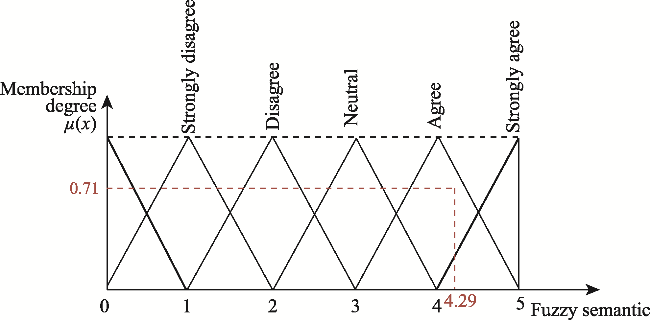
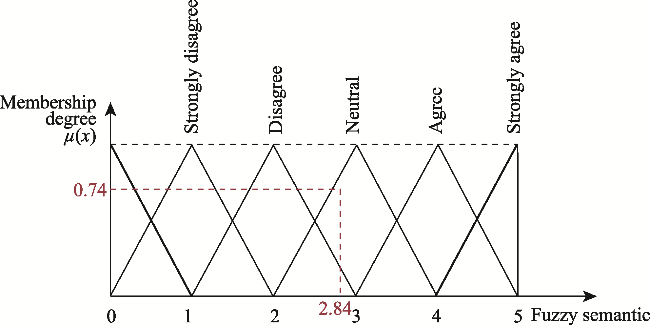
The third section of the questionnaire focused on the impact of bionic design features on the emotional resonance and ecological identity of residents, specifically examining morphological differences, material integration, and functional interaction. As shown in Table 6, Q3-8, “The green spaces in the rural environment make you feel relaxed and comfortable,” received a score of 4.29. The corresponding membership function is µ(x)=(5-4.29)/(5-4)=0.71, which indicates that the value of 4.29 is close to “Strongly Agree,” as shown in Figure 4. However, Q3-10, “Rural design makes you feel like part of the community, enhancing your sense of belonging,” shows a fuzzy semantic value of 2.84. The corresponding membership function is µ(x)= (2.74-2)/ (3-2)=0.74, which indicates that the value is closer to “Neutral,” as shown in Figure 5.
Table 6 Descriptive statistics of the emotional resonance and ecological identity of residents (N=560)
Question Fuzzy semantic value SD
Q3-1 3.48 1.15472
Q3-2 3.83 1.13738
Q3-3 4.08 1.03008
Q3-4 3.57 1.10718
Q3-5 4.01 1.09349
Q3-6 3.64 1.26438
Q3-7 3.37 1.28023
Q3-8 4.29 0.76578
Q3-9 3.57 1.10718
Q3-10 2.84 1.36706
Figure 4 Membership degree and fuzzy semantic relationships of Q3-8
Figure 5 Membership degree and fuzzy semantic relationships of Q3-10
Based on the fuzzy semantic values from the second part of the questionnaire, a correlation analysis was conducted between these values and the emotional responses of residents in the third part of the questionnaire. Pearson's Chi-square test (X2), degrees of freedom (df), and significance analysis (P) were primarily applied using SPSS software. Pearson's Chi-square tests are used to assess the independence or association between two categorical variables by comparing the difference between observed and expected frequencies. This helps to determine whether there is a statistically significant association between variables. In this study, the relationship between the residents’ perceptions of bionic design features and their emotional resonance and ecological identity was examined.
The degrees of freedom represent the independent pieces of information used to calculate statistics in a statistical model. It reflects the extent to which the sample data can vary without affecting the statistical parameters. The degrees of freedom provide a better interpretation of the Chi-square test results to ensure the reliability and validity of the conclusions. Significance analysis determines whether the observed statistical results are statistically significant by calculating the P-value. The P-value represents the probability of obtaining the current result, or one more extreme, assuming the null hypothesis is true. Generally, a significant association is indicated when P<0.05.
As shown in Table 7, the Chi-square statistics for most questions demonstrate a high level of significance (P<0.05), suggesting that “bionic design features (morphological differences)” are significantly correlated with “the emotional resonance and ecological identity of residents”. This indicates that the morphological differences in bionic design features have a significant impact on the emotional resonance and ecological identity of residents.
Table 7 The Chi-square test results for the association between design features and the emotional resonance and ecological identification of residents
Design feature Morphological difference Material
integration
Functional
interaction
X2 P X2 P X2 P
Q3-1 17.430 0.002 24.376 0.005 48.988 <0.001
Q3-2 17.901 0.002 20.975 0.008 14.591 0.006
Q3-3 24.930 0.006 31.737 0.006 13.618 0.008
Q3-4 17.751 0.009 20.984 0.009 45.149 0.007
Q3-5 23.707 0.007 29.938 <0.001 17.737 0.005
Q3-6 14.600 0.007 19.025 0.003 18.279 0.003
Q3-7 15.362 0.009 17.441 0.006 31.998 0.008
Q3-8 12.919 0.001 10.536 <0.001 6.304 0.001
Q3-9 17.751 0.009 20.984 0.009 45.149 0.007
Q3-10 25.181 0.002 40.650 0.004 15.513 <0.001
The Chi-square test between the material integration of bionic design features and their impact on the emotional resonance and ecological identity of residents (Q3-1 to Q3-10) revealed that the Chi-square statistics for all questions are statistically significant (P<0.05). This indicates that the bionic design feature “material integration” has a significant impact on the emotional resonance and ecological identity of residents. Therefore, in the optimization of human settlements, integrated design is a crucial factor in enhancing the living comfort of residents.
The Chi-square test of bionic design features (functional interaction) and their impact on the emotional resonance and ecological identity of residents (Q3-1 to Q3-10) revealed that the Chi-square statistics for all questions are statistically significant (P<0.05). This suggests that the “functional interaction” aspect of design also has a significant impact on the emotional resonance and ecological identity of residents. Thus, in the optimization of rural living environments, “functional interaction” is a crucial factor. Designers should focus on this aspect to enhance the satisfaction and comfort of residents.

4.4 Linear regression analysis

This study used a linear regression model to assess how three design features—“morphological difference,” “material integration,” and “functional interaction”—affect the emotional resonance and ecological identity of residents.
The model summary (Table 8) shows that the correlations of all independent variables are highly significant. Among them, material integration has the strongest impact on emotional resonance and ecological identity, followed by morphological difference, and finally functional interaction. The adjusted R² values demonstrate the strong explanatory power of these independent variables in relation to the dependent variables. Notably, in the “material integration” model, higher R² values and lower standard errors indicate that this independent variable has a strong ability to explain emotional resonance and ecological identity. At the same time, the analysis further revealed the standardized regression coefficient (Beta value) for each independent variable and its impact on the dependent variable. The results show that morphological difference and material integration significantly affect emotional resonance and ecological identity, with Beta values of 0.117 and 0.122, respectively, and P-values less than 0.05. This demonstrates that both have significant positive effects on the dependent variables. Although the Beta value of functional interaction is 0.149, its high P-value (P=0.340) suggests that its effect in this model is not significant. Therefore, future research could explore ways to enhance the effect of functional interaction on emotional resonance and ecological identity, or consider supplementing it with other variables.
Table 8 Regression model fit statistics (N=560)
Model Beta T P Adjusted R² SD
Morphological difference 0.517 0.362 0.009 0.208 1.126
Material integration 0.522 0.497 0.008 0.223 1.116
Functional interaction 0.549 1.187 <0.001 0.142 1.106

Note: The dependent variables are the emotional resonance and ecological identity of residents. Coefficients are based on standardized linear regression results.

ANOVA was used to evaluate the impacts of independent variables on emotional resonance and ecological identity (Table 9). Based on the F-value and P-value results, morphological difference and material integration had statistically significant effects on emotional resonance and ecological identity (P<0.05). This suggests that these two design features have a significant positive effect on improving the emotional experience and ecological satisfaction of residents. The P-value for functional interaction (0.083) is slightly above 0.05, indicating that its effect on emotional resonance and ecological identity is not significant. This may be due to either other influencing factors or its relatively weak effect in the current data sample.
Table 9 ANOVA results for the effects of bionic design features on the emotional resonance and ecological identity of residents
Model Sum of squares df Mean square F P
Morphological difference Regression 10.336 3 3.445 2.544 0.002
Residual 717.954 556 1.291
Total 728.2893 559
Material integration Regression 23.969 3 7.990 5.617 0.007
Residual 704.321 556 1.267
Total 728.289 559
Functional interaction Regression 35.942 4 8.986 7.286 0.003
Residual 692.347 555 1.248
Total 728.289 559

Note: The dependent variables are the emotional resonance and ecological identity of residents.

5 Conclusions and practical recommendations

This study conducted an empirical analysis of the influence of bionic design features on the emotional resonance and ecological identity of residents in rural living environments, by using a fuzzy semantic computing model for quantitative modeling and evaluation. The main findings are threefold.
First, morphological diversity and material integration exhibit significant effects in enhancing the emotional resonance and ecological identity of residents. By introducing formal contrasts and visual impact, morphological diversity satisfies diverse functional and aesthetic needs, thereby strengthening the residents’ emotional attachment to the environment. Through the harmonious fusion of natural materials and spatial settings, material integration not only improves comfort and aesthetic pleasure but also reinforces the recognition of ecological values.
Second, functional interactivity plays a positive role in improving the residential experience and social participation, but its direct influence on emotional resonance and ecological identity is relatively limited. Designs such as smart navigation systems and shared spaces enhance interactivity; however, compared to morphological and material elements, their emotional and ecological impacts are more indirect.
Third, the fuzzy semantic computing model provides an effective quantitative approach for assessing the perceptual influence of bionic design features. This method is well-suited to handling the fuzziness of subjective perception, enhancing the precision and interpretability of design decisions. It demonstrated strong adaptability in evaluating emotional resonance and ecological identity.
In summary, the application of bionic design in the optimization of rural living environments should emphasize aesthetic diversity and ecological integration, while making appropriate use of morphological and material elements to enhance the emotional connection and ecological belonging of residents.
Based on the above conclusions, the following four recommendations are proposed.
(1) Enhance morphological diversity in design. Diversify architectural forms, façade expressions, and spatial organizations to enrich visual experiences and environmental uniqueness, thereby evoking stronger emotional resonance among residents.
(2) Strengthen material integration strategies. Prioritize the use of local, ecological, and sustainable materials to achieve harmonious coexistence between humans and nature and to foster a stronger sense of ecological identity among residents.
(3) Gradually introduce functional interactivity. Incorporate moderate amounts of interactive design elements, such as smart navigation systems and shared communal spaces, to enhance the sense of engagement and social experience among residents, particularly in community-oriented environments.
(4) Expand the application of fuzzy semantic models. Further integrate big data and intelligent analytical tools to deepen the role of fuzzy semantic computing in bridging subjective perception and design intention, thereby improving the scientific validity and operability of design evaluation and optimization.
[1]
Ahmad T, Madonski R, Zhang D, et al. 2022. Data-driven probabilistic machine learning in sustainable smart energy/smart energy systems: Key developments, challenges, and future research opportunities in the context of smart grid paradigm. Renewable and Sustainable Energy Reviews, 160: 112128. DOI: 10.1016/j.rser.2022.112128.

[2]
Chien C J, Tsai H H. 2000. Using fuzzy numbers to evaluate perceived service quality. Fuzzy Sets and Systems, 116(2): 289-300.

[3]
D’Aniello G, Gaeta M, Loia F, et al. 2018. An environment for collective perception based on fuzzy and semantic approaches. Journal of Artificial Intelligence and Soft Computing Research, 8(3): 191-210.

[4]
Dubois D, Prade H. 1997. The three semantics of fuzzy sets. Fuzzy Sets and Systems, 90(2): 141-150.

[5]
Fang Z, Yao J, Shi J. 2024. The influence of environmental factors, perception, and participation on industrial heritage tourism satisfaction—A study based on multiple heritages in Shanghai. Buildings, 14(11): 3508. DOI: 10.3390/buildings14113508.

[6]
Goel R K, Vishnoi S. 2022. Urbanization and sustainable development for inclusiveness using ICTs. Telecommunications Policy, 46(6): 102311. DOI: 10.1016/j.telpol.2022.102311.

[7]
Guillaume S. 2001. Designing fuzzy inference systems from data: An interpretability-oriented review. IEEE Transactions on Fuzzy Systems, 9(3): 426-443.

[8]
Hsu T H, Lin L Z. 2005. Fuzzy set theory for building analysis matrixes of travel risk. Sun Yet-sent Management Review, 13(2): 479-509.

[9]
Ibeh L, Kouveliotis K, Unune D R, et al. 2025. A novel approach to integrating community knowledge into fuzzy logic-adapted spatial modeling in the analysis of natural resource conflicts. Sustainability, 17(5): 2315. DOI: 10.3390/su17052315.

[10]
Jetter A J, Kok K. 2014. Fuzzy Cognitive Maps for futures studies—A methodological assessment of concepts and methods. Futures, 61: 45-57.

[11]
Kaufmann A, Gupta MM. 1991. Introduction to fuzzy arithmetic. New York, USA: Van Nostrand Reinhold Company.

[12]
Lee A S. 2014. The investigation into the influence of the features of furniture product design on consumers’ perceived value by fuzzy semantics. South African Journal of Business Management, 45(1): 79-93

[13]
Lin X H, Sayuti N A A. 2023. Concept combination and inter-transformation of semiotics and semantic learning in design. In: Dwyer R J (Ed.). Digitalization and Management Innovation II (OL): 127-133. DOI: 10.3233/FAIA230724.

[14]
Lin X H, Toyong N M P, Nurul B A S. 2023. The influence of semantic and semiotic features of furniture shape design on consumer preference based on fuzzy computing. In: Tallón-Ballesteros A J and Beltrán-Barba R (Eds.). Fuzzy Systems and Data Mining IX (OL): 797-803. DOI: 10.3233/FAIA231091.

[15]
Liu M. Zhang H, Xu Z, Ding K. 2024. The fusion of fuzzy theories and natural language processing: A state-of-the-art survey. Applied Soft Computing, 162: 111818. DOI: 0.1016/j.asoc.2024.111818.

[16]
Marzouk M, Othman A. 2020. Planning utility infrastructure requirements for smart cities using the integration between BIM and GIS. Sustainable Cities and Society, 57: 102120. DOI: 10.1016/j.scs.2020.102120.

[17]
Pedrycz W. 1994. Why triangular membership functions? Fuzzy Sets and Systems, 64(1): 21-30.

[18]
Qin R J, Leung H H. 2021. Becoming a traditional village: Heritage protection and livelihood transformation of a Chinese village. Sustainability, 13(4): 2331. DOI: 10.3390/su13042331.

[19]
Tiku S, Pecht M. 2010. Validation of reliability capability evaluation model using a quantitative assessment process. International Journal of Quality & Reliability Management, 27(8): 938-952.

[20]
Tim Y, Cui L, Sheng Z. 2021. Digital resilience: How rural communities leapfrogged into sustainable development. Information Systems Journal, 31(2): 323-345.

[21]
Vashishtha S, Gupta V, Mittal M. 2023. Sentiment analysis using fuzzy logic: A comprehensive literature review. Wiley Interdisciplinary Reviews: Data Mining and Knowledge Discovery, 13(5): 1509. DOI: 10.1002/widm.1509.

[22]
Zadeh L A. 1971. Quantitative fuzzy semantics. Information Sciences, 3(2): 159-176.

[23]
Zhang S, Zhu D, Shi Q, et al. 2018. Which countries are more ecologically efficient in improving human well-being? An application of the index of ecological well-being performance. Resources, Conservation and Recycling, 129: 112-119.

Outlines

/