Journal of Resources and Ecology >
Study on the Spatial Coordination Relationship between High Quality Development and Ecological Environmental Protection in the Yellow River Basin under the Perspective of Ecosystem Service Value
|
LI Enze, Email: lienze51@163.com |
Received date: 2024-01-22
Accepted date: 2024-10-20
Online published: 2025-10-14
Supported by
The Commerce Statistical Society of China 2024 Annual Planning Project(2024STY75)
The Research Project of Higher Education Institutions in Guizhou Province for the Year 2023 (Youth Project)([2022]164)
The 2024 Annual Henan Province Federation of Social Sciences Circles Research Project(SKL-2024-1765)
This study employs the coupled coordination gravity model to explore the spatial relationship between high-quality development and ecological environmental protection in the Yellow River Basin, using ecosystem service value (ESV) as a key perspective. The research begins by introducing the ecological and developmental context of the Yellow River Basin alongside relevant theoretical foundations. Subsequently, data from nine provinces in the Yellow River Basin from 2011 to 2022 are analyzed. ESV are calculated using established methodologies, and an index system for high-quality development is constructed and evaluated. The coupled coordination gravity model is then applied to analyze the data. The results indicate that the value of ecosystem services in the basin has fluctuated upward over the study period. Spatial development in high-quality development indices is evident across provinces, with Shaanxi and Ningxia achieving the highest levels of coupling and coordination, while Inner Mongolia exhibits relatively lower levels. Based on these findings, policy recommendations include continuing ecological restoration projects, enhancing policy support for central and western regions, fostering synergies between ecological and economic development, and promoting deeper regional cooperation.
LI Enze , XU Minghao , TANG Yuanxiu . Study on the Spatial Coordination Relationship between High Quality Development and Ecological Environmental Protection in the Yellow River Basin under the Perspective of Ecosystem Service Value[J]. Journal of Resources and Ecology, 2025 , 16(5) : 1366 -1376 . DOI: 10.5814/j.issn.1674-764x.2025.05.010
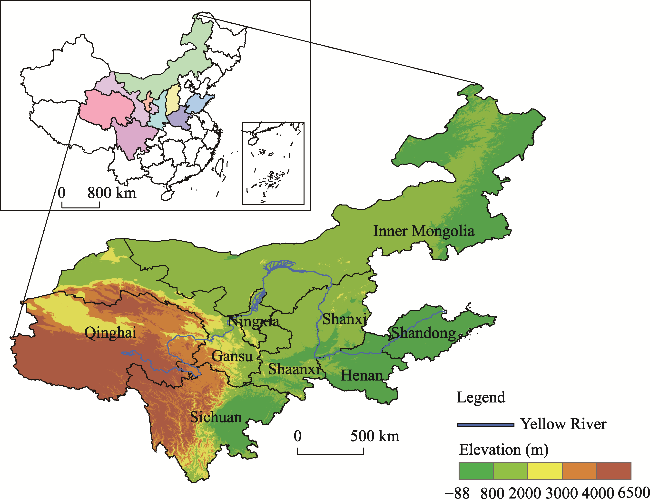
Figure 1 Geographical location of the Yellow River Basin |
Table 1 Ecosystem service equivalent value per unit area in the Yellow River Basin |
| Ecosystem classification | Supply service | Regulation service | Support service | Cultural service | |||||
|---|---|---|---|---|---|---|---|---|---|
| Food production | Production of material | Gas conditioning | Climate regulation | Hydrologic condition | Soil conservation | Maintain nutrient cycle | Bio- diversity | Aesthetic landscape | |
| Farmlands | 1.11 | 0.25 | 0.89 | 0.47 | 0.19 | 0.52 | 0.16 | 0.17 | 0.08 |
| Forests | 0.25 | 0.58 | 1.91 | 5.71 | 4.04 | 2.32 | 0.18 | 2.12 | 0.93 |
| Grasslands | 0.23 | 0.34 | 1.21 | 3.19 | 2.53 | 1.47 | 0.11 | 1.00 | 0.59 |
| Waters | 0.40 | 0.12 | 0.48 | 1.42 | 59.91 | 0.47 | 0.04 | 1.28 | 0.99 |
| Wetlands | 0.51 | 0.50 | 1.90 | 3.60 | 26.82 | 2.31 | 0.18 | 7.87 | 4.73 |
| Deserts | 0.01 | 0.02 | 0.07 | 0.05 | 0.13 | 0.08 | 0.01 | 0.07 | 0.03 |
Table 2 High-quality development indicator system in the Yellow River Basin |
| Dimension | Aspect | Indicator | Effect |
|---|---|---|---|
| Innovation | Regional GDP growth rate | Regional GDP growth rate | + |
| R&D investment intensity | R&D expenditures of industrial enterprises / Regional GDP | + | |
| Investment efficiency | Investment rate / Regional GDP growth rate | - | |
| Technology trade activity rate | Technology transaction turnover / Regional GDP | + | |
| Coordination | Demand structure | Total retail sales of consumer goods / Regional GDP | + |
| Urban and rural structures | Urbanization rate | + | |
| Government debt burden | Government debt stock / Regional GDP | - | |
| Industry structure | Share of tertiary sector in GDP | + | |
| Greenness | Energy consumption per unit of GDP | Total energy consumption / Regional GDP | - |
| Energy consumption elasticity coefficient | Growth rate of energy consumption / Regional GDP growth rate | - | |
| Wastewater per unit of output | Wastewater discharge / Regional GDP | - | |
| Exhaust gas per unit of output | Sulfur dioxide emissions / Regional GDP | - | |
| Openness | Degree of marketization | Regional marketization index | + |
| Share of foreign investment | Actual utilization of foreign investment / Regional GDP | + | |
| External trade dependence | Total exports and imports / Regional GDP | + | |
| Level of financial development | Growth in individual loans / Regional GDP | + | |
| Sharing | Share of workers’ compensation | Remuneration of workers / Regional GDP | + |
| Elasticity of personal income growth | Growth rate of disposable income per capita / Regional GDP | + | |
| Urban-rural consumption gap | Consumption expenditure of urban residents / Consumption expenditures of rural residents | - | |
| Share of private fiscal expenditure | Financial expenditure on people's livelihoods / Total financial expenditure | + |
Table 3 ESV of different land types in the Yellow River Basin (Unit: yuan km-2) |
| Year | Farmland | Forest | Grassland | Water | Wetland | Desert |
|---|---|---|---|---|---|---|
| 2011 | 8203.16 | 38537.76 | 22793.68 | 139090.55 | 103436.72 | 1004.03 |
| 2012 | 8799.75 | 41340.49 | 24451.39 | 149206.17 | 110959.34 | 1077.05 |
| 2013 | 8708.17 | 40910.24 | 24196.91 | 147653.32 | 109804.54 | 1065.84 |
| 2014 | 9357.83 | 43962.29 | 26002.09 | 158668.79 | 117996.36 | 1145.36 |
| 2015 | 8532.36 | 40084.29 | 23708.39 | 144672.31 | 107587.67 | 1044.32 |
| 2016 | 7621.04 | 35803.03 | 21176.18 | 129220.35 | 96096.59 | 932.78 |
| 2017 | 8101.18 | 38058.67 | 22510.31 | 137361.40 | 102150.81 | 991.55 |
| 2018 | 7715.67 | 36247.59 | 21439.12 | 130824.86 | 97289.81 | 944.37 |
| 2019 | 8141.02 | 38245.82 | 22621.00 | 138036.86 | 102653.13 | 996.43 |
| 2020 | 9127.47 | 42880.09 | 25362.00 | 154762.89 | 115091.68 | 1117.16 |
| 2021 | 10084.76 | 47377.36 | 28021.98 | 170994.47 | 127162.53 | 1234.33 |
| 2022 | 11047.76 | 51901.46 | 30697.82 | 187322.85 | 139305.36 | 1352.20 |
Table 4 Changes in the total ESV in the Yellow River Basin from 2011 to 2022 (Unit: 108 yuan) |
| Year | Farmlands | Forests | Grasslands | Waters | Wetlands | Deserts | Total |
|---|---|---|---|---|---|---|---|
| 2011 | 8.10 | 33.21 | 51.17 | 8.96 | 0.10 | 0.97 | 102.52 |
| 2012 | 8.68 | 35.73 | 54.81 | 9.54 | 0.11 | 1.04 | 109.91 |
| 2013 | 8.56 | 35.44 | 54.18 | 9.25 | 0.11 | 1.03 | 108.57 |
| 2014 | 9.21 | 38.13 | 58.08 | 9.85 | 0.11 | 1.11 | 116.49 |
| 2015 | 8.36 | 34.90 | 52.96 | 9.02 | 0.09 | 1.01 | 106.34 |
| 2016 | 7.43 | 31.33 | 47.27 | 8.10 | 0.08 | 0.90 | 95.11 |
| 2017 | 7.87 | 33.49 | 50.16 | 8.65 | 0.08 | 0.96 | 101.20 |
| 2018 | 7.48 | 32.05 | 47.54 | 8.08 | 0.09 | 0.92 | 96.16 |
| 2019 | 7.88 | 34.05 | 49.91 | 8.59 | 0.12 | 0.97 | 101.53 |
| 2020 | 8.79 | 38.36 | 55.77 | 9.78 | 0.14 | 1.10 | 113.93 |
| 2021 | 9.71 | 42.51 | 61.52 | 10.76 | 0.15 | 1.21 | 125.86 |
| 2022 | 10.64 | 46.74 | 67.09 | 11.64 | 0.15 | 1.33 | 137.61 |
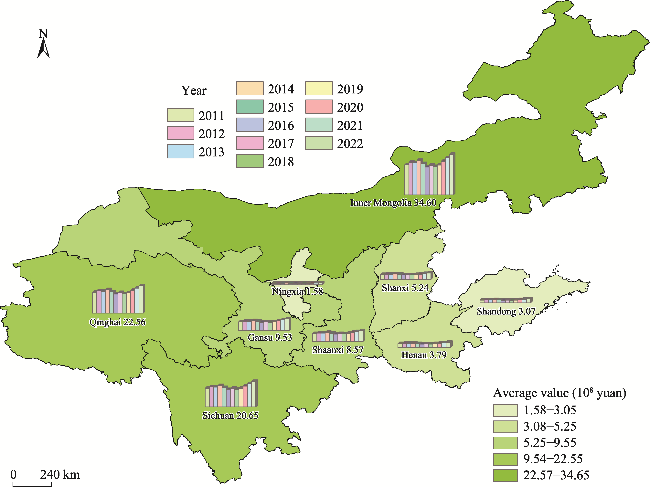
Figure 2 Changes in the spatial pattern of ESV in the Yellow River BasinNote: For each province, the embedded column chart displays the annual ecosystem service value (ESV) for 2011-2022. |
Table 5 High-quality development indices |
| Year | Shandong | Henan | Shanxi | Shaanxi | Inner Mongolia | Ningxia | Gansu | Sichuan | Qinghai |
|---|---|---|---|---|---|---|---|---|---|
| 2011 | 0.2946 | 0.2365 | 0.2285 | 0.2336 | 0.2185 | 0.1919 | 0.2249 | 0.2360 | 0.2396 |
| 2012 | 0.2967 | 0.2466 | 0.2249 | 0.2337 | 0.2270 | 0.1917 | 0.2197 | 0.2361 | 0.2146 |
| 2013 | 0.2987 | 0.2285 | 0.2288 | 0.2607 | 0.2013 | 0.1886 | 0.2275 | 0.2276 | 0.2144 |
| 2014 | 0.2904 | 0.2220 | 0.2431 | 0.2612 | 0.1889 | 0.1839 | 0.2269 | 0.2422 | 0.1931 |
| 2015 | 0.2744 | 0.2184 | 0.2757 | 0.2753 | 0.1836 | 0.1682 | 0.2299 | 0.2421 | 0.1983 |
| 2016 | 0.2332 | 0.1750 | 0.1822 | 0.2138 | 0.1553 | 0.1280 | 0.1905 | 0.1887 | 0.1468 |
| 2017 | 0.3229 | 0.2416 | 0.2260 | 0.2794 | 0.2838 | 0.2243 | 0.3481 | 0.2552 | 0.1998 |
| 2018 | 0.3500 | 0.2459 | 0.2681 | 0.2954 | 0.2071 | 0.2348 | 0.2754 | 0.2853 | 0.2027 |
| 2019 | 0.3522 | 0.2576 | 0.2633 | 0.3006 | 0.1748 | 0.2325 | 0.2728 | 0.3130 | 0.1824 |
| 2020 | 0.3365 | 0.2444 | 0.2427 | 0.2681 | 0.2546 | 0.2293 | 0.2457 | 0.3051 | 0.1848 |
| 2021 | 0.3598 | 0.2697 | 0.2620 | 0.2950 | 0.2961 | 0.2569 | 0.2513 | 0.3383 | 0.1949 |
| 2022 | 0.3831 | 0.2950 | 0.2813 | 0.3219 | 0.3376 | 0.2845 | 0.2569 | 0.3715 | 0.2050 |
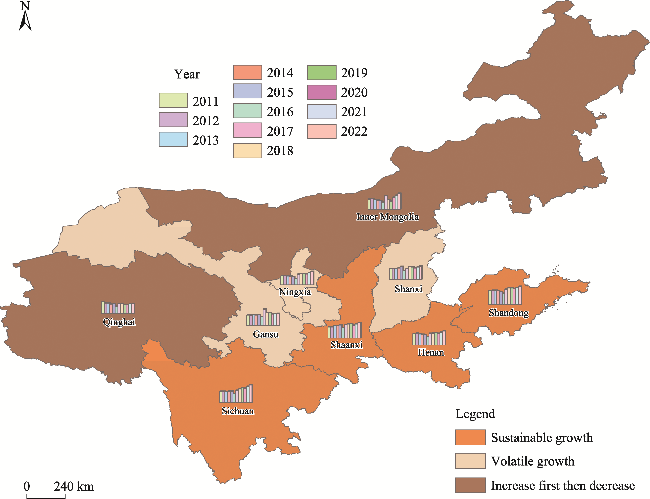
Figure 3 Changes in the spatial pattern of the high-quality development indices in the Yellow River BasinNote: For each province, the inset column chart depicts annual high-quality development indices. |
Table 6 Coupling and coordination gravity matrix of ESV and high-quality development level in the Yellow River Basin |
| Province | Gansu | Henan | Inner Mongolia | Ningxia | Qinghai | Shandong | Shanxi | Shaanxi | Sichuan | Total |
|---|---|---|---|---|---|---|---|---|---|---|
| Gansu | - | 0.10 | 0.05 | 0.72 | 0.47 | 0.07 | 0.13 | 0.22 | 0.23 | 1.99 |
| Henan | 0.10 | - | 0.13 | 0.41 | 0.05 | 0.97 | 1.44 | 0.83 | 0.13 | 4.06 |
| Inner Mongolia | 0.05 | 0.13 | - | 0.15 | 0.02 | 0.20 | 0.28 | 0.11 | 0.03 | 0.98 |
| Ningxia | 0.72 | 0.41 | 0.15 | - | 0.16 | 0.21 | 0.68 | 2.01 | 0.34 | 4.68 |
| Qinghai | 0.47 | 0.05 | 0.02 | 0.16 | - | 0.03 | 0.05 | 0.08 | 0.15 | 1.01 |
| Shandong | 0.07 | 0.97 | 0.20 | 0.21 | 0.03 | - | 0.68 | 0.25 | 0.07 | 2.48 |
| Shanxi | 0.13 | 1.44 | 0.28 | 0.68 | 0.05 | 0.68 | - | 1.08 | 0.11 | 4.46 |
| Shaanxi | 0.22 | 0.83 | 0.11 | 2.01 | 0.08 | 0.25 | 1.08 | - | 0.24 | 4.83 |
| Sichuan | 0.23 | 0.13 | 0.03 | 0.34 | 0.15 | 0.07 | 0.11 | 0.24 | - | 1.28 |
| [1] |
|
| [2] |
|
| [3] |
|
| [4] |
|
| [5] |
|
| [6] |
|
| [7] |
|
| [8] |
|
| [9] |
|
| [10] |
|
| [11] |
|
| [12] |
|
| [13] |
|
| [14] |
|
| [15] |
|
| [16] |
|
| [17] |
|
/
| 〈 |
|
〉 |