Resource Economics

Regional Differences in the Driving Factors and Decoupling Relationships of Carbon Emissions in Inner Mongolia

  • SUN Baojun , 1 ,
  • LIANG Yuqing , 2, *
Expand
  • 1. School of Computer Information Management, Inner Mongolia University of Finance and Economics, Hohhot 010070, China
  • 2. School of Business Administration, Inner Mongolia University of Finance and Economics, Hohhot 010070, China
* LIANG Yuqing, E-mail:

SUN Baojun, E-mail:

Received date: 2025-04-25

  Accepted date: 2025-07-22

  Online published: 2025-10-14

Supported by

The National Natural Science Foundation of China(71961022)

The Natural Science Foundation of Inner Mongolia Autonomous Region(2024MS07012)

The Fundamental Research Funds for the Central Universities of Inner Mongolia Autonomous Region(NCYWT23034)

The Fundamental Research Funds for the Central Universities of Inner Mongolia Autonomous Region(NCYWT23043)

The Inner Mongolia University of Finance and Economics 2025 High-Quality Research Achievements Cultivation Fund Project(GZCG24247)

The Inner Mongolia University of Finance and Economics 2025 High-Quality Research Achievements Cultivation Fund Project(GZCG2504)

The Special Research Project on the Five Major Tasks of Inner Mongolia Autonomous Region by Inner Mongolia University of Finance and Economics(NCXWD2419)

The Project of the Regional Digital Economy and Digital Governance Research Center of Inner Mongolia University of Finance and Economics(SZZL202401)

Abstract

Within the framework of China's pursuit of green and low-carbon development, Inner Mongolia is characterized by significant carbon emissions, a substantial share of energy-intensive industries, and disparate development levels across its cities, so it faces substantial challenges in attaining the objectives of carbon peak and neutrality. Utilizing the Logarithmic Mean Divisia Index (LMDI) model, this study investigated the drivers and regional differences in carbon emissions. Drawing upon Tapio’s decoupling framework, the decoupling status between economic growth and carbon emissions among cities was analyzed in phases. We introduced the Extreme Gradient Boosting (XGBoost) machine learning algorithm to construct a classification model that correlates carbon emission drivers with decoupling states, elucidated by the Shapley Additive exPlanations (SHAP) interpretable model, and performed a spatial analysis of regional differences to assess the significance of industrial energy intensity for achieving strong decoupling in each prefecture-level city. The outcomes revealed two main results. (1) Spatially, regional differences in the influence of driving factors can be classified into four categories: energy intensity-dominant, double-effect negative driven, coexistence of positive and negative effects, and economic growth-driven. (2) Temporally, regional differences in the impact of industrial energy intensity on strong decoupling can be categorized into three types: overall positive, marked fluctuation, and stage stability. Consequently, tailoring emission reduction policies based on regional differences will be instrumental for expediting the achievement of the “dual carbon” targets.

Cite this article

SUN Baojun , LIANG Yuqing . Regional Differences in the Driving Factors and Decoupling Relationships of Carbon Emissions in Inner Mongolia[J]. Journal of Resources and Ecology, 2025 , 16(5) : 1327 -1342 . DOI: 10.5814/j.issn.1674-764x.2025.05.007

1 Introduction

Climate change, global warming, and the greenhouse effect are increasingly capturing global attention and propelling sustainable development to the forefront of public discourse (Xu and Wu, 2024). The concept of sustainable development is centered around the harmonious coexistence of environmental preservation and economic progress. On September 22, 2020, during the General Debate of the 75th Session of the United Nations General Assembly, China pledged to scale up its nationally determined contributions and adopt stronger policies and measures. The aim is to have CO2 emissions peak before 2030 and achieve carbon neutrality before 2060 (Zhuang and Dou, 2021). Within this context, examining the drivers of carbon emissions and the decoupling phenomenon can lead to a more profound understanding of the underlying causes and trends of carbon emissions, which is crucial for devising effective strategies to reduce emissions and realize sustainable development over the long term (Chen et al., 2020).
Numerous studies have extensively examined the driving factors of carbon emissions and the relationship between carbon emissions and economic development, and explored the driving factors of carbon emissions and decoupling status from different spatial perspectives. From the national perspective, existing research has analyzed the influencing factors and status of decoupling based on annual data from 30 provinces across the country and conducted heterogeneity studies based on the results (Xie et al., 2024). From the perspective of urban agglomerations, studies have analyzed carbon emission decoupling and driving factors in urban agglomerations such as the Pearl River Delta (Wang et al., 2025), Hohhot-Baotou-Erdos-Yulin (Zhou et al., 2024a), and Beijing-Tianjin-Hebei (Li et al., 2024), promptly adjusting the relevant factors to promote sustainable development. Some scholars have also investigated carbon emission decoupling from a provincial perspective, such as predicting carbon emissions and analyzing decoupling in Heilongjiang Province to provide options for achieving its carbon peaking goal (Gai et al., 2024). Another study analyzed the decoupling status of 11 cities in Zhejiang Province and the impact of digital development on decoupling status (Zhou et al., 2024b). Previous studies have covered the national, urban agglomeration, and single-province perspectives, but there is a lack of dedicated studies on carbon emissions in Inner Mongolia. As an energy and strategic resource base in China, Inner Mongolia is also a major carbon emitter that has a large proportion of high-energy-consuming industries in its industrial structure. Therefore, analyzing the driving factors of carbon emissions and decoupling status in Inner Mongolia is crucial. In response to this research gap, this study posits several questions. First, what are the driving factors of carbon emissions in Inner Mongolia, and what are the main driving factors of carbon emissions in each prefecture-level city? Second, what is the relationship between carbon emission driving factors and carbon emission decoupling; and what are the differences among cities? To address these questions, this study conducted a regional difference analysis of carbon emission driving factors in 12 cities in Inner Mongolia, combined the driving factors with carbon emission decoupling issues for analysis, and introduced a machine learning model to explore the relationship between carbon emission driving factors and decoupling status. An interpretable analysis model was used to conduct heterogeneity analysis among the cities.
The theoretical contributions of this study are threefold. First, since existing studies regarding carbon emission driving factors and the collected influencing factors of carbon emissions have shown industrial energy intensity to be a key driver, it was integrated into the decomposition via the LMDI model for carbon emission driving factors. Consequently, the carbon emission driving factors were decomposed into carbon emission coefficients, industrial energy intensity, industrial structure, economic scale, and population scale. The contributions of each driving factor to carbon emissions over the period from 2007 to 2021 were analyzed. Second, this study employed the Tapio decoupling elasticity coefficient to construct a decoupling model between economic development and carbon emissions for each prefecture-level city in Inner Mongolia. Utilizing Geographic Information Systems (GIS), the decoupling status was visualized to enhance the analysis of the carbon emission decoupling status in each prefecture-level city. Finally, the XGBoost machine learning algorithm was applied to establish the relationship between the contributions of carbon emission driving factors and the carbon emission decoupling status, and the SHAP interpretability model was used for interpretation. This approach offers novel insights for policymakers to dynamically formulate policies based on the real-time data for each driving factor.

2 Literature review

Current research on carbon emissions is extensive, with scholars probing the issue from diverse spatial dimensions and industrial perspectives. At the national level, analyses of the decoupling status among 192 countries have ascertained that energy intensity effects are the most prominent drivers of decoupling (Wang and Su, 2020). A decomposition of the principal carbon emission factors in 12 Middle Eastern countries and an exploration of their decoupling status have been carried out (Kouyakhi, 2022). The relationship between urbanization and carbon emission decoupling in 33 African countries has been dissected to guide sustainable development in Africa (Duan et al., 2022). Panel data analysis has been employed to investigate the decoupling of economic development and carbon emissions in China, which revealed the consistency and stage-wise characteristics of economic development and carbon emissions, as well as the decoupling disparities among the four major regions (Zhao et al., 2022). At the provincial level, for example, a study on the correlation between carbon emissions, energy consumption, and economic growth in Sichuan Province yielded targeted suggestions (Chen and Zeng, 2024). Regarding urban agglomerations, research on decoupling status and driving mechanisms has indicated that enhancing energy efficiency is crucial for carbon reduction in the Min Delta Region (Hou et al., 2022). In the Beijing-Tianjin-Hebei region, the influence of technological effects on carbon emissions is becoming progressively more pronounced (Li et al., 2019). From an industrial perspective, a decoupling relationship analysis framework between logistics and carbon emissions has been instituted for Chongqing’s logistics industry, which revealed the phased alterations between the logistics industry and carbon emissions (Gong and Guo, 2024). A study on the driving factors and decoupling status of carbon emissions in Sichuan’s agriculture unearthed the determinants of carbon emissions and provided a foundation for carbon reduction measures (Meng et al., 2024). An analysis of the elements affecting carbon emission changes in India’s manufacturing industry can assist in formulating energy and environmental policies (Sharma and Padhi, 2024). A decoupling analysis of the construction industry in 30 Chinese provinces can contribute to devising emission reduction strategies (Dai et al., 2024). Research on the equilibrium between economic growth and carbon emissions in China's industry can guide the formulation of customized policies based on local circumstances (Ye et al., 2024).
While the current research on carbon emissions is extensive, spanning national, provincial, urban agglomeration, and industry-specific strata, a conspicuous research gap exists concerning the Inner Mongolia region. In terms of methodological approaches, scholars have commonly resorted to the LMDI (Ang, 2015; Tian et al., 2024; Vincenzo, 2024) and the Tapio decoupling model (Song et al., 2022; Wu et al., 2023) to dissect the various driving factors of carbon emissions. Moreover, the assimilation of machine learning into carbon emission studies has been accelerating, with applications extending from the prognostication of carbon emissions (Xiong et al., 2024) to the identification of their determinants (Edwin et al., 2024). Building on this foundation, this study integrated the industrial energy intensity factor into the LMDI model, and assessed the carbon emission driving factors and decoupling status of 12 prefecture-level cities in Inner Mongolia from 2007 to 2021 employing the Tapio decoupling analysis. It identified the contributions of driving factors in Inner Mongolia across various phases and the regional differences of driving factors among different prefecture-level cities in space. Machine learning was introduced to develop classification models for carbon emission driving factors and decoupling status. This study investigated the heterogeneity of principal driving factors and strongly decoupled the prefecture-level cities in the temporal dimension. Given the opacity of internal algorithms in machine learning, this paper used the SHAP interpretable model to explicate the relationship between model features and variables (Li, 2022), such as employing SHAP to interpret and explore the intricate relationships between features and carbon emissions (Wang et al., 2024b). This study also used SHAP to determine the magnitude and direction of the contribution of each driving factor to the decoupling status classifications of carbon emissions among the different prefecture-level cities. The research outcomes can offer targeted perspectives for formulating emission reduction policies and measures, and the research methodology can function as a reference for application to other regions.

3 Methods

3.1 Study area

Situated in the northern expanse of China, the Inner Mongolia Autonomous Region boasts a distinctive, elongated geography that stretches from the northeast to the southwest. This vast territory is rich in natural endowments and colloquially described as having “forests to the east, mines to the west, agriculture to the south, and livestock to the north”. Inner Mongolia is particularly blessed with an abundance of mineral resources, which are not only diverse but also among the most plentiful in reserves, with 45 types ranking in the top three nationally and 103 types in the top ten for reserves. Notably, minerals such as coal, lead, zinc, silver, rare earth elements, niobium, germanium, fluorite, crystalline graphite, and others are predominant in the region . As a pivotal energy-exporting province in China, the intensive development and utilization of coal have led to significant carbon emissions. To mitigate environmental impacts, the “Green Mine Construction Plan of Inner Mongolia Autonomous Region” has been implemented to foster the ongoing advancement of sustainable mining practices. Inner Mongolia plays a critical role in the nation’s broader modernization agenda and serves as a key ecological safeguard in the north. During the 14th Five-Year Plan period (2021-2025), it is both crucial and timely to analyze the carbon emission drivers and decoupling progress of Inner Mongolia within the framework of green development. This endeavor is vital not only for meeting the five major national missions but also for strengthening partnerships with neighboring countries like Russia and Mongolia in the collaborative development of the “Belt and Road” initiative.

3.2 Data sources

This study focuses on the 12 prefecture-level cities within the Inner Mongolia Autonomous Region over the period from 2006 to 2021. Data on the gross domestic product (GDP), the permanent resident population at year-end, and the GDPs of the three main sectors for each administrative division were sourced from the municipal and county data section of the “Inner Mongolia Statistical Yearbook” editions spanning 2006 to 2021. Carbon emission coefficients were derived from the recommendations of the Intergovernmental Panel on Climate Change (IPCC). Detailed energy consumption figures were available only at the regional level, prompting the use of a GDP-based ratio to estimate energy consumption for individual prefectures and cities. Carbon emission data from 2006 to 2017 for each prefecture-level city were derived from an emissions inventory compiled with the most up-to-date energy figures (as of 2015) from the National Bureau of Statistics of China. Given the scarcity of data for the full research period from 2006 to 2021, a logarithmic regression model was employed to address any gaps in the dataset. The R² values exceeding 0.86 indicated the robustness of these models in providing accurate predictions and insights into carbon emission trends.

3.3 LMDI model

The LMDI model, renowned for its comprehensive decomposition capabilities, absence of residual terms, and factor reversibility (Miao et al., 2023), was used in this study to elucidate the drivers behind carbon emissions (Gong and Wang, 2013). The existing literature on carbon emission decomposition highlights key determinants such as carbon emission coefficients (Ge et al., 2024), economic expansion (Chen et al., 2022), demographic shifts (Chen et al., 2024), and the composition of industry (Liang et al., 2023). Amidst rapid economic growth, the insatiable rise in energy consumption and intensified extraction of mineral resources have led to a surge in carbon emissions which present significant environmental challenges. Against this backdrop, the “Action Plan for Carbon Emission Peak Before 2030” emphasizes the need to boost energy efficiency and reduce CO2 emissions. Launched in 2015, the “Made in China 2025” strategy aims to promote the optimization and advancement of the industrial sector, with a particular focus on low-carbon and environmentally sustainable industries. Based on previous studies, policy guidelines, and the availability of reliable data, this study included industrial energy intensity as a pivotal driver. Industrial energy intensity is a metric that reflects the efficiency and technological prowess of energy consumption within the industrial sector. The underlying formula is:
$\begin{align} & {{C}_{i}}=\sum\limits_{j=1}^{3}{\frac{{{C}_{ij}}}{{{E}_{i}}}\times \frac{{{E}_{i}}}{{{G}_{ij}}}\times \frac{{{G}_{ij}}}{{{G}_{i}}}\times \frac{{{G}_{i}}}{{{P}_{i}}}\times {{P}_{i}}} \\ & \ \ \ \ =\sum\limits_{j=1}^{3}{C{{F}_{ij}}\times C{{I}_{ij}}\times C{{S}_{ij}}\times C{{U}_{i}}\times {{P}_{i}}} \\ \end{align}$
where Cij represents the total amount of carbon emissions of sector j in year i (j=1, 2, 3); Ei represents both the total energy consumption and the industrial energy intensity (reflecting the efficiency and technological level of energy utilization within the industrial sector); Gij is the GDP of industry j in year i; Gi is the regional GDP or economic scale in year i; Pi is the regional population size in year i; and CFij is the carbon emission coefficient of sector j in year i. In addition, CIij denotes the energy intensity of the industries of sector j in year i; CSij signifies the industrial structure of sector j in year i; and CUi represents the economic size in the year i. All these factors were used to comprehensively analyze the driving factors of carbon emissions.
This study used the LMDI model to dissect the variation in carbon emissions, denoted as ΔC, between periods t and t+1. In line with the additive decomposition principle of LMDI, the impact of each contributing factor can be determined as:
$\Delta C={{C}^{t+1}}-{{C}^{t}}=\Delta CF+\Delta CI+\Delta CS+\Delta CU+\Delta P$
This equation employs several key indicators to dissect the change in carbon emissions (ΔC) from periods t to t+1. These include the carbon emission coefficient effect (ΔCF), which captures the impact of changes in the carbon intensity of energy use. The industrial energy intensity effect (ΔCI) reflects the efficiency of energy use across different industries. The industrial structure effect (ΔCS) indicates the GDP share from each industry, highlighting the role of industrial composition in urban carbon emissions. The economic scale effect (ΔCU), measured by per capita GDP, reveals the interplay between regional economic activity and carbon emissions. Lastly, the population scale effect (ΔP) signifies urban consumer demand, which delineates the correlation between population size and carbon emissions.
This study assumed that the carbon emission coefficient of energy was constant across the years, hence ΔCF was set to 0. As a result, the primary drivers of carbon emissions were identified as industrial energy intensity, industrial structure, economic scale, and population size. A positive effect value suggests that the factor contributes to an increase in carbon emissions, whereas a negative value indicates a dampening effect. The specific impact of each driver on carbon emissions is:
$\Delta CI=\underset{i}{\mathop \sum }\,\frac{{{C}^{t+1}}-{{C}^{t}}}{\ln {{C}^{t+1}}-\ln {{C}^{t}}}\times \ln \frac{I_{i}^{t+1}}{I_{i}^{t}}$
$\Delta CS=\underset{i}{\mathop \sum }\,\frac{{{C}^{t+1}}-{{C}^{t}}}{\ln {{C}^{t+1}}-\ln {{C}^{t}}}\times \ln \frac{S_{i}^{t+1}}{S_{i}^{t}}$
$\Delta CU=\frac{{{C}^{t+1}}-{{C}^{t}}}{\ln {{C}^{t+1}}-\ln {{C}^{t}}}\times \ln \frac{{{U}^{t+1}}}{{{U}^{t}}}$
$\Delta P=\frac{{{C}^{t+1}}-{{C}^{t}}}{\ln {{C}^{t+1}}-\ln {{C}^{t}}}\times \ln \frac{{{P}^{t+1}}}{{{P}^{t}}}$

3.4 Tapio decoupling elasticity coefficient

Decoupling theory, as introduced by the Organisation for Economic Co-operation and Development (OECD), serves as a cornerstone for understanding the severed link between economic expansion and resource utilization or environmental degradation. In 2005, Tapio delineated the Tapio decoupling model, which classifies decoupling conditions into three main categories and eight subcategories (Tapio, 2005). Building on that model, this study investigated the decoupling dynamics between urban carbon emissions and economic growth. The underlying formula is:
$\varepsilon =\frac{\Delta C/{{C}_{0}}}{\Delta G/{{G}_{0}}}=\frac{\left( {{C}_{T}}-{{C}_{0}} \right)/{{C}_{0}}}{\left( {{G}_{T}}-{{G}_{0}} \right)/{{G}_{0}}}=\frac{{{G}_{0}}\left( {{C}_{T}}-{{C}_{0}} \right)}{{{C}_{0}}\left( {{G}_{T}}-{{G}_{0}} \right)}$
In the equation, the symbol ε denotes the decoupling elasticity coefficient, a measure of the responsiveness of carbon emissions to changes in GDP. The terms ∆C and ∆G represent the absolute changes in carbon emissions and GDP, respectively. The variables C$\varepsilon$ and G$\varepsilon$ correspond to the carbon emissions and GDP during the base period, while CT and GT signify those in period T. This study focused on the most ideal and least ideal urban development states by refining the three original major categories into five distinct types to facilitate subsequent model training for classification, as shown in Table 1.
Table 1 Decoupling status and descriptions
Type Decoupling status ΔC ΔG Ɛ Status description Classification
Decoupling Strong decoupling $<$0 $>$0 $\left( -\infty,0 \right)$ Carbon emissions decrease while the economy remains in a growth state, representing the most ideal scenario for urban development 5
Weak decoupling $>$0 $>$0 $\left[ 0,0.8 \right]$ Carbon emissions increase and the economy grows, but at a rate lower than the economic growth 4
Recessive decoupling $<$0 $<$0 $\left( 1.2,+\infty \right)$ Carbon emissions decrease alongside an economic recession.
Coupling Expansive coupling $>$0 $>$0 $\left[ 0.8,1.2 \right]$ Carbon emissions increase concurrently with economic growth, with the rates being comparable 3
Recessive coupling $<$0 $<$0 $\left[ 0.8,1.2 \right]$ Carbon emissions decrease while the economy also declines, with the rate of decrease being equivalent to the economic decline
Negative
decoupling
Expansive negative
decoupling
$>$0 $>$0 $\left( 1.2,+\infty \right)$ Carbon emissions increase and the economy grows, with the growth rate exceeding that of the economy 2
Weak negative
decoupling
$<$0 $<$0 $\left[ 0,0.8 \right]$ Carbon emissions decrease while the economy declines, with the rate of decrease being less than the economic decline
Strong negative
decoupling
$>$0 $<$0 $\left( -\infty,0 \right)$ Carbon emissions increase alongside an economic recession, representing the least ideal scenario for urban development 1

3.5 XGBoost-SHAP analysis

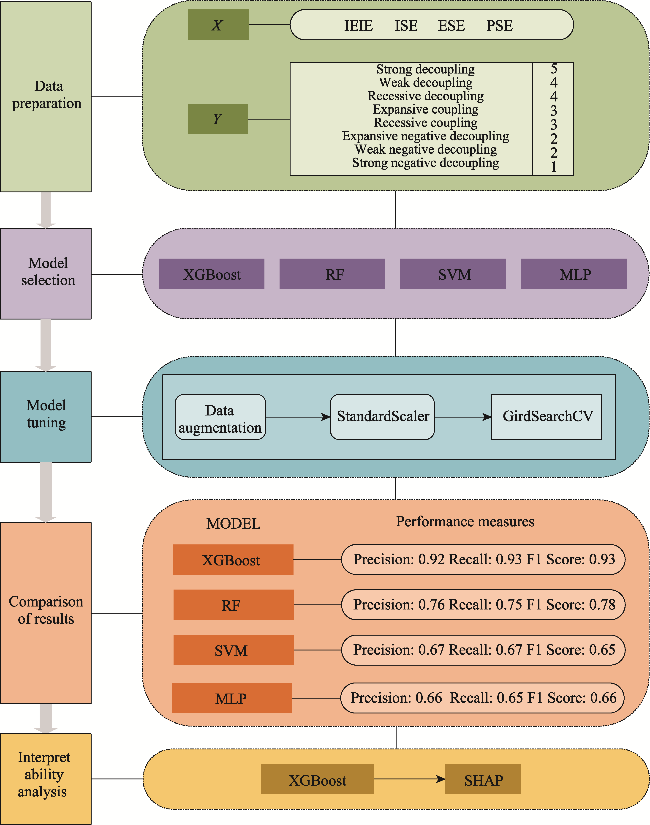
A literature review revealed that the machine learning algorithms frequently applied in this domain include Random Forest (RF) (Yuan et al., 2021; Khajavi and Rastgoo, 2023; Ding et al., 2024), XGBoost (Hou and Liu, 2024; Wang et al., 2024a), Support Vector Machine (SVM) (Bakay and Ağbulut, 2021; Huo et al., 2023), and Multilayer Perceptron (MLP) (Fan et al., 2024). To enhance the precision of predictions concerning the interplay between carbon emission drivers and decoupling states as explored in this study, a comparative analysis of these four algorithms was conducted. Then, an exhaustive evaluation was performed, focusing on three key performance indicators: prediction accuracy, recall rate, and the F1 score, all assessed on the test dataset. The methodology for model selection is depicted in Figure 1.
Figure 1 Technical roadmap for model selection
XGBoost is predicated on the principle of combining numerous weak classifiers to form a robust classifier. This study developed an XGBoost classification model predicated on four key indicators. The target variable Y, representing the decoupling status of cities—a Chinese administrative division—was predicted. The indicators correspond to the four carbon emission drivers extracted from the LMDI model: Industry Energy Intensity Effect (IEIE), Industry Structure Effect (ISE), Economic Scale Effect (ESE), and Population Scale Effect (PSE). The model was refined using GridSearchCV to optimize pivotal parameters, including the number of weak classifiers (dictating the ensemble size), tree depth (affecting the model’s ability to model complex interactions), and the learning rate (regulating each weak classifier’s impact on the final prediction). The goal was to determine the most effective parameter set to augment the model’s predictive accuracy. Post-training, the model can determine the decoupling states based on the emission drivers of various cities over multiple years.
Although XGBoost achieved an impressive 92% prediction accuracy, its complexity as an ensemble algorithm often earns it the label of a “black box”, implying a lack of interpretability. To address this limitation, we employed the SHAP model, an interpretability tool grounded in game- theoretic Shapley values, to clarify the importance and effect of each feature’s impact (Xing and Huo, 2025). The formula for calculating feature contributions is (Lundberg and Lee, 2017):
${{\phi }_{i}}=\underset{S\subseteq F\backslash \left\{ i \right\}}{\mathop \sum }\,\frac{\left| S \right|!\left( \left| F \right|-\left| S \right|-1 \right)!}{\left| F \right|!}\left[ {{f}_{S\mathop{\cup }^{}\left\{ i \right\}}}\left( {{x}_{S\mathop{\cup }^{}\left\{ i \right\}}} \right)-{{f}_{S}}\left( {{X}_{S}} \right) \right]$
In the equation, F denotes the complete set of features associated with carbon emission driving factors. S is a subset of F that excludes the specific influencing factor i. The notation $\left| F \right|$ represents the total count of features, while |S| indicates the number of features present in subset S. XS signifies the vector of input values for the features within subset S. The function ${{f}_{S}}\left( {{X}_{S}} \right)$ corresponds to the model’s prediction for the subset S. Lastly, ${{f}_{S\cup \left\{ \text{i} \right\}}}\left( {{x}_{S\cup \left\{ i \right\}}} \right)$ represents the model’s prediction outcome when the subset S is merged with the influencing factor i.

4 Results

4.1 Analysis of the decomposition of driving factors

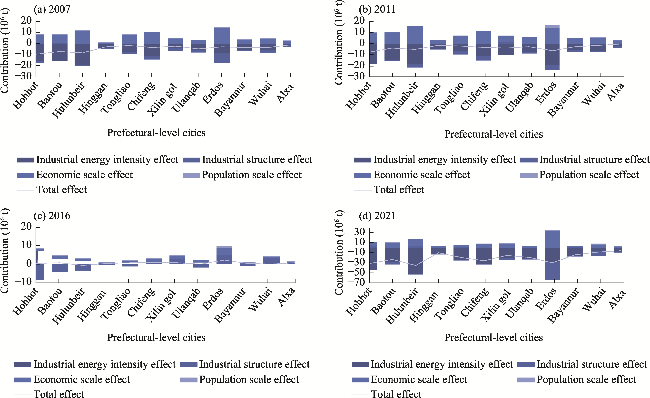
The LMDI model was employed to identify the carbon emission driving factors across the 12 prefectural-level cities (administrative divisions) in Inner Mongolia. By disaggregating and summing these factors, we derived effects including the carbon emission coefficient, industrial energy intensity, industrial structure, economic scale, and population size. This study analyzed four distinct periods, and the first year of each study period (2007, 2011, 2016, and 2021) was selected as representative of that period, as shown in Figure 2. To highlight the spatial variability of carbon emission drivers among these cities, this study conducted an in-depth analysis of the representative period of 2021, with the results presented in Table 2.
Figure 2 Effect analysis of various driving factors (10⁶ t)
Table 2 LMDI decomposition results of carbon emissions for various cities and prefectures in Inner Mongolia in 2021(10⁶ t)
City IEIE ISE ESE PSE TE
Hohhot -43.639 4.041 7.206 0.890 -31.503
Baotou -29.295 -3.623 10.177 0.172 -22.570
Hulunbeir -51.877 3.692 14.069 -0.915 -35.030
Hinggan -12.197 0.669 2.159 -0.120 -9.489
Tongliao -24.096 1.122 4.566 -0.218 -18.626
Chifeng -33.141 0.381 7.184 -0.187 -25.763
Xilin Gol -19.536 -3.938 8.098 0.275 -15.102
Ulanqab -22.058 -0.164 4.609 -0.892 -18.504
Erdos -29.575 -34.298 34.044 0.713 -29.116
Bayannur -17.695 0.912 3.879 -0.169 -13.073
Wuhai -6.330 -9.048 7.006 0.068 -8.305
Alxa -7.209 -2.161 2.953 0.167 -6.250

Note: IEIE: Industry Energy Intensity Effect; ISE: Industry Structure Effect; ESE: Economic Scale Effect; PSE: Population Scale Effect; TE: Total Effect. The same below.

4.1.1 Analysis of driving factor effects

The industrial energy intensity effect plays a significant role in reducing carbon emissions, often appearing below the coordinate axis in contrast to the economic scale effect. This impact is intricately linked to the gross domestic product (GDP) of industries. With improvements in energy efficiency, advancements in technological innovation, and ongoing optimization of the industrial structure, there has been a steady decline in energy consumption per unit of output. Concurrently, the GDP per unit of industry has shown a consistent upward trend, thereby reducing the ratio of industrial energy consumption to GDP and effectively curbing carbon emissions. This reflects the dual benefit of greater energy efficiency: it bolsters economic growth while also reducing carbon emissions, thus promoting sustainable development.
The industrial structure effect showed a notably positive influence on carbon emissions in 2021, but it was generally inhibitory in earlier periods. In 2006, the People’s Government of the Inner Mongolia Autonomous Region issued the “Notice of the State Council on Accelerating the Structural Adjustment of Overcapacity Industries”, which laid out comprehensive plans to address the structural imbalances in overcapacity industries across the region. In 2010, the “Opinions of the People’s Government of Inner Mongolia Autonomous Region on Further Eliminating Backward Production Capacity and Promoting Economic Structural Adjustment” were introduced as a targeted strategy to tackle overcapacity, resource wastage, and environmental pollution, aligning with the economic context of the time. The execution of these initiatives led to significant progress in the Inner Mongolia Autonomous Region, including successful structural adjustments in the overcapacity industries, the phasing out of outdated production capacities, and the promotion of economic restructuring, along with advancements in energy conservation and emission reduction, all of which contributed to the effective control of carbon emissions. However, to stimulate economic recovery after the COVID- 19 pandemic, there was an increased demand for energy, especially a heightened dependence on heavy industries and manufacturing. In the short term, this led to some resurgence in the positive driving effect of carbon emissions.
The economic scale effect exerts a notably positive influence on carbon emissions in Inner Mongolia, as evidenced by its placement in the positive half of the coordinate axis on the chart. This influence was especially pronounced in 2011. An analysis of macroeconomic data revealed that the gross domestic product (GDP) of the Inner Mongolia Autonomous Region experienced substantial and consistent expansion from 2006 to 2021, growing from 416.18 billion yuan to 2116.6 billion yuan. Notably, the GDP rose by 125.82 billion yuan in 2011, underscoring the significant correlation between economic expansion and carbon emissions during that timeframe.
Although the effect of population-scale on carbon emissions is comparatively modest, the variations in population growth indicate a positive contribution to carbon emissions. Throughout the study period, prefectural-level cities experiencing population declines demonstrated a negative, dampening effect on carbon emissions. This finding is consistent with research on the drivers of carbon emissions in six central Chinese provinces, which also confirms the positive influence of population growth on carbon emissions (Liu and Jin, 2019).

4.1.2 Analysis of regional differences in driving factors

From a spatial distribution standpoint, as detailed in Table 2, the diverse directions of carbon emission driving factors across prefectural-level cities can be classified into four distinct categories. Hohhot is representative of the first category, which is primarily influenced by the industrial energy intensity effect. Here, the industrial structure, economic scale, and population scale effects contribute positively to carbon emissions, albeit to a minor degree. In contrast, the industrial energy intensity effect has a notably negative impact on carbon emissions. Politically, as the capital of the autonomous region, Hohhot has the core mission of establishing the “Northern Ecological Security Barrier” and actively responding to the national “dual carbon” strategy. Socially, the growth of the permanent population and increasing urbanization rate drive energy consumption. Geographically, the prolonged severe winters create substantial heating demands, leading to elevated energy consumption. Cities in this category are marked by high energy utilization efficiency and relatively low energy consumption.
In the second category, characterized by dual negative driving forces, both the industrial energy intensity and industrial structure effects exert negative pressures on carbon emissions, with the former being particularly influential. Meanwhile, the economic and population scale effects contribute positively, although the role of the latter is minimal. Baotou, Xilin Gol, Erdos, Wuhai, and Alxa are examples of cities in this category. Politically, industrial policy adjustments and administrative measures are employed to compel industrial energy efficiency improvements. Socially, slower population growth in these regions results in reduced consumer-end carbon emission pressures. These cities have a distinct advantage in curbing carbon emissions through industrial restructuring compared to the first category.
The third category is defined by a mix of positive and negative effects. In this group, the industrial energy intensity and population scale effects inhibit carbon emissions, while the industrial structure and economic scale effects promote them. Hulunbeir, Hinggan, Tongliao, Chifeng, and Bayannur belong to this category, and are notable for their negative population growth, which also curbs carbon emissions. Politically, these regions have implemented strict industrial access restrictions, which has strengthened the negative effect of industrial energy intensity. Socially, the negative growth of the permanent resident population has weakened residential energy demand on the consumer side.
The fourth category is distinguished by an economically positive driving force. Here, the economic scale effect positively influences carbon emissions, while other factors have negative inhibitory effects. Wulanchabu is one example. Politically, administrative measures have been employed to compel traditional industries to transform, thereby strengthening the dominant role of the energy intensity effect. Socially, the negative growth trend of the permanent resident population has reduced carbon emission pressures. Economic development significantly impacts carbon emissions, although other elements provide some restraint.
In 2020, Inner Mongolia outlined key strategies for climate change and emission reduction, including the establishment and enhancement of coordination mechanisms, strengthening target responsibility assessment and evaluation, accelerating industrial and energy structure adjustments, and persistently executing the “Comprehensive Work Plan for Energy Conservation and Carbon Reduction in Inner Mongolia Autonomous Region”. During this period, the industrial energy intensity effect in each prefectural-level city in Inner Mongolia predominantly and negatively impacted carbon emissions, while the industrial structure effect varied slightly in its positive and negative influences among the cities. These initiatives not only reduced the carbon emission intensity in the region but also improved ecological environmental quality, laying a robust foundation for sustainable development.

4.2 Decoupling between economic development and carbon emissions

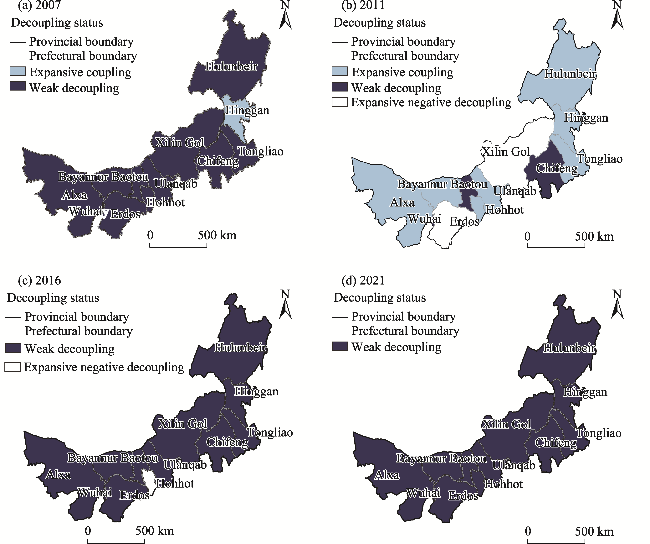
Employing the Tapio decoupling model, this study investigated the status of decoupling between economic development and urban carbon emissions among the 12 prefecture-level cities in the Inner Mongolia Autonomous Region from 2007 to 2021, with the results detailed in Table 3. This study analyzed four distinct periods, and the first year of each study period (2007, 2011, 2016, and 2021) was selected as a representative year, as illustrated in Figure 3. For this figure, GIS was used to visualize the decoupling status of each prefecture-level city over time. The visualizations clearly show that the decoupling status during these periods was primarily characterized by weak decoupling, intensive coupling, and intensive negative decoupling. A common feature among these states is economic growth, with variations in the rate of carbon emission growth relative to economic growth. Inner Mongolia’s GDP rose from 416.18 billion yuan in 2006 to 2116.6 billion yuan in 2021, and the economic indicators—including industrial value-added, manufacturing, investment, consumption, and residents’ income and living standards—reflect the region’s economic expansion over the study period.
Table 3 Decoupling status of various cities in Inner Mongolia from 2007 to 2021
Year Hohhot Baotou Hulunbeir Hinggan Tongliao Chifeng Xilin Gol Ulanqab Erdos Bayannur Wuhai Alxa
2007 WD WD WD EC WD WD WD WD WD WD WD WD
2008 WD WD WD WD WD WD WD WD WD WD WD WD
2009 WD WD WD WD WD WD WD WD WD WD WD WD
2010 EC EC WD EC WD WD EC END EC EC WD WD
2011 EC WD EC EC EC WD END EC END EC WD EC
2012 SD SD SD WD SD SD WD WD WD SD SD WD
2013 WD SD WD WD WD WD WD WD WD WD SD WD
2014 WD WD WD WD END WD WD WD WD WD WD WND
2015 SD SD SD SD SD SD SD SD SD SD WND SD
2016 END WD WD WD WD WD WD WD WD WD WD WD
2017 WD WD SD WD END WD SD WD SD SD WD SD
2018 SND SND SND SND SND SND SND SND SND SND SND SND
2019 WD WD WD WD WD WD WD WD WD WD WD WD
2020 END WD SND WD END WD WD WD SND SND WD WD
2021 WD WD WD WD WD WD WD WD WD WD WD WD

Note: SD, WD, RD, EC, RC, END, WND, and SND represent Strong decoupling, Weak decoupling, Recessive decoupling, Expansive coupling, Recessive coupling, Expansive negative decoupling, Weak negative decoupling, and Strong negative decoupling, respectively.

Figure 3 Visualization of decoupling status
Figure 3 reveals that the decoupling status in Inner Mongolia’s prefecture-level cities in 2007 was mainly weak decoupling. By 2011, an increase was observed in the number of cities showing intensive coupling and intensive negative decoupling. During this time, the Inner Mongolia Autonomous Region introduced the “Inner Mongolia Autonomous Region Energy Conservation and Emission Reduction Implementation Plan”, which marked a shift toward focusing on energy conservation and emission reduction and set specific targets for these efforts. However, from 2007 to 2010, Inner Mongolia’s energy utilization technology was relatively underdeveloped, with low energy efficiency and rapid economic growth, leading to more cities moving towards intensive coupling status. By 2016, except for Hohhot, all other prefecture-level cities had returned to weak decoupling. In 2014, the “Inner Mongolia Autonomous Region 2014-2015 Energy Conservation, Emission Reduction, and Low-Carbon Development Action Plan” was released, and it outlined specific measures and carbon reduction targets that significantly influenced the region during that period. Furthermore, the “Inner Mongolia Autonomous Region ‘13th Five-Year Plan’ Comprehensive Work Plan for Energy Conservation and Carbon Reduction”, released in 2017, resulted in the entire region transitioning to weak decoupling by 2021, indicating a significant acceleration in economic growth compared to the growth in carbon emissions.

4.3 Interpretability analysis of the classification model

We trained an XGBoost model using the carbon emission driving factors and decoupling status of 12 municipalities from 2007 to 2021 as a dataset, where the driving factors served as features and the quantized decoupling status as labels. After fine-tuning the parameters, the model achieved a 92% accuracy rate, indicating its superior capability for classifying the drivers of carbon emissions and their emission status.
However, while highly accurate, the XGBoost model suffers from a lack of transparency, and it is often referred to as a “black box” by users. To address this, we integrated the SHAP model, an interpretability tool designed to offer insights into a model’s predictions.

4.3.1 Analysis of driving factor importance

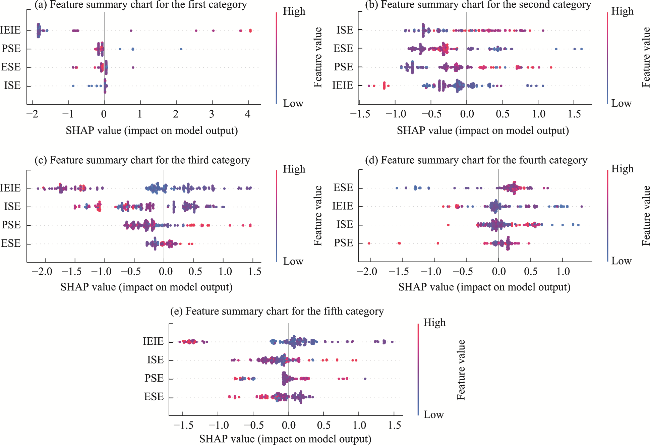
Figure 4 provides a categorical overview of the SHAP feature summaries for five distinct decoupling states, and the significance of each feature across the different states. The horizontal axis displays SHAP values, while the vertical axis lists the features, with higher positions indicating greater feature importance. Each dot represents a sample, and its color indicates the feature value’s magnitude. A negative SHAP value suggests a detrimental contribution to the decoupling state, while a positive value implies a beneficial contribution. Departments can adjust their strategies based on the importance of features in each category.
Figure 4 SHAP category summary plots
Figure 4a shows that IEIE has the most substantial impact on the strong negative decoupling state. Blue dots, indicating smaller IEIE values on the negative X-axis, suggest a minor negative effect on this state. Red dots, representing larger IEIE values on the positive X-axis, indicate a significant positive influence. The PSE also significantly affects strong negative decoupling, with larger values enhancing the inhibitory effect, suggesting that negative population growth helps prevent strong negative decoupling.
Figure 4b reveals that ISE has the most significant impact on the second category, involving weak negative and expansionary negative decoupling, although its effect direction is unstable. Larger ISE values strengthen the positive effect on this category. ESE also plays a significant role, with larger values leading to a more pronounced negative impact.
Figure 4c indicates that IEIE is crucial for the third category, encompassing recessionary and expansionary coupling, with larger values showing inhibitory effects. ISE plays a secondary role, with its effect direction aligning with IEIE, and larger values lead to more noticeable inhibitory effects.
Figure 4d demonstrates that ESE is decisive in the fourth category, including recessionary and weak decoupling, with larger values showing stronger positive effects. IEIE plays a secondary role, with smaller values leading to negative effects on this category.
Figure 4e shows that IEIE significantly influences the fifth category of strong decoupling. Smaller IEIE values have a positive effect, while larger values have a negative effect. This suggests that maintaining industrial energy intensity within a reasonable range is crucial. For example, optimizing production processes, reducing energy consumption, utilizing renewable energy, and providing government financial support for energy-saving initiatives can effectively manage the positive impact of industrial energy intensity on strong decoupling.
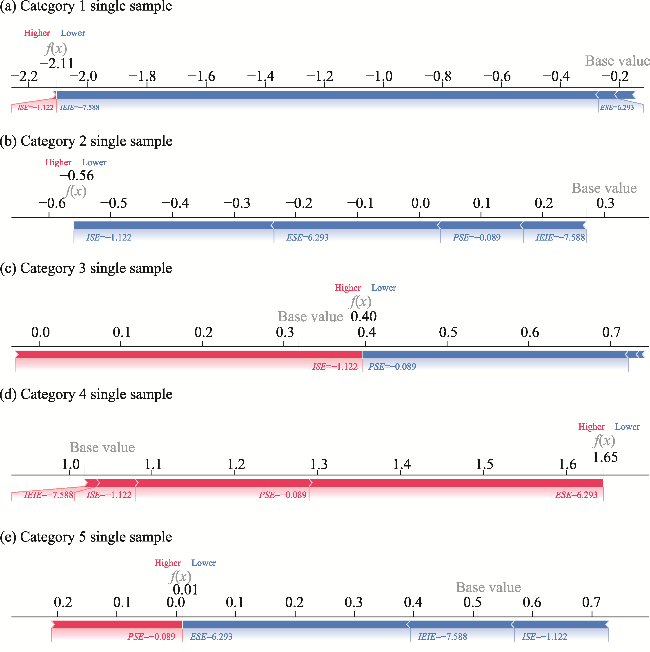
Figure 5 presents a force plot analysis for a single sample from each category. The prediction outcome is decomposed into a base value plus the aggregate contributions from all input features. In this visualization, blue indicates negative feature contributions to the sample, while red signifies positive contributions. The labels represent the original data used for model training. The lengths of the colored blocks correspond to the magnitude of each feature’s impact on its category. The base value is the average prediction of the XGBoost model for each category across the dataset. In sample a, IEIE is the most influential feature, exerting a negative effect and leading to a final prediction that the sample does not exhibit strong negative decoupling. For sample b, both ISE and ESE are the most impactful, causing the final prediction to deviate from the weak negative or expansive negative decoupling typical of category two. Sample c is predominantly influenced by ISE, which has a positive effect, suggesting that the sample shows signs of expansive and recessionary coupling. In sample d, ESE is the most influential, with a positive impact, leading to the prediction that the sample falls into the category of recessionary or weak decoupling. Sample e is significantly affected by ESE, despite its negative effect. With a SHAP value of 0.01, the final prediction indicates a strong decoupling state. Analyzing these individual samples is beneficial for authorities, as it allows for targeted assessments of the decoupling status in specific cities or municipalities for specific years.
Figure 5 SHAP value single sample force plots by category

4.3.2 Heterogeneity analysis of SHAP values based on the time dimension

The analysis indicates that the Industrial Energy Intensity Effect (IEIE) is a significant factor in classifying carbon emission decoupling states, particularly its influence on strong decoupling. The results of this study include the SHAP values of IEIE for the strong decoupling state (category five) from 2007 to 2021.
Table 4 shows the impact of the industrial energy intensity feature on the strong decoupling state for each prefecture-level city. Note that before 2017, IEIE generally had a positive impact on strong decoupling, which can be linked to the Inner Mongolia Autonomous Region’s specific goals during the “Eleventh Five-Year Plan” and “Twelfth Five- Year Plan” to phase out outdated production capacities and curb the rapid growth of energy-intensive industries. After 2017, IEIE primarily undermined strong decoupling. During the “Thirteenth Five-Year Plan”, the industrial structure’s reliance on high energy consumption led to high carbon emissions in several cities or municipalities (Dong et al., 2022). This suggests that strict enforcement of national industrial policies, reduced reliance on energy-intensive industries, and the robust development of renewable energy can effectively manage industrial energy intensity and are more likely to achieve the strong decoupling goal.
Table 4 SHAP values of IEIE for the strong decoupling state (category five) from 2007 to 2021
Year Hohhot Baotou Hulunbeir Hinggan Tongliao Chifeng Xilin Gol Ulanqab Erdos Bayannur Wuhai Alxa
2007 -0.176 -0.096 -0.206 0.039 0.086 0.085 -0.028 0.065 0.030 -0.014 0.068 0.040
2008 -0.077 -0.218 -0.206 0.225 0.085 -0.195 0.087 0.165 -0.248 0.052 0.068 -0.028
2009 0.059 0.060 -0.236 0.133 0.085 0.083 0.068 0.065 0.030 0.078 0.087 0.038
2010 0.152 0.159 -0.208 0.133 0.010 0.072 -0.009 0.174 0.131 -0.042 -0.056 1.370
2011 -0.077 0.089 -0.196 -0.014 0.085 0.083 0.184 0.072 -0.206 0.052 0.075 -0.024
2012 0.102 0.362 0.090 -0.020 0.085 0.086 0.088 0.052 -0.191 0.225 0.362 0.146
2013 0.060 0.362 0.165 0.133 0.334 0.254 0.254 0.133 0.102 0.133 0.172 0.159
2014 -1.404 0.126 0.523 0.169 0.241 0.706 0.241 0.839 0.332 0.241 0.172 0.332
2015 0.907 1.266 1.477 1.356 1.356 1.276 0.151 1.356 0.913 1.235 0.157 1.370
2016 -1.542 0.156 0.186 1.235 0.169 0.133 0.241 0.156 0.297 0.169 0.241 0.839
2017 0.362 0.387 0.359 0.133 0.334 0.359 0.403 0.334 0.214 0.334 0.334 0.359
2018 -1.465 -1.494 -1.325 -1.335 -1.419 -1.402 -1.432 -1.402 -1.480 -1.335 -1.389 -1.411
2019 0.210 0.164 -1.401 -1.427 0.241 -1.370 0.527 -1.303 0.625 0.169 -1.366 0.034
2020 -1.483 -1.347 -1.347 -1.156 -1.196 -1.347 -1.346 -1.217 -1.458 -1.196 0.526 -0.188
2021 -0.017 -0.233 -0.006 0.225 -0.116 -0.115 -0.233 -0.228 -0.219 -0.115 0.042 0.094
There is considerable variation in IEIE’s impact on strong decoupling among the different cities in Inner Mongolia, with a predominantly negative effect after 2017. The impacts before 2017 can be broadly classified into three categories. The first category shows an overall positive effect and includes cities like Hinggan, Tongliao, Xilin Gol, Ulanqab, Bayannur, Wuhai, and Alxa, where IEIE had a positive or slightly negative impact on strong decoupling from 2007 to 2017. These cities all have effective government implementation of energy conservation and emission reduction policies and measures, along with energy-saving management in major energy-consuming enterprises, which promote energy conservation, consumption reduction, and green development, and drive economic decoupling from carbon emissions. The second category, characterized by significant fluctuations, includes Hohhot, Baotou, Chifeng, and Erdos. These cities have relatively fast economic growth, but their industrial restructuring lags behind economic development demands, hindering the achievement of strong decoupling. The third category is stage-stable, exemplified by Hulunbeir. It showed stable inhibition from 2007 to 2017 and stable promotion from 2011 to 2017, which aligned with the timing of the five-year plans. During “The 11th Five-Year Plan (2006-2010)” Hulunbeir’s rapid economic growth was offset by relatively outdated technology, inhibiting strong decoupling. During “The 12th Five-Year Plan (2011-2015)”, the focus on structural optimization and energy efficiency led to a significant decline in energy consumption per unit of output, facilitating the achievement of strong decoupling.

5 Discussion

This study employed the LMDI model, including the industrial energy intensity factor, to assess the primary influences of various driving factors on carbon emissions over the study period. The results indicate that the industrial energy intensity effect significantly inhibits carbon emissions, the industrial structure effect generally acts as an inhibitor, and the economic scale effect has a substantial positive impact. The population scale effect, influenced by population growth, also drives carbon emissions, albeit to a lesser extent.
Variations in the impacts of driving factors on carbon emissions are apparent among cities within the autonomous region. Thus, this study focused on 2021 for an analysis of the spatial regional differences of driving factor directions among cities, and identified four distinct types: energy intensity-dominated, dual negative effect-driven, mixed positive and negative effects, and economically positive-driven.
By employing the Tapio decoupling model, we analyzed the decoupling status of each city during the study period. The findings highlight that, amid sustained economic growth, government policies on energy conservation and consumption reduction significantly influence changes in decoupling status.
By integrating XGBoost with SHAP, we evaluated the contribution of each driving factor to the decoupling status. The results showed that the importance of driving factors differs across decoupling states, and the performance of a given characteristic can vary in different cities. Strong decoupling is the most desirable state. Therefore, this study investigated the regional differences in the effect of industrial energy intensity on strong decoupling among the cities and categorized the findings into three types: overall positive, significantly fluctuating, and phase stable.

6 Conclusions

Drawing on the research and findings discussed above, the following policy recommendations are proposed to tackle the carbon emissions and environmental issues in Inner Mongolia, while also fostering green and sustainable development.
Spatially, the influences of carbon emission driving factors differ among the prefecture-level city types. By pinpointing key factors and understanding the development patterns and characteristics of various cities and based on reform of the fiscal authority and expenditure responsibility division in Inner Mongolia, the following actionable policy recommendations are proposed so that authorities can develop more precise policies on energy conservation, emission reduction, and low-carbon growth. Cities like Hohhot, where energy intensity remains dominant, require intensified policy guidance. To address this, authorities should establish a transformation fund for high-energy-consuming industries that prioritizes support for the upgrading of carbon emission reduction technologies through incentive-based mechanisms. Concurrently, they must strengthen regulatory restrictions on high-energy-consuming activities while implementing positive guidance measures for daily energy-saving behaviors of residents. This includes providing consumption subsidies for energy-efficient appliance purchases, enhancing public education campaigns on energy conservation, and intensifying promotional activities to raise environmental awareness. Cities with dual negative driving effects, such as Baotou, should establish a dedicated fund for corporate R&D expenditure and adopt a PPP financing model to attract private capital participation. In addition, increasing investment in energy utilization technology R&D is crucial for driving a low-carbon economic shift. Cities with mixed effects, like Hulunbeir, should implement a dedicated fund for the digital transformation of traditional industries, deepen industrial restructuring, boost technological investment, and encourage high-energy-consuming industries to embrace technological transformation. Economically driven cities, such as Ulanchab, must provide financial subsidies for newly-built wind-solar-storage integrated projects, expand clean energy development, establish a fiscal incentive mechanism for corporate carbon emissions to enhance the motivation of enterprises for low-carbon transformation, increase investment in low-carbon technology R&D, and strengthen urban low-carbon planning and management. In addition, reducing the costs associated with corporate low-carbon transformation is equally important.
Temporally, the impacts of carbon emission driving factors on decoupling status also vary. This study examined the link between industrial energy intensity, which typically restrains carbon emissions, and the ideal state of strong decoupling, and classified the 12 cities into three categories. Cities in the first category, showing a positive trend, should implement shared fiscal authority for carbon emission regulation between the autonomous region and league-city governments; and they should enforce enhanced supervision and law enforcement to ensure policy adherence. Cities in the second category, marked by significant fluctuations, need to balance economic growth with industrial restructuring; establish a tripartite shared transformation fund among the autonomous region, league-city governments, and corporate entities; provide more policy support to businesses; incentivize transformation and upgrading; and reduce their dependence on high-energy consumption. Cities in the third category, with stable phases, should establish and enforce strict carbon reduction standards; tighten supervision; strictly limit high-energy-consuming industries; promote the growth of low-energy-consuming industries; and formulate/implement strict carbon emission intensity standards with stringent restrictions on high-energy-consuming sectors while encouraging their transition to low-energy-consuming alternatives.
Although this study has made progress in revealing the relationships between carbon emission drivers and decoupling status, some informal energy uses were not fully taken into account due to limitations in data availability, and carbon emission measurements covering the entire life cycle of coal were not completed due to data restrictions. Furthermore, this study did not explore the dynamic changes in carbon emissions among different league-cities under varying policy adjustments. These issues need to be prioritized in future research. Future studies should pay more attention to improving data acquisition methods, technological breakthroughs, inter-regional spillover effects, and the dynamic impacts of policy changes. Based on the accessible data, adopting full life cycle carbon emission data and employing a “data-model-policy” research framework will provide solutions for green transition strategies in Inner Mongolia and even nationwide that are more operationally feasible.
[1]
Ang B W. 2015. LMDI decomposition approach: A guide for implementation. Energy Policy, 86: 233-238.

[2]
Bakay M S, Ağbulut Ü. 2021. Electricity production based forecasting of greenhouse gas emissions in Turkey with deep learning, support vector machine and artificial neural network algorithms. Journal of Cleaner Production, 285: 125324. DOI: 10.1016/j.jclepro.2020.125324.

[3]
Chen F, Zhang J, Ren J, et al. 2022. Spatiotemporal variations and influencing factors of carbon emissions in the Yellow River Basin based on LMDI model. Journal of Earth Environment, 13(4): 418-427. (in Chinese)

[4]
Chen J H, Zeng Q H. 2024. Analysis on effect of decoupling carbon emissions and energy consumption from economic development in Sichuan Province. Environmental Science & Technology, 47(9): 198-209. (in Chinese)

[5]
Chen J, Xu C, Song M. 2020. Determinants for decoupling economic growth from carbon dioxide emissions in China. Regional Environmental Change, 20(1): 1-12.

[6]
Chen T, Li X Y, Chen B. 2024. Decoupling effect and peak projection of carbon emissions in transportation industry under dual-carbon target. Journal of Traffic and Transportation Engineering, 24(4): 104-116. (in Chinese)

[7]
Dai C, Tan Y, Cao S, et al. 2024. Study on interprovincial equity and the decoupling of carbon emissions in the construction industry—A case study in China. Buildings, 14(7): 2200. DOI: 10.3390/buildings14072200

[8]
Ding Y K, Li Y P, Zheng H R, et al. 2024. A graph-factor-based random forest model for assessing and predicting carbon emission patterns—Pearl River Delta urban agglomeration. Journal of Cleaner Production, 469: 143220. DOI: 10.1016/j.jclepro.2024.143220

[9]
Dong Q X, Dong F L, Geng Y, et al. 2022. The path and countermeasures of green and low-carbon development in Inner Mongolia under the background of carbon peak and neutrality. Scientific Management Research, 40(6): 77-83.

[10]
Duan X L, Li X, Tan W F, et al. 2022. Decoupling relationship analysis between urbanization and carbon emissions in 33 African countries. Heliyon, 8(9): e10423. DOI: 10.1016/j.heliyon.2022.e10423.

[11]
Edwin T A, Liu Y L, Isaac O A, et al. 2024. Determinants of carbon emissions in Africa: new evidence based on machine learning algorithms. Environment, Development and Sustainability: 1-34. DOI: 10.1007/s10668-024-05566-6.

[12]
Fan Y, Hao Y, Chen Z, et al. 2024. Artificial intelligence for computation and development of nanodrug solubility in supercritical solvent: Analysis of temperature and pressure influence. Journal of Molecular Liquids, 414: 126095. DOI: 10.1016/j.molliq.2024.126095.

[13]
Gai Z M, Liu R T, Liu X, et al. 2024. Prediction and path analysis of carbon peak in Heilongjiang Province. Environmental Science, 46(5): 2828-2836. (in Chinese)

[14]
Ge Q X, Yang P G, Pu Y X. 2024. Decoupling status and driving factors of provincial transport carbon emissions in China. Environmental Science, 46(4): 2009-2019. (in Chinese)

[15]
Gong F, Wang F. 2013. Carbon emissions in Inner Mongolia. Journal of Arid Land Resources and Environment, 27(2): 36-40. (in Chinese)

[16]
Gong Q X, Guo G X. 2024. Decoupling relationship between logistics growth and carbon emissions and driving factors in Chongqing: A novel decomposition framework. Journal of Environmental Management, 370: 122931. DOI: 10.1016/J.JENVMAN.2024.122931.

[17]
Hou L P, Wang L, Qian Y, et al. 2022. Decoupling status and driving mechanisms of carbon emissions in the Golden Triangle of Southern Fujian under “carbon peaking and neutrality” goals. Acta Ecologica Sinica, 42(23): 9663-9676. (in Chinese)

[18]
Hou Y F, Liu S W. 2024. Predictive modeling and validation of carbon emissions from China's coastal construction industry: A BO-XGBoost ensemble approach. Sustainability, 16(10): 4215. DOI: 10.3390/su16104215.

[19]
Huo Z G, Zha X T, Lu M Y, et al. 2023. Prediction of carbon emission of the transportation sector in Jiangsu Province—Regression prediction model based on GA-SVM. Sustainability, 15(4): 3631. DOI: 10.3390/su15043631.

[20]
Khajavi H, Rastgoo A. 2023. Predicting the carbon dioxide emission caused by road transport using a Random Forest (RF) model combined by Meta-Heuristic Algorithms. Sustainable Cities and Society, 93: 104503.DOI: 10.1016/j.scs.2023.104503.

[21]
Kouyakhi N R. 2022. CO2 emissions in the Middle East: Decoupling and decomposition analysis of carbon emissions, and projection of its future trajectory. Science of the Total Environment, 845: 157182. DOI: 10.1016/j.scitotenv.2022.157182.

[22]
Li J, Wang Y, Wang Y. 2019. Decoupling analysis and influence factors between resource environment and economic growth in Beijing-Tianjin-Hebei Region. Economic Geography, 39(4): 43-49. (in Chinese)

DOI

[23]
Li Y J, Song J L, Wang J N. 2024. County carbon peak type classification and influencing factors in Beijing-Tianjin-Hebei based on decoupling model and spatial Dubin model. Environmental Pollution & Control, 46(9): 1346-1351, 1390.

[24]
Li Z Q. 2022. Extracting spatial effects from machine learning model using local interpretation method: An example of SHAP and XGBoost. Computers, Environment and Urban Systems, 96: 101845. DOI: 10.1016/J.COMPENVURBSYS.2022.101845.

[25]
Liang E F, Guo B Y, Zhao L, et al. 2023. Research on peaking carbon dioxide emissions of equipment manufacturing industry in Dalian based on Kaya formula. Journal of Thermal Science and Technology, 22(5): 513-520. (in Chinese)

[26]
Liu Y K, Jin S T. 2019. Temporal and spatial evolution characteristics and influencing factors of energy consumption carbon emissions in six provinces of central China. Economic Geography, 39(1): 182-191. (in Chinese)

DOI

[27]
Lundberg S M, Lee S I. 2017. A unified approach to interpreting model predictions. Advances in Neural Information Processing Systems, 30: 4768-4777.

[28]
Meng Y, Shen Y Y, Wang W, et al. 2024. Who affects carbon emissions? Drivers and decoupling effects of agricultural carbon emissions—Evidence from Sichuan, China. Frontiers in Sustainable Food Systems, 8: 16. DOI: 10.3389/fsufs.2024.1441118.

[29]
Miao A K, Yuan Y, Wu H, et al. 2023. Pathway and policy for China's provincial carbon emission peak. Environmental Science, 44(8): 4623-4636. (in Chinese)

[30]
Sharma H, Padhi B. 2024. Analysis of the carbon emissions trend in the Indian manufacturing sector: A decomposition and decoupling approach. Environmental Science and Pollution Research, 31(35): 48205-48221.

[31]
Song D Y, Song Q Y, Zhang Q. 2022. An analysis of the driving factors of China's transportation carbon emissions: Based on decoupling theory and generalized fisher index decomposition. Science and Technology Management Research, 42(11): 216-228.

[32]
Tapio P. 2005. Towards a theory of decoupling: Degrees of decoupling in the EU and the case of road traffic in Finland between 1970 and 2001. Transport Policy, 12(2): 137-151.

[33]
Tian L Y, Chai J, Zhang X K, et al. 2024. Spatiotemporal evolution and driving factors of China's carbon footprint pressure: Based on vegetation carbon sequestration and LMDI decomposition. Energy, 310: 133299. DOI: 10.1016/j.energy.2024.133299.

[34]
Vincenzo B, Furio C, Sergio N. 2024. Analysis of the carbon emissions trend in European Union. A decomposition and decoupling approach. Science of the Total Environment, 909: 168528. Doi: 10.1016/j.scitotenv.2023.168528.

[35]
Wang Q, Su M. 2020. Drivers of decoupling economic growth from carbon emission—An empirical analysis of 192 countries using decoupling model and decomposition method. Environmental Impact Assessment Review, 81: 106356. DOI: 10.1016/j.eiar.2019.106356.

[36]
Wang Y Q, Li J Y, Liu B, et al. 2024a. Spatial heterogeneity of carbon emissions from construction projects based on XGBoost-SHAP. Environmental Science, 46(7): 4090-4100. (in Chinese)

[37]
Wang Y Y, Cai Y P, Zhang P. 2025. Decoupling effect and driving factors of net carbon emissions and economic development in the Pearl River Delta urban agglomeration. Acta Ecologica Sinica, 45(3): 1303-1314. (in Chinese)

[38]
Wang Z Q, Ren J G, Han S, et al. 2024b. Interpretable machine learning-based carbon emission prediction in the materialization stage of buildings. Journal of Safety and Environment, 24(6): 2454-2466. (in Chinese)

[39]
Wu Y F, Xu Y, Tang Y B, et al. 2023. Temporal and spatial characteristics of net CO2 emissions and decoupling analysis in Yangtze River Economic Belt. Environmental Science, 44(3): 1258-1266. (in Chinese)

[40]
Xie P J, Shu Y L, Sun F H, et al. 2024. Decoupling economic development from carbon emissions: Insights from Chinese provinces. Energy, 308: 133008. DOI: 10.1016/j.energy.2024.133008.

[41]
Xing H, Huo X Q. 2025. The spatiotemporal pattern evolution and influencing factors of synergistic reduction of pollution and carbon emissions in Chinese counties. China Environmental Science, 45(3): 1657-1673. (in Chinese)

[42]
Xiong S, Zhang X, Yang B. 2024. Research on carbon emission prediction of Qinghai Province based on machine learning. The Frontiers of Society, Science and Technology, 6(9): 52-58.

[43]
Xu H, Wu Y. 2024. Study of the measurement of the global inclusive green growth index under the sustainable development goals. Economic Geography, 45(1): 36-47. (in Chinese)

[44]
Ye Y, Lu Y M, Xie J Y, et al. 2024. Decoupling and decomposition analysis of industrial carbon emissions and economic growth in China from a dynamic perspective. Environment, Development and Sustainability, 27(2): 5159-5181.

[45]
Yuan F, Lu X Q, Li H Y. 2021. A random forest-based model for the prediction of construction-stage carbon emissions at the early design stage. Journal of Cleaner Production, 328: 129657. DOI: 10.1016/J.JCLEPRO.2021.129657.

[46]
Zhao X C, Jiang M, Zhang W. 2022. Decoupling between economic development and carbon emissions and its driving factors: Evidence from China. International Journal of Environmental Research and Public Health, 19(5): 2893. DOI: 10.3390/IJERPH19052893.

[47]
Zhou M T, Yang J R, Ning X W, et al. 2024a. Analysis of the characteristics and driving mechanisms of carbon emission decoupling in the Hu-Bao-O-Yu City Cluster under the “Double Carbon” target. Sustainability, 16(17): 7290. DOI: 10.3390/su16177290.

[48]
Zhou Y, Gong Y, Zhao C. 2024b. Study on the decoupling effect of economic growth and carbon emission in Zhejiang Province. Frontiers in Economics and Management, 5(5): 67-85.

[49]
Zhuang G Y, Dou X M. 2021. Policies on peaking carbon emissions and their implementation in the new development pattern. Journal of Xinjiang Normal University, 42(6): 124-133. (in Chinese)

Outlines

/