Resource Environment and Green Development

The Impact and Mechanism Analysis of Digital Inclusive Finance on Urban Green Development

  • LIU Yunqin , 1, 2 ,
  • JIANG Tingyao , 3, *
Expand
  • 1. College of Economics & Management, China Three Gorges University, Yichang, Hubei 443002, China
  • 2. College of Economics & Management, Nanchang Institute of Science & Technology, Nanchang 330108, China
  • 3. College of Computer & Information Technology, China Three Gorges University, Yichang, Hubei 443002, China
*JIANG Tingyao, E-mail:

LIU Yunqin, E-mail:

Received date: 2024-04-03

  Accepted date: 2024-09-01

  Online published: 2025-08-05

Supported by

The Nanchang Social Science Planning Project(YJ202329)

The Humanities and Social Science Project of Nanchang Institute of Science & Technology(NGRW-22-02)

Abstract

Based on the panel data of Chinese cities during 2013 and 2021, this study establishes a panel fixed-effect model and a panel threshold model to empirically investigate the effect of digital inclusive finance on urban green development, as well as the mechanism, threshold characteristics and heterogeneity. The study reveals the following four points: (1) Digital inclusive finance can significantly drive urban green development, whose coverage breadth has more prominent promotional effect on urban green development compared to the usage depth and the digitization level. (2) In terms of the acting mechanism, the current effect of digital inclusive finance on urban green development is mainly achieved through promoting economic development and environmental protection, while its promotion effect on social progress is not yet significant. (3) The impact of digital inclusive finance on urban green development varies depending on the agglomeration degree of urban digital economy and its geographical location. In non-agglomeration areas of digital economy and western regions, the promotion effect of digital inclusive finance on urban green development is more obvious. (4) The promotion effect of digital inclusive finance on urban green development exhibits non-linear characteristics with different levels of urban economic development and digital inclusive finance development.

Cite this article

LIU Yunqin , JIANG Tingyao . The Impact and Mechanism Analysis of Digital Inclusive Finance on Urban Green Development[J]. Journal of Resources and Ecology, 2025 , 16(4) : 1052 -1063 . DOI: 10.5814/j.issn.1674-764x.2025.04.011

1 Introduction

With the energy shortages and environmental pollution increasingly becoming the focus of global attention, green development has become a new trend of global development. The Chinese government emphasizes the need to “accelerate the green transformation of development methods” and “promote the formation of green and low-carbon production as well as lifestyle”. Currently, China is in a critical stage of high-quality economic development, where green development is an important support for achieving the high-quality goal. Finance plays a policy-guiding role in promoting green economic development, which is regarded as an important regulatory tool for environmental governance. Digital finance is an important direction of financial reform in China in the current digital economy environment. As a new type of finance that combines digital technology with traditional finance, digital finance is characterized by sharing, convenience, a low cost and a low threshold (Demertzis et al., 2018), which is widely integrated into various aspects of social and economic development, advocating for green production by enterprises and green consumption by consumers, having a wide-ranging impact on society and having become a new driving force for promoting green development. The Chinese government has also proposed to “improve the financial, taxation, investment, pricing policies and standard systems that support green development, develop green and low-carbon industries, and improve the market-oriented allocation system of resources as well as environmental factors”, putting forward new requirements for financially support green development at the national level. Thus, a question worth considering and verifying is whether the current digital finance has released its environmental effects or promoted urban green development? If the answer is affirmative, what is the mechanism and characteristics of such influence? In view of this, this article aims to accurately evaluate the impact of digital finance on urban green development, and further explore its impact mechanism as well as characteristics, so as to provide references for the Government to formulate relevant policies.
The existing literatures regarding digital finance mainly explore its economic effects at both the macro and micro level, with relatively little research on its environmental effects. There is also a lack of attention to the intrinsic relationship between digital finance and urban green development. Although scholars have paid attention to the relationship between digital finance and green development (Mao and Wang, 2023), its relatively-single identification of green development based on unit GDP energy consumption, unit GDP carbon emissions or environmental pollution index cannot fully reflect the connotations of urban green development and its requirements for the economy, environment or society. Compared with existing literatures, this study attempts to analyze urban green development from three aspects: social production, ecological environment and urban life, focusing on the impact and mechanism of digital inclusive finance on urban green development, while examining the characteristics presented by this impact. The possible contributions of this study are below: firstly, three dimensions, namely economic development, environmental protection and social progress, are considered to examine urban green development, which fully encompass the requirements and manifestations of green development in the fields of production, ecology and life; secondly, explore the threshold characteristics of the impact of digital finance on urban green development at different economic development intervals and different levels of digital finance; thirdly, analyze the heterogeneity of digital finance in promoting urban green development from the perspective of different locations and digital economic agglomeration degrees, further confirming the inclusiveness of digital finance.

2 Literature review

The existing research on green development is mainly focused on theoretical connotations, evaluations and influencing factors. About theoretical connotations, Wang and Zhang (2012) consider that green development is a holistic system, which is a result of the interactions among green environment, green economy, green politics and green culture. Hu and Zhou (2014) believe that green development is a mode focused on reducing carbon emissions and achieving sustainability, which is the second generation of sustainable development concept emphasizing the integration and coordination among economy, society and the nature. Under the guidance of the new development concept, the purpose of development is not only to reduce resource consumption and environmental pollution, but also to improve people’s well-being (Zhu et al., 2023). In summary, existing research generally agrees that green development is sustainable and advanced, which combines resource conservation, environmental friendliness and social progress, and can balance the production, ecology as well as living aspects of the social economy. Here, this study defines that urban green development is an efficient and low-pollution urban economic development model that can be used to simultaneously achieve the urban development goals of economic development, environmental protection and social progress.
In terms of measuring and evaluating green development, some scholars have proposed concepts such as ecological efficiency (Burritt and Schaltegger, 2001), environmental total factor productivity (Chen, 2010), GTFP (Li et al., 2013), ecological capital efficiency (Yan et al., 2013) and green development efficiency (Meng and Ding, 2024) from the perspective of efficiency, which essentially aim to achieve greater economic development, social equity and ecological environment quality with the minimal resource consumption and environmental pollution. Some scholars have also constructed comprehensive indicators from multiple dimensions to measure green development (Xu et al., 2021; Wang et al., 2022).
The influencing factors of green development are also the focus of scholars’ research. Existing research has confirmed that foreign investments (Huang and Wu, 2021), environmental regulations (He and An, 2019), fiscal expenditures (Wei and Jiang, 2018), industrial agglomerations (Li et al., 2022) and technological innovations (Zhang et al., 2018) are all important factors affecting green development. In recent years, the digital economy has been flourishing, scholars have found that the digital economy and digital technology have positive promoting effect on green development, and this action has spatial spillover effects as well as nonlinear characteristics (Liu et al., 2022a; Luo and Qiu, 2022; Wei and Hou, 2022).
With the penetration of digital technology in the financial field, people have began to notice the interaction between digital inclusive finance (hereinafter referred to as Difi in this study for brevity) and the ecological environment. Researches include Difi and high-quality development (Teng and Ma, 2020; Zhang et al., 2024), Difi and green total factor productivity (Liu et al., 2023; Xu, 2023), Difi and carbon emissions (Huang et al., 2022; Gao et al., 2024), Difi and green technology innovation (Zhong et al., 2022; Han et al., 2023), Difi and industry green development (Wang et al., 2024), Difi and energy efficiency (Wei and Chen, 2022; Zhang and Li, 2022). Specifically, regarding Difi and green development, Liu et al. (2022a) used provincial panel data to examine the relationship between Difi and green development, and concluded that Difi mainly promotes green development through stimulating technological innovation and empowering green finance. Mao and Wang (2023) also affirmed the empowering role of Difi in green development, and promoting the “quantity” and “quality” of green technology innovation and improving social environmental awareness are the influencing mechanism. Ma (2023) constructed a green development measurement index system based on the requirements of new development concept, and tested the driving effect of Difi using provincial-level data.
Based on the above analysis, it can be found that there is lots of research on green development, and scholars have explored factors that promote green development from multiple perspectives. However, as a new form of finance in the digital economy era, the impacts of digital finance on green development have not been given sufficient attention, while the exploration of its impact mechanism and characteristics is even rarer. Based on panel data from 284 prefecture cities in China from 2013 to 2021, this study analyzes the impacts and mechanisms of digital inclusive finance on urban green development from both the theoretical and empirical perspective, while exploring the heterogeneity and threshold characteristics of such effect. It is a supplement and deepening of existing research on the environmental effects of digital finance.

3 Theoretical analysis and research hypotheses

3.1 The promoting effect of Difi on urban green development

From the perspective of the economic effects of Difi, firstly, it helps promoting economic development by alleviating financial exclusion. With the traditional financial model, financial institutions mainly target 20% of upscale customers (Yu et al., 2020), yet the inclusive characteristic of Difi effectively alleviates the financing constraints of the long tail group, meeting the needs of the public as well as a large number of small and micro enterprises for entrepreneurship, consumption and investments to a greater extent. Secondly, Difi promotes economic development by optimizing resource allocation. The technologies such as big data, where Difi relies on enabling both parties in demand to obtain the required transaction information more efficiently and accurately, resolve information asymmetry issues, and reduce transaction costs. In a digital inclusive financial environment, accesses to enter the financial market are more diverse, service barriers are further lowered, and investments as well as financing channels are further expanded. Thirdly, digital inclusive finance improves economic stability by effectively preventing and controlling risks. Through the utilization of big data, digital inclusive finance establishes a credit risk management system, which can quickly identify and analyze financial risks, helping to take timely response measures to potential risks, enhance risk prevention capabilities and avoid losses (Huang and Qiu, 2021).
From the perspective of the environmental effects of Difi, firstly, it provides a more convenient and extensive financing support for enterprises, and assists in the development of innovation activities (Teng and Ma, 2020). Innovations have been widely recognized as the most important force that drives industrial transformation and upgrade, which also transforms the past high energy consumption and pollution economic growth mode (Han et al., 2023). Secondly, digital inclusive finance itself has green attributes, which can connect people’s behavior with low-carbon living and green consumption, promoting economic development in an environmentally-friendly and resource-efficient manner. Digital inclusive financial activities such as mobile payments and online credits are environmentally-friendly green financial services that guide people towards green consumption. The second-hand trading represented by Xianyu relies on an environmental protection service platform built by Difi to achieve the integration of upstream and downstream resources, reducing resource waste and environmental pollution caused by repeated production. Once again, the Government uses Difi as a carrier to mine big data on environmental pollution in production and consumption, so as to timely manage environmental pollution activities (Ma, 2023).
From the perspective of the social welfare effect of Difi, its wide coverage and convenience can create more entrepreneurial and employment opportunities, help more vulnerable groups such as remote areas as well as small and micro enterprises solve the funding supply difficulties, help reducing unemployment, and promote social stability. At the same time, the growth and development of enterprises also create more tax revenues to the Government, which is beneficial for the Government to increase public expenditures and improve the welfare level of residents. Difi can change the internal logic of financial market operation, promote innovations in a series of financial products and services, accelerate the efficiency of financial support for the real economy, as well as promote urban economic development, environmental protection and social progress, thereby promoting the realization of urban green development. According to the above statements, the following hypotheses are proposed from the three dimensions of urban green development (hereinafter referred to as Gde in this study for brevity).
Hypothesis 1: Digital inclusive finance can promote urban green development.
Hypothesis 2a: Digital inclusive finance is beneficial to economic development.
Hypothesis 2b: Digital inclusive finance is beneficial to environmental protection.
Hypothesis 2c: Digital inclusive finance is beneficial to social progress.

3.2 The threshold effects of Difi on urban green development

According to the Environmental Kuznets Curve Hypothesis, economic growth will positively drive environmental quality when economy develops to a certain degree. Finance, which is the core of modern economic development, provides financial support for the stable operation of social and economic systems. Digital inclusive finance itself is also a product of economic development at a certain stage, which also complement each other. The low-level economic development is not sufficient to support Difi, nor is it conducive to the full play of its role. With the development of economy, Difi can better activate social economy and guide green technology innovations, thus promoting urban Gde to a greater extent.
In the early stage of digital inclusive finance development, due to the limited scope and weak intensity of network diffusion, it is unable to fully unleash its effects. As Difi develops to a certain stage, information costs will further decrease, the beneficiary groups will continue increasing, and economic interactions between institutions and departments will become increasingly frequent. The economic effects brought by Difi will continue being highlighted. With the continuous improvement of regulatory policies for Difi and the gradual enhancement of risk-controlling capabilities, the effectiveness of Difi in serving real economy will also be significantly improved. According to the above discussion, the following hypothesis is proposed.
Hypothesis 3: With further development of regional economy and digital inclusive finance, the promoting effect of Difi on urban green development will become more apparent.

4 Research design

4.1 Baseline model

To confirm the above hypothesis, a panel data fixed-effects model is employed in this paper for analyzing the effect of Difi on urban Gde:
Gdei,t=α0+α1Difii,t+αcXi,t+μi+δt+εi,t
where Gdei,t denotes the level of green development comprehensive index of city i in year; Difii,t stands for the value of digital inclusive finance of the same city in the same year; the corresponding coefficient α1 is the key target, indicating the degree to which the Difi affects Gde; Xi,t expresses the several control variables included; αc is the corresponding coefficient of each control variable; α0 is the intercept term; µi is used to control the individual fixed effect; δt is used to control the time fixed effects; and εi,t means the random disturbance term.
This study constructs an indicator system of urban Gde from three dimensions: Economic development, environmental protection and social progress. Furthermore, to investigate the impact mechanism of Difi on Gde, that is, the effect on the three dimensions of urban green development, the following Model (2) is established, where the dependent variables of economic development, environmental protection and social progress are separately included to explore the mechanism through which digital inclusive finance promotes Gde.
Dimi,t=β0+β1Difii,t+βcXi,t+μi+δt+εi,t
In Model (2), Dimi,t represents the three dimensions of urban green development; β0 is the intercept term; β1 and βc are the corresponding coefficient of Difi and control variables. The other symbols are the same as above.

4.2 Definition and measurement of variables

(1) Explained variable
The explained variable of this study is the urban green development. Based on the connotations and requirements of urban green development, considering the systematical, scientific, comparable and accessible principles, an inclusive index system for Gde, covering eighteen indicators across three domains: Production, ecology and livelihood, is formulated in this study, including three dimensions, which are economic development, environmental protection and social progress. A principal component analysis is used to measure the level of Gde. A detailed index system is provided in Table 1.
Table 1 Comprehensive index of urban green development
Primary index Dimensions Specific indicators Indicator attribute
Urban green
development
(Gde)
Economic development (Ed) Per capita GDP +
GDP growth rate +
Labor productivity +
Proportion of tertiary industry +
Government technology expenditure +
Environmental protection (Ep) Electricity consumption per unit of GDP -
Total water supply per unit GDP -
Construction land per unit GDP -
Utilization rate of general industrial solid waste +
Centralized processing rate of sewage +
Harmless treatment rate of domestic garbage +
Removal rate of SO2 +
Social progress (Sp) The rate of green coverage in built up areas +
Bus ownership per 10000 people +
Public library collection per 100 people +
Per capita urban road area +
Per capita number of beds in hospital and medical institutions +
Internet penetration rate +
(2) Core explanatory variable
The core explanatory variable of this study is digital inclusive finance (Difi). The Digital Inclusive Finance Index issued by the Digital Inclusive Finance Research Center of Peking University selects multiple indicators involving payments, credits, insurances, investments, monetary funds and other businesses to measure the development level of digital inclusive finance in China from three dimensions: coverage breadth, usage depth and digitization degree, which has good representativeness and is therefore selected as the proxy variable for the development level of digital inclusive finance in this study (Guo et al., 2020), with its logarithm taken in an empirical analysis.
(3) Control variables
Considering the potential impact on the robustness of empirical results coming from other factors, this study includes five control variables as follow. More precisely, ind is characterized by the proportion of added value of the 2nd industry to GDP. The fdi is gauged by the ratio of foreign direct investments originating from both foreign entities and regions like Hong Kong, Macao and Taiwan in comparison to GDP, taking the logarithm in an empirical analysis. The env is expressed by the comprehensive utilization rate of industrial solid waste. The inf is measured using the ratio of total postal and telecommunication business to regional GDP. The fin is expressed by the proportion of RMB loan balance of various financial institutions to GDP each year.

4.3 Data sources and analysis

This study establishes the panel data of 284 cities in China during 2013 and 2021 to empirically investigate the causal relationship between digital inclusive finance and Gde. Except for Difi searched from the Peking University Digital Finance Research Center, most of the data is obtained from China Urban Statistics Yearbook, various regional statistical yearbooks as well as economic and social development statistical bulletins. The linear interpolation method is employed to fill the missing values. Table 2 reports the overall characteristics of the data.
Table 2 Descriptive statistical results of main variables
Variables Observations Mean Standard deviation Min Max
Explained variable Gde 2556 1.780 0.775 0.004 7.936
Explanatory variables Difi 2556 5.311 0.275 4.475 5.885
coverage_breadth 2556 5.259 0.307 4.190 5.918
usage_depth 2556 5.270 0.314 4.254 5.870
digitization_level 2556 5.501 0.230 4.560 6.365


Control variables
ind 2556 44.139 11.173 11.040 82.230
fdi 2556 10.111 1.933 2.708 14.941
env 2556 80.068 20.895 0.340 101.907
inf 2556 0.031 0.040 0.002 0.486
fin 2556 1.104 0.632 0.118 9.622
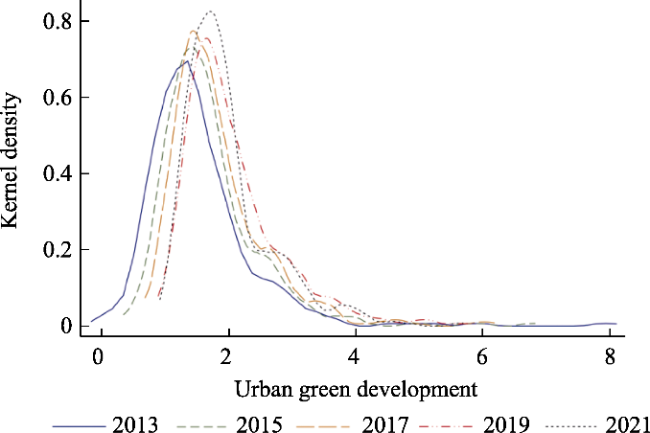
Figure 1 shows a kernel density estimation of the Gde level of sample cities in 2013, 2015, 2017, 2019 and 2021. From the perspective of evolutionary trends, the center of the annual nuclear density curve gradually shifts to the right, reflecting the overall improvement of China’s Gde; the kurtosis of each curve shows an overall upward trend, with a clear but shortened right tail, indicating that the green development data of the sample cities is more centralized, and that the regional gap among cities is narrowing. During the period from 2013 to 2021, the overall level of Gde in Chinese cities shows a significant upward trend, indicating that over the years, China has adhered to the concept of high-quality development, transformed its economic growth mode, pursued a harmonious coexistence between humans and the nature, continuously strengthened environmental pollution control in various fields of social economy, and achieved significant effect in practicing green development.
Figure 1 Time-series dynamic evolutionary characteristics of the Gde level
Meanwhile, although the uneven green development of various cities has been alleviated, it still clearly exists. In the future, efforts should be made continuously to achieve balanced development among regions.

5 Empirical results and analysis

5.1 Benchmark regression results

Table 3 represents the regression results of the baseline model. As shown in Column (1) and Column (2), the coefficient of Difi is consistently significant and positive after gradually introducing control variables, implying that Difi can significantly promote urban Gde. Hypothesis 1 is thus confirmed. Furthermore, the three dimensions of Difi also have positive promoting effect on Gde, all of which have passed the significance level test of 1%. Specifically, the coefficients of the three dimensions are 0.527, 0.308 and 0.304 respectively, indicating that compared to usage depth and digitization level, the coverage breadth of Difi has more significant positive promoting effect on urban Gde, whose reason may be that coverage breadth represents the number of opportunities to access financial services. Difi can break through the bottleneck of traditional finance, cover more users, guide people to green consumption, stimulate enter-prises to participate in green innovations, and promote Gde. In the process of serving the high-quality transformation of social economy through the new financial model of Difi, it is necessary to expand the range of beneficiaries as much as possible and ensure that more users can enjoy this digital dividend. The usage depth reflects the diversification of Difi products and services. A higher usage depth means that more types of financial services in payments, insurances and monetary funds are provided in digital inclusive finance, making it easier for the public to meet their demands for financial services, which is more conducive to green travel, green consumption and technology innovations, thus promoting low-carbon development. The digitization level reflects the degree to which digital technology is used in the products and services provided by financial institutions. With the deep development and continuous optimization of digital technology itself, its application in the financial field is also deepening. The integration and application of digital technology in financial products and services can help alleviate information asymmetry, improve service efficiency, reduce resource consumption to some extent, and promote green development.
Table 3 Benchmark regression results
Variables Gde
(1) (2) (3) (4) (5)
Difi 0.515*** 0.511**
(0.177) (0.202)
coverage_breadth 0.527***
(0.0364)
usage_depth 0.308***
(0.0311)
digitization_level 0.304***
(0.0363)
ind −0.0041*** −0.0035** −0.0081*** −0.0097***
(0.0014) (0.0015) (0.0015) (0.0014)
fdi −0.0093 −0.0117 −0.0101 −0.0116
(0.0087) (0.0092) (0.00942) (0.0095)
env 0.001* 0.0007 0.0011* 0.0006
(0.0005) (0.0006) (0.0006) (0.0006)
inf 0.809*** 0.0582 0.389** 0.443**
(0.192) (0.175) (0.177) (0.178)
fin 0.0409* 0.0382* 0.0707*** 0.0869***
(0.0218) (0.0230) (0.0235) (0.0234)
Constant −0.969 −0.905 −1.037*** 0.200 0.230
(0.857) (0.988) (0.251) (0.231) (0.259)
City fixed effect Yes Yes Yes Yes Yes
Year fixed effect Yes Yes Yes Yes Yes
Obs. 2556 2556 2556 2556 2556
R2 0.336 0.346 0.254 0.214 0.203
Number of id 284 284 284 284 284

Note: *, ** and *** indicate statistical significance at the 10%, 5% and 1% levels, respectively. Standard errors are in parentheses. The same below.

5.2 Robustness test

Although fixed-effects models can help alleviate the endogeneity problems, endogeneity caused by omitted variables or reverse causality is still difficult to avoid. Referring to the existing research, the endogeneity problem is further treated using the intersection term (iv1) of post offices per million people in each city in 1984 and the urban internet penetration rate in the previous year (Zhao et al., 2020), with the lag one period of Difi (iv2) as the instrumental variable. Firstly, the number of historical post offices and the lag one period of digital inclusive finance are highly correlated with the current period of digital inclusive finance, which meets the requirements of correlation; secondly, the number of historical post offices and the lag of Difi will not change with the level of Gde in the current period, and there is no direct correlation between instrumental variables and random disturbance terms, which conforms to the condition of exogenous instrumental variables.
Table 4 displays the results of instrumental regression. Column (1) and Column (3) represent the first stage of the regression results. Both iv1 and iv2 have passed the under-identification and weak-identification tests of instrumental variables. The results of the second stage of 2SLS regression in Column (2) and Column (4) indicate that after identifying endogeneity issues, Difi still has a significantly positive impact on Gde, further verifying the rationality of Hypothesis 1. Meanwhile, compared with the benchmark regression, it can be found that ignoring endogeneity issues would underestimate the promoting effect of Difi on Gde.
Table 4 Instrumental regression results
Variables (1) (2) (3) (4)
Difi Gde Difi Gde
Difi 3.3165***
(0.7294)
0.5867***
(0.0502)
iv1 0.0054***
(0.0010)
iv2 0.8207***
(0.0068)
Constant 1.157***
(0.024)
−1.692***
(0.175)
1.053***
(0.0382)
−1.4316***
(0.3317)
Controls Yes Yes Yes Yes
City fixed effect Yes Yes Yes Yes
Year fixed effect Yes Yes Yes Yes
K-P LM statistics 87.46*** 146.55***
K-P Wald rk F statistics 32.38 369.24
Obs. 2556 2556 2272 2272
R2 0.1926 0.0374 0.2010 0.1947
To further ensure the reliability of the results, this study adopts the following four methods for robustness testing. Firstly, replace the core explanatory variable. The Difi lagged one period is selected as an explanatory variable for regression. Secondly, exclude some samples. Considering that municipalities have better conditions for economic development, infrastructure construction and talents compared with other cities, which can provide a good foundation for the development of green transformation of urban economy, thereby affecting the accuracy of results of the study. The four municipalities, namely Beijing, Shanghai, Tianjin and Chongqing, are dropped for regression. Thirdly, tail reduction processing. Perform tail reduction on the percentile of 1% for core explanatory and control variables. Fourthly, replace the regression method. Considering that there may be sequence correlation and heteroscedasticity issues in the data, which may affect the regression results, this study adopts the generalized least squares (GLS) methodology to effectively estimate the existing data. The robustness testing results are shown in Table 5. After a series of tests, the coefficient of Difi is still significantly positive, indicating that the conclusion drawn earlier is still valid.
Table 5 Robustness test
Variables (1) Replacing the core explanatory variable (2) Excluding the municipalities (3) Winsorize (4) GLS
Difi 0.4160* 0.542*** 0.371* 0.6940***
(0.2126) (0.205) (0.192) (0.0267)
Constant −0.4074 −1.059 −0.313 −3.688***
(1.0445) (1.001) (0.938) (0.1443)
Controls Yes Yes Yes Yes
City fixed effect Yes Yes Yes Yes
Year fixed effcet Yes Yes Yes Yes
Obs. 2272 2520 2556 2556
R2 0.1633 0.348 0.399 0.190

5.3 Heterogeneity analysis

(1) Analysis of urban location heterogeneity
Considering the vast land area and significant differences in resource endowments among regions, this study divides the country into three regions: The eastern, central and western region to investigate the regional heterogeneity of the impact of Difi on green development efficiency. Table 6 shows the grouped regression results. Difi has shown a positive impact on Gde, which is significant at the statistical level of 1%, but the degree of effect in different areas appears to be variant. Specifically, the impact on the western region is significantly greater than that on the eastern and central region. The reason may be that the efficiency of Gde and the degree of financial development in the western region are generally lower, both of which have significant space for improvement. The promotion of new financial models is more likely to show the effect of improving green development efficiency. In contrast, developed regions already have a relatively complete financial service system, which may generate a certain degree of crowding out effect on Difi (Liu et al., 2022b). This confirms the inclusive characteristic of Difi once again, which can promote regional green development while having better green optimization effects on underdeveloped areas.
Table 6 Heterogeneity analysis
Variables Gde
(1) Eastern (2) Central (3) Western (4) Digital economy agglomeration area (5) Digital economy non-agglomeration area
Difi 0.408*** 0.476*** 0.635*** 0.336*** 0.548***
(0.0824) (0.0429) (0.0727) (0.122) (0.0374)
Constant 0.108 −1.082*** −1.747*** −0.675 −1.290***
(0.600) (0.294) (0.484) (0.971) (0.256)
Controls Yes Yes Yes Yes Yes
City fixed Yes Yes Yes Yes Yes
Year fixed Yes Yes Yes Yes Yes
Obs. 900 882 774 567 1989
R2 0.131 0.353 0.347 0.160 0.308
(2) The heterogeneity of agglomeration degree of digital economy
Referring to the research of Han et al. (2023), this study classifies cities located in Beijing, Tianjin, Hebei Province, Yangtze River Delta and Pearl River Delta as digital economy agglomeration areas, with cities located in other provinces as digital economy non-agglomeration areas. Furthermore, differences in the effect of Difi on urban green development under different degrees of digital economy agglomeration are investigated. As shown in Table 6, regardless of the agglomeration degree of digital economy, Difi shows significant positive promoting effect on urban green development. Compared to digital economy agglomeration areas, Difi has more significant green effect on non-agglomeration areas of digital economy. Similar to the eastern and central region, digital economy agglomeration areas have a more complete information infrastructure and financial service system, which has fully unleashed the digital dividend. Compared to the non-agglomeration zones of digital economy, the green effect of Difi is relatively weak.

5.4 Mechanism test

This study constructs an indicator system for urban green development level from three dimensions: economic development, environmental protection and social progress. Referring to the approach of Li and Xu (2018) for the impact mechanism, the three dimensions of green development sub-indices are included as dependent variables of the model to explore the mechanisms through which Difi promotes green development. The regression results are shown in Table 7. All the coefficients of Difi for both economic development and environmental protection are significantly positive at a statistical level of 1%, indicating that digital inclusive finance can promote economic development and benefit environmental protection, thus promoting Gde. The coefficient of Difi for social progress is positive but not significant. In comparison, the promoting effect of Difi on environmental protection is the strongest, followed by that of economic development. Hypothesis 2a and Hypothesis 2b are verified. After conducting a grouped regression to the eastern, central and western region separately, the results are basically consistent, as shown in Table 8. The coefficient of Difi for regional economic development and environmental protection is significantly positive at the statistical level of 1%, while that of Difi for social progress is only significantly positive in the western region. Since implementing the concept of high-quality development, China has achieved significant performance in promoting economic growth, resource conservation and environmental friendliness. In the future, while continuing ensuring coordinated progress between economic development and environmental protection, it is also necessary to further increase the level of social welfare, so that people can fully enjoy the fruits of high-quality development.
Table 7 Mechanism test: Full sample
Variables (1) Economic development (Ed) (2) Environmental protection (Ep) (3) Social progress (Sd)
Difi 0.0442*** 0.162*** 0.0028
(0.0035) (0.0081) (0.0028)
Constant -0.203*** 1.025*** 0.0722***
(0.0241) (0.0561) (0.0197)
Controls Yes Yes Yes
City fixed effect Yes Yes Yes
Year fixed effect Yes Yes Yes
Obs. 2556 2556 2556
R2 0.165 0.414 0.010
Table 8 Mechanism test: Regional division
Variables Eastern region Central region Western region
Ed Ep Sd Ed Ep Sd Ed Ep Sd
Difi 0.0785*** 0.135*** -0.0062 0.0372*** 0.185*** 0.0035 0.0122*** 0.155*** 0.0177***
(0.0092) (0.0139) (0.0064) (0.0043) (0.0138) (0.0028) (0.0012) (0.0151) (0.0055)
Constant -0.354*** 1.023*** 0.162*** -0.217*** 1.026*** 0.0517*** -0.042*** 0.989*** -0.0137
(0.067) (0.101) (0.0466) (0.0294) (0.0947) (0.0190) (0.0077) (0.101) (0.0365)
Controls Yes Yes Yes Yes Yes Yes Yes Yes Yes
City fixed Yes Yes Yes Yes Yes Yes Yes Yes Yes
Year fixed Yes Yes Yes Yes Yes Yes Yes Yes Yes
Obs. 900 900 900 882 882 882 774 774 774
R2 0.160 0.387 0.016 0.369 0.444 0.054 0.406 0.438 0.065

5.5 Threshold effects test

Considering the possible nonlinear effect of Difi on Gde, this study takes the level of economic development (with per capita GDP as the proxy variable) and Difi as threshold variables, and constructs the following panel threshold model:
Gdei,t=ϕ0+ϕ1Difii,t×I(THi,tθ)+ϕ2× Difii,t×I(THi,t>θ)+ϕiXi,t+μi+δt+εi,t
where the threshold variable is denoted by THi,t; I() is an indicator function that takes a value of 1 or 0; θ is an unknown threshold value; ϕ0 is the intercept term; ϕ1, ϕ2 and ϕi are the regression coefficients of the corresponding variables. Before threshold estimation, a threshold existence test is conducted. As shown in Table 9, the threshold variables pgdp and Difi have passed a single threshold and double thresholds respectively, indicating that with the development of economy and Difi, the green effect of Difi will exhibit non-linear changes.
Table 9 Threshold effect test results
Threshold variables Threshold type Threshold value F-value P-value Bootstrap Critical value
10% 5% 1%
pgdp Single threshold 14.9277 30.38 0.0100 300 16.8656 18.9587 27.9243
Double threshold - 24.35 0.1367 300 0.000 0.000 0.000
Difi Single threshold 5.3399 54.84 0.0367 300 48.2504 51.8629 62.9351
Double threshold 5.1452, 5.6732 51.37 <0.001 300 32.5538 36.5643 45.1225
Triple threshold - 45.21 0.6400 300 0.000 0.000 0.000
The regression results of the threshold model are presented in Table 10. Taking per capita GDP (pgdp) as the threshold variable, as is shown in Column (1), the marginal effect of digital inclusive finance on green development is 0.4773 when per capita GDP is below the threshold value of 14.9277, which passes the significance test at the level of 1%. However, when per capita GDP crosses 14.9277, the positive promoting effect of Difi on Gde significantly increases to 0.5368. This implies that with the development of economy, the green development effect of Difi will be gradually strengthened, which also verifies to some extent that the Environmental Kuznets Curve still holds in the context of digital inclusive finance. As is shown in Column (2), taking Difi as the threshold variable, when the level of Difi is lower than the first threshold value of 5.1452, its marginal effect on green development is 0.7441, which passes the significance test at the level of 1%. When it crosses the first threshold and is lower than the second threshold of 5.6732, its positive promoting effect on green development increases to 0.8170 at a significance level of 1%. After the development level of Difi exceeds 5.6732, its positive promoting effect on green development further significantly increases to 0.8544, which means that with the improvement of digital inclusive finance, the green development effect of Difi will show a growing trend. Hypothesis 3 has been validated.
Table 10 Threshold effect regression results
Variables Gde
Threshold_pgdp (1) Threshold_Difi (2)
Threshold1 0.4773*** (7.50) 0.7441*** (7.96)
Threshold2 0.5368*** (9.58) 0.8170*** (10.02)
Threshold3 - 0.8544*** (10.02)
Controls Yes Yes
City fixed effect Yes Yes
Year fixed effect Yes Yes
Obs. 2556 2556
R2 0.2738 0.1811

Note: The T values are in parentheses.

6 Conclusions and policy suggestions

This study investigated the casual relationship between Difi and urban green development theoretically and empirically using the panel data of 284 prefecture-level cities in China during 2013 and 2021. The main findings are as follows: 1) The overall level of Gde of Chinese cities shows a significant upward trend during the sample period, and the regional gap in green development levels among cities shows a narrowing trend. However, the phenomenon of regional development imbalance among cities still exists. Difi has positive promoting effect on urban Gde, and this conclusion still establishes after endogeneity processing and a series of robustness tests. Furthermore, the coverage breadth, using depth and digitization degree of Difi can all significantly promote urban Gde, and in comparison, the positive promotion effect of the coverage breadth of Difi on urban green development is more significant than that of the using depth and digitization degree. 2) A mechanism analysis shows that the current promotion effect of Difi on urban green development is mainly reflected in promoting economic development and environmental protection, while its positive impact on social progress has not yet been reflected. 3) A heterogeneity analysis shows that in the western region and non-agglomeration areas of digital economy, the positive promotion effect of Difi on urban green development is more significant. 4) A threshold effect analysis finds that the promotion effect of digital inclusive finance on urban green development shows a non-linear characteristic of increasing marginal effects with the development of regional economic and digital inclusive finance.
Based on the above conclusions, this study draws the following policy implications:
1)Accelerate the development process of digital inclusive finance, vigorously promote the new financial model of Difi, and cover as many regions and populations as possible. Optimize the regional layout of Difi, strengthen the service quality and efficiency of the digital inclusive finance system, accelerate the construction of digital inclusive finance infrastructures, improve the institutional environment for the development of Difi, and enhance the ability of digital inclusive finance to support green economy; strengthen the incentive and guarantee role of Difi in green technology innovations, alleviate the financing constraints of green innovations in enterprises, and better promote urban green development. 2) Fully leverage the green effects of Difi in production, support regional economic development and environmental protection, also pay more attention to the application of Difi in urban life, and ensure that digital inclusive finance can further contribute to the improvement of urban green welfare. 3) Further leverage the inclusive effect of Difi, increase the popularization of Difi in the central and western region and non-agglomeration areas of digital economy, promote the inclusive development of regional green economy, and provide financial system support to alleviate the problem of uneven and insufficient development among regions. This research has confirmed the positive effects of digital inclusive finance on urban green development from both the theoretical and empirical perspective, and examines the characteristics of such effects from multiple angles. However, whether there is spatial spillover of this impact still needs to be further revealed, which is a limitation of this study and also a direction that future research needs to deeply consider and explore.
[1]
Burritt R, Schaltegger S. 2001. Eco-efficiency in corporate budgeting. Environmental Management and Health, 12(2): 158-174.

[2]
Chen S Y. 2010. Green industrial revolution in China: A perspective from the change of environmental total factor productivity. Economic Research Journal, 45(11): 21-34, 58. (in Chinese)

[3]
Demertzis M, Merler S, Wolff G B. 2018. Capital markets union and the fintech opportunity. Journal of Financial Regulation, 4(1): 157-165.

[4]
Gao G S, Wang Q Z, Zhi H B. 2024. Impact of digital financial inclusion on agricultural carbon emission intensity. On Economic Problems, (1): 57-65. (in Chinese)

[5]
Guo F, Wang J Y, Wang F, et al. 2020. Measuring China’s digital financial inclusion: Index compilation and spatial characteristics. China Economic Quarterly, 19(4): 1401-1418. (in Chinese)

[6]
Han X F, Zheng Z J, Song W F, et al. 2023. Research on the dynamic influence of digital finance on green technology innovation under environmental regulation. Chinese Journal of Management, 20(8): 1180-1188. (in Chinese)

[7]
He A P, An M T. 2019. Competition among local governments, environmental regulation and green development efficiency. China Population, Resource and Environment, 29(3): 21-30. (in Chinese)

[8]
Hu A G, Zhou S J. 2014. Green development: Functional definition, mechanism analysis and development strategy. China Population, Resources and Environment, 24(1): 14-20. (in Chinese)

[9]
Huang L, Wu C Q. 2021. Foreign investment, environmental regulation and green development efficiency of cities along the Yangtze River Economic Belt. Reformation, (3): 94-110. (in Chinese)

[10]
Huang Y C, Huang Y S, Hu S L, et al. 2022. Can digital finance boost green and low-carbon development? Journal of Nanjing University of Finance and Economics, (4): 88-97. (in Chinese)

[11]
Huang Y P, Qiu H. 2021. Big tech lending: A new credit risk management framework. Journal of Management World, 37(2): 12-21, 50, 2. (in Chinese)

[12]
Li B, Peng X, Ouyang M H. 2013. Environmental regulation, green total factor productivity and the transformation of China’s industrial development mode—Analysis based on data of China’s 36 industries. China Industrial Economics, (4): 56-68. (in Chinese)

[13]
Li J L, Xu B. 2018. Curse or blessing: How does natural resource abundance affect green economic growth in China? Economic Research Journal, 53(9): 151-167. (in Chinese)

[14]
Li T, Li G P, Xue L. 2022. Research on the impact of producer services agglomeration on the efficiency of green economy. Scientology Research, 40(11): 1968-1978. (in Chinese)

[15]
Liu M L, Huang X, Sun J. 2022a. Impact of digital finance on China’s green development and its mechanism. China Population, Resources and Environment, 32(6): 113-122. (in Chinese)

[16]
Liu Q, Ma Y R, Xu S X. 2022b. Has the development of digital economy improved the efficiency of China’s green economy? China Population, Resource and Environment, 32(3): 72-85. (in Chinese)

[17]
Liu Z S, Lai B B, Liu G H, et al. 2023. Regional competition, digital inclusive finance promotion and green economic efficiency. Management Review, 35(1): 39-51. (in Chinese)

[18]
Luo J, Qiu H T. 2022. The spatial effect of urban digital economy on the green development of manufacturing industry. Economic Geography, 42(12): 13-22. (in Chinese)

DOI

[19]
Ma Y R. 2023. Measurement of green development in the new development stage and research on the driving effect of digital finance. Contemporary Economic Management, 45(11): 46-54. (in Chinese)

[20]
Mao X M, Wang R Z. 2023. Digital finance and green development—Empirical evidence from 286 cities in China. Finance Forum, 28(9): 69-80. (in Chinese)

[21]
Meng X, Ding T. 2024. How does livelihood public service affect urban green development efficiency? Evidence from 281 cities in China. Journal of Resources and Ecology, 15(2): 304-316.

DOI

[22]
Teng L, Ma D G. 2020. Can digital finance help to promote high-quality development? Statistical Research, 37(11): 80-92. (in Chinese)

[23]
Wang F, Mao J Y, Zhang X J, et al. 2024. Digital financial inclusion and agricultural green development—From the perspectives of easing financial constraints. Rural Finance Research, (2): 39-57. (in Chinese)

[24]
Wang L L, Zhang Y G. 2012. Exploring the connotation of “green development”. Socialism Studies, 205(5): 143-146. (in Chinese)

[25]
Wang X H, Zhang S P, Li X T. 2022. Research on the impact of innovative city construction on the green development of cities. Science Research Management, 43(8): 1-9. (in Chinese)

[26]
Wei J H, Jiang J F. 2018. Green finance expenditure: Theory and practice— Reflection on the deepening green development proposed by the 19th national congress of CPC. Contemporary Finance & Economics, (12): 26-36. (in Chinese)

[27]
Wei L L, Chen X. 2022. Digital finance, technological progress and energy intensity. Lanzhou Academic Journal, (5): 36-49. (in Chinese)

[28]
Wei L L, Hou Y Q. 2022. Research on the impact of China’s digital economy on urban green development. The Journal of Quantitative & Technical Economics, 39(8): 60-79. (in Chinese)

[29]
Xu W C. 2023. Digital finance, heterogeneous environmental regulation and green total factor productivity: Empirical evidence from micro firms. Finance & Economics, (11): 1-16. (in Chinese)

[30]
Xu X G, Fan H, Su Y S, et al. 2021. Research on the driving factors of China’s green economy development level. The Journal of Quantitative & Technical Economics, 38(7): 65-82. (in Chinese)

[31]
Yan L D, Qu Z G, Huang L. 2013. Research on ecological capital efficiency under the perspective of green economic transition. China Population, Resources and Environment, 23(4): 18-23. (in Chinese)

[32]
Yu C Y, Wang X B, Sun G L. 2020. Digital finance and the quality of economic growth in China: Internal mechanism and empirical evidence. Inquiry into Economic Issues, (7): 1-14. (in Chinese)

[33]
Zhang G J, Liang Z Y, Wu Z S. 2024. The evolution characteristics of digital financial inclusion in Chinese urban agglomerations and its effects on high-quality development. Geographical Research, 43(3): 621-639. (in Chinese)

[34]
Zhang J X, Chang Y, Zhang L X, et al. 2018. Do technological innovations promote urban green development?—A spatial econometric analysis of 105 cities in China. Journal of Cleaner Production, 182: 395-403.

[35]
Zhang Y H, Li S F. 2022. Can the development of digital finance improve energy efficiency. Collected Essays on Finance and Economics, (3): 47-55. (in Chinese)

[36]
Zhao T, Zhang Z, Liang S K. 2020. Digital economy, entrepreneurship, and high-quality economic development: Empirical evidence from urban China. Journal of Management World, 36(10): 65-76. (in Chinese)

[37]
Zhong T Y, Huang Y B, Sun F C. 2022. Digital inclusive finance and green technology innovation: Dividend or gap. Financial Economics Research, 37(3): 131-145. (in Chinese)

[38]
Zhu M, Nicholas S, Joseph E S, et al. 2023. Embracing the new paradigm of green development: A study of China carbon neutrality policy framework. The Journal of World Economy, 46(3): 3-30. (in Chinese)

Outlines

/