Journal of Resources and Ecology >
Influence of Ecotourism Experience on Tourists’ Environmentally Responsible Behavior: A Case Study of Luya Mountain Scenic Area
|
WEI Xiaoqin, E-mail: niu_weixq@163.com |
Received date: 2023-09-12
Accepted date: 2024-04-06
Online published: 2025-03-28
Supported by
The Shanxi Province Graduate-Level Quality Course Project(2023YZ28)
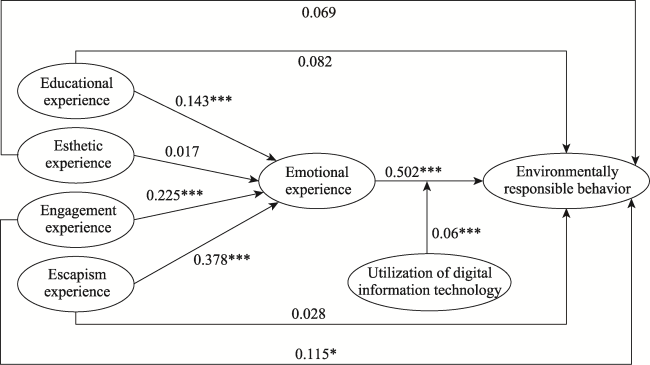
This paper explores the pathway toward harmonious coexistence between humanity and nature through the lens of ecotourism, delving into its impact on tourists’ cognition of the natural environment, cultivation of emotional connections, and its pivotal role in shaping environmentally responsible behavior. At the Luya Mountain Scenic Area, a case study was conducted in July 2021, collecting 632 valid tourist questionnaires to investigate the nexus among “ecotourism experience”, “emotional experience”, and “environmental responsibility behavior” using structural equation modeling. Moreover, the relationship between tourism and daily environmental behavior was scrutinized with canonical correlation analysis. The findings unveil several substantial revelations: (1) Engagement experience significantly and positively influences tourists’ inclination toward responsible behavior. (2) Emotional experience mediates the relationship between educational, engagement, and escapism experiences and the inclination to act responsibly. (3) The utilization of digital information technologies positively moderates the conversion of emotional experience into a willingness to behave responsibly. (4) Ecotourism responsibility is linked to daily behavior, and cognitive and emotional experiences foster long-term environmental protection. This study provides a pioneering approach to enhancing tourism offerings within the scenic area and nurturing a sustainable human-environment relationship.
WEI Xiaoqin , CHENG Zhanhong . Influence of Ecotourism Experience on Tourists’ Environmentally Responsible Behavior: A Case Study of Luya Mountain Scenic Area[J]. Journal of Resources and Ecology, 2025 , 16(2) : 558 -568 . DOI: 10.5814/j.issn.1674-764x.2025.02.023
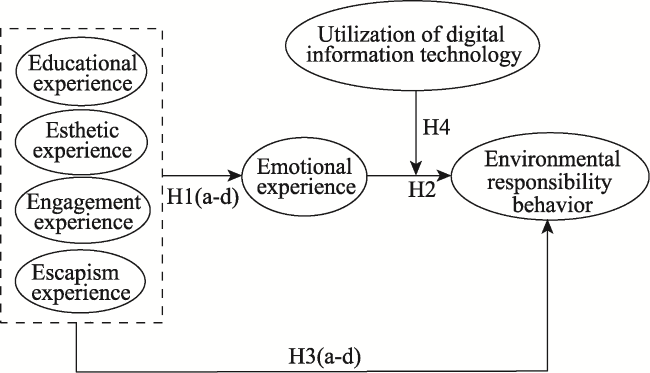
Figure 1 The theoretical model |
Table 1 Reliability and validity test |
| Variable | Code | Factor loading | CR | AVE | Cronbach’s alpha |
|---|---|---|---|---|---|
| Educational experience | TLE1 | 0.788 | 0.901 | 0.603 | 0.9 |
| TLE2 | 0.809 | ||||
| TLE3 | 0.752 | ||||
| TLE4 | 0.779 | ||||
| TLE5 | 0.773 | ||||
| TLE6 | 0.755 | ||||
| Esthetic experience | TAE1 | 0.741 | 0.865 | 0.562 | 0.864 |
| TAE2 | 0.745 | ||||
| TAE3 | 0.763 | ||||
| TAE4 | 0.785 | ||||
| TAE5 | 0.711 | ||||
| Engagement experience | TENE1 | 0.753 | 0.873 | 0.579 | 0.872 |
| TENE2 | 0.767 | ||||
| TENE3 | 0.781 | ||||
| TENE4 | 0.775 | ||||
| TENE5 | 0.728 | ||||
| Escapism experience | TESE1 | 0.69 | 0.851 | 0.588 | 0.85 |
| TESE2 | 0.777 | ||||
| TESE3 | 0.807 | ||||
| TESE4 | 0.788 | ||||
| Emotional experience | TEMOE1 | 0.735 | 0.89 | 0.536 | 0.892 |
| TEMOE2 | 0.722 | ||||
| TEMOE3 | 0.76 | ||||
| TEMOE4 | 0.658 | ||||
| TEMOE5 | 0.739 | ||||
| TEMOE6 | 0.758 | ||||
| TEMOE7 | 0.749 | ||||
| Environmentally responsible behavior | TERB1 | 0.731 | 0.888 | 0.5 | 0.893 |
| TERB2 | 0.733 | ||||
| TERB3 | 0.784 | ||||
| TERB4 | 0.746 | ||||
| DERB1 | 0.664 | ||||
| DERB2 | 0.641 | ||||
| DERB3 | 0.682 | ||||
| DERB4 | 0.657 |
Table 2 Differential validity test |
| Validity test | Educational experience | Esthetic experience | Engagement experience | Escapism experience |
|---|---|---|---|---|
| Educational experience | 0.603 | |||
| Esthetic experience | 0.743 | 0.562 | ||
| Engagement experience | 0.733 | 0.719 | 0.579 | |
| Escapism experience | 0.622 | 0.656 | 0.667 | 0.588 |
| Ave square root | 0.777 | 0.750 | 0.761 | 0.767 |
Table 3 Goodness-of-fit indices for path validity |
| Effect path | Standardized coefficients | SE | Bias-corrected 95% CI | Percentile 95% CI | ||||
|---|---|---|---|---|---|---|---|---|
| Lower | Upper | P | Lower | Upper | P | |||
| Indirect effect 1 | 0.072 | 0.034 | 0.020 | 0.157 | 0.004 | 0.017 | 0.148 | 0.007 |
| Indirect effect 2 | 0.008 | 0.034 | -0.055 | 0.079 | 0.778 | -0.058 | 0.076 | 0.827 |
| Indirect effect 3 | 0.113 | 0.036 | 0.054 | 0.199 | <0.001 | 0.046 | 0.186 | <0.001 |
| Indirect effect 4 | 0.190 | 0.054 | 0.108 | 0.318 | <0.001 | 0.103 | 0.312 | <0.001 |
| Standardized Indirect effect 1 | 0.105 | 0.045 | 0.028 | 0.212 | 0.005 | 0.026 | 0.202 | 0.007 |
| Standardized Indirect effect 2 | 0.011 | 0.044 | -0.071 | 0.102 | 0.784 | -0.074 | 0.100 | 0.827 |
| Standardized Indirect effect 3 | 0.155 | 0.047 | 0.075 | 0.261 | <0.001 | 0.065 | 0.251 | <0.001 |
| Standardized Indirect effect 4 | 0.220 | 0.054 | 0.130 | 0.340 | <0.001 | 0.127 | 0.336 | <0.001 |
Note: The path of effect 1: educational experience → emotional experience → environmentally responsible behavior; the path of effect 2: esthetic experience → emotional experience → environmentally responsible behavior; the path of effect 3: engagement experience → emotional experience → environmentally responsible behavior; the path of effect 4: escapism experience → emotional experience → environmentally responsible behavior. |
Figure 2 Path coefficients of the structural equation modelNote: *** indicates P≤0.01, ** indicates P≤0.05, and * indicates P≤0.1. |
Table 4 Typical correlation coefficients |
| Dimensions | Code/variables | U1 | V1 | U2 | V2 |
|---|---|---|---|---|---|
| Tourism environmental responsibility intention variable | X1 (Tourism environment learning intention) | -0.796 | -0.573 | 0.289 | 0.460 |
| X2 (Tourism environment action intention) | -0.774 | -0.557 | 0.538 | 0.860 | |
| X3 (Tourism environment discourages intention) | -0.859 | -0.618 | -0.154 | -0.240 | |
| X4 (Tourism environment persuades willingness) | -0.848 | -0.61 | -0.322 | -0.051 | |
| Daily environmental responsibility intention variable | Y1 (Daily environment learning intention) | -0.592 | -0.823 | 0.420 | 0.264 |
| Y2 (Daily environment action intention) | -0.557 | -0.775 | 0.039 | 0.247 | |
| Y3 (Daily environment consuming intention) | -0.601 | -0.835 | 0.000 | 0.002 | |
| Y4 (Daily environment persuades willingness) | -0.585 | -0.813 | -0.093 | -0.581 |
Note: U1 & V1 represents the first pair of canonical variables extracted from the willingness for environmental responsibility behavior, and U2 & V2 signifies the second pair. |
| [1] |
|
| [2] |
|
| [3] |
|
| [4] |
|
| [5] |
|
| [6] |
|
| [7] |
|
| [8] |
|
| [9] |
|
| [10] |
|
| [11] |
|
| [12] |
|
| [13] |
|
| [14] |
|
| [15] |
|
| [16] |
|
| [17] |
|
| [18] |
|
| [19] |
|
| [20] |
|
| [21] |
|
| [22] |
|
| [23] |
|
| [24] |
|
| [25] |
|
| [26] |
|
| [27] |
|
| [28] |
|
| [29] |
|
| [30] |
|
| [31] |
|
| [32] |
|
| [33] |
|
/
| 〈 |
|
〉 |