Ecotourism

Development of Leisure Sports Industry Clusters in Sichuan Province Based on Resource Competitiveness

  • GUO Jianying , 1 ,
  • WEI Yating 2 ,
  • HU Shiwei , 3, *
Expand
  • 1. School of Tourism and Geographic Sciences, Leshan Normal University, Leshan, Sichuan 614000, China
  • 2. College of Tourism, Northwest Normal University, Lanzhou 730070, China
  • 3. The Engineering & Technical College, Chengdu University of Technology, Leshan, Sichuan 614007, China
*HU Shiwei, E-mail:

GUO Jianying, E-mail:

Received date: 2024-09-12

  Accepted date: 2024-12-06

  Online published: 2025-01-21

Supported by

Sichuan Tourism Development Research Center(LY24-03)

Abstract

Sichuan Province has abundant leisure sports resources. An evaluation of the competitiveness of its leisure sports resources can provide a scientific basis for the selection and development of leisure sports industry clusters in Sichuan Province. In addition, a competitiveness evaluation index system for leisure sports resources was constructed to assess the competitiveness of leisure sports resources for 21 regions in Sichuan Province. The results showed significant differences among the 21 regions, and they could be divided into three levels. Specifically, the first level included the seven regions of Chengdu, Leshan, Yibin, Mianyang, Zigong, Aba and Luzhou; the second level included the 11 regions of Ya’an, Guangyuan, Ganzi, Neijiang, Deyang, Guang’an, Liangshan, Nanchong,Panzhihua, Bazhong and Dazhou; and the third level included Meishan, Suining and Ziyang. In view of the resource conditions, environmental conditions, and development conditions, Chengdu, Leshan, Yibin, Mianyang, and Zigong were chosen as the most suitable areas for leisure sports industry clusters in Sichuan Province. Furthermore, suggestions for these five potential leisure sports industry clusters were proposed to promote the high-quality development of the sports industry in Sichuan Province.

Cite this article

GUO Jianying , WEI Yating , HU Shiwei . Development of Leisure Sports Industry Clusters in Sichuan Province Based on Resource Competitiveness[J]. Journal of Resources and Ecology, 2025 , 16(1) : 245 -252 . DOI: 10.5814/j.issn.1674-764x.2025.01.022

1 Introduction

Domestic and foreign scholars have defined leisure sports and leisure sports resources in different ways. For example, the American scholars Richard et al. defined sports, leisure, and entertainment as “sports activities arranged for participation and enjoyment itself” (Richard et al., 2009). According to the Japanese Association for the Revitalization of Leisure Sports, leisure sports can achieve the goals of joy, mental and physical happiness, a cheerful mood, and the elimination of fatigue (Huang, 2010). As pointed out by Roger (1996), leisure sports are a higher stage of physical activity, which pursues physical relaxation and comfort through informal and spontaneous sports activities. In addition, the definitions of Chinese leisure sports can be divided into three main views. The first viewpoint is that sports activities are carried out during leisure time (Yu and Liang, 2003; Guo, 2019). The second is that sports activities are aimed at entertainment and fitness (Luo and Liu, 2004). The third is that sports activities are aimed at pleasing the body and mind (Cao and Lü, 2021). Leisure sports refer to sports activities carried out during leisure time, and the purposes of these activities are diverse, including fitness, happiness, interpersonal communication and self-value realization, health preservation, and others.
The competitiveness of leisure sports resources is an important component of regional competitiveness, which changes dynamically with various conditions. There are few studies on the competitiveness of leisure sports from the perspectives of regional competitiveness and enterprise competitiveness. From the perspective of regional competitiveness, Zhang and Tan proposed that the competitiveness of leisure sports tourism consists of resource perception, project perception, service perception, and overall satisfaction (Zhang and Tan, 2020). Jiang et al. proposed a competitiveness evaluation index system for leisure sports which includes the natural environment, sports resources, infrastructure basis, social-economic conditions, product structure, innovation environment, sports enterprises, institutions and association support. Based on their evaluation index system, they appraised the competitiveness of leisure sports in 31 provinces in mainland China. Generally, the competitiveness of leisure sports in China is at an average level. The spatial differences in leisure sports competitiveness are obvious, presenting a gradient that decreases from east to west (Jiang et al., 2022). Another study proposed that population, sports facilities, and related industrial factors constitute the competitiveness of the urban leisure sports industry. In addition, leisure sports industry competitiveness can be divided into four levels of highest, mid-high, mid-low and low in the Beijing, Tianjin and Hebei metropolitan zone (Li and Wang, 2013). A diamond model was adopted to evaluate the competitiveness of Sichuan’s leisure sports industry. Despite strong competitive strength of the leisure sports industry in Sichuan, it still has significant space for improvement (Li and Hou, 2021). Regarding the competitiveness of leisure sports enterprises, Yang proposed an evaluation system for assessing the competitive power of leisure sports enterprises in Wuhan. That system consists of four primary indicators (peer competitor threat, potential entrant threat, buyer bargaining power, and supplier bargaining power) as well as 12 secondary indicators (such as business growth rate). Moreover, there is a regional functional distinction in the leisure sports enterprises of Wuhan (Yang, 2019). The above studies considered leisure sports resources, but none of them were specifically designed to construct an evaluation system for the competitiveness of leisure sports resources.
Industrial clusters are the regional agglomeration effects that occur during the industrial development process. Industrial clusters can make regional competitive advantages more prominent. As pointed out by Marshall, industrial clusters are the process in which small and medium-sized enterprises from the same or related industries gather in a certain geographical area and obtain certain external economic benefits through specialized division of labor and cooperation (Marshall, 1879). According to Porter, an industrial cluster is a phenomenon in which many interrelated enterprises are concentrated in a certain geographical area, thereby forming a sustained competitive advantage (Porter, 2000). However, leisure sports industry clusters in China are rarely studied. An in-depth analysis of the research content revealed that the main areas of focus are the development mode, development path, and competitiveness of the leisure sports industry clusters. Studies conducted on Nanchang City (Huang, 2024), Henan Province (Liu, 2024), Jiaodong Economic Circle, and Chengdu City (Shen, 2021) all indicate the importance of industrial clusters for the development of leisure sports. Research in various regions has proposed development paths and optimization strategies based on their respective regional characteristics, and have emphasized the roles of policy guidance, industry integration, and regional synergy, providing valuable references for the healthy development of future leisure sports industry clusters.
Recently, the construction of a strong sports nation has been adopted as a national strategy. The sports industry will become a landmark cause for the great rejuvenation of the Chinese nation (General Office of the State Council of China, 2019). Under the guidance of national policies, research on leisure sports has always been a hot topic for many scholars. The goals of this study were: 1) To construct a quantitative evaluation index system for the competitiveness of leisure sports resources; 2) To assess the competitiveness of leisure sports resources for 21 regions in Sichuan Province; and 3) To choose the suitable areas for leisure sports industry clusters in Sichuan Province. The research results can provide theoretical and practical references for the high-quality development of leisure sports in Sichuan.

2 Study area

Sichuan Province (26°03ʹ-34°19'N and 97°21ʹ-108°12ʹE) is located in the southwestern part of China. It has abundant leisure sports resources, including natural, cultural and artificial leisure sports resources. Because of its complex geological structures, high mountains and deep canyons, Sichuan is rich in natural leisure sports resources. It has a good resource foundation for various outdoor mountain leisure activities such as sightseeing, mountaineering, hiking, exploration, scientific research, camping, cycling, skiing, rock climbing, ice climbing, and low-altitude flying. Known as the “province of thousands of rivers”, Sichuan has a dense river network. This network includes more than 1400 tributaries of the Yangtze River system and the Yellow River system, with 343 basins covering an area of more than 500 km2. There are diverse types of water resources, mainly including rivers, wetlands, lakes and ponds, waterfalls, springs, ice and snow areas, and others. They are ideal resources for conducting water-based leisure activities such as drifting, water skiing, river tracing, kayaking, and others (Editorial Committee of Sichuan Provincial Cultural and Tourism Yearbook, 2023).
Sichuan has abundant cultural leisure resources related to sports. As a multi-ethnic region, it has unique ethnic customs, and distinctive sports activities and sports cultures. The Tibetan people are known for their traditional riding and skilled sports activities. Traditional riding activities include horse racing, equestrianism, yak racing, and others. In addition, skilled sports activities encompass gezhuang singing and dancing, archery, wrestling, and others. Qiang ethnic sports can be classified into martial arts, religious rituals, and traditional competitions. Among them, martial arts include putting, wrestling, martial arts and archery. Religious rituals include gezhaung singing and dancing, sheepskin drum dancing, dragon lantern dancing, and other activities. At the same time, traditional competitions include wrench power, cockfighting, climbing poles, qigong, and others. Yi ethnic sports include martial arts (e.g., knife and sword dancing) and games (e.g., tug of war and tree stump grabbing) (Yu, 2019). Traditional sports like martial arts, Loong Boat rowing, and lion and dragon dancing of the Han people in Sichuan are also popular.
There are also abundant manmade leisure sports resources in Sichuan. With the socio-economic development of Sichuan, many leisure sports facilities have been built in the cities and rural areas. These leisure sports resources include sports venues, sports parks, green-ways, and sports equipment facilities, which have become the preferred resources for the daily leisure of urban and rural residents.

3 Research methods

3.1 Classification of leisure sports resources

Leisure sports resources refer to the resources and carriers that support sports activities during leisure time. The classification of leisure sports resources is the basis for evaluating their competitiveness. According to different standards, various leisure sports resource classification systems have been developed.
According to the carrier of resources, they can be divided into: mountain resources (e.g., mountaineering, skiing, rock climbing, hiking), water resources (e.g., river tracing, drifting, water sports), forest and grassland resources (e.g., equestrian, golf), desert resources (e.g., self-driving, hiking, gliding, sand skiing), folk sports resources (e.g., wrestling, martial arts), venue resources (e.g., tennis, badminton, table tennis, football, basketball), and others.
According to the form of resources, they can be classified as tangible resources and intangible resources. On the one hand, tangible resources are the activity venues, sports equipment, natural conditions suitable for leisure sports, various leisure sports exhibitions (such as festivals and events), as well as cultural and creative products. On the other hand, intangible resources mainly include sportsmanship, intangible cultural heritage sports resources, and others.
According to their geographical location, they can be classified into urban leisure sports resources and rural leisure sports resources.

3.2 Construction of a competitiveness evaluation index system for leisure sports resources

Relatively mature evaluation methods for Chinese tourism resources exist and the national standard Classification, Investigation and Evaluation of Tourism Resources (GB/T 18972-2017) has been released (Office of the Ministry of Culture and Tourism of China, 2022). The classification of leisure sports resources is very similar to that of tourism resources. For its competitiveness evaluation, the quantitative evaluation method of tourism resources can be referenced to construct an evaluation index system and conduct evaluations.
In this study, the Analytic Hierarchy Process was used to construct an evaluation index system for the competitiveness of leisure sports resources. The index system includes four layers: evaluation target layer, evaluation comprehensive layer, evaluation element layer, and evaluation factor layer. The comprehensive layer includes three indicators, the evaluation element layer has seven indicators, and the evaluation factor layer has 22 indicators (Table 1). This indicator system is the basic framework for evaluating the competitiveness of leisure sports resources in various cities and prefectures in Sichuan Province in the subsequent sections.
Table 1 A competitiveness evaluation index system for leisure sports resources and the indicator weights
Evaluation target layer (S) Evaluation comprehensive layer (A) Evaluation element layer (B) Evaluation factor layer (C)
Leisure sports resources
competitiveness
Resource condition A1
(0.614)
Entertainment value B1
(0.409)
Type diversity C1 (0.068)
Quantity C2 (0.124)
Quality C3 (0.165)
Density C4 (0.043)
Interpersonal communication and self-worth B2 (0.052) Suitable population range C5 (0.043)
Self-challenging C6 (0.009)
Resource endowment B3
(0.153)
Fame and influence C7 (0.114)
Scarcity and uniqueness level C8 (0.039)
Environmental condition A2
(0.168)
Natural environmental conditions B4 (0.042) Suitable usage duration C9 (0.023)
Suitable usable area C10 (0.015)
Environmental capacity C11 (0.004)
Humanistic environmental
conditions B5 (0.126)
Leisure and sports activity atmosphere C12 (0.022)
Sports competition C13 (0.065)
Daily average sports and leisure time C14 (0.024)
Per capita sports venue area C15 (0.015)
Development condition A3
(0.218)
Location conditions B6
(0.062)
Accessibility C16 (0.032)
Convenient transportation C17 (0.030)
Social-economic foundation B7 (0.156) Local economic foundation C18 (0.058)
Market size C19(0.040)
Venue construction investment C20 (0.025)
Policy and regulatory protection C21(0.009)
Number of leisure sports enterprises C22 (0.024)

3.3 Determination of indicator weights

Indicator weights were determined through the Analytic Hierarchy Process (AHP). Based on the competitiveness evaluation index system for leisure sports resources, a survey questionnaire was designed to obtain a judgment matrix for each indicator (Wang et al., 2023). Based on pair-wise comparisons, the weight of each indicator in the same layer was compared to the indicator in the previous layer. The relative importance between indicators was expressed by criteria of 1, 3, 5, 7, and 9 (where the greater the value, the more important the indicator), with the numbers 2, 4, 6, and 8 representing the intermediate values of the above adjacent judgments. The importance of the latter compared with the former was then represented by its mathematical reciprocal.
The survey questionnaires were distributed to 10 experts from the tourism department, sports bureau, relevant universities and research institutions. Based on the questionnaire results, the arithmetic mean of the values of each judgment matrix was calculated. Consistency testing was conducted on the CR value of each judgment matrix. Then, the weights for each indicator were finally obtained (Table 1).
The five-level Likert scale was used as the scoring standard to provide the scores of the evaluation factor layer. The specific scoring standards are shown in Table 2. This table provides a weighting basis for comparing the competitiveness of leisure sports resources in various cities and prefectures in Sichuan Province.
Table 2 Scoring standards for the evaluation factor layer
Evaluation factor layer Five-level Likert scale score
5 4 3 2 1
Type diversity C1 (categories) ≥5 4 3 2 1
Quantity C2 (number) ≥200 100-199 50-99 20-49 0-19
Quality C3 Very good Good Medium Bad Very bad
Density C4 Very high High Medium Low Very low
Suitable population range C5 Very wide Wide Medium Narrow Very narrow
Self-challenging C6 Very high High Medium Low Very low
Fame and influence C7 Very high High Medium Low Very low
Scarcity and uniqueness level C8 Very high High Medium Low Very low
Suitable usage duration C9 (months) ≥9 7-8 5-6 3-4 1-2
Suitable use area C10 Very large Large Medium Small Very small
Environmental capacity C11 Very high High Medium Low Very low
Leisure and sports activity atmosphere C12 Very high High Medium Low Very low
Sports competition C13 (provincial-level or above events per year) ≥10 9-10 6-8 3-5 1-2
Daily average sports and leisure time C14 (h) ≥2 h 1.5-2 h 1-1.5 h 0.6-1 h ≤0.5 h
Per capita sports venue area C15 (m2) ≥3.6 3.1-3.5 2.6-3 2.1-2.5 ≤2
Accessibility C16 (types) 5 4 3 2 1
Convenient transportation C17 (km km-2) ≥2 1.5-2 1-1.5 0.5-1 ≤0.5
Local economic foundation C18 (per capita GDP, 10000 yuan) 8-10 6-8 4-6 2-4 ≤2
Market size C19 (10000 people) ≥1001 801-1000 501-800 201-500 ≤200
Venue construction investment C20 Very high High Medium Low Very low
Policy and regulatory protection C21 Have None
Number of leisure sports enterprises C22 (number) ≥501 401-500 301-400 201-300 ≤200

4 Evaluation of the competitiveness of leisure sports resources in Sichuan

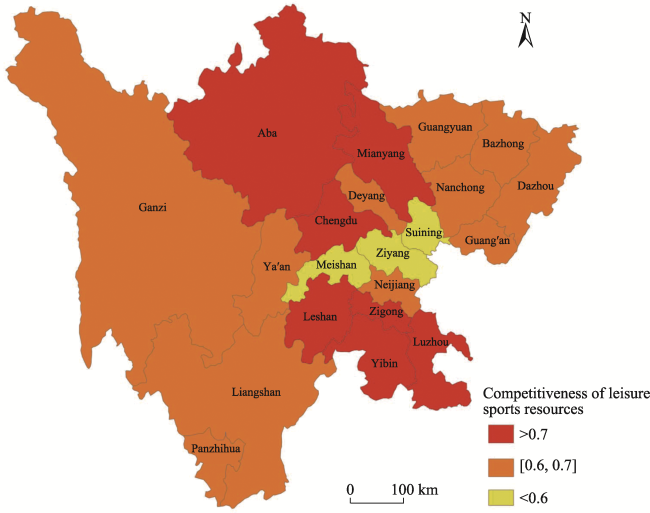
The data on leisure sports resources and environmental conditions were collected from the Sichuan Cultural and Tourism Yearbook (Editorial Committee of Sichuan Provincial Cultural and Tourism Yearbook, 2023) and the Sichuan Provincial Cultural and Tourism Resources Cloud Platform (http://res-inves.exp.daqsoft.com). In addition, the development condition data were sourced from the Sichuan Statistical Yearbook (Sichuan provincial bureau of statistics, 2023), statistical bulletins of various regions in Sichuan, the local life and city 8090 website, and Tianyancha (https://www.tianyancha.com/). According to 1Tables and 2, the evaluation factors were scored and evaluated individually. Then, the competitiveness of leisure sports resources in various regions in Sichuan Province was obtained (Figure 1, Table 3). The sorted results of this table directly reflect the competitiveness of leisure sports resources in various cities and prefectures in Sichuan Province.
Figure 1 Competitiveness of leisure sports resources in Sichuan Province
Table 3 Evaluation of the competitiveness of leisure sports resources in various regions of Sichuan
Region Comprehensive evaluation Resource condition Environmental condition Development condition
Chengdu 0.9424 0.5774 0.1534 0.2116
Zigong 0.7230 0.5062 0.0816 0.1352
Panzhihua 0.6454 0.4006 0.1238 0.1210
Luzhou 0.7060 0.4652 0.1066 0.1342
Deyang 0.6708 0.4322 0.0928 0.1458
Mianyang 0.7560 0.5182 0.1096 0.1282
Guangyuan 0.6846 0.4720 0.0896 0.1230
Suining 0.5932 0.3676 0.0970 0.1286
Neijiang 0.6770 0.4322 0.1148 0.1300
Leshan 0.7846 0.5752 0.0862 0.1232
Nanchong 0.6486 0.4240 0.0866 0.1380
Meishan 0.5962 0.3992 0.0854 0.1116
Yibin 0.7644 0.5138 0.1100 0.1406
Guang’an 0.6702 0.4426 0.0940 0.1336
Dazhou 0.6338 0.3924 0.1008 0.1406
Ya’an 0.6902 0.4832 0.0978 0.1092
Bazhong 0.6432 0.4254 0.0926 0.1252
Ziyang 0.5776 0.4074 0.0810 0.0892
Aba 0.7082 0.5304 0.0910 0.0868
Ganzi 0.6810 0.5222 0.0720 0.0868
Liangshan 0.6516 0.4578 0.0942 0.0996
In terms of the comprehensive competitiveness of leisure sports resources, Chengdu, Leshan, Yibin, Mianyang, Zigong, Aba, and Luzhou ranked at the first level with scores higher than 0.7. Among them, Chengdu had a comprehensive evaluation score of 0.9424, which was much higher than those of the other regions. The second-level regions were Ya’an, Guangyuan, Ganzi, Neijiang, Deyang, Guang’an, Liangshan, Nanchong, Panzhihua, Bazhong, and Dazhou, with comprehensive scores ranging from 0.6 to 0.7. The third-level regions were Meishan, Suining, and Ziyang, with comprehensive scores below 0.6.
From the perspective of resource evaluation, the regions with resource condition scores higher than 0.5 included Chengdu, Leshan, Yibin, Mianyang, Zigong, Aba, and Ganzi. The resource condition of Luzhou was relatively less competitive, yet its scores for environmental and development conditions were high, putting its comprehensive competitiveness in the first level. Ganzi had a high score for resource condition, but low scores for environmental and development conditions, preventing it from entering the first level.
From the perspective of environmental condition, seven regions had scores greater than 0.1, including Chengdu, Yibin, Mianyang, Luzhou, Neijaing, Panzhihua, and Dazhou. From the perspective of development condition, nine regions had scores greater than 0.13, including Chengdu, Yibin, Zigong, Luzhou, Deyang, Neijiang, Guang’an, Nanchong, and Dazhou.

5 Development of leisure sports industry clusters based on resource competitiveness evaluation

5.1 Site selection for leisure sports industry clusters

The formation of industrial clusters has two basic criteria: spatial agglomeration and industrial connectivity. Due to insufficient statistical data on the output value of the sports industry and enterprise output value in various regions in Sichuan Province, the leisure sports industry clusters could not be determined through quantitative methods like the industry concentration index and cluster degree. According to the comprehensive competitiveness evaluation of leisure sports resources above, the most suitable regions for cultivating leisure sports industry clusters in Sichuan Province are Chengdu, Leshan, Yibin, Mianyang, Zigong, Aba, and Luzhou. Due to the low resource condition score of Luzhou and the low development condition score of Aba, the five cities of Chengdu, Leshan, Yibin, Mianyang, and Zigong are the most suitable areas for fostering leisure sports industry clusters in Sichuan Province.

5.2 Suggestions for the development of leisure sports industry clusters

First, the government should guide the leisure sports industry to gather in the five regions listed above, and further plans for leisure sports cluster development need to be made. In combination with leisure sports resources and the industrial development foundation, the five leisure sports industry clusters should implement functional zoning and differentiated development. Specifically, Chengdu should highlight the sports competition and performance industry, sports big data, leisure sports complexes, and the leisure sports manufacturing industry. Leshan should focus on mountain sports, and Emei on martial arts and water sports. Yibin should develop sports competitions and performances and sports tourism. Mianyang should emphasize water sports, aviation sports, and sports tourism. Zigong should pay attention to leisure sports complexes and water sports.
Second, the government should build a series of leisure sports destination images. High-quality sporting events and festivals are indispensable for image building, and they should be held regularly to draw the attention of the global audience and media. During these events, leisure sports stars will emerge, and they can serve as the spokesmen of the leisure sports clusters to enhance the popularity and attractiveness of the destinations. The leisure sports products supply is also important in image building. It is essential to construct leisure sports towns, sports complexes and other leisure sports projects and improve the original leisure sports products. Leisure sports brand construction should not be ignored in the image building. In addition, some national and provincial sports tourism demonstration bases and other brands should be positively applied. By integrating diverse leisure sports, these bases will not only have unique natural scenery and cultural heritage, but they will also provide tourists and local people with deep participation and satisfaction.
Third, the government should adopt a “sports +” strategy to promote the development of leisure sports industrial clusters. A “sports +” strategy means that the leisure sports industry development should be integrated with health and wellness, tourism, education and other industries. Therefore, the government needs to support the integrated development through policies, funds, markets, land use and other aspects. At the policy level, a series of preferential policies and guidance should be introduced to encourage the integration of cross-border enterprises. These enterprises should have a simple approval processes and convenient project implementation. In terms of funds, establishing diverse money raising channels is essential, such as special funds, loan interest subsidies, and social investment. Prioritized investments should be made in sports and wellness, sports tourism, and sports education. As for market cultivation, modern information technologies such as big data and cloud computing should be fully utilized to accurately analyze the market demand. Based on that market demand, novel integrated leisure sports products, service models and routes could be provided to enhance regional competitiveness. In terms of the land use, it must be planned reasonably, while prioritizing the land demand for integrated projects such as sports and wellness or sports tourism. Only in this way can the integrated projects be pushed forward and completed on schedule.
Finally, the government should cultivate talents for the leisure sports industry clusters. The development of leisure sports industry clusters is always driven by talent. Strengthening the professionalization and specialized training of existing practitioners is crucial. Leisure sports associations, higher education institutions and leading enterprises should regularly organize “sports manager training and testing” projects. While enhancing the professional competence and market insight ability of management personnel, these efforts can encourage more outstanding talents to obtain industry recognized qualifications. Then, it will be essential to deepen the cooperation with colleges and universities, implement the order-type talent training model, accurately meet the needs of the industry, and customize the training of leisure sports professionals. This cooperative model can not only effectively solve the problem of talent shortages in the leisure sports industry, but also promote the deep integration of education and the leisure sports industry while injecting fresh blood and innovative vitality into the industry. According to future trends, higher education institutions should actively develop new training programs for fostering integrated sports talents, which would cultivate a group of composite talents who are proficient in sports professional knowledge and skills, as well as knowledge in multiple key fields such as management, marketing, and information technology. These talents would become a key force in promoting the innovative development of the leisure sports industry, driving innovation in the management mode, service mode, products and business forms in the industrial development layer, and propelling cluster development with innovation.

6 Conclusions and discussion

In this study, the analytic hierarchy process (AHP) was used to carefully construct a set of evaluation indicators for the competitiveness of leisure sports resources in Sichuan Province. Using this tool, we conducted a comprehensive and in-depth evaluation of the competitiveness of leisure sports resources in Sichuan Province. Based on the detailed evaluation results, we then conducted scientific and reasonable planning for the locations of the leisure sports industry clusters in Sichuan Province. The core results of this study are twofold.
(1) There are significant regional differences in the competitiveness of leisure sports resources in Sichuan Province, and they are clearly divided into three tiers. Among them, Chengdu, Leshan, Yibin, Mianyang, Zigong, Aba, and Luzhou have outstanding leisure sports resources and firmly occupy the first tier. Chengdu’s comprehensive evaluation score is particularly noteworthy. At 0.9424, it significantly surpasses the other cities and prefecture-level cities in the province, highlighting its absolute advantage in leisure sports resources. The leisure sports resource competitiveness scores of the other first-tier regions are all above 0.7, fully demonstrating the strong competitiveness of these regions in the leisure sports field.
(2) Based on the evaluation results, we selected the five most suitable regions in Sichuan Province for the cultivation of leisure sports industry clusters, namely Chengdu, Leshan, Yibin, Mianyang, and Zigong. For these regions, we proposed unique development suggestions for their leisure sports industry clusters. Chengdu should leverage its strong overall advantages and focus on developing sports competitions and performances, sports big data, leisure sports complexes, and leisure sports manufacturing to build a high-end industry cluster; Leshan should break through with mountain sports, and Emei with martial arts and water sports to form a distinctive industry cluster; Yibin should take full advantage of its natural conditions and build a unique industry cluster centered on sports competitions and performances and sports tourism; Mianyang should focus on water sports and aviation sports, and combine them with sports tourism to create a diversified industry cluster; and Zigong should take leisure sports complexes and water sports as the leading factors for promoting the rapid development of its industrial clusters.
In the evaluation of leisure sports resource competitiveness in Sichuan, the existing advantages and potential were deeply explored while providing a basis for future scientific planning. Through the development of a scientific and systematic evaluation system, the unique advantages of resource conditions, environmental conditions, and development conditions in the different regions of Sichuan Province could be accurately identified. This approach provides strong support for the spatial layout of the leisure sports industry in Sichuan Province, especially in identifying the best locations for Sichuan's leisure sports industry clusters. In addition, some suggestions were put forward to foster five leisure sports clusters in Sichuan. Hopefully, those clusters would improve the overall development of the leisure sports industry in Sichuan to meet the diversified and personalized sports consumption needs of the people. Of course, due to the complexity of factors affecting the competitiveness of leisure sports resources, the indicator elements selected in this study are not comprehensive. For instance, the indicators do not account for certain factors such as the unique economic development characteristics of leisure sports in various cities and prefectures in Sichuan Province. Therefore, developing more reasonable and scientifically based indicator elements and improving the evaluation index system remains to be supplemented and improved in future research.
[1]
Cao Y, S T. 2021. Reconsideration of mass sports, social sports and leisure sports—Sorting out and identifying the relationship between concepts. Journal of Guangzhou Sport University, 41(3): 6-10, 35. (in Chinese)

[2]
Editorial Committee of Sichuan Provincial Cultural and Tourism Yearbook. 2023. Sichuan cultural and tourism yearbook 2023. Chengdu, China: University of Electronic Science and Technology of China Press: 48-51. (in Chinese)

[3]
General Office of the State Council of China. 2019. Outline for building a strong sports nation. https://www.gov.cn/zhengce/zhengceku/2019-09/02/content_5426485.htm.

[4]
Guo P. 2019. Literature review on the research of leisure sports in China on the 70th anniversary of the founding of the People’s Republic of China. Sichuan Sports Science, 38(3): 94-103. (in Chinese)

[5]
Huang H. 2010. China’s leisure sports’ current situation and development trend in post-Olympic era. Journal of Jilin Institute of Physical Education, 26(3): 161-162. (in Chinese)

[6]
Huang T. 2024. Study on the development of leisure sports industry in Nanchang City from the perspective of clusterization. Sports Goods & Technology, 19: 77-79.

[7]
Jiang L, Zhang Y Y, Zhang J Q, et al. 2022. Evaluation and differential analysis of provincial leisure sports competitiveness based on entropy weight TOPSIS method. Journal of Shaanxi Normal University (Natural Science Edition), 50(6): 113-123. (in Chinese)

[8]
Li G Q, Wang D P. 2013. A study on competitiveness evaluation of leisure sports industry in BTH zone. Journal of Nanjing Sport Institute, 27(6): 60-65. (in Chinese)

[9]
Li L Y, Hou G H. 2021. Analysis of Sichuan leisure sports competitiveness based on diamond model. Science & Technology of Stationery & Sporting Goods, 8: 47-48. (in Chinese)

[10]
Liu H S. 2024. Research on optimizing the path of developing leisure sports tourism industry cluster in Henan Province. Agricultural Development & Equipment, (6): 68-70.

[11]
Luo L, Liu C L. 2004. Discussed on the value of sports participating in leisure based on the definition and era background of leisure. Journal of Sports and Science, 25(3): 35-38. (in Chinese)

[12]
Marshall A. 1879. The economics of industry. London, UK: Macmillan.

[13]
Office of the Ministry of Culture and Tourism of China. 2022. Classification, investigation and evaluation of tourism resources. https://zwgk.mct.gov.cn/zfxxgkml/zykf/202206/t20220601_933315.html.

[14]
Porter M E. 2000. Location, competition, and economic development: Local clusters in a global economy. Economic Development Quarterly, 14(1): 15-34.

[15]
Richard F M, Kathryn G B, Lynn M J. 2009. Entertainment and sports management. Translated by Han Y, Kang S. Shenyang, China: Liaoning Science and Technology Press. (in Chinese)

[16]
Roger S. 1996. Leisure. Translated by Jiang Y Q. Beijing, China: The Commercial Press: 73. (in Chinese)

[17]
Shen K B. 2021. Study on the path of leisure sports industry cluster development in Chengdu City. Technology Information, 19(1): 235-237.

[18]
Sichuan Provincial Bureau of Statistics. 2023. Sichuan statistics yearbook 2023. https://tjj.sc.gov.cn/scstjj/c105855/nj.shtml. Viewed on 2024-08-25. in Chinese)

[19]
Wang D L, Liu Q Y, Hu S W. 2023. Study on the exploitation potential of ecotourism in Leshan City based on a multi-hierarchy grey method. Journal of Resources and Ecology, 14(2): 321-330.

DOI

[20]
Yang J. 2019. Research on the competitive power of leisure sports enterprises in Wuhan. Diss., Wuhan, China: Wuhan Sport University: 25-30. (in Chinese)

[21]
Yu K H, Liang R W. 2003. The discussion on leisure sports based on definition of leisure. China Sport Science and Technology, 39(1): 21-23, 31. (in Chinese)

[22]
Yu Z X. 2019. Traditional sports of ethnic minorities in the Tibetan, Qiang and Yi Corridor. Beijing: Xinhua Publishing House. (in Chinese)

[23]
Zhang T M, Tan Y M. 2020. Enhancing the competitiveness of sports tourism in leisure tourism destinations—Based on perspective of tourist perception and taking outdoor sports in mountain areas of Enshi Prefecture as an example. Journal of South-Central University for Nationalities (Humanities and Social Sciences), 40(2): 114-120.. (in Chinese)

Outlines

/