Rural Revitalization and Ecotourism

The Spatio-temporal Evolution and Influencing Factors of Common Prosperity Level in the Wuling Mountain Area

  • LI Huiqin , * ,
  • HOU Yujie
Expand
  • School of Economics and Management, China University of Geosciences (Wuhan), Wuhan 430074, China
* LI Huiqin, E-mail:

Received date: 2023-10-01

  Accepted date: 2024-02-20

  Online published: 2024-12-09

Supported by

The National Social Science Foundation of China(19BJY202)

Abstract

As China successfully won the tough battle against poverty, advancing common prosperity on all fronts has gradually become an important task in realizing Chinese modernization. The evaluation index system for common prosperity is constructed of four dimensions of “affluence, sharing, commonality, and sustainability”, and the Entropy weight-TOPSIS method, Theil index, and Multiscale geographically weighted regression are applied to analyzing the spatio-temporal evolution and influencing factors of common prosperity level in the Wuling Mountain area. The results show that the level of common prosperity in the Wuling Mountain area was low but slowly increased from 2011 to 2021. The spatial development pattern of common prosperity in the Wuling Mountain area shows an evolutionary trend of being “fast in the north and east, and slow in the south and west". The core counties have a positive spillover effect on the neighboring counties. The overall gap in the level of common prosperity in the Wuling Mountain area displays a trend of “weakly fluctuating and slightly declining”, with the main source of development differences within the Hunan region. Each factor shows various impact intensit on the level of common prosperity in the Wuling Mountain area and its fluctuation directions at different times. Among these factors, GDP per capita has the strongest impact and always plays a positive role. The conclusions of this study can provide a theoretical basis and scientific reference for the less developed regions to effectively articulate rural revitalization and realize common prosperity.

Cite this article

LI Huiqin , HOU Yujie . The Spatio-temporal Evolution and Influencing Factors of Common Prosperity Level in the Wuling Mountain Area[J]. Journal of Resources and Ecology, 2024 , 15(6) : 1578 -1592 . DOI: 10.5814/j.issn.1674-764x.2024.06.015

1 Introduction

Chinese modernization is the modernization of common prosperity for all and “make more notable and substantive progress in promoting the people’s well-rounded development and prosperity for all” has been adopted as one of the key tasks in the long-range objectives of basically realizing socialist modernization by the Year 2035. The most challenging and arduous task of achieving common prosperity in China remains in the rural areas, owing to the current prominent problem of imbalances and inadequacies in development, as well as the wide gaps in development and income distribution between urban and rural areas and between regions. Therefore, narrowing the development gap between urban and rural areas and bringing common prosperity to rural areas and rural residents are the outward manifestations of promoting social fairness and justice in the new era (Wang and Jiao, 2023), as well as the core content of the common prosperity for all (Li and Li, 2022). The 14 concentrated contiguous destitute areas established by China in 2011 cover the vast majority of rural areas and farmers’ agglomerations in China. These regions are important obstacles to the socio-economic development of China (Ding, 2014). Poverty alleviation and eradication is the path China must take to realize common prosperity under socialism with Chinese characteristics (Wang, 2022). Analyzing the characteristics of common prosperity in the concentrated contiguous destitute areas that have been lifted out of poverty is of great practical significance for rural areas to move steadily and effectively toward a new journey of common prosperity.
International accounts directly addressing common prosperity are scarce. Some scholars articulate “shared prosperity” from a political economy perspective and recognize that this concept is complex and requires the integration of perspectives from multiple disciplinary fields (Phillips, 2005). Similar to the concept of common prosperity, there are other concepts such as welfare society (Fedotova, 2019), narrowing the income gap (Sugimoto, 2006), anti-poverty (Seth and Tutor, 2021), etc., which only illustrate equity from the single perspective of material level. Chinese scholars have performed more in-depth investigations on the meaning, features, and realization path of common prosperity. Scientifically understanding the meaning of common prosperity serves as the foundation for the study of it (Hou et al., 2022). Common prosperity refers to affluent sharing as well as shared affluence (Li and Zhu, 2022). Affluence is defined as both material and spiritual plenty (Yang and Yang, 2023), whereas sharing is described as an increasing sense of fulfillment for the whole population in economic, political, cultural, ecological, and social aspects. Thus, the connotation of common prosperity includes the two fundamental notions of “commonality” and “prosperity” (Shen et al., 2022; Sun and Cao, 2022). It can alternatively be characterized as general affluence and the sharing of development outcomes, with the sharing dimension further separated into population groups, regions, and urban-rural inequities (Liu et al., 2021). The carrying capacity of the population, resources, and environment should be coordinated with common prosperity. In addition to the two dimensions of commonality and prosperity, a sustainable dimension should be added to emphasize intergenerational equity and prosperity (Chen et al., 2021; Li and Yu, 2022). The essence of common prosperity is to satisfy all the people’s needs for a better life. To characterize the nature of common prosperity in the new period, the dimension of people’s livelihood and well- being must be added (Chao and Ren, 2022). The measurement of common prosperity is critical to the study of how to achieve common prosperity. Some studies have constructed an indicator system for evaluating common prosperity and statistical data were used to measure the level of common prosperity in areas at different scales, such as national (Song, 2022), regional (Wu and Zhang, 2023), provincial (Zheng and Li, 2023), municipal (Zhang et al., 2022), etc. In-depth exploration also was initiated in terms of regional differences (Li et al., 2023a), dynamic evolution (Wang et al., 2023b), spatial and temporal differentiation (Zhang et al., 2023), etc. Other scholars have elucidated the influencing factors and internal mechanisms of the spatial and temporal differentiation of common prosperity on the basis of exploratory spatial analyses (Liu et al., 2023), geo-detectors (Li et al., 2023b), panel regression model (Hu and Yao, 2023), and other methods. The existing literature provides a solid foundation for the research in this study, but there is still room for improvement. Firstly, studies based on the national macro level are the most abundant, and special areas such as concentrated contiguous destitute areas that have been lifted out of poverty are not yet common in studies on common prosperity. Secondly, the current research mostly takes provinces as geographic units, and the exploration around small-scale geographic units, such as counties, still needs to be supplemented. As the smallest unit of a country’s political, economic, and social development, the county is an important field of rural living and working (Chen, 2023). Therefore, to clarify the key points and difficulties in the development of common prosperity, it is necessary to conduct a study on the level of common prosperity from the perspective of counties. Finally, most of the current research is based on global regression models to analyze the main factors influencing common prosperity, without taking into account the “spatial instability” of spatial data.

As China’s first pilot region for eradicating absolute poverty, the Wuling Mountain area took the lead in planning regional development and poverty alleviation in 2011 and has since formally initiated the 14 concentrated contiguous areas of extreme poverty as the main battlefield for poverty alleviation. Therefore, the evolution of common prosperity in the Wuling Mountain area is more typical and representative. What kind of spatio-temporal evolution pattern does the level of common prosperity in the Wuling Mountain area show? What are the characteristics of the development gaps among areas within the Wuling Mountain area? What kind of development measures should be implemented in the future? Research on the above issues can further provide theoretical reference and scientific basis for the Wuling Mountain area and other poverty-stricken areas to consolidate and build on the gains in poverty alleviation and realize common prosperity. This study collects the panel data of 71 county-level administrative districts in the Wuling Mountain area ranging from 2011 to 2021, constructs an indicator system and measures the level of development on the basis of clarifying the meaning of common prosperity. The analysis of the gap in the level of common prosperity is based on the Thiel index. This study determines the main influencing factors of common prosperity in the Wuling Mountain area by OLS regression methods and explores the spatial differentiation characteristics of these influencing factors with the help of multi-scale geographically weighted regression models. Accordingly, the above three questions are answered, and policy recommendations are provided for the promotion of common prosperity in the Wuling Mountain area.

2 Data sources and research methods

2.1 Research region

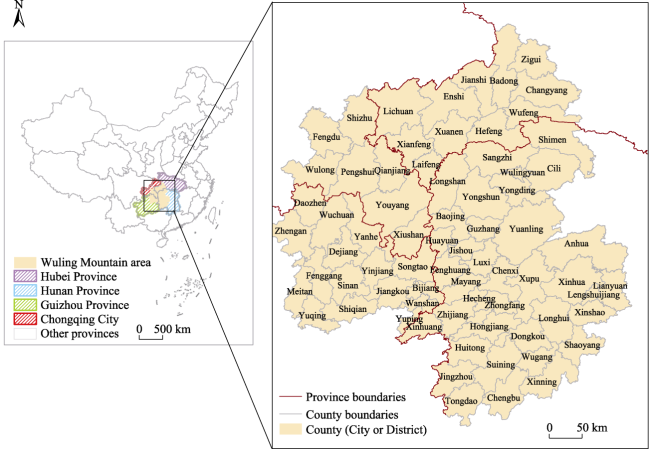
The Wuling Mountain area covers an area of 17.18×10⁴ km2 and is located at the junction of four provinces or cities (Hubei, Hunan, Chongqing, and Guizhou). It includes 71 counties (cities and districts) at the Wuling Mountain and its ranges (Fig. 1). More than 70 percent of the counties here are national key counties for poverty alleviation and provincial key counties. The Wuling Mountain area is well endowed with mountainous, mineral, forestry, cultural and tourism resources, with unique natural landscapes. Twenty- eight ethnic minorities live here, including the Bai, Tujia, and Gelao. The Wuling Mountain area is not only a typical less developed region with multi-ethnic integration and an important ecological barrier zone in the Yangtze River Basin, but also the first pilot area of China’s poverty alleviation program. Its experience in poverty reduction and eradication is extensive and its results are evident. At the end of 2010, the GDP per capita of the Wuling Mountain area accounted for 33.76 percent of the national average, and the income ratio of urban and rural residents was 3.04:1, which shows that its economic development is backward and the gap between urban and rural areas is obvious. Owing to pro-poor policies, GDP per capita in 2020 was already 48.95 percent of the national average, and the ratio of urban to rural incomes was 2.69:1. Compared to 2010, regional imbalances have been significantly reduced and remarkable progress has been made in poverty eradication (You et al., 2020).
Fig. 1 The scope of the Wuling Mountain area

2.2 Index system and data sources

Based on existing research, this study measured the level of common prosperity in the Wuling Mountain area in four dimensions: affluence, sharing, commonality, and sustainability (Tan et al., 2022).
Raising the overall level of wealth, income and consumption is not only a material guarantee for achieving economic development but also a direct measure of the effectiveness of poverty eradication in underprivileged areas. At the same time, meeting the people’s intellectual needs is also an important part of common prosperity in the new era. Therefore, the increase of affluence should focus on the organic unity of material and spiritual affluence. Commonality indicates that the common prosperity is centered on all the people (Peng et al., 2023). Reducing regional, urban-rural and population gaps can lead to a higher level of commonality. Regional disparities mainly include inter-regional disparities in per capita disposable income, per capita wealth, and per capita basic public service expenditures. The Wuling Mountain area has a weak foundation for development, and its social class differences are not obvious. Therefore, narrowing the regional gap and the urban-rural gap is the main task of realizing common prosperity in the Wuling Mountain area. Increasing regional commonality also requires bridging the urban-rural income and consumption gap, promoting the citizenship of some peasants, and implementing the integrated development of urban and rural. The degree of sharing is used to measure whether the fruits of reform and development benefit everyone equitably. In impoverished areas, infrastructure development is inadequate and public service systems are insufficient. The sharing of social resources represented by employment security, healthcare, and education levels should be accelerated, which can effectively promote the equalization of basic public services in urban and rural areas, safeguard social fairness and justice, and enable the fruits of poverty eradication to be shared by the people. The process of realizing common prosperity is phased and dynamic (Wang et al., 2023a), and identifying the state of sustainable development of production, environment, and finance in poor areas can help them to form a lasting power mechanism for common prosperity (Tan et al., 2022). A rational industrial structure can narrow the urban-rural gap and ensure sustained regional economic growth (Xiao et al., 2022). It is conducive to achieving a higher level of common prosperity by integrating environmental sustainability into the construction of high-quality economic development. The ratio of local government revenue to expenditure can be used to measure the self-sufficiency and economic resilience of poor areas. An increase in the level of financial self-sufficiency can enhance the internal dynamics of economic development and sustainably provide material wealth to support the smooth functioning of the economy. This will improve the risk-resistant capacity of the regional economic system.
This study finally constructed the evaluation index system of the common prosperity level in the Wuling Mountain area, which included four dimensions and fourteen standard indicators (Table 1). The data for the study were mainly sourced from the Statistical Yearbooks of Hubei Province, Hunan Province, Chongqing City, Guizhou Province and all cities, as well as Statistical Bulletins on the national economic and social development of the counties. A small number of missing values were completed by linear interpolation.

2.3 Research methods

2.3.1 Entropy weight-TOPSIS

In order to avoid the bias of subjective factors on the evaluation results, the entropy weighting method was used to objectively assign weights to the selected indicators, and the TOPSIS method was used to measure the value of the common prosperity level in the Wuling Mountain area. The calculation process is: 1) Standardize and level positive and negative indicators. 2) Calculate the information entropy of each indicator. 3) Calculatethe weight of each indicator (Table 1). 4) Construct a weighting matrix and then determine the optimal scheme, which is the positive and negative ideal final result of the indicator. 5) Evaluate the distance between the indicators and their positive and negative ideal final results. 6) Calculatethe relative proximity between 0 and 1, the closer it is to 1, the higher the level of common prosperity in the county. For specific calculation formulas, please refer to Fu et al. (2023).
Table 1 Indicator system for measuring common prosperity level in the Wuling Mountain area
Dimension Standard Measure Index weight Dimension weight
Affluence Level of income Per capita disposable income 0.096 0.422
Level of consumption Per capita retail sales of consumers 0.194
Accumulation of wealth Per capita savings deposit balance 0.121
Spiritual culture Radio and television coverage rate 0.011
Commonality Income gap The ratio of per capita disposable income of urban and rural residents 0.023 0.118
Consumption gap The ratio of per capita consumption expenditure of urban and rural residents 0.016
Urban-rural integration Urbanization rate 0.079
Sharing Sharing pressure of resource Density of population 0.028 0.254
Rate of labor employment Employment in the secondary and tertiary industries×Year-end total population-1 0.060
Level of education Number of students per 10000 students 0.068
Level of medical Number of beds in medical and health institutions per 10000 people 0.098
Sustainability Environment Forest acreage 0.056 0.205
Resilience of economic General budget revenue of local finance×General budget expenditure of local finance-1 0.129
Advanced industrial structure Value-added of the primary industry×1+Value-added of the secondary industry×2+Value-added value of the tertiary industry×3 0.020

2.3.2 Theil index

The Theil index is used to measure regional development disparities andtheir sources. The interregional and intraregional disparities in the level of common prosperity in the Wuling Mountain area can be visually analyzed through the measurement of the Theil index. The specific formula is as follows:
T = 1 n i = 1 n y i y ¯ ln y i y ¯ , T 0 , 1
where, T represents the overall difference in the value of the common prosperity level. The closer the T is to 1, the greater the overall gap. y i denotes the level of common prosperity in county i, and y ¯ is the average value of common prosperity in 71 counties in the Wuling Mountain area.
Assuming that the sample containing n individuals is divided into k groups, gk denotes group k,and k∈(1, 2, 3,..., K), the number of individuals in group k is n k. Then there is k = 1 K n k = n. Through a further decomposition of the Theil index T, interregional and intraregional differences can be concluded:
T b = k = 1 K y k ln y k n k / n
T k = i g k y i y k ln y i / y k 1 / n k
T w = k = 1 K y k T k
where, T bindicates interregional variations. T k indicates variance within area k. T wdenotes the total variance within the area. y kdenotes the share of the sum of common prosperity levels in area k in the sum of common prosperity levels in the Wuling Mountain area. Based on this, the contribution of inter-regional variations and intraregional variations to the overall variations can be calculated. The formula is as follows:
D b = T b T
D w = T w T
D k = y k × T k T
Among these, D bindicates the contribution of interregional disparities; D windicates the contribution of intraregional variance; D kindicates the contribution to variation within area k; and T represents the overall difference in the value of the common prosperity level.

2.3.3 Multiscale geographic-weighted regression (MGWR)

The factors influencing spatial differences in the level of common prosperity in the Wuling Mountain area and their effects can be more accurately identified by a geographically weighted regression model incorporating the spatial factors. Traditional geographically weighted regression (GWR) is a method for quantitatively analyzing spatially non-stationary relationships between variables. However, multiscale geographically weighted regression (MGWR) can compensate for GWR’s shortcoming of the same variable bandwidth, and allows each variable to have the only bandwidth. Therefore, it is more reasonable to analyze the results through MGWR than GWR. The model’s formula is (Shen et al., 2020):
y i = j = 1 k β b w j u i , v i x i j + ε i
where, yi is the dependent variable for element i. xij is the attribute value of the independent variable j at position i. βbwj is the bandwidth used for the regression coefficient of the j th variable. (ui, vi) is the spatial coordinate of the i th element. ε i is the residual.

3 Spatio-temporal evolution and regional difference of common prosperity level in the Wuling Mountain area

3.1 Temporal evolution

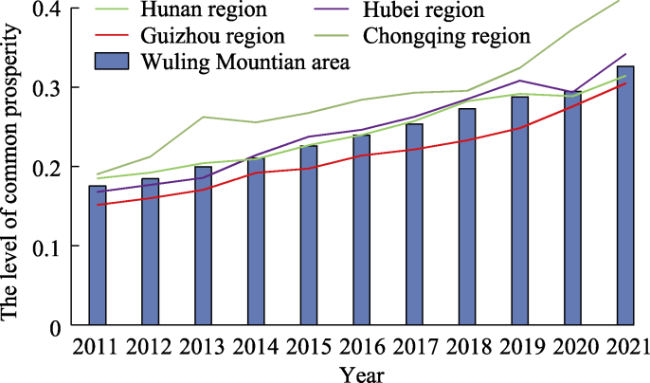
The value of the common prosperity level of 71 counties (cities or districts) in the Wuling Mountain area from 2011 to 2021 was measured by the Entropy weight-TOPSIS method (Fig. 2). Overall, with an annual average value of only 0.243, the level of common prosperity in the Wuling Mountain area was not high. Despite the low average annual value of common prosperity in the Wuling Mountain area (only 0.243), with an average annual growth rate of 6.4%, it shows a slow upward trend from 0.175 in 2011 to 0.326 in 2021. From the perspective of provincial area, levels of common prosperity fluctuated and increased in all four regions. The average value of common prosperity level in Hunan, Hubei, Chongqing, Guizhou regions from 2011 to 2021 are 0.245, 0.247, 0.288, 0.215, respectively; and the average annual growth rates are: 5.5%, 7.5%, 8.3%, 7.3%, respectively. Levels of common prosperity were similar in the Hubei and Hunan regions. Chongqing had the highest levels of common prosperity and the fastest growth rates. Guizhou had the lowest level of common prosperity but it is growing at a faster rate. From the county scale, the average values of common prosperity level for the top ten and bottom ten in 2011 are 0.317 and 0.120, respectively, with a fold change of 2.64. In 2021, the average values of common prosperity level of the top ten and bottom ten are 0.548 and 0.240, respectively, with a fold change of 2.28. The gap is still at a high degree in terms of the level of common prosperity in the Wuling Mountain counties, although the fold changed ecreased. By comparison, it can be found that the counties consistently in the top ten in 2011 and 2021 are: Lengshuijiang City, Hecheng District, Jishou City, Wulingyuan District, Bijiang District, Yongding District, Wulong District, Enshi City. They are all municipal districts and county-level cities with relatively developed economies and high levels of urbanization. What follows them are counties with flourishing tourism economy or industrial economies, such as Zigui, Shimen, and Xiushan Counties. It shows that economic factors play an important role in promoting common prosperity in the Wuling Mountain area.
Fig. 2 Trends in the level of common prosperity of the Wuling Mountain area and the four major regions, 2011-2021
Trends in the level of common prosperity in the Wuling Mountain area over time reveal that poverty in the Wuling Mountain area has been strongly alleviated through the struggle for poverty reduction. The potential for achieving common prosperity is great in the Wuling Mountain area, but the development gap within the area is still a cause for concern.

3.2 Spatial evolution

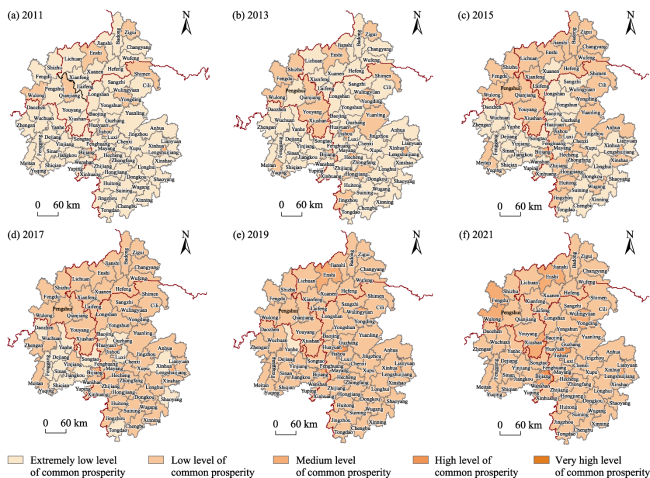
The level of common prosperity is classified into five grades through the quintile method to more intuitively analyze the spatial distribution characteristics and spatial-temporal variability of the level of common prosperity in the Wuling Mountain area (Han and Ge, 2022; Luo et al., 2022). Based on this, the connotation of each grade was interpreted concerning existing studies (Table 2). Higher values of the level indicate lower levels of relative poverty, implying that it is less difficult to achieve common prosperity. In this study, the odd-numbered years from 2011 to 2021 are selected as time nodes to visualize the spatial change trend of the common prosperity level in the Wuling Mountain area over time and ArcMap software is used to classify colors (Fig. 3).
Table 2 Intervals and Grades of common prosperity level division
Grades Interval of number Specific connotation
[0, 0.2) With severe relative poverty and great difficulty in realizing common prosperity, the area has an extremely low level
[0.2, 0.4) Poverty reduction in the area has been effective to a certain extent, and this area has a low level of common prosperity buthas more difficulty achievinga higher level
[0.4, 0.6) The relatively good basis for development and the effectiveness of poverty reduction make it easier to achieve common prosperity, and the area has a medium level of common prosperity
[0.6, 0.8) With a high level of development and sharing, the area has almost achieved relative poverty eradication, and therefore, common prosperity can be easily accomplished, and the area has a high level of common prosperity
[0.8, 1.0] Relative poverty eradication has been fully achieved and the area is on a virtuous track of development with a very high level of common prosperity
Fig. 3 Spatial distribution of common prosperity level grades in the Wuling Mountain area during 2011-2021
(1) The scope of Grade I counties continued to shrink until it is zeroed out; the spatial distribution of Grade II counties is gradually expanding to the whole region, from “sporadic distribution” to “continuous centralization”.
In 2011, the number of Grade I counties was no less than sixty. The number of Grade II counties was 10. And only Lengshuijiang City belonged to Grade III. These indicate that there is a serious problem of relative poverty in the Wuling Mountain area as a whole. From 2013-2019, the number of counties in Grade I gradually decreased and the number of counties in Grade II increased, and Jishou City turned into Grade IV in 2019. By 2021, there were no more Grade I countiesin the Wuling Mountain area. The number of counties in Grade Ⅲ had increased to 7, and three counties in Jishou City, Bijiang and Hecheng District had entered Grade IV, while the remaining 61 counties had entered Grade II.
(2) The overall level of common prosperity in the Wuling Mountain area has been rising, and the level of common prosperity in core counties shows positive spillover effects on neighboring counties.
A total of 11 counties were at the forefront of development in 2011, and since then the counties surrounding the 11counties have moved to higher grades of common prosperity. Among the 11 counties, Enshi City, Qianjiang District, Wulingyuan District, Yongding District, Jishou City, Bijiang and Hecheng District were the locations of the six central cities in the Wuling Mountain area . Lengshuijiang and Wulong districts are highly urbanized, and Zigui and Shimen counties have developed tourism and rich resources. As the “pioneer region” of common prosperity in the area, these 11 counties continued to give full play to their advantages and spillover effect to support and drive the development of neighboring regions so as to enhance the level of common prosperity in the Wuling Mountain area as a whole. However, probably due to limited resource endowment and development base, the 11 core districts did not have the highest level of common prosperity in all years, which slowed down the growth of their common prosperity level. Jishou, Bijiang, and Hecheng had always been at the forefront of the Wuling Mountain area in terms of the level of common prosperity, which made them the “Golden Triangle” of realizing coordinated development. Therefore, increasing policy inputs, strengthening the functions of central cities, and cultivating regional growth poles are part of the priorities for the future realization of common prosperity in the Wuling Mountain area.
(3) The overall evolution process of common prosperity in the Wuling Mountain area shows an evolutionary pattern of being “fast in the north and east, slow in the south and west”.
At the same point in time, there are obviously more low-grade counties in the western and southern Wuling Mountain area than in the eastern and northern area. Among them, the Hubei and Chongqing regions take the lead in realizing the clearing of GradeⅠcounties, followed by the Hunan region, and lastly by the Guizhou region. The observation that Yanhe County is the last one to exit the ranks of the extremely low grade of common prosperity is consistent with the actual situation. November 23, 2020, Guizhou Province announced that the last nine poverty counties, including Yanhe County, had been lifted out of poverty. And since then all of China’s 832 poverty counties have been shaken of poverty according to the current standards. This shows the depth of poverty and the difficulty of poverty reduction in Yanhe County.
Overall, the Wuling Mountain area has achieved remarkable results in poverty reduction and poverty eradication, and the level of common prosperity has increased significantly, with the northern and eastern regions higher than the western and southern regions. Few counties have entered the category of high grade, but at present every county is not on the benign development track, and there is still a long way to go before realizing common prosperity in the Wuling Mountain area.

3.3 Regional differences

3.3.1 Overall variances and trends

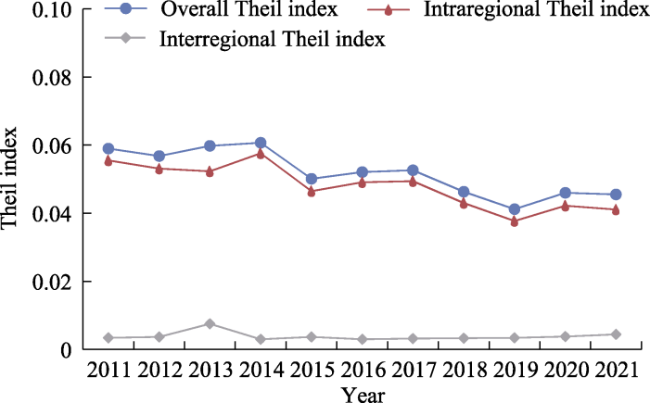
The formulas (1-3) are used to calculate the Theil index of the common prosperity level of 71 counties (cities and districts) in the Wuling Mountain area (Fig. 4). The maximum value of the Theil index is only 0.0607 and the minimum value is 0.0412 during the 11 years. The overall Theil index declined with fluctuation from 0.059 in 2011 to 0.0455 in 2021, with the difference index becoming significantly smaller in 2014 and 2017. These indicate that there is little difference in the overall level of common prosperity in the Wuling Mountain area and that there is a trend of “weak fluctuations and small decreases”. The generally weak foundation of development in the counties of the Wuling Mountain area has resulted in a slight difference among every radix, while the change in value between 2014 and 2017 may have benefited from the implementation of the policy of precise poverty alleviation and rural revitalization in China. On the whole, the overall difference in the level of common prosperity is on a downward trend, indicating that the Wuling Mountain area has made certain achievements in coordinated regional development and sharing the fruits of prosperity for all residents.
Fig. 4 Theil index of common prosperity level and the trend of changein the Wuling Mountain area
From the structural decomposition, it is derived that the average value of the contribution of intraregional variance in each year is as high as 92.5% by formulas (5-6). This means that intraregional variance is the main source of overall variation in the level of common prosperity in the Wuling Mountain area, while interregional differences contributed less to the variation. The contribution rate of intraregional variations generally shows a “fluctuating downward” trend, as itdeclined from 94.17% in 2011 to 87.46% in 2013, rose to 95% in 2014 and then dropped to 90.39% in2021. In contrast, the contribution rate of interregional differences generally displays a “fluctuating upward” trend, rising from 5.83% in 2011 to 9.61% in 2021. Although intraregional variance is the dominant factor in the differences in the level of common prosperity in the Wuling Mountain area, the interregional differences in 2021 must not be overlooked because they have widened significantly compared to 2011.

3.3.2 Differences and trends in the four major regions

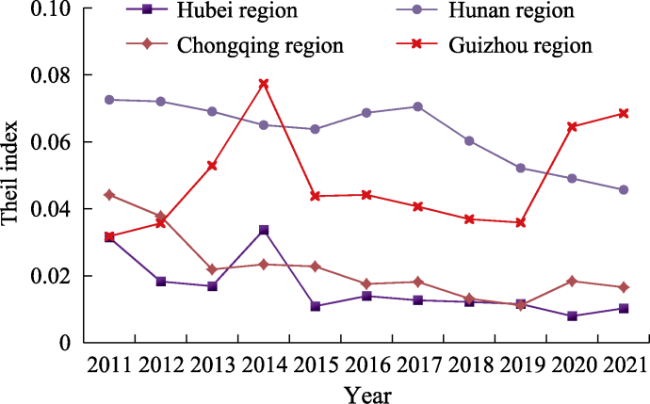
In order to analyze the differences in the level of common prosperity in the provincial regions, the paper further decomposes the intraregional differences and finds that there are significant internal differences in the level of common prosperity among the four major regions (Fig. 5). The mean values of the Theil index for Hunan, Hubei, Chongqing, and Guizhou regions are 0.0626, 0.0164, 0.0223, and 0.0484, respectively. The dataindicate that Hunan region has the largest internal variance, followed by Guizhou and Chongqing regions, while the smallest internal variance is found in Hubei region. Meanwhile, during the 11 years, the Theil indexes of Hunan, Hubei, and Chongqing regions decreased from 0.0726, 0.0314, and 0.0442 in 2011 to 0.0457, 0.0103, and 0.0166 in 2021, respectively, which are all in a decreasing trend. However, the differences within the Guizhou region show a trend of “rising, dropping and rising again”. The reason for the significantly higher internal variance in the Hunan region than in other regions may be that it covers 32 counties in the Wuling Mountain area, which makes it more difficult to achieve coordinated development and leads to large differences in the level of common prosperity within the region.
Fig. 5 Theil index and changing trend in the level of common prosperity in the four major regions
In addition, the mean values of contribution rate in Hunan, Hubei, Chongqing, and Guizhou regions are 63.82%, 4.78%, 4.89%, and 19.00%, respectively, which corroborates that the variation within the Hunan region is the main source of the overall variation in the Wuling Mountain area. With a clear downward trend, the contribution of variation decreased from 67.74 % in 2011 to 50.42% in 2021 within the Hunan region. In contrast, the contribution of variation within Guizhou region increases gradually, from 10.51% in 2011 to 31.71% in 2021. It can be seen that although the difference in the overall level of common prosperity in the Wuling Mountain area gradually decreased from 2011 to 2021, the degrees of influence of the differences within the four major regions on the overall differences showed divergent trends.

4 Analysis of the factors influencing the spatio-temporal evolution of common prosperity in the Wuling Mountain area

The development concept of common prosperity is influenced by a confluence of multiple factors (Gao, 2022). Based on previous studies, this study selects influencing factors from six aspects: natural conditions, spatial location, transportation conditions, economic conditions, policy support, and tourism resources.

4.1 Selection of variables

(1) Natural conditions such as elevation, topography, and geomorphology play a relatively important role in the economic landscape. Topography is the basic factor that sustains the living and working of people living in mountainous areas (Yang et al., 2021). Areas with less topographic relief are more suitable for conducting human activities, especially economic activities. Considering that the Wuling Mountain area is characterized by mountainous terrain, it is necessary to explore the extent to which the natural conditions of the area affect the level of common prosperity. This study adopts the degree of topographic relief to measure the state of natural conditions in the counties of the Wuling Mountain area, which is recorded as X1, and the data are derived from the research results (You et al., 2018).
(2) The spatial location reflects the accessibility of an area to economic, political, and cultural centers (Wang et al., 2018). The closer an area is to the administrative center, the better the accessibility to development and the more conducive to the process of common prosperity. The Wuling Mountain area is located at the junction of four provinces, and all counties are far away from the provincial capitals. Therefore, the distance from each county to the prefecture-level city is chosen to reflect the spatial location conditions of every county, which is denoted as X2.
(3) As the basis for spatial connectivity, transportation not only affects the convenience of living and travel but also attracts inward investment and consumption. Due to the influence of the terrain, transportation between counties in the Wuling Mountain area is mainly by road. Therefore, local transportation conditions are measured in terms of road mileage per 10000 people, which is denoted by X3.
(4) Economic development is one of the leading factors affecting social justice. A solid economic foundation and a high level of economic development can help the region accelerate the realization of common prosperity by improving public service facilities, expanding industrial scales, and enhancing the quality of life of residents. In this study, the economic development of counties in the Wuling Mountain area is measured by GDP per capita, which is denoted as X4.
(5) Deeply impoverished areas have aweak capacity for independent development and less internal momentum. The government’s promulgation of favorable policies in industry, technology and talent is conducive to helping impoverished areas break through development bottlenecks. Areas with higher levels of policy support have fewer obstacles to realizing common prosperity. The amount offixed assetinvestment is selected as the guiding indicator for policy support (Ma and Yang, 2019), which is denoted as X5.
(6) The Wuling Mountain area is a typical mountainous tourist area and ethnic minority gathering area. Rich natural and cultural resources are the material guarantee for tourism development. The development of tourism can promote common prosperity in terms of improving infrastructure, providing employment opportunities and beautifying the environment of the community. This study evaluates tourism resources by calculating the value assigned to high- grade scenic spots in each county, and assigns 5 points, 4 points, and 3 points to 5A, 4A, and 3A scenicspots respectively (Wang and Lin, 2023), which is denoted as X6.

4.2 Traditional OLS (Ordinary least squares) regression

The raw data are logarithmized in order to ensure that they are stable and comparable. For the purpose of avoiding the pseudo-regression problem, the data are first subjected to a unit root test. The results show that the unit root test of the panel data for the influencing factors is smooth and allows for regression analysis. The results of OLS regression show that (Table 3): 1) F-test is significant at the 1% level, indicating that the total linear relationship between the independent and dependent variables holds. The VIF (Variance Inflation Factor) test results show that the variance inflation factor of each influence factor is less than 5, which indicates that there is no redundancy and multicollinearity problem as well as the model is reasonable. 2) In terms of the significance of the regression coefficients of each influencing factor, all six influencing factors are significant at the 1% level. 3) In terms of the positivity and negativity of the regression coefficients of each influence factor, lnX2 and lnX3 are negative. This shows that the distance of the county centers from the higher city centers and the number of road mileage per 10000 people are negatively correlated with the level of common prosperity in the Wuling Mountain area, while the rest of the influencing factors are positively correlated. Among them, except for “road mileage per 10000 people”, the positivity and negativity of the other influencing factors are generally consistent with the expected results. Thus, the selection of factors is reasonable and provides advance validation for the subsequent empirical analysis of the MGWR model. 4) The degree of contribution is ranked according to the absolute value of the regression coefficients, in order from largest to smallest, economic development, transportation condition, natural condition, policy support, location condition, and tourism resource. The most driving force is the economic development factor, indicating that the level of common prosperity in the Wuling Mountain area is closely related to economic development.
Table 3 Results of traditional OLS regression
lnX Coef. S.E. t-value P-value VIF
lnX1 0.1124962*** 0.0124094 9.07 <0.001 1.41
lnX2 -0.0120814*** 0.0032077 -3.77 <0.001 1.13
lnX3 -0.1469949*** 0.0129885 -11.32 <0.001 1.63
lnX4 0.5477131*** 0.0118954 46.04 <0.001 1.44
lnX5 0.0555696*** 0.0081620 6.81 <0.001 1.28
lnX6 0.0037247*** 0.0009368 3.98 <0.001 1.34
Constant -7.0121900*** 0.1456201 -48.15 <0.001
F-test 597.675
Prob > F <0.001
R2 0.822
Number of obs 781

Note: ***, **, * denote significant at the 1%, 5%, and 10% levels, respectively.

4.3 MGWR spatial heterogeneity analysis

4.3.1 Model comparison

In order to further explore the spatially localized effects of the influence factors as well as the positive and negative differential effects of each factor over time, simultaneous modeling regressions using GWR and MGWR incorporating spatial factors are conducted, and the model with better results is selected for further analysis. This study carries out regression analysis on the heterogeneity of factors affecting the level of common prosperity in the Wuling Mountain area, and divides the study period into three, namely 2011-2014, 2015-2017, and 2018-2021, so as to eliminate the temporal volatility of the impact of each indicator on the level of common prosperity (Table 4).
Table 4 Results of model comparison (MGWR vs GWR)
Period Stage Ⅰ (2011-2014) Stage Ⅱ (2015-2017) Stage Ⅲ (2018-2021)
GWR MGWR GWR MGWR GWR MGWR
AICc 415.981 157.758 315.899 87.383 447.648 170.552
R2 0.761 0.939 0.758 0.953 0.733 0.939
Variable bandwidth X1 57 58 57 44 57 45
X2 50 44 45
X3 45 44 57
X4 45 44 53
X5 53 48 50
X6 45 61 45
Regression results of the two models: 1) The MGWR regression model had a higher goodness-of-fit because the R2 of the MGWR model is greater than the GWR in all years. 2) The bandwidth of the variable indicates discrepancies in the scale of action of different influences on the level of common prosperity in the Wuling Mountain area and measures the heterogeneity of the effects of the influences. The spatial heterogeneity of the effects of the influencing factors shows an opposite pattern to its bandwidth. Smaller bandwidth means greater heterogeneity. The comparison reveals that the AICc (Corrected Akaike Information Criterion) value of MGWR is smaller than that of GWR. Taken together, the MGWR model is more applicable to the study of factors affecting the level of common prosperity in the Wuling Mountain area.

4.3.2 Analysis of regression results

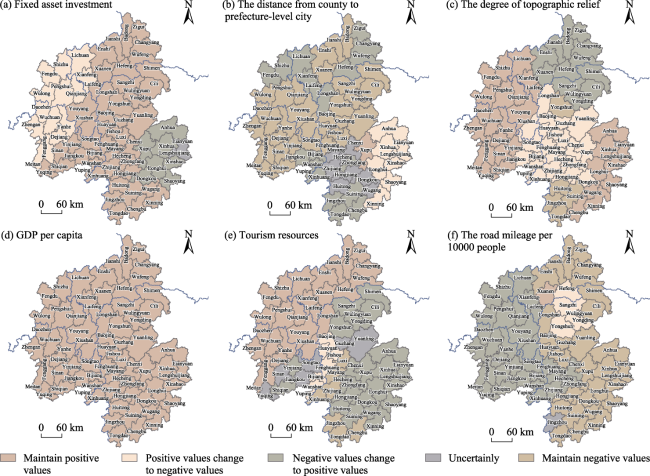
The regression coefficients of the indicators in different counties displayed positive and negative variability. In order to intuitively further analyze the characteristics of the spatial and temporal differences of the influencing factors in the three stages, the regression coefficients were classified into five categories according to the trend of change: maintaining positive values, positive values changing to negative values, negative values changing to positive values, maintaining negative values, uncertainty (Hou et al., 2020).
(1) Spatial and temporal patterns influenced by fixed asset investment.
It revealed that fixed asset investment has mainly positive effects on promoting common prosperity in the Wuling Mountain area, and the regions of positive effects are increasing in scope and expanding to the east (Fig. 6a). This is because the construction of infrastructure is the core guarantee for the economic development of poverty-stricken areas, and the financial support invested by the national and local governments in relative poverty-stricken areas is conducive to stimulating the demand for production and increasing social productivity (Wang et al., 2023), thus raising the level of local common prosperity.
Fig. 6 Spatial distribution of trends in the MGWR regression coefficients for the three stages of change
The fixed asset investment of only 14 counties located in the Guizhou and Chongqing regions has shifted from a positive to a negative effect. This may be due to the backwardness of economic development in the Guizhou region compared with other regions, which inhibited the process of common prosperity. It easily leads to the redundancy of fixed asset investment, imbalance in the structure of supply and demand, and irrational utilization of resources, when the scale of investment far exceeds the level of local economic development and fails to match the scale of the economy (Zhong, 2020). The Chongqing region has a high level of common prosperity in creasing fast speed. The efficiency of the impact of continuous inputs begins to decrease when the marginal effect of social investment in fixed assets is maximized, so that fixed assets investment shows a negative correlation with the level of common prosperity. These results reflect the fact that investment in fixed assets must not be expanded blindly, but should be in line with the actual situation of regional development in order to maximize its positive effects.
(2) Spatial and temporal patterns influenced by the distance from each county to the prefecture-level city.
The distance from each county to the prefecture-level city is largely negatively correlated with the level of common prosperity in the Wuling Mountain area (Fig. 6b). The counties in the Wuling Mountain area are far from the provincial capitals. And they are difficult to obtain economic, political, and cultural radiation because of the effect of distance. The limited driving capacity of prefecture-level cities within the Wuling Mountain area gives the more remote areas more backward economic development. The location conditions show an inhibitory effect on common prosperity.
There are 20 counties where the negative values of the regression coefficients shifted to positive values, mainly located in parts of Yichang, Enshi, Shaoyang, Huaihua, and Tongren. The level of common prosperity in these areas is less sensitive to locational conditions. This is due to the fact that these counties have continued to cultivate internal momentum for development, thereby gradually shedding their dependence on higher levels of government. Therefore, other counties should learn from their excellent development experience and develop leading industries based on local resources and advantages to overcome the obstacles to economic development caused by geographical distance.
(3) Spatial and temporal patterns influenced by the degree of topographic relief.
The degree of topographic relief shows a significant positive and negative differential effect on the level of common prosperity in the Wuling Mountain area (Fig. 6c). The regions with negative regression coefficients are mainly in the western and northern parts of Hunan Province. Northwestern Hunan is characterized by towering mountains 800-1200 m above sea level. This terrain is not conducive to economic activity and is, therefore, an impediment to shared prosperity. But a negative situation is not set in stone. For example, the degree of topographic relief shifted from a negative to a positive effect in the northeastern Wuling Mountain area. This is because as changes such as the restructuring of industries, the diversification of livelihoods, and the improvement of agricultural production techniques happened, the role of topographic relief as an obstacle to people’s living and working has decreased or even disappeared. In addition, the degree of topographic relief consistently plays a positive role in the western and southeastern parts of the Wuling Mountain area. On the one hand, it is due to the undulating topography that has created rich mountain-type tourism resources and promoted the development of the regional tourism economy. On the other hand, because ofthe increase in topographic relief, the population density decreases and the pressure of resource sharing decreases (Feng et al., 2008), which thereby affect the level of common prosperity at the dimension of “sharing”.
(4) Spatial and temporal patterns influenced by GDP per capita
For all counties, the GDP per capita regression coefficient is consistently positive in three stages (Fig. 6d). Economic development has been the core driver of the increase in the level of common prosperity. In terms of the mean value of the regression coefficients, the average impact coefficient for the first stage is 0.8237, while the average impact coefficient for the third stage is 0.6261. The mean value of the regression coefficient gradually decreased over time. The dependence of the common prosperity level on GDP per capita decreased, indicating that the economic results of poverty alleviation and development have been significant in the Wuling Mountain area over the past 11 years. In the future promotion of common prosperity, apart from affluence, the other three dimensions of common prosperity should not be neglected.
(5) Spatial and temporal patterns influenced by tourism resources
The area of positive effects of tourism resources is expanding from the northwest to the southeast and gradually covers the whole territory (Fig. 6e). With its unique karst landscape and topographical conditions, the Wuling Mountain area has formed numerous eco-tourism resources of high leveland large scale (Tao et al., 2023). Meanwhile, the tourism industry provides resources for the region to take the road of sustainable new-type urbanization with mountainous characteristics.
Counties that maintained negative values and changed from positive values to negative values were mainly located in the western and southern Hunan regions. And the effect of tourism resources on the enhancement of the level of common prosperity decreased. Southwest Hunan is well endowed with tourism resources and its tourism development started earlier, such as Fenghuang County repeatedly recognized as one of China’s top hundred counties in tourism. Areas with a high dependence on the tourism industry are prone to the “Resource Curse” phenomenon, whereby tourism impedes regional economic growth by creating a “crowding-out effect” on other industries (Tao et al., 2018). Therefore, the development of tourism should proactively seek different development paths according to market changes and actively innovate to break through the resource curse dilemma.
(6) Spatial and temporal patterns influenced by road mileage per 10000 people
Although the range of positive and negative regression coefficients is similar, there is a tendency for the positive area to expand (Fig. 6f). So it can be seen that there is a tendency for road mileage per 10000 people to change from a negative to a positive effect on the level of common prosperity in the Wuling Mountain area. This is because the Wuling Mountain area is a typical karst mountain area with an average elevation of more than 1000m above sea level. Special geographic conditions such as high levels of rocky desertification, high ecological vulnerability, and limited land area suitable for highway construction have increased the cost and difficulty of constructing highways. A large number of inputs in the early stage of development could not produce the same outputs in a short period, which makes the construction of roads a disincentive to common prosperity. And in the later stages, with the improvement of infrastructure in the Wuling Mountain area, the highway generates economic benefits in terms of logistics, transportation, and tourists carrying capacity (Zhang and Tu, 2020). Improvement of transportation conditions can also reduce the cost of commodity transportation between counties and urban and rural areas, promote commodity trading, and continue to contribute to the narrowing of the income gap between residents (Liu and Hong, 2022). These results will have a positive effect on common prosperity.
It is worth noting that although the level of common prosperity in the Guizhou region is the last, its regression coefficient of transportation conditions is the first to change from negative to positive values. This is attributed to the fact that governments at all levels in Guizhou province pay great attention to the construction of transportation infrastructure at all levels. By 2021, Guizhou is the only province in western China that realizes thegoal of “every county having highways”. Therefore, in the future, the Guizhou region should use strong transportation conditions as the main driving force to gatherpeople, logistics andcapital flow, which will strongly support the high-quality development of the area.

5 Conclusions and suggestions

5.1 Conclusions

This study constructs a common prosperity evaluation index system from the four dimensions of “affluence, sharing, commonality, and sustainability”, and measures and evaluates the level of common prosperity in the Wuling Mountain area by using county statistical data from 2011 to 2021. The study also summarizes the spatial and temporal evolution process, regional differences, and influencing factors of the region’s transition from poverty alleviation to common prosperity. This study provides a scientific basis for further improving the development situation of concentrated contiguous destitute and rural areas, solving the problem of imbalances and inadequacies in development. The conclusions of the study are as follows:
(1) The value of the common prosperity level is low but generally shows a slow upward trend in the Wuling Mountain area from 2011 to 2021. The Hubei and Hunan regions have similar levels of common prosperity. Chongqing has the highest level of common prosperity and the fastest growth rate, while Guizhou has the lowest level but a faster growth rate. The overall level of common prosperity in the Wuling Mountain area has room for improvement.
(2) In terms of spatial distribution, the process of common prosperity is faster in the northern and eastern parts of the Wuling Mountain areathan in the western and southern parts. The majority of counties have been in Grade II for a long period of time, with several counties moving into the Grade Ⅳ. Jishou, Bijiang, Hecheng and other core counties continue to play the role of the central city in leading the development of surrounding counties by radiation.
(3) From 2011 to 2021, the overall difference in the level of common prosperity in the Wuling Mountain area is decreasing and the difference mainly comes from the intraregional variation, but the contribution of interregional differences tends to expand. The Hunan region has the largest intraregional variation, followed by the Guizhou, Chongqing, and Hubei regions. Narrowing the development gap within Hunan province is an effective means to promote common prosperity in the Wuling Mountain area.
(4) The level of common prosperity in Wuling Mountain areais driven by fixed asset investment, distance from county to prefecture-level city, degree of topographic relief, GDP per capita, tourism resources, road mileage per 10000 people. And different factors show positive or negative differential effects over time. Among them, economic development has the greatest positive impact. Therefore, upgrading the level of economic development in each county is one of the important tasks for common prosperity in the Wuling Mountain area.

5.2 Suggestions

Under the guidance of China’s long-term poverty alleviation policy, absolute poverty has been eliminated, but the socio- economic level of the concentrated contiguous destitute areas is still at a low grade. Since the establishment of the poverty alleviation program in 2011, strong policies have eased the relative poverty level in the Wuling Mountain area, and there has been a significant increase in its level of common prosperity. However, the results of this study show that by 2021, more than 80% of the counties will still be in a state of low common prosperity, and there is still a long way to go before entering the benign development track of common prosperity. Therefore, the following can be considered in the future development process:
(1) It is necessary to deeply understand the theoretical connotation of common prosperity in rural areas. In view of the important role of the economic factor in common prosperity, the first task of the development of the Wuling Mountain area is to focus on the high-quality improvement of the degree of prosperity. At the same time, the Wuling Mountain area should utilize diversified governance tools to address the imbalance of the four dimensions of common prosperity in the development process.
(2) Administrative barriers between counties should be broken down and the core counties should be utilized as a driving force. The Wuling Mountain area should maintain a sense of wholeness and global awareness and determine the direction of global development at the macro level. Forming an overall development pattern with “Jishou, Hecheng, Bijiang” as the core, the Wuling Mountain area should accelerate the effective flow of factors between urban and rural areas through the spatial spillover effect of core counties.
(3) The Wuling Mountain area should focus on the uneven development of the provinces and prevent the imbalance from increasing further. Development measures applicable to each province should be proposed in a timely and localized manner, based on the current status of development in each province. Governments at every level should promote resources and support measures in Hunan and Guizhou regions. Each region develops leading industries with the help of its advantageous resources and fosters the ability to develop itself. Also, the Wuling Mountain area should adhere to the priority development of education in order to encourage the proactivity of people.

5.3 Future research

The results of the analysis of the spatial and temporal evolution and the influencing factors show that the process of realizing common prosperity is dynamic and staged. The intensity and direction of the effects of each factor at various times are different and regularized. These findings provide new ideas for a region to realize common prosperity at the practical level. This study also has some things that could be improved. First, considering the complexity of the connotation of common prosperity, this study constructs a multi-dimensional evaluation index system based on “affluence, sharing, commonality, and sustainability”, but it does not measure subjective indicators such as residents' satisfaction and well-being, and future research can incorporate more dimensions to measure the level of common prosperity in a more comprehensive way. Second, in terms of the identification of influencing factors, this study does not obtain data on indicators that may have an impact on the level of common prosperity over a long period, such as natural disasters, labor migration, etc., so there may be a problem of omitted variables and a more comprehensive quantitative study is needed in the future. Finally, this study only provides an explanation and exploratory summary of the common prosperity process in the Wuling Mountain area, which is a pilot project for poverty alleviation planning. Although the area is representative, a comparative study based on the 14 concentrated contiguous destitute areas in China is still the focus of future research. In addition, after China complete eradication of poverty in 2020, research in longer-term dimensions needs to be further tracked.
[1]
Chao X J, Ren B P. 2022. Theoretical connotation, measurement and evaluation index system construction of common prosperity in the new stage of development. Research on Financial and Economic Issues, 44(7): 3-11. (in Chinese).

[2]
Chen D F. 2023. Taking county as a unit to promote rural common prosperity. Journal of Henan Normal University (Philosophy and Social Sciences Edition), 50(3): 63-68. (in Chinese)

[3]
Chen L J, Yu J X, Xu Y N. 2021. Construction of the common prosperity index model. Governance Studies, 37(4): 5-16. (in Chinese)

[4]
Ding J J. 2014. Comparative analysis on poverty degree of China’s 11 contiguous destitute areas: With view of comprehensive development index. Scientia Geographica Sinica, 34(12): 1418-1427. (in Chinese)

[5]
Fedotova V G. 2019. Welfare state and the good society. Voprosy Filosofii, (11): 5-10.

DOI

[6]
Feng Z M, Tang Y, Yang Y Z, et al. 2008. Relief degree of land surface and its influence on population distribution in China. Journal of Geographical Sciences, 18(2): 237-246.

DOI

[7]
Fu X M, Zhang P, Zhang M J, et al. 2023. Performance evaluation of rural characteristic industry development in metropolitan areas based on the topsis method—Taking the Xi’an metropolitan area as an example. Journal of Resources and Ecology, 14(5): 1044-1052.

DOI

[8]
Gao F. 2022. How does the development of urban-rural integration affect the realization of China’s common prosperity goal. China Economic Studies, 64(5): 12-24. (in Chinese)

[9]
Han J Y, Ge H Q. 2022. Measurement, regional differences and dynamic evolution of China’s common affluence level. Statistics & Decision, 38(23): 57-62. (in Chinese)

[10]
Hou X D, Zhu Q L, Wan C F, et al. 2022. Centennial common prosperity: Evolution, theoretical innovation and path choice. On Economic Problems, 44(2): 1-8. (in Chinese)

[11]
Hou X Y, Huang F, Zhao Q, et al. 2020. Spatial-temporal pattern evolution and driving mechanism of forest loss in Fujian Province, China. Mountain Research, 38(6): 829-840. (in Chinese)

[12]
Hu Y Z, Yao H. 2023. Higher education expansion, human capital transmission and achieving common wealth. Journal of East China Normal University (Educational Sciences), 41(10): 116-130. (in Chinese)

[13]
Li C, Hao Y X, Luo Z J. 2023a. Distribution dynamics, regional differences and convergence of common affluence level. Statistics & Decision, 39(13): 68-73. (in Chinese)

[14]
Li H Y, Feng Z R, Xu Y C. 2023b. Identifying the geographic attributes and drivers of multidimensional poverty under the goal of common prosperity. Statistics & Decision, 39(3): 78-83. (in Chinese)

[15]
Li J C, Yu W. 2022. Discussion on statistical monitoring and evaluation of common prosperity. Statistical Research, 39(2): 3-17. (in Chinese)

[16]
Li N, Li Z Y. 2022. Mechanisms and pathways of new collective economy empowering the common prosperity of rural and farmers. Economist, 34(10): 119-128. (in Chinese)

[17]
Li S, Zhu M B. 2022. Promoting the reform of income distribution system and the realization of common prosperity. Journal of Management World, 38(1): 52-61. (in Chinese)

[18]
Liu H, Hong Y Y. 2022. The new urbanization path of “inverted U-shaped” urban-rural income gap in underdeveloped areas based on the practical test of Guizhou Province. Journal of Guizhou University of Finance and Economics, 40(6): 98-108. (in Chinese)

[19]
Liu P L, Qian T, Huang X H, et al. 2021. The connotation, realization path and measurement method of common prosperity for all. Journal of Management World, 37(8): 117-129. (in Chinese)

[20]
Liu Y, Zhao X, Mao F. 2023. Research on the driving force, mechanism, and spatial spillover effects of digital economy bolstering common prosperity in the Yangtze River Delta. China Soft Science, 38(4): 98-108. (in Chinese)

[21]
Luo R, He H Q, Chen S. 2022. Original Contiguous Destitute Areas’ common prosperity capability evaluation and evolution transition. Economic Geography, 42(8): 154-164. (in Chinese)

[22]
Ma X F, Yang X. 2019. Spatio-temporal distribution of high-level tourist attractions and spatial heterogeneity of its influencing factors in Western Hunan. Journal of Natural Resources, 34(9): 1902-1916. (in Chinese)

[23]
Peng G, Yang D L, Yang L. 2023. Distribution pattern and influence factors of cities’ common prosperity in China. Economic Geography, 43(1): 44-54. (in Chinese)

[24]
Phillips F. 2005. Toward an intellectual and theoretical foundation for ‘shared prosperity’. Systemic Practice and Action Research, 18(6): 547-568.

[25]
Seth S, Tutor M V. 2021. Evaluation of anti-poverty programs’ impact on joint disadvantages: Insights from the Philippine experience. Review of Income and Wealth, 67(4): 977-1004.

[26]
Shen T Y, Yu H C, Zhou L, et al. 2020. On hedonic price of second-hand houses in Beijing based on multiscale geographically weighted regression: Scale law of spatial heterogeneity. Economic Geography, 40(3): 75-83. (in Chinese)

[27]
Shen Y, Yin Y X, Zhong X. 2022. The measurement of the quality of life of rural residents in China and its temporal and spatial evolution from the perspective of common prosperity. Journal of Southwest Minzu University (Humanities and Social Sciences Edition), 43(2): 103-114. (in Chinese)

[28]
Song N. 2022. Research on China’s common prosperity development level measurement and innovative development. Journal of Technical Economics & Management, 43(8): 123-128. (in Chinese)

[29]
Sugimoto Y. 2006. Inequality, growth, and overtaking. Macroeconomic Dynamics, 10(5): 625-651.

[30]
Sun H, Cao X Y. 2022. Measurement and evaluation of China provincial common prosperity. Zhejiang Social Sciences, 38(6): 4-18. (in Chinese)

[31]
Tan Y Z, Wang C, Chen S M, et al. 2022. Measurement and spatio-temporal differentiation of common prosperity level of Chinese farmers. Economic Geography, 42(8): 11-21. (in Chinese)

DOI

[32]
Tao H, He Y M, Ran X F, et al. 2023. Spatial structure and geographical characteristics of tourist towns in the Wuling Mountain area. Journal of Resources and Ecology, 14(3): 644-655.

DOI

[33]
Tao H, Wen J M, Zhu H, et al. 2018. Analysis of spatial mismatch of tourism development in Guangdong Province. Journal of Resources and Ecology, 9(2): 181-190.

DOI

[34]
Wang J, Zhu J, Luo X. 2023a. Research on the measurement of China’s common prosperity development level and its temporal and spatial evolution characteristics. Contemporary Economic Management, 45(6): 51-60. (in Chinese)

[35]
Wang Q, Liu S L, Zhang E, et al. 2023b. Regional differences, distribution dynamic evolution and spatial correlation of common prosperity level in China. Journal of Xian Jiaotong University (Social Sciences), 43(2): 8-18. (in Chinese)

[36]
Wang S S, Lin Z M. 2023. Spatial mismatch between tourist resources and tourist economy in Guilin. Journal of Arid Land Resources and Environment, 37(5): 198-208. (in Chinese)

[37]
Wang Y H. 2022. Common prosperity and anti-poverty theory with Chinese characteristics theory beyond the western poverty reduction theory. Journal of the Party School of the Central Committee of the C.P.C. (Chinese Academy of Governance), 26(2): 109-118. (in Chinese)

[38]
Wang Y M, Wu D T, Wang M X, et al. 2018. Density, distance, and division: Rural poverty in a developing country context. Growth and Change, 49(3): 473-489.

[39]
Wang Z W, Jiao F Y. 2023. An empirical test of digital-based rural construction energizing the shared prosperity of farmers and rural areas. Journal of Yunnan Minzu University (Philosophy and Social Sciences Edition), 40(3): 100-110. (in Chinese)

[40]
Wu T, Zhang Y P. 2023. Measure analysis of common prosperity level in western region. Journal of Southcentral Minzu University (Natural Science Edition), 42(2): 274-282. (in Chinese)

[41]
Xiao W Z, Wang J J, Zhao X D. 2022. Industrial structure, employment structure and urban-rural income disparity. Macroeconomics, 44(9): 78-86. (in Chinese)

[42]
Yang C F, Yang M M. 2023. High-quality development, common prosperity and their dialectica relationship. Journal of Chongqing University (Social Science Edition), 29(5): 278-290. (in Chinese)

[43]
Yang Q, Zhang F T, An Y Z, et al. 2021. Spatial distribution characteristics and influencing factors of tourism poverty alleviation villages in Guizhou Province—Taking the national key villages for poverty alleviation by rural tourism as an example. Research of Soil and Water Conservation, 28(6): 316-322. (in Chinese)

[44]
You J, Leng Z M, Ding J J. 2020. The development report of China contiguous destitute areas (2020-2021). Beijing, China: Social Science Literature Publishing House.

[45]
You Z, Feng Z M, Yang Y Z. 2018. Relief degree of land surface dataset of China (1 km). Journal of Global Change Data & Discovery, 2(2): 151-155.

[46]
Zhang D H, Wu H, Wu W, et al. 2022. Ice and snow tourism and regional co-prosperity: An empirical study based on the panel data of six cities in Northeast China. Scientific Decision Making, 29(8): 136-149. (in Chinese)

[47]
Zhang D P, Tu J H. 2020. A study on the evaluation of efficiency of poverty alleviation through tourism and its influencing factors in ethnic destitute areas—Evidence from Wuling Mountain area. Journal of Hubei Minzu University (Philosophy and Social Sciences), 38(5): 58-67. (in Chinese)

[48]
Zhang W, Bai Y X, Zhang J K. 2023. Temporal and spatial differentiation and promotion path of common prosperity of Chinese-style modernization. China Soft Science, 38(1): 171-185. (in Chinese)

[49]
Zheng Z T, Li W W. 2023. Construction and measurement of provincial common prosperity evaluation index system—Based on the panel data of Jiangsu Province from 2009 to 2019. Journal of Hubei University of Economics, 21(3): 19-32. (in Chinese)

[50]
Zhong X J. 2020. Tourism development, infrastructure construction and poverty reduction—An empirical study based on provincial panel data. Social Scientist, 35(6): 66-72. (in Chinese)

Outlines

/