Tourism Resources and Its Integration with Cultural and Creative Industries

The Impact of Cultural and Creative Products Arising from Intangible Cultural Heritage on Economic Development: A Case Study of Ebian County, China

  • ZHANG Lei , 1, * ,
  • WAN Jialing 2
Expand
  • 1. Leshan Vocational and Technical College, Leshan, Sichuan 614000, China
  • 2. Jiajiang County Party School of the Communist Party of China, Leshan, Sichuan 614100, China
* ZHANG Lei, E-mail:

Received date: 2023-10-15

  Accepted date: 2024-05-10

  Online published: 2024-07-25

Supported by

Sichuan Provincial Science and Technology Department(21RKX0301)

Abstract

With the promotion of the rural revitalization strategy, cultural and creative industries of tourism have gradually become an important driving force for rural revitalization. Since the economic level of minority areas is low and the concept of industrial development lags behind, developing the cultural and creative industries of tourism has a positive role in cultural revitalization and economic structure transformation. In recent years, Ebian Yi Autonomous County (Ebian County) has relied on rich intangible cultural heritage resources and achieved fruitful results in the development of cultural and creative products of rural tourism, adding vitality to its rural tourism and rural revitalization. Starting from the economy and the development of cultural and creative industries empowered by intangible cultural heritage (ICH), this study analyzed the impact of related cultural and creative products of Ebian County on its economic development in the five-year period from 2018 to 2022 by means of qualitative and quantitative research methods. Three main conclusions could be drawn. (1) The impact of intangible cultural heritage cultural and creative industries of Ebian County on the economy has been positive and expanding gradually with time. (2) The number of inheritors and workshops, and the business income of workshops are the three major factors affecting the development of cultural and creative industries. (3) Ebian already has a good foundation of cultural and creative industries of intangible cultural heritage, so the investment of funds and training of talents have played a major role in promoting the development of cultural and creative industries of intangible cultural heritage.

Cite this article

ZHANG Lei , WAN Jialing . The Impact of Cultural and Creative Products Arising from Intangible Cultural Heritage on Economic Development: A Case Study of Ebian County, China[J]. Journal of Resources and Ecology, 2024 , 15(4) : 1106 -1112 . DOI: 10.5814/j.issn.1674-764x.2024.04.028

1 Introduction

Rural revitalization is a multifaceted systematic project, which includes the comprehensive revitalization of the economy, society, culture, ecological civilization and governance innovation (Wei, 2019). With the prosperous development of rural tourism and the promotion of the rural revitalization strategy, rural tourism cultural and creative products will become an important carrier for continuing rural regional culture and an important driving force for empowering rural revitalization.
Empirical studies have showed that the development of rural tourism is a strong backbone, a key pathway, and a significant engine for achieving rural revitalization in minority areas (He, 2021). Relying on rich intangible cultural heritage, the development of cultural and creative industries in minority areas makes huge contributions to their cultural revitalization and economic structural transformation. In the context of rural revitalization, the development of cultural and creative products will provide a new impetus for the revitalization of rural economies. The “innovativeness” of the cultural and creative industries of intangible cultural heritage is the source for cultivating a new impetus for economic growth, thus providing a strong capacity for renewal. In particular, minority areas can rely on their unique intangible cultural resources and vigorously develop cultural and creative products, which will become a new way to achieve poverty alleviation and promote economic development. The exploration of cultural and creative products can not only carry forward and promote rural culture, but also optimize the industrial structure, link and promote related industries, achieve the organic integration of rural industries, and thus effectively solve the problem of rural employment and inject a new impetus for rural revitalization.
However, research on the relationships between cultural and creative industries of intangible cultural heritage and economic growth is still in the exploratory stage and has not yet formed a mature theoretical system. Recently, Tu (2022) studied the impact of Guangxi’s cultural industry development on the economy from the perspective of rural revitalization. Li and Chen (2020) elaborated the total utility and cultural contribution rate of national culture in economic output through empirical research on characteristic villages. Zhang (2023) studied the impact of the integration of culture and tourism industries on the high-quality development of the economy of Qinghai Province. Cong (2022) studied the impact of China’s cultural and creative industries on the high-quality development of the economy. Wang (2022) delved into the contribution of Beijing’s sports industry to economic growth and the influencing factors. Zhou et al. (2023) studied the coupling relationship between rural revitalization and rural tourism in deeply impoverished areas.

2 Concepts related to intangible cultural heritage

2.1 Definition

Intangible cultural heritage refers to the practices, performances, expressions, knowledge and skills, as well as the instruments, objects, artefacts and cultural spaces associated with them, that are recognized as part of the cultural heritage of communities, groups or, in some cases, individuals (UNESCO, 2003). Adopted in 2011, the Law of the People’s Republic of China on Intangible Cultural Heritage divided intangible cultural heritage into five main categories (see Table 1). In the 2003 Convention, the intangible cultural heritage was emphasized as having an inherited, ecological and creative character, as well as a sense of cultural identity and continuity.
Table 1 Classification of intangible cultural heritage
No. UNESCO (2003) China (2011)
1 Oral transmissions and expressions, including the language regarded as intangible cultural heritage Traditional oral literature and the language in which it is transmitted
2 Performing arts Traditional fine arts, calligraphy, music, dance, theatre, curiosities and acrobatics
3 Social practices, rituals and festivals Traditional performing arts, medicine and calendars
4 Knowledge and practices relating to nature and the universe Traditional rituals, festivals and other folklore
5 Traditional craft skills Traditional sports and games

2.2 Cultural and creative products

“Cultural and creative products of intangible cultural heritage” refers to cultural and creative products designed with intangible cultural heritage as a resource (Yang, 2017). The cultural creative products that are related to cultural creative resources of intangible cultural heritage are composed of two aspects. On the one hand, they come from intangible cultural heritage, such as production techniques and folk customs; but on the other hand, they come from intangible cultural heritage artifacts and carriers, including products that materialize the cultural concepts of intangible cultural heritage, cultural spaces related to intangible cultural heritage, artifacts formed with the production techniques, and others. Intangible cultural heritage is the crystallization of human cultural dissemination, and cultural and creative products are important carriers of this process.

2.3 Types of cultural and creative products

Cultural and creative products refer to “products originating from cultural themes, transformed by creativity, and possessing market value” (Chen, 2017). According to the industrial chain of cultural and creative products, Pi (2014) elaborated that cultural and creative products can be divided into three categories: content-based cultural and creative products, including traditional culture and popular research and innovation, animation films, and news releases; creativity-based cultural and creative products, using design and creativity to transfer culture into products; and derivative cultural and creative products, which can provide non-material processes and services to experience culture. Cultural and creative products need to have three characteristics. First, they should have the commodity attributes of general products, which can be used for selling and exchanging them and to meet the needs of consumers. Second, they need to be processed with additional creative design, so that the product's form, color, pattern, usage and other features have innovative characteristics. Third, they need to have culturally recognizable genes, which can remind consumers of a particular culture and create a sense of identity. The cultural and creative products of intangible cultural heritage in this study mainly belong to the categories of creative cultural and creative products and derivative cultural and creative products.

3 Path of cultural and creative products of intangible cultural heritage in promoting economic growth

3.1 Offering of products and services

The economic impact of cultural and creative products of intangible cultural heritage is either the utilization and recreation of rural cultural resources through cultural productivity, transforming cultural factors into cultural products in material form, and carrying out industrial production and professional sales; or it is integrating cultural elements into activities such as artistic performances, films and television, interactive games and providing services in the form of labor. The exploration of cultural and creative products of intangible cultural heritage is mostly carried out in the rural development mode of “intangible cultural heritage + handicrafts”, which is based on traditional intangible cultural heritage. This can be achieved through establishing workshops of intangible cultural heritage with outstanding characteristics and a driving effect to connect traditional crafts with modern business, or by focusing on transforming the resources of intangible cultural heritage into products of intangible cultural heritage and realizing industrialization. Creating a brand for the cultural and creative industries of intangible cultural heritage directly contributes to economic growth.

3.2 The high added value of culture

Cultural and creative products can break the boundaries of traditional industries, use “cultural symbols” as a link to form industrial cross-border and industrial integration, promote the integrated development of traditional industries and cultural industries, and play a cross-border role in modern agriculture, modern service industries and specialty processing industries. The so-called “cultural and creative IP” refers to a product symbol derived from the combination of cultural creation and original IP. Minority areas can use cultural resources as a carrier to build the cultural and creative IP with profound influence, and they can integrate minority cultural elements into daily necessities, the development of tourism souvenirs and the production of creative agricultural products, thus promoting economic growth.

3.3 Role of innovation and product heterogeneity

Innovation is one of the driving forces that support long- term economic growth. Cultural and creative products of intangible cultural heritage take creative elements as their soul, and regard knowledge, technology and innovative concepts as their core resources to fully release the vigor of creativity. The creativity of cultural and creative products of intangible cultural heritage requires that the workers engaged in cultural and creative industries have innovative thinking and the ability to apply advanced high-tech science and technology. Through innovative thinking, the accumulation of knowledge and self-renewal, they can continuously update their products and enhance product differentiation, innovate spiritual products and enrich spiritual civilization, so as to drive the sustained, stable and long-term growth of the economy through innovation.

4 Empirical research

4.1 Overview of the intangible cultural heritage of Ebian County

Ebian Yi Autonomous County (Ebian County) is the hometown of “Ganmo Aniu”, the goddess of beauty of the Yi ethnic group. The culture of the Yi ethnic group in Xiaoliang Mountain is unique and charming, and it enjoys a rich intangible cultural heritage. At present, 53 items of intangible cultural heritage have been declared, including nine items of provincial-level intangible cultural heritage, which are the legend of Ganmo Aniu, the embroidery skills of the Xiaoliang Mountain Yi ethnic group, the traditional wine-brewing skills (folk brewing wine of Yi ethnic group), the Nuosu Zuomumo, the customs of the Yi Ethnic group Weike Dajie, the marriage customs of the Yi ethnic group, and the ceremony of dress-changing of the Yi ethnic group. There are also 16 municipal intangible cultural heritage items represented by the “Ebian Yi Ethnic group Traditional Yueqin Making Technique”, and 28 county intangible cultural heritage items represented by the traditional dance of “Twisting & Twisting”. In addition, the intangible cultural heritage inheritors include three at the provincial level, 13 at the municipal level and 14 at the district level, covering a wide range of categories such as traditional cultural expressions, traditional handicraft skills, folklore activities, rituals, festivals, and traditional folk knowledge and practices.

4.2 Development of cultural and creative products of intangible cultural heritage in Ebian County

The development of cultural and creative products of intangible cultural heritage in Ebian County started late in 2006. Recently, under the background of rural revitalization, the cultural and creative industries of intangible cultural heritage represented by Xiaoliang Mountain Yi embroidery, Ganmo Aniu, Yi silver jewelry and other items have shown a good situation of vigorous development. They have received strong support from the government, enterprises and various parties in terms of funding and inheritance, forming the model of “intangible cultural heritage + enterprise + inheritor + poverty alleviation”, establishing special funds for the protection and industrialization of intangible cultural heritage, and fostering a number of intangible cultural heritage workshops.
By cultivating the brand of “Yi Embroidery for the World”, many different cultural and creative products such as Yi embroidery clothes, accessories and bags have been created, and the popularity and influence of Yi embroidery have continuously improved. In 2022, the output value of Yi embroidery in the county reached 35 million yuan, and more than 4000 women were employed to work at home(① Data from Ebian Yi Autonomous County Integrated Media Center: Ebian Online: http://eb.leshan.cn/.). The brand of “Ganmo Aniu” has been registered for a series of performance products, and a large-scale national stage musical “Ganmo Aniu” has been created, the “Ganmo Aniu” art festival has been held, and a series of artistic performance activities were carried out to create the “Ganmo Aniu” cultural features in Ebian. At the same time, the city IP image of “Ganmo Aniu” was designed, and a series of animated cultural and creative products were derived from it. The development of this series of products of intangible cultural heritage has promoted the development of the local economy. Cultural and creative products of intangible cultural heritage can be transformed into commodities with market value, providing new economic growth points for the local manufacturing and tourism industries. The cultural and creative industries also drive the development of related industries, such as packaging design and logistics, which promotes the economic development of Ebian County.

4.3 Evaluation indicator system for the economic impact of cultural and creative products

The construction of an evaluation indicator system is the key to this study. At present, there are few studies on the economic impacts of cultural and creative products of intangible cultural heritage. The most commonly adopted analytical model for the evaluation of cultural industry competitiveness is Hua Jian’s “Hierarchical Model” (Hua, 2005). According to that model, the competitiveness of the cultural industry includes four core competencies: overall innovation ability, market expansion ability, cost control ability and sustainable development ability, which can be divided into seven major competitiveness parts: industrial strength, industrial benefits, industrial connection, industrial resources, industrial ability, industrial structure and industrial environment. Drawing on the “Hierarchical Model”, this study constructed indicators according to the relevant references, the actual situation of the research object and the availability of data. It screened out the five important indicators affecting the development level of cultural and creative products of intangible cultural heritage: production factors, market demand, cultural and creative ability, market expansion ability and external environment, in order to construct the indicator system for the economic impact of the development level of cultural and creative products of intangible cultural heritage.

4.3.1 Data sources

In order to accurately and comprehensively evaluate the economic impact of Ebian’s cultural and creative products of intangible cultural heritage in the context of rural revitalization, this study selected the five-year period from 2018 to 2022. According to the actual situation of the research object and the availability of the data sources, the data were mainly obtained from the Bureau of Culture, Sports and Tourism, the Bureau of Agriculture and Rural Affairs, and the official website of Ebian County. To eliminate the bias caused by the statistical caliber, the data were standardized before subsequent analyses.

4.3.2 Construction of the indicator system

In this study, the evaluation indicator system is divided into three levels: first-level indicators (X), second-level indicators (Y) and third-level indicators (E). The first-level indicators include five items for the factors of production (X1), market demand (X2), cultural creativity capacity (X3), market expansion capacity (X4), and the external environment (X5). The second-level indicators include nine items for public resources (Y1), human resources (Y2), asset resources (Y3) and other indicators. The third-level indicators include ten items for the number of intangible cultural heritage (E1) and relevant workers (E2), the number of cultural and creative units of intangible cultural heritage (E3) and others. A detailed description of the specific indicator system is shown in Table 2.
Table 2 Evaluation index system for the economic impact of intangible cultural heritage creative industries
First-level Indicator Second-level indicator Third-level indicator Description of indicator
Factors of
production (X1)
Public resources (Y1) Number of intangible cultural heritage items (E1) Number of intangible cultural heritage items above the county level
Human resources (Y2) Workers (E2) Workers of intangible cultural heritage industries
Asset resources (Y3) Cultural and creative units of intangible cultural heritage (E3) Number of workshops of intangible cultural heritage
Market demand (X2) Cultural consumption (Y4) Per capita consumption of cultural and creative industries of intangible cultural heritage (E4) Per capita consumption expenditure on cultural and creative industries of intangible cultural heritage
Cultural creative capacity (X3)
Inheritors (Y6) Persons awarded the title of inheritors of intangible cultural heritage (E6) Persons awarded the title of inheritors of intangible cultural heritage above the county level
Market expansion capacity (X4) Industrial benefits
(Y7)
Added value of cultural and creative industries of intangible cultural heritage (E7) Added value of cultural and creative industries of intangible cultural heritage
Income of workshops of intangible cultural heritage (E8) Income of workshops of intangible cultural heritage
External environment (X5) Government support (Y8) Financial support (E9) Amount of financial support
Economic benefits (Y9) Coefficient of investment efficiency (E10) Benefit ratio of input and output investment
To address the objective problems in the development of cultural and creative products of intangible cultural heritage in Ebian County and considering operability and scientific validity, this study adopted the entropy value evaluation method. To compare different years, this model was improved by adding time variables. The specific processing steps were as follows.
(1) Selection of indicators: the range of data samples was five years, and there were 10 three-level indicators.
(2) In this study, the entropy method was used to process the data for each indicator in the evaluation index system. The standard value of the indicator data was obtained by the range method and deneutralization, and the entropy value and weight of the indicator were calculated on this basis. The specific calculation formula was:
${{{X}'}_{ij}}=\frac{{{X}_{ij}}-{{X}_{i,\min }}}{{{X}_{i,\max }}-{{X}_{i,\min }}}$
where Xij is the indicator value of indicator i in year j, Xij is the standardized value of indicator Xij, Xi,max is the maximum value of indicator i , and Xi,min is the minimum value of indicator i.
(3) The weights of the i-year evaluation index values under the j index system (see Table 3) were calculated as:
${{Z}_{ij}}={{{X}'}_{ij}}/\underset{i=1}{\overset{m}{\mathop{\mathop{\sum }^{}}}}\,{{{X}'}_{ij}}$
Table 3 Weights of the economic impacts of the creative industry of intangible cultural heritage in different years
Indicator Weights
2018 2019 2020 2021 2022 Average value
Factors of production (X1) E1 0.0621 0.0634 0.0666 0.0674 0.0695 0.0658
E2 0.1216 0.1231 0.1245 0.1256 0.1267 0.1243
E3 0.1118 0.1136 0.1169 0.1186 0.1211 0.1164
Market demand (X2) E4 0.0245 0.0267 0.0283 0.0397 0.0318 0.0282
Creative capacity (X3) E5 0.0678 0.0692 0.0718 0.0704 0.0818 0.0722
E6 0.1231 0.1241 0.1259 0.1267 0.1282 0.1256
Market expansion capacity (X4) E7 0.1426 0.1447 0.1452 0.1461 0.1484 0.1454
E8 0.2352 0.2361 0.2376 0.2384 0.2422 0.2379
External environment (X5) E9 0.0151 0.0164 0.0171 0.0179 0.0185 0.0170
E10 0.0527 0.0556 0.0574 0.0583 0.0620 0.0572
where Zij represents the proportion of the i-th evaluation index value, m is the number of the 10 three-level indicators, and Xij is the weight of indicator i in year j.
(4) The information entropy value of index i was determined as:
${{M}_{i}}=\frac{-\underset{j=1}{\overset{n}{\mathop{\mathop{\sum }^{}}}}\,{{Z}_{ij}}\times \ln {{Z}_{ij}}}{\ln n}$
where Mi represents the entropy value of index i and n is the number of the 10 three-level indicators.
(5) The entropy redundancy value was calculated as:
${{W}_{i}}=\left( 1-{{M}_{i}} \right)/\underset{i=1}{\overset{n}{\mathop{\mathop{\sum }^{}}}}\,{{M}_{i}}$
where Wi is entropy redundancy value.
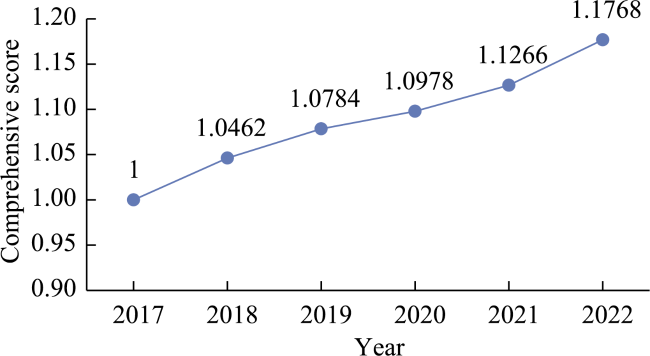
(6) The comprehensive scores of the economic impact of intangible cultural heritage cultural and creative products (see Fig. 1) were calculated for each year:
${{Z}_{j}}=\underset{i=1}{\overset{m}{\mathop{\mathop{\sum }^{}}}}\,{{W}_{i}}{{{X}'}_{ij}}$
where Zj is the comprehensive score of the economic impact of intangible cultural heritage in year j.
Fig. 1 The economic impact of cultural and creative products of intangible cultural heritage

Note: The comprehensive score for the impact of intangible cultural heritage creative products on the economy in 2017 was set to 1.

4.4 Results and analyses

A comprehensive analysis of the graphs and tables led to the following results.
(1) The impact of cultural and creative industries of intangible cultural heritage in Ebian County on the economy has increased significantly, and shows a promising trend.
(2) The three major factors affecting the development of cultural and creative industries of intangible cultural heritage are: the number of inheritors of intangible cultural heritage, the number of intangible cultural heritage workshops, and the business income of intangible cultural heritage workshops, with weights of 0.1256, 0.1164, and 0.2379, respectively.
(3) The high scores in cultural production factors and cultural creativity indicate that Ebian already has a good foundation of cultural and creative industries of intangible cultural heritage in terms of the number of intangible cultural heritage, workers, inheritors, units, patents, etc. The investment of funds and training of talents have played a major role in promoting the development of intangible cultural heritage cultural and creative industries.
(4) The low scores of market demand and the external environment indicate three things: the consumer demand for cultural and creative products is not sufficient and needs to be stimulated, the financial investment in cultural and creative industries is not adequate, and the government's financial support for ICH cultural and creative industries needs to be further improved.
(5) The high score for market expansion ability indicates that the benefits of the intangible heritage industry are good, and the added value of cultural and creative industries of intangible cultural heritage and the business income of the intangible cultural heritage workshops are increasing.

5 Conclusions and recommendations

5.1 Conclusions

Taking Ebian County as an example, this study conducted an empirical analysis of the impact of cultural and creative products of intangible cultural heritage on economic development in the five-year period from 2018 to 2022, and the specific conclusions are as follows.
(1) Cultural and creative products of intangible cultural heritage promote economic development. The comprehensive impact value of cultural and creative products on the economy increased from 1.0462 in 2018 to 1.1768 in 2022, showing obvious year-on-year increases, of which the weights of factors for the production of intangible cultural heritage (assets and resources, workers), creativity (number of patents and number of inheritors), market expansion (industrial benefits, added value of the cultural and creative industries, operating income of workshops) and other indicators are higher. In general, cultural creative products and industries of intangible cultural heritage have a positive impact on economic development.
(2) Cultural and creative products and industries of intangible cultural heritage are increasingly promoting each other. From the perspective of the three major factors affecting their development, the number of workshops and the business income of workshops have weights of 0.1164 and 0.2379, respectively, which are significant in general. An increase in the number of workshops activates the design and output momentum of cultural and creative products, thus promoting the innovation of cultural and creative products, increasing the categories and number of cultural and creative products, and strengthening the attraction of consumption and the economic growth of workshops as well as the cultural and creative industries. In addition, cultural and creative products are a key factor in promoting the development of relevant industries, with a significant leading role to mutually reinforce both sides.
(3) Financial support has promoted the development of cultural and creative industries of intangible cultural heritage. According to the indicator system, the stronger the financial support, the higher the output benefits. Ebian has a good foundation of cultural and creative industries of intangible cultural heritage, such as the gradually increasing numbers of intangible cultural heritage above the county level, workers and workshops, and the intangible cultural and creative industries are gradually developing. In recent years, Ebian has continuously invested in supporting the research and development of cultural and creative products of intangible cultural heritage, the training of talents and the construction of workshops, so that the economic benefits of cultural and creative industries are continuously improving.

5.2 Recommendations

Cultural and creative products and industries of intangible cultural heritage are a necessary part of the rural revitalization strategy, and cultural and creative products are an important means of promoting rural revitalization, which can effectively contribute to economic development.
(1) The government should ensure the co-ordination of planning and increase financial investment. It should also continue to do a good job of coordinating the planning for the development of cultural industries and increase its financial investments, linking joint coordination among “the government, workshops, enterprises, villages and schools”. First, the government should provide financial, tax and other policy support to workshops and enterprises, and adopt the strategy of “Opening-up + Going-global” to promote the development of cultural and creative industries of intangible cultural heritage in various workshops and enterprises. Second, it is important to increase the financial investment in rural inheritors, to strengthen the training of workers, to enhance the income of cultural and creative industries, and to increase the attractiveness of cultural and creative industries. Third, strengthening cooperation with universities is necessary, so that they can jointly participate in the protection, inheritance and promotion of cultural resources of intangible cultural heritage, thereby stimulating the vitality of the cultural and creative industries and promoting the market economy.
(2) Enhance the quality of research and development of cultural and creative products to stimulate consumer demand. First, strengthening the R&D and innovation of cultural and creative products is necessary to avoid homogenization while maintaining regional cultural characteristics, and to meet the aesthetic and usage needs of different groups. Second, the quality of cultural and creative products should be improved, and the quality requirements for the selection of materials and workmanship should be strengthened to avoid shoddy production. Third, more attention should be paid to improving the quality of workers in cultural and creative products. Meanwhile, talent training should be carried out for the product design concept, R&D innovation, production technology, market operation and other aspects. Through joint training by the government, townships, enterprises and schools, the capabilities of cultural and creative workers can be continuously improved, which will in turn enhance the quality of cultural and creative products and stimulate demand for consumption.
[1]
Chen Z L. 2017. Definitional classification of cultural products and the principle of “3C” resonance. Modern Communication, (2): 24-26. (in Chinese)

[2]
Cong L. 2022. Research on the influence of China’s cultural and creative industries on the high-quality development of the economy. Diss., Shenyang, China: Liaoning University. (in Chinese)

[3]
He J W. 2021. Study on the coupled development of rural revitalization and rural tourism in ethnic areas—A case study of Qiandongnan Miao and Dong Autonomous Prefecture in Guizhou Province. Reform and Development, (7): 23-31. (in Chinese)

[4]
Hua J. 2005. Connotation, structure and strategic focus of competitiveness of cultural industries. Journal of Peking University (Philosophy and Social Science Edition), (2): 9-16. (in Chinese)

[5]
Li Z B, Chen X J. 2020. Innovation of cultural industries in characteristic villages and rural revitalization: Values, mechanisms and paths. Journal of Nanning Normal University (Philosophy and Social Science Edition), 41(2): 46-53. (in Chinese)

[6]
Pi Y S. 2014. Interpretation and appreciation of cultural creative products. Chongqing, China: Southwest Normal University Press. (in Chinese)

[7]
Tu S Y. 2022. Study on the impact of cultural industry development on economy in Guangxi under the perspective of rural revitalization. Diss., Nanning, China: Guangxi Minzu University. (in Chinese)

[8]
The National People’s Congress of China. 2011. Law of the People’s Republic of China on Intangible Cultural Heritage. http://www.npc.gov.cn/zgrdw/huiyi/cwh/1119/2011-02/25/content_1625617.htm.

[9]
UNESCO. 2003. Convention for the Intangible Cultural Heritage (the 2003 Convention). https://www.un.org/zh/documents/treaty/ich.

[10]
Wang O Y. 2022. Research on the contribution of Beijing sports industry to economic growth and influencing factors. Diss., Beijing, China: Capital University of Physical Education and Sports. (in Chinese)

[11]
Wei H K. 2019. Grasping the rich connotation of rural revitalization strategy. Rural Areas. Agriculture & Farmesr (B), (3): 13-14. (in Chinese)

[12]
Yang H Z. 2017. Intangible cultural heritage and cultural and creative product design. Diss., Beijing, China: China Art Research Institute. (in Chinese)

[13]
Zhang J. 2023. Study on the impact of cultural and tourism industry integration on high quality economic development in Qinghai Province. Diss., Xining, China: Qinghai Normal University. (in Chinese)

[14]
Zhou W Y, Liu Q Y, Li Q Y. 2023. The coupling of rural revitalization and rural tourism in former deep poverty areas—Taking Didigu Village, Ebian Yi Autonomous County as an example. Journal of Resources and Ecology, 14(5): 1034-1043.

DOI

Outlines

/