Tourism Environmental Behavior and Farmer’ Participation in Tourism

Influence of Tourists’ Perception of Rural Tourism Quality and Place Attachment on Tourists’ Environmentally Responsible Behavior: A Case Study of the Longji Terrace Scenic Area in Guangxi

  • CHEN Wuxiang , 1, 2 ,
  • LIU Shanshan 1 ,
  • ZHU Yahui 1 ,
  • TANG Chengcai , 3, *
Expand
  • 1. School of History Culture and Tourism, Guangxi Normal University, Guilin, Guangxi 541001, China
  • 2. Tourism Research Institute of Guangxi Normal University, Guilin, Guangxi 541001, China
  • 3. School of Tourism Sciences, Beijing International Studies University, Beijing 100024, China
*TANG Chengcai, E-mail:

CHEN Wuxiang, E-mail:

Received date: 2023-08-13

  Accepted date: 2023-11-29

  Online published: 2024-05-24

Supported by

The Guangxi Innovation-driven Development Special Fund Project(GuikeAA20302011)

The University Social Science Project(ZX2023016)

The Innovation Project of Guangxi Graduate Education(XJCY2023002)

Abstract

While rural tourism contributes to both economic and social benefits, its impact on the environment is a crucial issue requiring attention. This study aimed to explore the factors influencing tourists’ environmentally responsible behavior in rural tourism contexts. To this end, environmentally responsible behavior is categorized into self-restraint and protective-promotion dimensions, taking the Longji Terrace Scenic Area in Guangxi as a case study. From the perspective of tourists, a structural equation model is constructed with tourists’ perception of rural tourism quality as an antecedent variable and place attachment as a mediating variable. The results can be summarized as follows: (1) Both tourists’ perception of rural tourism quality and place attachment positively influence tourists’ environmentally responsible behavior, with a more significant impact on their self-restraint behavior. (2) Tourists’ perception of rural tourism quality has a significant positive influence on place attachment. (3) Place attachment and place identity play a mediating role in the relationship between tourists’ perception of rural tourism quality and tourists’ environmentally responsible behavior. In enhancing tourism quality, rural destinations should focus on visitors’ perceptual experiences, reinforce their place attachment, and stimulate environmental responsibility to alleviate ecological burdens.

Cite this article

CHEN Wuxiang , LIU Shanshan , ZHU Yahui , TANG Chengcai . Influence of Tourists’ Perception of Rural Tourism Quality and Place Attachment on Tourists’ Environmentally Responsible Behavior: A Case Study of the Longji Terrace Scenic Area in Guangxi[J]. Journal of Resources and Ecology, 2024 , 15(3) : 673 -682 . DOI: 10.5814/j.issn.1674-764x.2024.03.014

1 Introduction

Rural tourism is a form of tourism that relies on the rural characteristics of an area as the core content and attraction (Han et al., 2010). It is considered a win-win strategy for achieving economic development as well as cultural and environmental protection (Xiao, 2015). However, in addition to economic and social benefits, the increasing fre-quency of tourism activities has also brought about an increased ecological burden on tourist destinations. In particular, apart from excessive development, uncivilized tourist behaviors, such as littering, damaging plants, and disrupting natural habitats, contribute to resource deterioration, including water, soil, and vegetation, thereby affecting the sustainability of rural tourism (Yin et al., 2021). Tourists are the primary actors in tourism activities, and tourist destinations serve as the backdrop for these activities. Therefore, the inherent contradiction and conflict between tourists and tourist destinations in terms of environmental impact are inevitable. Nevertheless, research suggests that tourists, as active participants in environmental conservation at tourist destinations, can contribute to the sustainable development of these areas through responsible behaviors (Brown et al., 2010; Yin et al., 2021). Therefore, motivating tourists to exhibit more responsible environmental behavior is an imperative path toward achieving sustainable rural tourism development (Qiu, 2017).
In this context, inspiring tourists’ environmentally responsible behavior has become a practical necessity for protecting the ecological environment of rural tourist destinations. Existing research has primarily focused on the influencing factors of environmental responsibility, including tourists’ personal emotional factors such as reverence (Qi et al., 2018), ecological values (Duan et al., 2021), altruistic values (Huang et al., 2018), and cultural identity (Xu et al., 2021), as well as perceptions such as landscape perception (Liu et al., 2021), climate change perception (Wang et al., 2023), and perceived value (Zhang et al., 2020). These studies have enriched our understanding of environmental responsibility. Moreover, most studies have focused on specific dimensions of tourist destination quality perception, such as experiential quality (Wu et al., 2017; Han et al., 2022), service quality (Li and Shi, 2019). However, research on tourists’ perception of destination quality from the perspective of sustainable rural tourism is lacking.
Building upon this background, this study focused on rural tourists as the study subjects and took the Guangxi Longji Terrace Scenic Area as the research area. Place attachment was employed as a mediating variable to explore the influence of the quality perception of rural tourism on tourists’ environmentally responsible behavior. This approach aims to broaden the scope of influencing variables for tourists’ environmentally responsible behavior and provide a theoretical foundation for the ecological environment protection and sustainable development of rural tourist destinations.

2 Literature review and research hypotheses

2.1 Literature review

2.1.1 Tourists’ perception of rural tourism quality

Tourists serve as the perceiving and evaluating subjects of rural tourism quality. Hence, the perception of rural tourism quality from the tourists’ perspective encompasses the comprehensive evaluation of its quality attributes (Huang and Huang, 2007). Empirical studies on the perception of rural tourism quality have predominantly focused on single dimensions. For instance, scholars have delved into experiential quality (Wu et al., 2017; Han et al., 2022), service quality (Li and Shi, 2019), and accommodation quality (Liu and Ji, 2019; Pavić et al., 2019), among other aspects. However, research on tourists’ perspective of rural tourism quality comprehensively encompasses the diverse quality attributes of rural tourist destinations. Singular quality attributes cannot adequately gauge the holistic quality attributes of rural tourist destinations (Chi et al., 2020). Hence, building upon existing research achievements and considering the developmental disparities and geographical variations of rural tourist destinations, this study posits that research on the perception of rural tourism quality necessitates a multi-dimensional approach. Natural resources and heterogeneous cultures constitute the core allure that attracts tourists to rural tourism. Facilities and services play pivotal roles in shaping tourists’ overall perceived quality, while experiences represent the profound indulgence that tourists ardently pursue. Therefore, this study divides the tourists’ perception of rural tourism quality into four perceptual dimensions: resource quality perception, facility quality perception, service quality perception, and experience quality perception.

2.1.2 Environmentally responsible behavior

Currently, the academic focus of the study of environmentally responsible behavior is still on exploring its influencing factors and formation mechanisms. In terms of dimensionality, most scholars have studied environmentally responsible behavior under single dimensions (Qiu, 2017; Huang et al., 2018; Qi et al., 2018). In recent years, some scholars have begun to explore multidimensional research. Ramkisson et al. (2012) subdivided environmentally responsible behavior into compliance-oriented and proactive environmentally responsible behavior. Xia and Chen (2015), in designing an environmental responsibility intention questionnaire for eco-tourists, divided eco-tourists’ environmental responsibility intentions into four dimensions through rigorous exploratory factor analysis: knowledge support, economic actions, general responsibility, and proactive protection. Scholars such as Luo et al. (2017) categorized environmental behavior by summarizing existing studies and suggested that environmental behavior can fundamentally be divided into self-restraint and protective promotion dimensions.
Based on the refinement of the dimensions of environmental behavior and from the essence of behavior, this study concurs with the findings of scholars such as Luo et al. (2017). Environmental protection first involves proactive self-constraint, followed by persuasion and supervision of others’ behavior. Therefore, this study divides environmental responsibility into two dimensions: self-restraint behavior and protective-promotion behavior.

2.1.3 Place attachment

The perception of tourism quality by tourists to some extent reflects their attitude and evaluation of the tourism destination. The attachment emotions formed by tourists during the tourism process are based on specific spaces. Place attachment refers to the emotional connection between individuals and specific places and represents a positive human-place relationship (Hidalgo and Hernández, 2001). Williams et al. (1992) divided place attachment into two dimensions: place dependence and place identity. Place dependence reflects tourists’ demand for the functions and resources of the tourism destination, indicating the extent to which the conditions and environment provided by the place match the individual’s engagement in tourism activities. It represents a functional dependence. On the other hand, place identity is a strong sense of identification and belonging formed over a long period, emphasizing emotional recognition. This two-dimensional division has been widely recognized by many scholars and is also adopted in this study.

2.2 Research hypotheses

2.2.1 Tourists’ perception of rural tourism quality and place attachment

Tourists attribute unique emotional significance to a destination based on real experiences gained during their travels, which serves as a crucial foundation for identifying with and forming an attachment to the place. When tourists experience a high-quality tourism experience, their functional and emotional needs for travel satisfaction may be fulfilled. The two dimensions of place attachment, place dependence and place identity, precisely emphasize the functional and emotional aspects of the place. Therefore, this study hypothesizes that when tourists develop a satisfactory level of tourism quality perception, they will also develop place dependence and place identity. Based on this, the following hypotheses are proposed:
H1a: Tourists’ perception of rural tourism quality has a significant positive impact on place dependence.
H1b: Tourists’ perception of rural tourism quality has a significant positive impact on place identity.
Initially, the two dimensions of place attachment were studied in parallel. However, as the research progressed, scholars realized the possibility of another logical relationship between them. Tourists’ attachment to a place primarily forms when they experience a better tourism experience compared to other places. This higher satisfaction and dependence may lead to emotional identification, ultimately resulting in a transition from dependence to attachment. Based on this understanding, the following hypothesis is proposed:
H2: Place dependence significantly influences place identity.

2.2.2 Tourists’ perception of rural tourism quality and environmentally responsible behavior

Tourists’ subjective experiences during the tourism process, i.e., tourist perceptions, directly influence their travel decisions. In contrast to urban tourism resources, rural tourism resources emphasize heterogeneity and indigenous attributes. Therefore, tourists’ perception of rural tourism quality is primarily related to the environmental endowment and satisfaction derived from heterogeneous experiences. The value of resources is a key factor influencing environmentally responsible behavior (He and Gao, 2017). Research has also indicated that tourists’ satisfaction with rural landscapes and cultural experiences directly affects their intention for environmental protection (Kong et al., 2019). Quality perception represents an external factor affecting tourists, while environmentally responsible behavior reflects their internal drive, manifesting as proactive responses toward the environment. External factors can stimulate individuals’ intrinsic behavior. Thus, the perception of higher external quality is more likely to drive responsible environmental behavior (He et al., 2021).
Based on empirical research on the relationship between perceived context and behavioral intention in relevant tourism scenarios, this study posits that in the context of rural tourism, the perceived tourism quality of rural destinations also influences tourists’ inclination towards environmentally responsible behavior. Therefore, the following research hypotheses are proposed:
H3a: Tourists’ perception of rural tourism quality has a significantly positive impact on self-restraint behavior.
H3b: Tourists’ perception of rural tourism quality has a significantly positive impact on protective-promotion behavior.

2.2.3 Place attachment and environmentally responsible behavior

The mechanism of environmentally responsible behavior from the perspective of place attachment is a key focus and hotspot in this field of study. Several studies have empirically demonstrated that place attachment can positively drive the environmental responsibility of tourists (Qi et al., 2018; Zhang et al., 2020; Duan et al., 2021). The higher the degree of place attachment, the more likely tourists are to develop a positive willingness for environmental protection. They are also more willing to exhibit self-responsibility and actively implement environmentally responsible behavior (Zhang et al., 2008). Based on the above, in the context of rural tourism, the following hypotheses are proposed:
H4a: Place dependence has a significantly positive impact on self-restraint behavior.
H4b: Place dependence has a significantly positive impact on protective-promotion behavior.
H5a: Place identity has a significantly positive impact on self-restraint behavior.
H5b: Place identity has a significantly positive impact on protective-promotion behavior.

2.2.4 Mediating role of place attachment

As discussed above, place attachment is directly related to tourists’ environmentally responsible behavior. Similarly, multiple studies have confirmed the mediating effects of place attachment on the relationship between different independent variables and tourists’ environmental responsibility (Xu et al., 2021; Cheng et al., 2022). Therefore, the following hypotheses are proposed:
H6a: Place dependence mediates the relationship between tourists’ perception of rural tourism quality and self-restraint behavior.
H6b: Place dependence mediates the relationship between tourists’ perception of rural tourism quality and protective-promotion behavior.
H7a: Place identity mediates the relationship between tourists’ perception of rural tourism quality and self-restraint behavior.
H7b: Place identity mediates the relationship between tourists’ perception of rural tourism quality and protective-promotion behavior.
H8a: Place dependence and place identity play a chain-mediated role between tourists’ perception of rural tourism quality and self-restraint behavior.
H8b: Place dependence and place identity play a chain-mediated role between tourists’ perception of rural tourism quality and protective-promotion behavior.
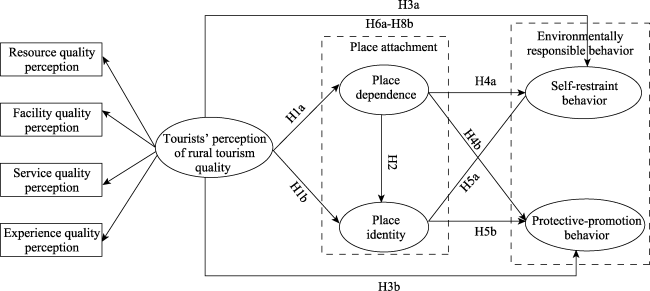
Based on the theoretical foundation and research hypotheses mentioned above, this study constructs a theoretical model to explore the mechanism and impact relationship of the perception of rural tourism quality on place attachment and environmentally responsible behavior (Fig. 1).
Fig. 1 Theoretical model and hypothetical relationships

3 Research design

3.1 Study area

The Longji Terrace Scenic Area is located in Longsheng Town, Guilin City, Guangxi. It consists of classic scenic spots such as Ping’an Village Terraced Fields, Jinkeng Red Yao Terraced Fields, Longji Ancient Zhuang Village Terraced Fields, and traditional ethnic villages such as “Longji Thirteen Villages”. Designated as a National 4A-level tourist attraction, it is renowned as the “homeland of world terraced fields”. The scenic area covers 11 administrative villages with over 2700 households. Among them, Dazhai Village has 293 households, and nearly every household offers tourist accommodations. In 2022, Dazhai Village was even selected by the United Nations World Tourism Organization as the “Best Tourist Village”. The magnificent terraced landscapes and the charm of Zhuang and Yao ethnic villages attract numerous photography and travel enthusiasts every year. The Longji Terrace Scenic Area is a relatively mature rural tourism scenic area, and it received 1.5 million domestic and international tourists before the pandemic in 2019, generating nearly 100 million yuan in tourism revenue. In 2022, the scenic area received 399600 visitors, reflecting its high popularity among tourists. As the scenic spot relies on a good ecological environment to maintain the original terraced landscape, a key requirement in the development of rural tourism is the protection of the local environment. However, the increased number of tourists in such a large-scale setting has also led to improper tourist behaviors, posing certain threats to the ecological environment and terraced fields of the scenic spot. Furthermore, with the increase of tourist activity, improper tourism behaviors will inevitably increase. Therefore, in order to ensure that the terraces remain a sustainable resource of the scenic spot, balancing the development of rural tourism and the protection of the ecological environment has become an important task for the Longji Terrace Scenic Area. Hence, the Longji Terrace Scenic Area was selected as the research area because it is representative and typical of rural tourist destinations facing increased tourist activity.

3.2 Data source

The field survey for this study was conducted primarily in September to October 2021, mainly in crowded tourist spots within the Longji Scenic Area, such as the observation decks of Ping’an Village, Dazhai Village, “Seven Stars with the Moon”, and “Nine Dragons and Five Tigers”. Two methods were employed, namely paper-based questionnaires and on-site filling of online questionnaires. A total of 500 questionnaires were distributed, with 186 paper-based questionnaires and 314 online questionnaires collected. After excluding incomplete and fully duplicated questionnaires, 463 valid questionnaires were obtained, resulting in an effective response rate of 92.6%.

3.3 Questionnaire design

This study aimed to explore the relationship between tourists’ perception of rural tourism quality, place attachment, and environmentally responsible behavior in the context of rural tourism. The variables included facility quality perception, resource quality perception, service quality perception, experience quality perception, place dependence, place identity, self-restraint behavior, and protection-promotion behavior. For all measurement items, a Likert 5-point Scale was used (1 = strongly disagree, 5 = strongly agree).

3.3.1 Tourists’ perception of rural tourism quality

This study on the tourists’ perception of rural tourism quality is based on the research of Yao et al. (2008) and Huang and Huang (2007). With reference to the names of their dimensions and considering the actual situation of the case area, this study investigated the perception of rural tourism quality from four dimensions: facility quality perception, resource quality perception, service quality perception, and experience quality perception. A total of 14 items were determined to assess tourists’ perception of rural tourism quality (Table 1).
Table 1 Measurement scale for tourists’ perception of rural tourism quality
Dimension Code Measurement items
Resource quality perception RQP1 I am amazed by the villages and terraced fields here
RQP2 I feel the richness of tourism resources here
RQP3 The festivals and celebrations of the local folk are very distinctive, unlike anything I've seen before
Facility quality perception FQP1 Well-equipped and clean local service reception
FQP2 The local accommodations and catering facilities meet my needs
FQP3 The locally available event facilities were marked with safety signs and met my expectations
FQP4 Local infrastructure such as roads, parking lots, and tourist restrooms are well-developed and personally satisfactory
Service quality perception SQP1 I am satisfied with the service attitude of the staff at the local scenic area
SQP2 I am satisfied with the quality of the accommodation and catering services
SQP3 I am satisfied with the tourist services promised by the local scenic area
Experience quality perception EQP1 The environment here meets my expectations for a tourism experience
EQP2 The beautiful cultural and natural landscapes here have provided me with an excellent travel experience
EQP3 This trip has given me a unique experience
EQP4 Overall, I am satisfied with this trip

3.3.2 Place attachment and environmentally responsible behavior

Regarding place dependence and place identity, this study designed eight measurement items by referring to existing scales from scholars such as Qi et al. (2018) and Duan et al. (2021). The scale for environmental responsibility was developed on the basis of the research of Luo et al. (2017) and Cheng et al. (2022), resulting in the identification of five measurement items. The relevant measurement items are shown in Table 2.
Table 2 Measurement scale for place attachment and environmentally responsible behavior
Dimension Code Measurement items
Place dependence PD1 Longsheng’s vibrant and colorful local culture has captivated me
PD2 I believe the terrace culture here is unmatched by other places
PD3 I relish in the blend of humanities and landscapes in this area
PD4 Longsheng is superior to other places I’ve visited
Place identity PI1 I have an affinity for Longsheng and its charm
PI2 For me, Longsheng holds many cherished memories
PI3 For me, visiting Longsheng is of great significance
PI4 Longsheng’s rich history of terrace cultivation fills me with pride
Self-restraint behavior SRB1 I take the initiative to maintain environmental hygiene
SRB2 I actively participate in environmental conservation campaigns and will never damage or tread upon the terraced fields
SRB3 When I come across litter during my visit, I proactively pick it up
Protective-promotion behavior PPB1 I encourage my fellow travelers to join me in preserving environmental cleanliness during our explorations
PPB2 I willingly intervene and report actions that are detrimental to the protection of the Longji Terrace environment

4 Empirical analysis

4.1 Composition of data sample

In terms of sample composition, the gender ratio was 44.9% male and 55.1% female. The age distribution was concentrated in the range of 26 to 45 years old (comprising 67%), while those aged 25 and below accounted for 17.9% and those aged 46 and above accounted for 15.1%. Regarding education levels, respondents generally had a higher level of education, with 52.7% having completed a bachelor’s degree or above.
In terms of occupation, the surveyed individuals were primarily self-employed (36.7%) and company employees (30.7%). Government employees accounted for 15.1%, while students and migrant workers accounted for 8.6% and 8.9%, respectively. The per capital annual income was mainly in the moderate range, with 22.2% earning between 20000 and 30000 yuan, 23.1% earning between 30001 and 50000 yuan, 19.4% earning between 50001 and 100000 yuan, 21.6% earning less than 20000 yuan, 13.7% earning more than 100000 yuan. Overall, the sample distribution was relatively even, exhibiting a high degree of randomness and good content validity.

4.2 Test of reliability and validity

The collected questionnaire data were subjected to statistical analysis using SPSS 26.0. The results indicated that the Cronbach’s α coefficients of each latent variable were all greater than 0.8. The Kaiser-Meyer-Olkin (KMO) coefficient was calculated to be 0.932, and the P-value of Bartlett’s sphericity test was significant, indicating suitability for factor analysis.
Confirmatory factor analysis was conducted using Amos 24.0. The standardized factor loadings of each measurement item ranged from 0.682 to 0.898, well above the threshold of 0.5. Composite Reliability (CR) values ranged from 0.804 to 0.975, all exceeding the critical threshold of 0.7, indicating good internal consistency among the measurement items. The average variance extracted (AVE) of each latent variable ranged from 0.590 to 0.700, which is also well above the standard of 0.5 (Anderson and Gerbing, 1988), indicating good convergent validity among items within the same latent variable. As shown in Table 3, the square roots of AVE for each latent variable ranged from 0.768 to 0.830, and the correlation coefficients ranged from 0.486 to 0.693. The former values were all greater than the latter values, satisfying the criterion for discriminant validity.
Table 3 Results of discriminant validity test
Latent variables Tourist perception of rural tourism quality Place dependence Place identity Self-restraint behavior Protection-promotion behavior
Tourists’ perception of rural tourism quality 0.830
Place dependence 0.655*** 0.787
Place identity 0.609*** 0.629*** 0.768
Self-restraint behavior 0.678*** 0.482*** 0.564*** 0.775
Protection-promotion behavior 0.693*** 0.636*** 0.683*** 0.486*** 0.820

Note: The square root of AVE for latent variables is on the diagonal, and the values below the diagonal represent the correlations between latent variables. *** means P<0.001.

4.3 Data analysis

4.3.1 Structural equation model test

In this study, the maximum likelihood estimation method was employed to test the structural model and research hypotheses. According to the results presented in Table 4, the model’s chi-square degrees of freedom ratio (χ2/df) was 2.006, and all other fit indices (RMSEA=0.050, RMR=0.036, GFI=0.911, TLI=0.955, IFI=0.960, CFI=0.960) met the criteria for a standard model. This indicates that the research data fit the hypothetical model reasonably well and support the appropriateness of the model for further testing.
Table 4 Test of model fitting degree
Model fitting degree χ2/df CFI GFI TLI IFI RMR RMSEA
Ideal values ≤3 ≥0.9 ≥0.9 ≥0.9 ≥0.9 ≤0.1 ≤0.06
Observed values 2.006 0.960 0.911 0.955 0.960 0.036 0.050
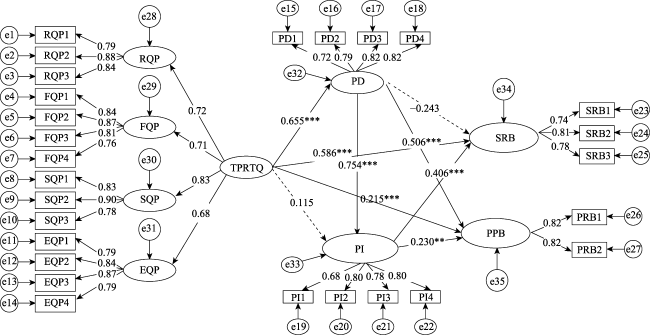
The results presented in Table 5 and Fig. 2 show that the path coefficients of the influence of tourists’ perception of rural tourism quality on place dependence, self-restraint behavior, and protection-promotion behavior are 0.655, 0.586, and 0.215, respectively (P<0.001). However, no significant impact was observed on place identity. Therefore, hypotheses H1a,H3a and H3b are supported, while hypothesis H1b is not supported. The path coefficient of the influence of place dependence on place identity is 0.754 (P<0.001), confirming hypothesis H2.
Table 5 Results of hypothesis test
Hypothesis Path Standardizedpath coefficient Standard error t-value P-value Results
H1a Tourists’ perception of rural tourism quality → Place dependence 0.655 0.070 8.902 *** Support
H1b Tourists’ perception of rural tourism quality → Place identity 0.115 0.067 1.954 0.058 Invalid
H2 Place dependence → Place identity 0.754 0.084 10.698 *** Support
H3a Tourists’ perception of rural tourism quality → Self-restraint behavior 0.586 0.099 6.655 *** Support
H3b Tourists’ perception of rural tourism quality → Protective-promotion behavior 0.215 0.067 3.653 *** Support
H4a Place dependence → Self-restraint behavior -0.243 0.137 -2.102 0.36 Invalid
H4b Place dependence → Protective-promotion behavior 0.506 0.113 5.419 *** Support
H5a Place identity → Self-restraint behavior 0.406 0.108 3.722 *** Support
H5b Place identity → Protective-promotion behavior 0.230 0.086 2.695 ** Support

Note: ** means P<0.01, and *** means P<0.001.

Fig. 2 Results of the hypothesis test of SEM

Note: Significance levels: ** means P<0.01, and *** means P<0.001.

Regarding the direct impact of place attachment on environmentally responsible behavior, the influence of place dependence on self-restraint behavior is not significant and even exhibits a negative correlation, hypothesis H4a is not supported. The path coefficients of the influences of place dependence on protective-promotion behavior, place identity on self-restraint behavior, and place identity on protective-promotion behavior are 0.506, 0.406 (P<0.001), and 0.230 (P<0.01), respectively. Thus, hypotheses H4b, H5a, and H5b are supported.

4.3.2 Mediation effect test

In the Amos software, the Bootstrap method (Wen and Ye, 2014) was employed to test the mediating effects of place dependence and place identity. A 95% confidence interval and 5000 iterations of repeated sampling were set. If the confidence interval does not include 0, then the mediating effect is considered significant; otherwise, it is not significant. The results, as presented in Table 6, indicate two pathways where place dependence acts as a mediator: tourists’ perception of rural tourism quality → place dependence → protective-promotion behavior (β=0.047, 95% CI= [0.132]), demonstrating a standalone mediating effect; tourists’ perception of rural tourism quality → place dependence → place identity → protective-promotion behavior (β=0.114, 95% CI=[0.217]), where both place dependence and place identity act as a chained mediator. Two direct mediating paths of place identity are confirmed: tourists’ perception of rural tourism quality → place identity → self-restraint behavior (β=0.200, 95% CI=[0.404]); tourists’ perception of rural tourism quality → place identity → protective-promotion behavior (β=0.332, 95% CI= [0.504]).
Table 6 Results of mediating effect test
Hypothesis Path Effect value SE Bias-corrected 95% CI Results
Lower Upper
H6a Tourists’ perception of rural tourism quality → Place dependence →
Self-restraint behavior
-0.159 0.107 -0.407 0.011 Invalid
H6b Tourists’ perception of rural tourism quality → Place dependence →
Protective-promotion behavior
0.047 0.032 0.003 0.132 Support
H7a Tourists’ perception of rural tourism quality → Place identity →
Self-restraint behavior
0.200 0.086 0.071 0.404 Support
H7b Tourists’ perception of rural tourism quality → Place identity → Protective-promotion behavior 0.332 0.076 0.201 0.504 Support
H8a Tourists’ perception of rural tourism quality → Place dependence → Place identity → Self-restraint behavior 0.026 0.023 -0.002 0.089 Invalid
H8b Tourists’ perception of rural tourism quality → Place dependence → Place identity → Protective-promotion behavior 0.114 0.051 0.012 0.217 Support

5 Discussion

While previous studies have measured the perception of rural tourism quality from different points of view—almost in single dimensions, this study considers all possible dimensions of rural tourism quality and comprehensively measures the ones that can affect tourists’ perception of rural tourism quality, making up for the deficiency of previous single dimensions. Next, from tourists’ perspective, it has innovated in creating a theoretical model “tourists’ perception of rural tourism quality—place attachment—tourist environmentally responsible behavior”. Moreover, it has ascertained the significant influence of tourists’ perception of rural tourism quality on environmentally responsible behavior through empirical test, not only supplementing crucial solid evidence for analyzing factors influencing tourist environmentally responsible behavior in theory but also providing a new attention perspective and management enlightenment for the operation and management and environmental protection of rural tourism destinations in practice. The study has found that a positive tourist perception of rural tourism quality favors tourists implementing proactive environmentally responsible behaviors. The stronger the positive perception of tourism quality in rural tourism destinations, the more willing tourists are to undertake environmentally responsible behaviors to keep the quality of tourism destinations from downgrading. This also coincides with the idea in existing studies that high-quality rural landscapes and rural cultures are key driving forces stimulating environmentally responsible tourist behaviors (Kong et al., 2019). Meanwhile, this study has introduced the mediating variable place attachment to further verify that place attachment does have a significant influence on environmentally responsible behavior and can play a mediating role in the influence of tourists’ perception of rural tourism quality on environmentally responsible behavior. This finding has reinforced the key mediating position of place attachment in environmentally responsible behavior (Liu and Wang, 2020; Zhang et al., 2020). Nevertheless, the study has found that place attachment has a significant positive influence on protective-promotion behavior and no positive influence on self-restraint tourist behavior, which disagrees with the previous research conclusions (Cheng et al., 2022). This disparity between studies may stem from the difference of tourism situations selected in studies: while this study is based on rural tourism situations, previous ones are based on situations in urban natural scenic areas; the selection of tourists differs by their tourism situation.
The study is of specific theoretical and practical significance to exploring the bearing of tourists’ perception of rural tourism quality on environmentally responsible behavior, though there exist some limitations: First, it fails to consider the influence of tourists’ sociodemographic characteristics on environmentally responsible behavior, as can be further explored under different groupings in follow-up studies; second, the study has verified the mere mediating effect of place attachment without considering the moderating effects of other variables, such as values, subjective well-being, and other personal emotional factors, which can be included in follow-up studies; lastly, no other rural tourism attractions than the scenic area of Longji terrace scenic area in a minority area, the tourism destination under investigation, having been selected for verification, follow-up studies can test the validity and general applicability of the conclusions in different rural tourism situations.

6 Conclusions and suggestions

6.1 Conclusions

(1) Tourists’ perception of quality positively influences their environmentally responsible behavior in rural tourism. When tourists perceive rural tourism destinations more positively, they are more inclined towards stimulating their sense of responsibility, self-examination, and constraining their behaviors. As their sense of responsibility intensifies, more responsible protective behavior is exercised beyond mere constraint.
(2) Place identity significantly and positively influences self-restraint behavior and protective-promotion behavior, but place dependence does not have a positive impact on self-restraint behavior. This could be attributed to the fact that place dependence signifies tourists’ functional reliance on the destination, highlighting the utilitarian value offered by the tourism site. As a result, tourists might overlook the importance of adhering to conventional environmental behavioral norms. In contrast, tourists’ emotional preferences and psychological dependence play a crucial role in environmental responsibility. Therefore, the effects of positive perception of rural tourism quality can be amplified and the cultivation of environmental responsibility behaviors can be accelerated by enhancing tourists’ place attachment. As a result, the stronger the emotional attachment to the tourism destination, the more likely tourists are to activate an inherent sense of responsibility, thereby promoting environmental responsibility.
(3) Place attachment acts as a mediator between the perception of rural tourism quality and environmentally responsible behavior. On one hand, both place dependence and place identity independently mediate the relationship between the perception of rural tourism quality and protective-promotion behavior. On the other hand, place dependence and place identity serve as sequential mediators between the perception of rural tourism quality and environmentally responsible behavior, facilitating a chain effect.

6.2 Suggestions

Based on the above analysis of the conclusions, this study proposes the following suggestions for the managing party of rural tourism destinations to enhance tourist perception of rural tourism quality and urge tourists to implement proactive environment-protecting behaviors during tour:
(1) That rural facilities construction and service quality upgrade be emphasized to enhance tourist perception of quality. The tourist source in rural tourism destinations is composed mainly of remote tourists and urban residents, whose requirements for infrastructures and service standards are typically higher than local residents’. Therefore, the managing party of rural tourism destinations should give priority to rural public health and accommodation and catering facilities construction, upgrade the public service system, perfect tourism supporting facilities, and create a safe and diverting tourist atmosphere to boost the overall quality and standard of tourism destinations practically and comprehensively and enhance tourist satisfactions with rural tourism quality.
(2) That product experience be deepened and business types of tourism be diversified to strengthen tourists’ place identity. While cultivating and developing rural tourism, rural tourism destinations should pay attention to the utilization of featured resources, explore cultural connotations in depth, and painstakingly create a batch of tourist experience products with unique features to increase interactions between tourists and destinations, strengthen tourists’ affective identification with tourism destinations during the experience, and stimulate more responsible behaviors for environment.
(3) That the “responsible” image of the managing party of rural tourism destinations be exhibited to shorten the emotional distance and deepen tourists’ willingness of protection. Authorities of environmentally responsible places can draw tourists’ interest in environmental protection by enhancing the interestingness of propaganda content and the novelty of representation patterns. For example, they can carry out activities to popularize trivial scientific knowledge about rural resources, circulate the importance of environmental protection with the help of the currently popular short video, and deepen tourists’ willingness of environmental protection and implement responsible behaviors for environment by virtue of the “responsible” demeanor of scenic areas.
[1]
Anderson J C, Gerbing D W. 1988. Structural equation modeling in practice: A review and recommended two-step approach. Psychological Bulletin, 103(3): 411-423.

[2]
Brown T J, Ham S H, Hughes M. 2010. Picking up litter: An application of theory-based communication to influence tourist behaviour in protected areas. Journal of Sustainable Tourism, 18(7): 879-900.

[3]
Cheng W J, Cheng S Y, Liu Q. 2022. Study on the effect of destination social responsibility, place attachment on environmentally responsible behavior: A case study of Yuelu Mountain Scenic Areas in Changsha City. Areal Research and Development, 41(5): 112-118. (in Chinese)

[4]
Chi X T, Lee S K, Ahn Y J, et al. 2020. Tourist-perceived quality and loyalty intentions towards rural tourism in China. Sustainability, 12(9): 3614. DOI: 10.3390/su12093614.

[5]
Duan Z L, Peng Z, He X R. 2021. Impact of tourists’ ecological values on their environmental responsibility behavior: The case of Yuelu Mountain Scenic Areas. Areal Research and Development, 40(1): 132-137, 167. (in Chinese)

[6]
Han C X, Zhang X Y, Li D S. 2022. A study on the attribute structure of rural tourism experience quality. Journal of Nanjing Xiaozhuang University, 38(2): 107-113, 124. (in Chinese)

[7]
Han F, Cai J M, Liu J P. 2010. Driving force analysis on rural tourism destination development in suburbs: A case of Beijing. Journal of Arid Land Resources & Environment, 24(11): 195-200. (in Chinese)

[8]
He W, Gao M. 2017. The value improvement of the tourism-oriented new countryside from tourist satisfaction to environmental liability behavior. Journal of Ningbo University (Liberal Arts Edition), 30(2): 104-109. (in Chinese)

[9]
He X H, Cheng J, Hu D B, et al. 2021. Influence mechanism of service quality on tourist environmentally responsible behavior. Economic Geography, 41(8): 232-240. (in Chinese)

[10]
Hidalgo M C, Hernández B. 2001. Place attachment: Conceptual and empirical questions. Journal of Environmental Psychology, 21(3): 273-281.

[11]
Huang T, Liu J L, Tang N, et al. 2018. The influence of values and scenic-spot’s policy on tourists’ environmentally responsible behavior: An extended theory of planned behavior model. Journal of Arid Land Resources and Environment, 32(10): 88-94. (in Chinese)

[12]
Huang Y H, Huang F C. 2007. Tourists’ perceived value model and its measurement: An empirical study. Tourism Tribune, 22(8): 43-47.

[13]
Kong Y D, Huang Z X, Tao Z M, et al. 2019. Study on the influence mechanism of tourists’ environmentally responsible behavior based on perception of rurality—A case study of Jiangning District of Nanjing City. Journal of Nanjing Normal University (Natural Science Edition), 42(1): 124-131. (in Chinese)

[14]
Li X R, Shi Y K. 2019. Study on the service quality of rural eco-tourism—Taking Fanggan Eco-tourism Area as an example. Forestry Economics, 41(9): 73-79. (in Chinese)

[15]
Liu F, Fu W C, Hong S P, et al. 2021. Study on the relationship between landscape perception and environmental responsibility behavior of tourists in urban parks—A case study of Mountain Parks in Fuzhou City. Forestry Economics, 43(8): 80-96. (in Chinese)

[16]
Liu J, Wang H Z. 2020. Driving forces of tourists’ environmental responsibility behavior: Based on the empirical analysis of coastal scenic spots. Areal Research and Development, 39(6): 84-90, 97. (in Chinese)

[17]
Liu W L, Ji R R. 2019. Evaluation of rural tourism accommodation quality based on online reviews—Empirical analysis combining AHP and BP neural networks. Jiangsu Agricultural Sciences, 47(21): 38-43. (in Chinese)

[18]
Luo W B, Zhang X H, Zhong C, et al. 2017. Research on the influencing factors of tourists’ environmental responsibility behavior in urban natural scenic spots. China Population, Resources and Environment, 27(5): 161-169. (in Chinese)

[19]
Pavić L, Blešić I, Petrović M D, et al. 2019. Can the quality of hospitality services play a role in sustainable equestrian tourism in Slovenia? Mediations, effects, and implications. Sustainability, 11(21): 6155. DOI: 10.3390/su11216155.

[20]
Qi X X, Zhao L, Hu Y C. 2018. Tourists’ awe and environmentally responsible behavior: The mediating role of place attachment. Tourism Tribune, 33(11): 110-121. (in Chinese)

[21]
Qiu H L. 2017. Tourism festival image, festival attachment, festival tourist's environmentally responsible attitude and behavior: A case of Hangzhou Xixi Flower Fairy Festival. Zhejiang Social Sciences, (2): 84-93, 117, 158. (in Chinese)

[22]
Ramkisson H, Weiler B, David Graham Smith L. 2012. Place attachment and pro-environmental behavior in national parks: The development of a conceptual framework. Journal of Sustainable Tourism, 20(2): 257-276.

[23]
Wang J W, Lu G J, Zhang L Y, et al. 2023. Effects of climate change perception on urban residents’ environmentally responsible behavior in ice and snow tourism: A case study of Beijing. Geographical Research, 42(2): 440-457. (in Chinese)

[24]
Wen Z L, Ye B J. 2014. Analyses of mediating effects: The development of methods and models. Advances in Psychological Science, 22(5): 731-745. (in Chinese)

DOI

[25]
Williams D R, Patterson M E, Roggenbuck J W, et al. 1992. Beyond the commodity metaphor: Examining emotional and symbolic attachment to place. Leisure Sciences, 14(1): 29-46.

[26]
Wu H C, Cheng C C, Ai C H. 2017. A study of experiential quality, equity, happiness, rural image, experiential satisfaction, and behavioral intentions for the rural tourism industry in China. International Journal of Hospitality & Tourism Administration, 18(4): 393-428.

[27]
Xia Z C, Chen S L. 2015. The influence of eco-tourists’ perceived value on environmentally friendly behavior intention. Journal of Central South University of Forestry & Technology (Social Sciences), 9(1): 27-32, 77. (in Chinese)

[28]
Xiao Y. 2015. Reflections on development and poverty reduction in periphery—A case study from the Yunnan-Guizhou Plateau. China Agricultural University Journal of Social Sciences Edition, 32(4): 5-14. (in Chinese)

[29]
Xu N N, Guo Y Z, Liu H B. 2021. Influence of cultural identity on tourists’ responsibility behavior—A chain intermediary model. Journal of Arid Land Resources & Environment, 35(8): 199-208. (in Chinese)

[30]
Yao J, Chen B, Tian S Z. 2008. Study on tourists’ perception of rural travel quality in ethnic region—A case study of Dushi Farm, Changji Prefecture, Xinjiang. Tourism Tribune, 23(11): 75-81. (in Chinese)

[31]
Yin L J, Zhang N, Chang Z Y. 2021. Study on the impact of tourism quality perception on tourists’ environmentally responsible behaviour in rural tourism areas. IOP Conference Series: Earth and Environmental Science, 626(1): 012015. DOI: 10.1088/1755-1315/626/1/012015.

[32]
Zhang T, Liu J L, Cong L, et al. 2020. Influence of perception value and place attachment on visitors’ environmental responsibility behavior—A case of Beijing Olympic Forest Park. Journal of Arid Land Resources & Environment, 34(6): 202-208. (in Chinese)

[33]
Zhang Z H, Wen J, Li J. 2008. An explanation of theory of locality in the foreign study of perceptive image in tourist destinations. Tourism Tribune, 23(3): 43-49. (in Chinese)

Outlines

/