Tourism Environmental Behavior and Farmer’ Participation in Tourism

The Generation Path and Influencing Factors of Pro-environmental Behavior based on Motivation-oriented Mechanism—Taking Camping Tourism as an Example

  • YANG Zhandong ,
  • DONG Yaohua ,
  • ZHAO Chenlei ,
  • MEI Xue ,
  • BU He , *
Expand
  • School of Sports Leisure and Tourism, Beijing Sport University, Beijing 100084, China
*BU He, E-mail:

YANG Zhandong, E-mail:

Received date: 2023-08-31

  Accepted date: 2023-12-05

  Online published: 2024-05-24

Supported by

The National Social Science Foundation Project(21BTY052)

The Beijing Social Science Fund Project(21JCC049)

Abstract

Camping tourism is a relatively new form of travel and leisure, it has left many traces of consumption in the natural environment that cannot be restored. In order to assist consumers in camping in a polite, environmentally conscious, and traceless manner, this study begins with consumption motivation, consider leisure involvement and place attachment as dual intermediary variables, and investigates the mechanisms that influence the pro-environmental behaviour of leisure and camping tourists. The research findings are derived from the motivation-oriented behavior mechanism. (1) Consumption motivation has a significant positive impact on pro-environmental behavior. (2) Leisure involvement plays a mediating role between consumption motivation and pro-environmental behavior. (3) Place attachment plays a mediating role between consumption motivation and pro-environmental behavior. (4) Leisure involvement has a significantly positive impact on place attachment.

Cite this article

YANG Zhandong , DONG Yaohua , ZHAO Chenlei , MEI Xue , BU He . The Generation Path and Influencing Factors of Pro-environmental Behavior based on Motivation-oriented Mechanism—Taking Camping Tourism as an Example[J]. Journal of Resources and Ecology, 2024 , 15(3) : 663 -672 . DOI: 10.5814/j.issn.1674-764x.2024.03.013

1 Introduction

People’s consumption needs are gradually becoming “refined”, as they enter post-modern society, and following the COVID-19 epidemic, the leisure tourism sector has experienced a significant increase both quantitatively and qualitatively (Tang et al., 2022a). Tourists not only continue to pursue ornamental consumption but have also begun to pay attention to experiential consumption (Lu et al., 2023), so recently the new industry of camping, tourism, and leisure consumption has gradually emerged and became the most popular way of leisure and entertainment consumption activity (Tang et al., 2022b). In order to regulate the development of the camping tourism market, 14 departments, including the Ministry of Culture and Tourism, issued the “Guiding Opinions on Promoting the Healthy and Orderly Development of Camping Tourism and Leisure”, which for the first time clarified the definition of camping tourism and introduced a series of development measures.
In fact, the term “camping” was first described as a shelter from smog and dust storms but it evolved into a form of tourism and leisure for contemporary people seeking to escape city life (Rantala and Varley, 2019). As camping tourism is booming in China, “Camping” has become synonymous with exquisite life. Furthermore, being symbolic of leisure consumption, it represents people’s yearning and demand for getting close to nature; additionally, it also reflects people’s desire for a free and high-quality life. Individuals who engage in short-term camping activities during their leisure time are commonly referred to as campers. These campers typically opt for safer activities, frequently travel with friends and family, and have ample forms of subsidiary activities during the camping process.
In recent years, exquisite camping has become a popular camping mode in China. Due to the impact of COVID-19, urban residents are unable to travel long distances for many days. In order to fulfill their travel and leisure needs, they choose to engage in activities at more mature campsites in the suburbs of the city. This type of campsite usually has complete facilities, excellent services, aesthetic appeal, and a vibrant outdoor style that can attract extravagant people from the city. Campsites that are more aesthetically pleasing and comfortable completely satisfy the demands of today’s young and middle-aged urban consumers. A lot of consumers who follow trends of “outdoor experience” but have never played outdoor sports pour into campsites. This is especially true in the camping industry, where it fuels the expansion of campsite businesses and increases demand for related services like transportation, catering, and camping equipment. According to Cheng and Luo (2023), luxurious camping is a type of consumption behaviour that young people seek out as a spiritual experience. In the research on camping tourism that is currently available, researchers primarily examine the physical surroundings of campsites (Liu et al., 2016). Through a restorative perception of the environment, campers can achieve the effect of protecting the environment during this consumption experience between man and nature (Yang et al., 2023). Consequently, in addition to enjoying the outdoors, campers ought to take responsibility for safeguarding the environment of the campsite.
In the process of camping tourism, many traces of consumption are invisible on the campsite, which is likely to cause irreparable damage to the ecological environment system (Ya and Wang, 2023). Thus, the goal of this study is to determine how to convert campers into environmentalists and how to use the incentive of camping tourism consumption to propel pro-environmental behaviour (Zhang et al., 2023). In order to analyze the pathways to environmentally responsible behavior of camping participants, it is necessary to pay attention to the place of camping activities. Exquisite camping has some characteristics of participation that are different from other forms of camping activities, for example, a vast majority of activities for exquisite campers are done at the campsite. A well-equipped and themed campsite with a well-decorated overall visual appearance acts as a special stimulus for consumers to display behavior during camping activities that is very different from that displayed. In addition, customers find that campsites that are both physically and psychologically distant from their everyday lives provide them an excellent setting for introspection, fulfillment, and self-expression. In a sequence of processes involving destination selection, activities performed at the destinations, the campsite as an object plays a significant role in creating a rich emotional connection with the campers. While the campers need to be aware of the functioning of the campsite, the campsite also fosters emotional attachment, which encourages consumers to choose camping destinations wisely in the same way that they maintain their own homes (Jin et al., 2023). Therefore, this paper intends to explore the influence mechanism between consumption motivation and pro-environmental behaviors in association with leisure, which consists of attractiveness, centrality and self-expression, and place attachment, which contains the sub-concepts of place dependence and place identity, as mediating variables.
In order to investigate whether or not leisure consumption of camping tourism can encourage pro-environmental behaviours, this article will first address the motivation behind consumption. It will then use leisure involvement and place attachment as dual intermediary variables to help consumers camp in a manner that is civilised, environmentally friendly, and traceless.

2 Literature review and hypotheses

2.1 Motivation-oriented behavior mechanism

There is a strong connection between consumer motivation and consumer behavior (Lin and Chuang, 2021). Su et al. (2005) believed that tourist motivation is generated by the push-pull mech anism, which results from a combination of internal and external factors. Xin et al. (2018) emphasized that motivation is the internal driving force and psychological motivation of consumer behavior, which not only includes consumers’ attitudes and tendencies, but also the fundamental reasons for consumption. In the field of management, the goal-oriented behavior mechanism is an effective incentive measure that can stimulate employees’ innovative behavior (Lu and Chang, 2007). Clear goals may lead to generation of corresponding attitudes, emotions, desires, competencies, etc., thereby positively promoting behavior in the right direction. On the contrary, as far as camping consumers are concerned, leisure and entertainment are a process experience driven by psychology without definite purpose due to motivation; hence, they are like to engage unconsciously in pro-environmental behavior. In a sense, choosing the leisure mode of camping tourism determines the individual’s environmental awareness of getting close to nature and protecting nature. Therefore, a structural model equation based on the motivation-oriented behavior mechanism was constructed to further explore the internal logic and relationship between camping tourism consumption motivation and pro-environmental behavior.

2.2 Consumption motives for camping tourism

In psychological research, motivation drives an individual’s internal movements and can facilitate or transform human behavior (Munn, 1967). In recent years, scholars in different fields have used demand theory, value theory, expectation theory, etc., to explain the impact of consumer motivation on behavior (Kay, 2003). But for sports tourism, consumption motivation is not only affected by external factors such as relatives and friends, the media, but also related to personal internal emotional factors, such as temporary escape from reality, perception, participation desire, interest, etc., (Kurtzman and Zauhar, 2005). In view of the characteristics of camping tourism, Hollender (1977) divided its consumption motivation into seven specific dimensions, namely primitive lifestyle, escape from daily responsibilities, camp safety, entertainment, outdoor aesthetic experience, escape from urban pressure, and escape from the usual environment. According to the research results of Whiting (2017) on outdoor leisure activities, the motivation of camping tourism consumption can also be divided into four categories: social interaction, physical health, relaxation and recovery, and interaction with nature. Existing research results align with the finding that in the field of tourism consumption, consumer behavior is equally influenced by motivation.

2.3 Leisure involvement and place attachment

Sherif (1947) first proposed the concept of involvement to measure individual attitudes and behaviors in social psychology. Referring to the concept of consumer involvement, Havitz and Dimanche (1997) believed that leisure involvement (Li et al., 2023) refers to the leisure and entertainment behavior caused by specific stimuli or situations which act as a driving force. Subsequently, the concept of leisure involvement was widely used in the field of rest and leisure. Based on the existing literature, the scholars have divided leisure involvement into three dimensions: attractiveness, centrality, and self-expression. Attractiveness specifically refers to the degree to which an individual engages in active leisure activities that are enjoyable and fun (McIntyre and Pigram, 1992). Centrality is a measure of the importance of an activity to an individual, which is closely related to the centrality of lifestyle and social environment (Kyle and Chick, 2002). Self-expression refers to the degree to which a particular activity symbolizes an individual that facilitates the creation and maintenance of the self (Wattanasuwan, 2005).
Motivation refers to the premise of involvement. When the motivation reaches the peak of persistence the individual becomes more involved (Kyle et al., 2006). The motivation of this kind of involvement behavior arises from needs, values and goals, and matches the motivation, so as to drive the individual to perform the expected behavior. Wang analyzed foreign leisure motivations and believed that leisure motivation is an antecedent variable for the formation of leisure involvement, which can affect individuals attitudes towards leisure involvement (Wang et al., 2020). Leisure motivation of the adolescents positively impacts their leisure involvement (Chen et al., 2013). Therefore, it was deduced that campers’ consumption motivation can be a predictor of campers leisure involvement, and campers’ consumption motivation is an important parameter for judging their leisure involvement. The following inferences were drawn:
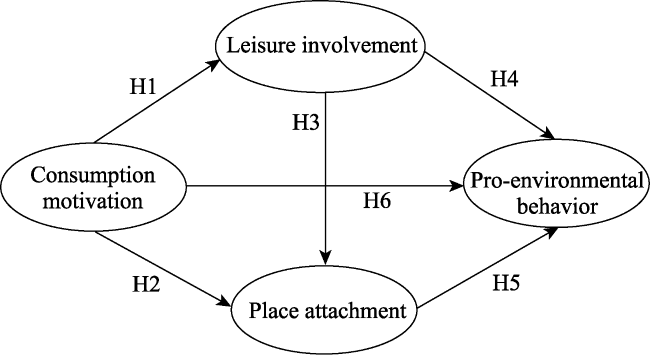
H1: Consumption motivation has a significant positive effect on leisure involvement.
Initially, Williams and Roggenbuck (1989) proposed the concept of Place Attachment (PA) and defined it as the degree to which an individual is emotionally attached to a particular place. Williams also believed that place attachment can be divided into two dimensions; one is place dependence, which emphasizes people’s functional dependence on places, and the other is place identity, which reflects people’s emotional identification with places. Subsequently, this two-dimensional taxonomy was generally accepted by scholars and widely used in research on people and places (Zhang and Xu, 2023). Indeed, campsites often appear as case sites for place attachment research (Price et al., 2018). For example, Wong et al. (2021) demonstrated that campsite dependence, campsite identification, and camping emotional attachment would mediate the impact of endurance participation on camping tourism behavior. In addition, Jia et al. (2022) analyzed the complex relationship between tourism consumption behavior and place attachment based on the SOR (stimuli-organism-response) theory. Therefore, place attachment is the key link between the behavior of camping consumers and campsites, and it can fully describe the harmonious symbiotic relationship between man and nature.
Tourist motivation can promote tourists’ attachment to the destination (Prayag et al., 2018). Studies have shown that tourists’ motivation to participate in last-chance tourism is strongly related to tourists’ sense of place identity (Groulx et al., 2016). Zhang et al. (2021) believed that the tourism motivation of holding festivals in floating population areas has a positive impact on place attachment. Therefore, when the natural environment provides various psychological, social, and material outcome expectations to the campers; they form an invisible attachment complex with the natural environment (Kyle et al., 2004). The degree of this place attachment also deepened with time (Genson, 2010). Therefore, this study makes the following assumptions:
H2: Consumption motivation has a significant positive effect on place attachment.
Similarly, there is a complex relationship between leisure involvement and place attachment. Xie et al. (2022) verified that there is an overall positive correlation between leisure involvement of the elderly and place attachment. However, Tao et al. (2022) believes that although leisure involvement has a significant direct impact on place attachment, it also has an indirect impact on flow experience. Additionally, Chen et al. (2021) constructed a model of “leisure involvement-place attachment” and discussed the applicability of this model in the context of independent bookstore consumers. Therefore, the following assumptions were made:
H3: Leisure involvement has a significant positive effect on place attachment.

2.4 Campers’ pro-environmental behavior

Pro-environmental behavior (PEB) is a collection of similar concepts, such as environmentally responsible behavior, environmentally friendly behavior, environmentally sustainable consumer behavior, environmental protection, ecological behavior, green behavior, etc. This behavior emphasizes that when participants are active in the natural ecological environment, they are likely to display behaviors that can reduce negative impacts on the environment or that are beneficial for environmental protection and restoration (Black and Cherrier, 2010). In recent years, with the rapid increase in the number of people participating in outdoor leisure activities, pro-environmental behaviors have attracted more and more attention of the academic circles and the market. In the process of practicing pro-environmental behaviors, the “Leave no Trace” campaign conceptualized in the United States, has gradually developed into a code of conduct widely accepted by outdoor sports participants in the past forty years. In recent years, campers in our country are gradually accepting and learning concepts based on Leave No Trace (LNT) principles, such as adequate planning before the start of the activity, careful selection of routes and destinations during the activity, respect for others and wild animals and plants, etc. The principle of pro-environmental behavior represented by LNT has gradually resulted in a mature education and training system, which has a strong reference value in the context of the rapid development of Chinese outdoor sports industry. On the one hand, the implementation of environmentally responsible behavior is conducive to the protection of the ecological environment; on the other hand, a more standardized and responsible behavior of the participants is conducive to the reduction of management costs of destination enterprises, thereby promoting the expansion of business scale.
In the existing research on leisure and recreation, leisure involvement has proven to be able to drive tourists to display some specific behaviors. Taking Nansha Wetland Park as an example, tourist involvement can effectively predict pro-environmental behavior (Xu et al., 2018). When an individual is a member of a normative society, pro-environmental behavior is likely to be displayed, and the influence is positively correlated to the behaviors of people individual considers important, and their effects on the individual. The higher the degree of norms, the stronger is the driving force experienced by individuals (Schwartz, 1977). In addition, emotional experience expectations before and during activities are also likely to have an impact on individual behavior. For example, pride can affect tourist behavior, which in turn creates a sense of morality, which further leads to responsible behavior (Rosenthal and Ho, 2020). Therefore, when campers are active in the natural environment, they may be influenced by invisible environmental norms and demonstrate pro-environmental behaviors, such as avoiding stepping on the lawn and proactively picking up garbage. Based on the above literature review, the following assumptions were made:
H4: Leisure involvement has a significant positive impact on pro-environmental behavior.
H4a: Leisure involvement has a positive mediating effect between consumption motivation and pro-environmental behavior.
Place attachment is one of the important driving factors of formation of consumer behavior. When place attachment reaches a certain level, it can inspire tourists to protect the environment of the tourist destination. Chow et al. (2019) found through a survey of tourists in South China that place dependence and place identity are positively correlated with environmentally responsible behavior intentions. Li et al. (2023) demonstrated that tourists’ attachment to tourist destinations is negatively correlated with the difficulty of implementing environmental protection behaviors. When the psychological connection between consumers and the natural environment is established, the sense of closeness to nature will enhance consumers’ attachment complex, strengthen their willingness to protect the environment, and their pro-environmental behavior will be strengthened. In addition, in the case of festivals and activities, there is increased participation in environmental protection activities in the host site due to place attachment (Alonso-Vazquez et al., 2019). Therefore, it was hypothesized that place attachment can have an impact on the formation mechanism of pro-environmental behavior in camping tourism, and hence, the following assumptions were made:
H5: Place attachment has a significant positive effect on pro-environmental behavior.
H5a: Place attachment plays a positive mediating role between consumption motivation and pro-environmental behavior.
There are many motivations that cause pro-environmental behavior, some are external motivations derived from material rewards, and some are intrinsic motivations derived from values, sense of responsibility, behavioral attitudes, etc., (Osbaldiston and Sheldon, 2003). Research findings reveal that tourists’ travel motivations are significantly related to tourists’ environmental attitudes and environmental behaviors (Ma et al., 2018). Ecotourists in coastal wetlands are likely to possess different travel motivations, which will affect whether their travel will be accompanied by environmentally responsible behaviors (Kerstetter et al., 2004). In addition, a survey of hikers on the Florida National Scenic Trail revealed a significant correlation between motivation and environmental behavior (Kil et al., 2014). Therefore, it was assumed that the consumption motivation of camping tourism can have a direct impact on the pro-environmental behavior of campers:
H6: Consumption motivation has a significant positive effect on pro-environmental behavior.
Fig. 1 Hypothetical model

3 Research design

3.1 Selection of research area

Beijing is located in North China. It is surrounded by rich natural resources such as mountains, rivers, lakes, and forests, and has many campsites, camping communities, and camping clubs. Therefore, the campsites around Beijing were selected for the study, and a questionnaire survey of the local campers was conducted. Five popular campsites around Beijing, including Jinhai Lake Campground in Weilan Valley, Longwan International Camping Park, Xiangshui Lake Scenic Area, Lingshan Scenic Area and Campgrounds along the 42-kilometer greenway from Dongxiaokou Forest Park were selected for research.

3.2 Questionnaire design

SPSS 26.0 and AMOS 26.0 data analysis software were used to conduct confirmatory factor analysis, model analysis and hypothesis testing, and Bootstrapping method was used to test the mediating effect of the two variables, namely leisure involvement and place attachment. The questionnaire has two parts. The first part pertains to the basic personal information of the campers, and the second part which is the main part of the questionnaire contains items measuring the variables. All scales that were used in this study are in the form of 5-point Likert scale, with response scores ranging from 1-5 for completely disagree to completely agree. The consumption motivation scale is derived from the article items of the scale designed by Shao et al. (2021) and Song (2019), which pertain to China’s leisure consumption culture, and is selected based on the characteristics of camping tourism; the leisure involvement scale is selected from Kyle et al. (2003) and Chen et al. (2021), the three dimensions of attraction, centrality, and self-expression were unified and combined, and the items were deleted after pre-survey; while the place attachment scale is composed of the two dimensions of place identity and place dependence, mainly referring to the scale of Kyle et al. (2005); the pro-environmental behavior scale is adapted from the scales of Cai and Zhu (2021) and Lee et al. (2013). The scales mentioned above are based on established research scales, are semantically adjusted to account for the unique circumstances of the case site and the camping tourism scenario, and were all assessed by experts before being combined to create the questionnaire that is utilised in this study.

3.3 Data sources

The survey was conducted from April 16 to May 14, 2022. Before beginning with the survey, the members selected two campsites, Longwan International Camping Park and Lingshan Scenic Area, to conduct a small-scale pre-investigation. A total of 100 valid questionnaires were collected, and the reliability and validity of the questionnaires were tested. Some items were deleted, and finally a formal questionnaire was formed. In the formal survey, 500 valid questionnaires were obtained through offline-based and online-assisted methods, with an effective rate of 91.4%. Among them, male campers accounted for 53.4%, and females accounted for 46.6%. In terms of age, there are more young and middle-aged people in the age range of 31-44 years; in terms of education, 71.8% had a bachelor’s degree or above; in terms of occupation, 59% were employees of enterprises, and the rest were public institution personnel and students. In terms of income, 47.2% of the campers had a monthly per capita disposable income of 5001-10000 yuan, and 25.2% had a monthly per capita disposable income of more than 10000 yuan.

4 Research results and analysis

4.1 Reliability and validity test

First, the KMO test and Bartlett’s sphericity test were performed on the questionnaire. The results showed that the KMO test was 0.946 (>0.8), the approximate Chi-square value of Bartlett’s sphericity test was 3402.382, the degree of freedom was 120, and the significance P<0.001. It shows that the overall reliability of the model met the standard, and the questionnaire was suitable for factor analysis. The reliability of the questionnaire was determined through Cronbach’s α coefficient which represented the internal consistency of the questionnaire. The Cronbach’s α value of the overall scale is 0.915 (>0.8), indicating that the overall reliability of the scale is good. Second, confirmatory factor analysis was used to test the validity of the questionnaire. This method was used to verify the fit between various indicators. The test results are depicted in Table 1. The factor loadings are all close to 0.70, the CR (Composite Reliability) values are all greater than 0.70, and the AVE (Average Variance Extracted Amount) values lie between 0.414 and 0.563, which are higher than the minimum limit of 0.36 (Fornell and Larcker, 1981), indicating that the construct validity among variables is high. In terms of fitting indicators, as shown in Table 2, all indicators satisfy the parameters (Bagozzi and Yi, 2012), indicating that the model used in the research has a good fit. Finally, the discriminant validity of the questionnaire was determined. Table 3 reveals a significant correlation between each variable (P<0.01), and the correlation coefficients are all less than the square root of the corresponding AVE, all latent variables are correlated, and there is a certain degree of differentiation between them.
Table 1 Results of measurement model analysis
Variable Item Factor loading Cronbach’s α value Combination
reliability
Average variance extraction amount
Consumption Motivation
(CM)
0.726 0.739 0.414
I crave for relaxation and stress relief while camping 0.651
I want to spend a quality vacation 0.658
I hope to strengthen interpersonal communication through camping 0.600
I hope to experience a different lifestyle through camping 0.664
Leisure Involvement
(LI)
0.770 0.770 0.455
When I mention camping, I can tell people a lot about camping there 0.681
While camping in the area, I want others to see me as I want to appear (think I am healthy and alive) 0.673
I can reveal a lot about myself during camping 0.657
I would like to spend time and energy camping in this place 0.688
Place Attachment
(PA)
0.837 0.837 0.563
I love this campsite more than any other 0.740
In contrast to other tourist spots, this campsite is better equipped to fulfil my travel requirements. 0.753
This campsite gives me a sense of fulfillment that I don’t get anywhere else 0.747
I love camping at this campsite and don’t want to leave 0.760
Pro-environmental Behavior (PEB) 0.766 0.768 0.453
Will read reports, advertisements and books about the outdoor campsite environment 0.666
When I see people littering, scribbling and climbing, trampling and picking randomly, I will step forward to stop them 0.661
When you see garbage during camping, you will take the initiative to pick it up and put it in the trash can 0.691
Garbage generated during camping will be sorted 0.675
Table 2 Overall fitting coefficient table
Fit index x2/df NFI IFI RMSEA RFI CF1 PRATIO TLI
Fitting criteria <8 >0.9 >0.9 <0.08 >0.9 >0.9 >0.9 >0.9
Fitting result 2.643 0.916 0.946 0.057 0.908 0.946 0.917 0.941
Table 3 Discriminant validity table
Variable Consumption motivation Leisure involvement Place attachment Pro-environmental behavior
Consumption motivation 0.414
Leisure involvement 0.245 *** 0.455
Place attachment 0.249 *** 0.267 *** 0.563
Pro-environmental behavior 0.264 *** 0.334 *** 0.246 *** 0.453

Note: *P<0.05, ** P<0.01, *** P<0.001.

4.2 Structural model analysis

This article uses regression analysis to test and analyze the assumptions of the structural model. As shown in Table 4, consumption motivation has a significant impact on leisure involvement (β=0.697; P<0.001), place attachment (β= 0.587; P<0.001), and pro-environmental behavior (β= 0.646; P<0.001), that is, hypotheses H1, H2 and H6 were accepted; leisure involvement on place attachment (β=0.745; P<0.001) and pro-environmental behavior (β= 0.604; P<0.001) have a significant positive effect, that is, hypotheses H3 and H4 were accepted; finally, place attachment had a significant positive effect on pro-envir onmental behavior (β=0.595; P<0.001) and hence, hypothesis H5 was accepted.
Table 4 Hypothetical path results
Assumptions Normalized path coefficient β Standard error t-value Result
H1: Consumption Motivation (CM) → Leisure Involvement (LI) 0.697*** 0.030 21.701 Support
H2: Consumption Motivation (CM) → Place Attachment (PA) 0.587*** 0.031 16.171 Support
H3: Leisure Involvement (LI) → Place Attachment (PA) 0.745*** 0.027 24.915 Support
H4: Leisure Involvement (LI) → Pro-environmental Behavior (PEB) 0.604*** 0.036 16.896 Support
H5: Place Attachment (LI) → Pro-environmental Behavior (PEB) 0.595*** 0.040 16.503 Support
H6: Consumption Motivation (CM) → Pro-environmental Behavior (PEB) 0.646*** 0.032 18.892 Support

Note: *P<0.05, **P<0.01, ***P<0.001.

4.3 Mediation effect test

This article sets the confidence interval to 95%. If there is no 0 between the upper and lower valueof the confidence interval at 95% probability (Hayes, 2009), the mediating effect of the path can be considered significant. This article uses Bootstrapping in AMOS to run the data shown in Table 5. Within the 95% probability, in the mediation effect model established in this study, the confidence interval of the path of consumption motivation → leisure involvement → pro- environmental behavior is (-13.883, -0.543), and the path of consumption motivation → place attachment → pro- environmental behavior (-7.882, -0.274), and the confidence interval of the path of consumption motivation → leisure involvement → place attachment → pro-environmental behavior is (7.230, 13.543). Each hypothesized path does not have 0 in its interval, so the intermediate paths hypothesized in this study are established, and hypotheses H4a and H5a are verified. At the same time, the 95% confidence interval of the consumption motivation → pro-environmental behavior path is (0.962, 9.335) without the occurrence of 0, indicating that consumption motivation has a direct effect on pro-environmental behavior, and the mediating effects proposed in this study are all partial mediators.
Table 5 Mediating effect test
Effect Intermediary path 95% confidence interval Path coefficient Two-sided test P value Mediation effect
Lower value Upper value
Indirect effect CM→ LI→ PEB (H4a) -13.883 -0.534 2.568*** 0.007 Support
CM→ PA→ PEB (H5a) -7.882 -0.274 1.220** 0.001 Support
CM→LI→PA→PEB 7.230 13.543 2.570** 0.001 Support
Direct effect CM→PEB 0.962 9.335 2.136*** 0.001 Support
Total mediating effect CM→PEB -8.398 -0.098 1.219** 0.027 Support
Total effect CM→PEB 0.779 1.059 0.917** 0.001 Support

Note: *P<0.05, **P<0.01, ***P<0.001.

5 Discussion and conclusions

5.1 Theoretical contributions

First of all, the goal-oriented behaviour mechanism (Ji and Nie, 2017) is expanded to the motivation-oriented behaviour mechanism in this article by Guo et al. (2023) by providing a thorough explanation of the relationship between motivation and behaviour in the leisure field. Consumption motivation and positive emotions can potentially prompt camping consumers to adopt pro-environmental behaviors. At the same time, the study fills the research gap on campers’ consumption behavior and clearly outlines the role of leisure involvement on happiness (Weng et al., 2020; Liu and Wang, 2021) and other perceptions at the behavioral level; additionally, it also enriches the experience of camping tourism. The research perspective lays the foundation for research on emerging leisure consumption.
Secondly, this paper introduces leisure involvement into the field of pro-environmental behavior, giving new vitality to the study of pro-environmental behavior. Although there are many factors that affect the formation of campers’ pro-environmental behavior (Bai, 2019), such as urbanization, air pollution and many other objective reasons, pro- environmental behavior is the subjective behavior of campers, which is affected by their subjective motivation, involvement, attachment, etc. Therefore, the subjective role of campers is sorted out from motivation to behavior from shallow to deep, and the formation mechanism of pro-environmental behavior is perfected.
Finally, with the up grade of our country’s national consumption capacity, the demand for leisure consumption is increasing, but the research on leisure consumption motivation theory (Zhang et al., 2015) is relatively lacking. Therefore, this article supplements the research case of this theory to a certain extent through the investigation and research on camping consumers.

5.2 Management implications

Based on the research findings, the following are being provided for the management and operation of campgrounds: The level of involvement of campers should be heightened, and they should be motivated to be spiritually involved, thereby increasing their willingness to display pro-environmental behavior. Camping tourism differs from traditional tourism activities not only in the obvious ways, such as sleeping in a tent rather than a hotel room, but also in the way the campers create a psychological bond with nature and disconnect with the hectic daily life. It enables consumers to achieve a state of mind where they can relax and forget their worries in the natural environment of the campsite. Therefore, campsites need to set up some means to encourage campers to enter into a deep state of leisure involvement, and achieve self-satisfaction and self-expression in the process of activities. After this goal is achieved, and consumers enter a new emotional world, operators can invisibly train them in pro-environmental concepts and motivate them to display pro-environmental behavior, such as reducing the use of modern tools and avoiding wastage of resources.
Operators also need to strengthen campers’ place attachment and promote their sense of belonging to nature. Place attachment plays an important intermediary role in many behavioral theories, so campsites should pay special attention to the cultivation of campers’ emotional attachment, and that campers can avail the benefits of camping tourism to a maximum extent, and feel a sense of belonging at home. For example, the campsite should ensure that the activities that are preferred by frequent campers are provided and the narrative of “me” and the campground is promoted to raise the employees’ level of customer service awareness. Only when the campers have a home-like functional dependence and emotional recognition of the camping destination, they will gradually realize that some of their behaviors are likely to have serious negative impacts on the campsite environment, thus generating behavioral intentions that not only reduce damage but also facilitate maintenance and restoration of the environment; this is likely to promote pro-environmental behavior. The development of environmentally conscious campers and environmental education should be focussed and leave no trace campaign should be publicised. Maintenance of the normal operation of campsites requires enormous funds. Taking campsites in Beijing as an example, it is important to take into account not only the costs associated with water and electricity use but also infrastructure construction, tree protection, etc.; additionally garbage disposal, upkeep of surrounding vegetation, and use of sewage must be considered. Hence, campsites ought to lower passive environmental costs and provide opportunities for campers to develop an active awareness of environmental protection based on necessary expenditures. Making appeal cards for the preservation of the environment, handing out flyers encouraging polite conduct, planning camping events with an environmental focus, etc, should be promoted.

5.3 Conclusions

Consumption motivation has a significant positive impact on pro-environmental behavior. The results show that consumption motivation cannot only indirectly affect pro-environmental behavior through variables but also directly affect pro-environmental behavior. This coincides with the core of motivation-behavior theory (Zhang, 1996), that is, motivation can guide and drive individuals to produce specific behaviors. When campers generate consumption motivation for camping tourism, in order to achieve the motivation goal and realize a satisfactory tourism experience, they are likely to protect the ecological environment of the campsite and implement pro-environmental behaviors. Pro-environmental behaviour is even viewed by some campers as an extra experience pertaining to camping tourism leisure consumption, categorising it as a part of camping tourism.
Leisure involvement can play a mediating role between consumption motivation and pro-environmental behavior which aligns with the findings of Shao et al. (2021), and further explains the motivation and behavior pertaining to leisure consumption in the camping situation. At the same time, it also reflects a kind of leisure involvement which can be transformed into a willingness to act, thus prompting camping consumers to personally invest in the interaction between man and nature.
Place attachment can play a mediating role between consumption motivation and pro-environmental behavior. Place attachment can strengthen the emotional bond that exists between people and locations. It can also successfully channel a camper’s feelings into actions that are protective of the surrounding campground and align with the process of motivation (stimulus)-emotion (body)-behavior (response) (He et al., 2023).
Participating in leisure activities can enhance place attachment significantly. The findings of this study pertaining to the relationship between leisure involvement and place attachment align with the findings of Xie et al. (2022) and Chen et al. (2021). Simultaneously, it demonstrates that the level of customer participation, attention, and love for camping can strengthen their attachment to the campsite.

5.4 Deficiencies and prospects

There are still some shortcomings and limitations, which also serve as recommendations for future research, despite the fact that this paper improves the formation mechanism of pro-environmental behaviour, broadens the application field of consumption motivation theory, and enhances the research perspective of camping tourism. First, the sites that were selected for study were located in the surrounding areas of Beijing with most of them containing mountains and lakes and hence, they might not adequately represent the situation in other types of campsites. Therefore, in future, campsites from diverse locations such as deserts, beaches, and villages can be chosen for investigation and to validate the other characteristics of camping tourism leisure consumption. Second, too many items pertaining to emotions and feelings were included in the questionnaire, which will inevitably be affected by subjective expectations, resulting in a positive and neutral overall bias. Therefore, in future, qualitative methods such as field surveys and interviews should be combined to enhance the authenticity of research. Finally, factors such as satisfaction, tourism quality, etc., were not discussed in detail. Future research should examine the development process and determinants of pro-environmental behavior in campsites from a wider perspective.
[1]
Alonso-Vazquez M, Packer J, Fairley S, et al. 2019. The role of place attachment and festival attachment in influencing attendees environmentally responsible behaviours at music festivals. Tourism Recreation Research, 44(1): 91-102.

[2]
Bagozzi R P, Yi Y. 2012. Specification, evaluation, and interpretation of structural equation models. Journal of the Academy of Marketing Science, 40(1): 8-34.

[3]
Bai H. 2019. Research on the environmental responsibility behavior of ecotourism camping—An exploration of David A Fennell’s “Ecotourism”. Journalism Lover, 2019(6): 114-115. (in Chinese)

[4]
Black I R, Cherrier H. 2010. Anti-consumption as part of living a sustainable lifestyle: Daily practices, contextual motivations and subjective values. Journal of Consumer Behaviour, 9(6): 437-453.

[5]
Cai L B, Zhu X T. 2021. Does tourist-environment fit affect environmentally responsible behavior? Using memorable tourism experience and place attachment as intervening variables. Tourism Tribune, 36(7): 119-131. (in Chinese)

[6]
Chen W R, Li S, Wu Y C. 2021. Study on cultural customers’ leisure involvement and place attachment of independent bookstores: A case study of Guangzhou 1200bookshop. World Regional Studies, 30(2): 422-432.. (in Chinese)

[7]
Chen Y C, Li R H, Chen S H. 2013. Relationships among adolescents’ leisure motivation, leisure involvement, and leisure satisfaction: A structural equation model. Social Indicators Research, 110(3): 1187-1199.

[8]
Cheng D X, Luo F N. 2023. A sociological analysis of the phenomenon of exquisite camping. Journal of Chinese Youth Social Science, 42(1): 82-90. (in Chinese)

[9]
Chow A S, Ma A T, Wong G K, et al. 2019. The impacts of place attachment on environmentally responsible behavioral intention and satisfaction of Chinese nature-based tourists. Sustainability, 11(20): 5585. DOI: 10.3390/su11205585.

[10]
Fornell C, Larcker D F. 1981. Evaluating structural equation models with unobservable variables and measurement error. Journal of Marketing Research, 18(1): 39-50.

[11]
Genson J. 2010. Examining the interrelationship of motivation and place attachment in a residential 4-H camping environment. Blacksburg, USA: Virginia Tech.

[12]
Groulx M, Lemieux C, Dawson J, et al. 2016. Motivations to engage in last chance tourism in the Churchill Wildlife Management Area and Wapusk National Park: The role of place identity and nature relatedness. Journal of Sustainable Tourism, 24(11): 1523-1540.

[13]
Guo X L, Cheng S W, Li Y J. 2023. Analysis on motivation and behavior of parent-child recreational activity based on the grounded theory. Journal of Central China Normal University (Natural Sciences), 57(4): 1-12. (in Chinese)

[14]
Havitz M E, Dimanche F. 1997. Leisure involvement revisited: Conceptual conundrums and measurement advances. Journal of Leisure Research, 29(3): 245-278.

[15]
Hayes A F. 2009. Beyond Baron and Kenny: Statistical mediation analysis in the new millennium. Communication Monographs, 76(4): 408-420.

[16]
He Y M, Xu F F, La L Q, et al. 2023. Research on the driving mechanism of cultural and tourism consumption: A S-O-R model perspective. Tourism Science, 37(1): 116-132. (in Chinese)

[17]
Hollender J W. 1977. Motivational dimensions of the camping experience. Journal of Leisure Research, 9(2): 133-141.

[18]
Ji C L, Nie Y K. 2017. Chinese tourists’ gaming consumer behavioral intent and its influencing factors: An empirical test based on MGB theory. Tourism Tribune, 32(7): 37-46. (in Chinese)

[19]
Jia P S, Xu C B, Li X. 2022. Research on shopping behavior intention of ethnic tourist scenic spots—Based on SOR theory. Social Scientist, (4): 53-59. (in Chinese)

[20]
Jin M, Su M M, Wang M H, et al. 2023. Interactions between recreational involvements,place attachment and tourist protective behaviors in national cultural parks: A case of the Grand Canal Beijing. Journal of Arid Land Resources and Environment, 37(12): 162-171. (in Chinese)

[21]
Kay P. 2003. Consumer motivation in a tourism context: Continuing the work of Maslow, Rokeach, Vroom, Deci, Haley and others. Proceedings of the 2003 Australian and New Zealand Marketing Academy conference, 1-3 Dec 2003. Adelaide, Australia: Australian & New Zealand Marketing Academy.

[22]
Kerstetter D L, Hou J S, Lin C H. 2004. Profiling Taiwanese ecotourists using a behavioral approach. Tourism Management, 25(4): 491-498.

[23]
Kil N, Holland S M, Stein T V. 2014. Structural relationships between environmental attitudes, recreation motivations, and environmentally responsible behaviors. Journal of Outdoor Recreation and Tourism, 7-8: 16-25.

[24]
Kurtzman J, Zauhar J. 2005. Sports tourism consumer motivation. Journal of Sport & Tourism, 10(1): 21-31.

[25]
Kyle G, Chick G. 2002. The social nature of leisure involvement. Journal of Leisure Research, 34(4): 426-448.

[26]
Kyle G, Graefe A, Manning R. 2003. Satisfaction derived through leisure involvement and setting attachment. Leisure, 28(3-4): 277-305.

[27]
Kyle G, Graefe A, Manning R. 2005. Testing the dimensionality of place attachment in recreational settings. Environment and Behavior, 37(2): 153-177.

[28]
Kyle G T, Absher J D, Hammitt W E, et al. 2006. An examination of the motivation—Involvement relationship. Leisure Sciences, 28(5): 467-485.

[29]
Kyle G T, Mowen A J, Tarrant M. 2004. Linking place preferences with place meaning: An examination of the relationship between place motivation and place attachment. Journal of Environmental Psychology, 24(4): 439-454.

[30]
Lee T H, Jan F H, Yang C C. 2013. Conceptualizing and measuring environmentally responsible behaviors from the perspective of community-based tourists. Tourism Management, 36: 454-468.

[31]
Li Q, Li X, Chen W, et al. 2023. Involvement, place attachment, and envi-ronmentally responsible behaviour connected with geographical indication products. Tourism Geographies, 25(1): 44-71.

[32]
Lin C H, Chuang Y W. 2021. A study of participation motivation, experience and satisfaction in camping tourists. Open Journal of Applied Sciences, 11(2): 190-201.

[33]
Liu H X, Yang Z P, Wang C, et al. 2016. Camping suitability of world natural heritage based on GIS: A case study in Kurderning, a world heritage in the Tianshan Mountains, Xinjiang. Arid Zone Research, 33(4): 843-850. (in Chinese)

[34]
Liu X X, Wang Z Z. 2021. Effect of running involvement on well-being: Chain mediation effect of psychological capital and smooth experience. Journal of Wuhan Sports University, 55(9): 67-73. (in Chinese)

[35]
Lu A Q, Cong L, Hou H Y. 2023. The demand for forest-based wellness activities, products and destinations in Beijing. Journal of Resources and Ecology, 14(2): 289-298.

DOI

[36]
Lu L, Chang H H. 2007. Study on impact of goal-orientation to individual innovation behavior. R&D Management, (6): 44-51. (in Chinese)

[37]
Ma A T H, Chow A S Y, Cheung L T O, et al. 2018. Self-determined travel motivation and environmentally responsible behavior of Chinese visitors to national forest protected areas in South China. Global Ecology and Conservation, 16: e00480. DOI: 10.1016/j.gecco.2018.e00480.

[38]
McIntyre N, Pigram J J. 1992. Recreation specialization reexamined: The case of vehicle-based campers. Leisure Sciences, 14(1): 3-15.

[39]
Munn N L. 1967. Introduction to psychology. Houghton Mifflin, USA: Oxford & IBH Publishing.

[40]
Osbaldiston R, Sheldon K M. 2003. Promoting internalized motivation for environmentally responsible behavior: A prospective study of environmental goals. Journal of Environmental Psychology, 23(4): 349-357.

[41]
Prayag G, Suntikul W, Agyeiwaah E. 2018. Domestic tourists to Elmina Castle, Ghana: Motivation, tourism impacts, place attachment, and satisfaction. Journal of Sustainable Tourism, 26(12): 2053-2070.

[42]
Price S, Blacketer M, Brownlee M. 2018. The influence of place attachment on campers’ evaluations of ecological impacts due to recreation use. Journal of Outdoor Recreation and Tourism, 21: 30-38.

[43]
Rantala O, Varley P. 2019. Wild camping and the weight of tourism. Tourist Studies, 19(3): 295-312.

DOI

[44]
Rosenthal S, Ho K L. 2020. Minding other people’s business: Community attachment and anticipated negative emotion in an extended norm activation model. Journal of Environmental Psychology, 69: 101439. DOI: 10.1016/j.jenvp.2020.101439.

[45]
Schwartz S H. 1977. Normative influences on altruism:Advances in experimental social psychology. Amsterdam, The Netherlands: Elsevier.

[46]
Shao X M, Qiu L, Zhang Q, et al. 2021. Influence of leisure sports consumption motivation on behavior will: Double mediating effect of leisure involvement and experience quality. Journal of Xi'an Physical Education University, 38(2): 174-181. (in Chinese)

[47]
Sherif M. 1947. Hadley Cantril:The psychology of ego-involvements. New York, USA: John Wiley& Sons.

[48]
Song D Y. 2019. Research on the consumption motivation of young tourists on cruise tourism: Taking Shenzhen as an example. Research on Technology Economy and Management, (12): 65-69.

[49]
Su Q, Cao Y H, Zhang H X. 2005. A study on the patterns of tourists’ motivations and their behaviors—A case of Xidi World Heritage Sites. Human Geography, 20(4): 82-86. (in Chinese)

[50]
Tang C C, Zeng R, Yang Y Y, et al. 2022a. High-quality development paths of ice-snow tourism in China from the perspective of the winter olympics. Journal of Resources and Ecology, 13(4): 552-563.

[51]
Tang C C, Zhang H L, Zhao L, et al. 2022b. Discussion on the impact of COVID-19 on China’s tourism industry and its responses. Journal of Chinese Ecotourism, 12(1): 169-183. (in Chinese)

[52]
Tao H, Zhou Q, Tian D J, et al. 2022. The effect of leisure involvement on place attachment: Flow experience as mediating role. Land, 11(2): 151. DOI: 10.3390/land11020151.

[53]
Wang F, Lin L, Hu H, et al. 2020. Research progress of leisure motivation abroad from 1980 to 2018. Human Geography, 35(3): 17-28. (in Chinese)

[54]
Wattanasuwan K. 2005. The self and symbolic consumption. Journal of American Academy of Business, 6(1): 179-184.

[55]
Weng L S, Lei Y, Pan X J. 2020. Effects of leisure involvement on the well-being of elderly people: Mediation effects of self-efficacy and flow experience. Journal of Shanghai University of Sport, 44(9): 87-94. (in Chinese)

[56]
Whiting J W, Larson L R, Green G T, et al. 2017. Outdoor recreation motivation and site preferences across diverse racial/ethnic groups: A case study of Georgia state parks. Journal of Outdoor Recreation and Tourism, 18: 10-21.

[57]
Williams D R, Roggenbuck J W. 1989. Measuring place attachment:Some preliminary results. In: Danie R W, Joseph W R (eds.). Measuring place attachment: Some preliminary results. San Antonio, USA: NRPA Symposium on Leisure Research.

[58]
Wong J Y, Hsiung M L, Lee S J, et al. 2021. The relationship between endurance involvement and travel behavior in camping and the moderating effect of place attachment. Sustainability, 13(9): 5016. DOI: 10.3390/su13095016.

[59]
Xie D X, Xie X L, Lan Y, et al. 2022. Leisure involvement and place attachment among the elderly: An empirical study of urban parks in Guangzhou. Scientia Geographica Sinica, 42(4): 692-701. (in Chinese)

DOI

[60]
Xin X, Liu W C, Ren J S. 2018. Review of research on consumer’s shopping motivation. Taxation and Economy, (1): 62-67. (in Chinese)

[61]
Xu S J, Kim H J, Liang M Z, et al. 2018. Interrelationships between tourist involvement, tourist experience, and environmentally responsible behavior: A case study of Nansha Wetland Park, China. Journal of Travel & Tourism Marketing, 35(7): 856-868.

[62]
Ya J, Wang P W. 2023. Tourists’ willingness to pay conservation fees: The case of Hulunbuir grassland, China. Journal of Resources and Ecology, 14(3): 656-666.

DOI

[63]
Yang Z D, Zhao C L, Dong Y H, et al. 2023. A study on camping tourist’s environmentally responsible behavior formation path based on the mediating role of leave no trace attitude. Journal of Arid Land Resources and Environment, 37(5): 177-183. (in Chinese)

[64]
Zhang A Q. 1996. On the motivation of human behavior—A new theory of motivation. Journal of East China Normal University (Educational Sciences), (1): 71-80. (in Chinese)

[65]
Zhang H, Xu H G. 2023. The effects of tours cape and destination familiarity on tourists’ place attachment. Tourism Tribune, 38(6): 122-135. (in Chinese)

[66]
Zhang S, Li M, Hong Y. 2015. Comparative study the motivations of sport recreational consumers between China and United States. Journal of Xi'an Physical Education University, 32(4): 418-425. (in Chinese)

[67]
Zhang X Q, Jia Y J, Fan Z J. 2023. Influence of environmental values on residents’ willingness to choose green and low-carbon lifestyle: Environmental attitudes-based mediation effect. Journal of Arid Land Resources and Environment: 37(12): 1-9. (in Chinese)

[68]
Zhang Y Y, Park K S, Song H. 2021. Tourists’ motivation, place attachment, satisfaction and support behavior for festivals in the migrant region of China. Sustainability, 13(9): 5210. DOI: 10.3390/su13095210.

Outlines

/